Showing posts with label anniversaries. Show all posts

Monday, August 19, 2013

The Obscure Sorrow of Turning 26

"I'm thirty," I said. "I'm five years too old to lie to myself and call it honor."
—Nick Carraway in The Great Gatsby
I turned 26 last month. This, I'd thought, was not a particularly remarkable birthday to celebrate—turning 25, a quarter century, is what gets all of the hoopla. Yet in recent weeks, I've seen several references to the idea that one's twenty-sixth birthday marks the end of foolish youthful hedonism.

There's this humor piece on The Hairpin, "Thank You So Much For Being With Me to Celebrate My Twenty-Five-and-Twelve-Month Birthday," by Julia Meltzer:
As a twenty-five-and-twelve-month-old, it is completely appropriate that I spend Saturday nights locked in my apartment with the five of you and two boxes of Franzia playing Settlers of Catan, Drinking Rules Edition. Max and Joe, I still think that longest road trade was sketchy! No but seriously, when I turn twenty-six that will all be over. I will start going to casual dinners at sophisticated restaurants with friends I haven’t seen in soooooo long, having One or Two Cocktails, and heading home to watch an independent film with my serious boyfriend before knocking off a quick journal entry and falling asleep in a haze of contentment. 
(As many 26-year-olds do, I alternate between the "watching indie films with my serious boyfriend" phase of my life and the "drunken Settlers of Catan" phase. Nonetheless, I relate to what Meltzer is saying about the gap between our real lives and our ideal lives. It's one of my favorite subjects.)

Then there's this, from The Dictionary of Obscure Sorrows:
Midsummer, n. A feast celebrated on the day of your 26th birthday, which marks the point at which your youth finally expires as a valid excuse—when you must begin harvesting your crops, even if they’ve barely taken root—and the point at which the days will begin to feel shorter as they pass, until even the pollen in the air reminds you of the coming snow.
(Are you familiar with The Dictionary of Obscure Sorrows? I only just discovered it, but it is the best. It puts words to all the secret aches and regrets and doubts that characterize life as a sensitive soul in the 21st century, yet so often go unacknowledged. The kinds of delicate, poignant, but universal emotions that I want to write plays about.)

Maybe this is just confirmation bias, turning 26 and then suddenly becoming more aware of/interested in other writers who talk about this.

Or maybe it's that I was born into a huge cohort of Internet-equipped, navel-gazing youths, all full of So Many Feelings, all convinced that we're the first people ever to feel this way, and compelled to share our uneasy angst with the world. We're attending our five-year college reunions, and listening to the new Vampire Weekend album, and watching things like Frances Ha and Girls that speak to the anxieties of our generation; and we link to Buzzfeed articles about "growing up in the '90s" and wallow in nostalgia for a childhood that suddenly feels so far away; and I'm amazed that we don't all melt into one quivering blob of jelly, overwhelmed by the weight of all these obscure sorrows.

(Nota bene: I originally typed "quivering blog of jelly." A Freudian slip.)

And when the more practical voice in your head speaks up to tell you that nostalgia is a foolish waste of time, that your life is actually going pretty well, that you have no reason to castigate yourself for being an "irresponsible youth" because you're a type-A perfectionist who's had maybe two hours of true irresponsibility in your entire life... well, it can be tempting to wish that that voice would just shut up, even though it speaks the truth. Angst and nostalgia are so seductive, and it seems like it'd be so beautiful to stand with everyone else, in confusion and misery, and feel All the Feelings.

As a matter of fact, today is my five-year anniversary of moving to San Francisco. I love it here, and I also realize that during these five years I have matured, ridding myself of many of the self-delusions and false beliefs that held me back, and generally becoming a much happier, better-adjusted person. I'm more outgoing and confident; I have a better understanding of others' motivations, as well as my own. In many respects, I feel like I lead a charmed life (for which I try to cultivate gratitude). This anniversary should be cause for a (responsible) celebration! Yet my joy is tempered with a sense of "Okay, Marissa, you've had five years as an aimless flâneur; now it's time to get down to business, figure out what you want out of life, purge yourself of everything extraneous, and for God's sake, start saving for retirement! You are going to need to push yourself a lot more in the next five years in order to accomplish everything you want to do in your twenties."

In the first blog post I ever wrote after moving here, I quoted Angels in America: "Heaven is a city Much Like San Francisco."

And now, five years on, I'm saying to myself, "The Great Work begins."

And here's another question: now that I am 26, am I too old to refer to myself as a girl? My blog header calls me "a girl with an answer for some things and a question for most things," and in my Twitter bio I'm a "would-be girl-about-town," but at what point does that word start to become ridiculous when applied to a grown, adult woman?

Saturday, April 27, 2013

Bon Anniversaire, Cody Rishell

Today's post is dedicated to my friend Cody Rishell, because it's his birthday and because I haven't properly thanked him, on this blog, for all of the ways his art and his friendship have enhanced my life over the past three years.

The first real memory I have of Cody is working the Olympians Festival audition sign-in table with him in 2010. He was talking a mile a minute about The House of Mirth (he had just watched the heartbreaking Gillian Anderson film version) and "California Gurls" (the song had just been released and Cody already had it stuck in his head). Not many people can talk with equal authority and enthusiasm about Edith Wharton novels and Katy Perry songs -- so Cody immediately piqued my interest as someone I'd like to know better.

Since then, we have bonded over our mutual love for Alphonse Mucha, La Traviata, The Great Gatsby, indie theater, and much more. Last year, I served as copy-editor and Cody did the layout for the Bay One-Acts play anthology -- we had a ridiculously quick turn-around time to put the book together (one week) but we ended up having a surprising amount of fun doing it. When I discovered that I could use Google Docs to compile a list of typos as I found them, and Cody could see the list update automatically as I typed, he wrote that his "head was exploding with unicorn glitter sex." Yes, it is that much fun to work on copy-editing a book with Cody.

Cody coordinates all of the art for the Olympians Festival each year, meaning that he recruited the artists who did the beautiful posters for my plays Pleiades (Emily C. Martin) and Aphrodite (Kelly Lawrence).

This year, Cody did black-and-white portraits of me, Stuart Bousel, and Meg O'Connor to serve as the promo artwork for our "Behind the Curtain" mini-festival at the end of March. I love the portrait he did of me (based on my headshot photo), especially the eyebrows!


"I was trying to channel '1960s French secret agent go-go car racer girl,'" said Cody when I complimented him on the way he drew my eyebrows.

Because Cody says fabulous things like that. And then the only thing I could do in response was send him this YouTube video of Anna Karina singing "Roller Girl." (I cannot find a version of this online that I can embed in my blog. But click the link, it's worth it.)

Cody also had an art show last year called "Everyone Worth Knowing is a Mythological Creature in Disguise," which is a pretty great philosophy, n'est-ce pas?

I particularly like his drawings of the sexy minotaur girl who goes around carrying a parasol, which she wields like a weapon in defense of the less fortunate.

Cody also does all of the artwork for San Francisco Theater Pub, and I have to confess that one of the most exciting things about producing a show at Theater Pub was the prospect of seeing what Cody would draw for the program. His illustration for Orphée this month was even better than I could've hoped: it was double-sided, with Orphée on one side of the paper and Eurydice on the other. So if you hold it up to the light, the image of Eurydice shines through the paper like a ghost. I can't find a picture of this online (and that wouldn't be the right format for it, anyway) but trust me, it was amazing.

So happy birthday, Cody, you mythological creature in disguise, and thank you for all of your beautiful artwork. Here's to many more years and much more beauty.

Monday, February 11, 2013

Sylvia, You Deserve Better

My recent obsession with Jarvis Cocker led to my discovering the show he hosts on BBC Radio 6 Music, which then led to my discovering 6 Music in general. And it's pretty great: a commercial-free alternative-rock station, playing lots of new indie music plus some fun, unexpected oldies. I now frequently listen to it at work, instead of relying on my iPod. When I arrive at work in the morning, it's late afternoon in the UK, and Radio 6 is playing the "teatime" show hosted by Steve Lamacq. (And how charmed am I that they call it the teatime show rather than the drive-time show? Very charmed.)

One regular feature that Lamacq does is called the "National Anthem," where he reads a news story (typically a kind of whimsical human-interest story — not a major headline) and invites his listeners to suggest songs whose titles/lyrics have something to do with that situation. For instance, last week Lamacq found a news story about a cosmetics company that plans to market perfumes based on the '70s, '80s, and '90s, and the listeners decided that the appropriate National Anthem for that story was "Smells Like Teen Spirit." You get the picture.

Meanwhile, I've also been following the controversy about the new U.K. cover for the 50th-anniversary edition of Sylvia Plath's The Bell Jar, which ignores the book's sad and serious themes in favor of a colorful, frivolous image of a woman with a powder compact:


(Personally, when I saw the Bell Jar cover, what it most reminded me of is the cover of the 50th-anniversary edition of Breakfast at Tiffany's, another book that people want to pretend is far more full of Midcentury Manhattan Glamour than it really is. But at least the Tiffany's cover is a bit darker-colored and more serious-looking; the Bell Jar one is a total mismatch for the book's themes.)


And then, well, you know I've been listening to a lot of Pulp lately, and I realized that if the Bell Jar cover controversy were a National Anthem story, I knew the perfect song for it. What could it be besides Pulp's "Sylvia"? The one whose chorus goes "I know that you deserve better"?


Obviously, the Sylvia that Jarvis Cocker is singing about isn't Sylvia Plath, but I wonder if Plath is the reason he chose that name for the character in his song. If you're writing about a beautiful and troubled girl, your lyrics will gain an extra resonance if you name the girl "Sylvia," patron saint of the beautiful but troubled. It's a lovely name, and sounds similar to trendy names like "Sophia" and "Olivia," but it's rarely used, perhaps because of its tragic associations.

Which is really a shame. As are so many things related to Sylvia Plath. "You deserve better" is what I'd like to say to her on this, the 50th anniversary of her death. A better book cover. A better marriage. A better era in which to be a female artist.

Wednesday, August 24, 2011

Feliz Cumpleaños Borges

Today's Google Doodle doesn't look the way I think a "Borges" illustration ought to look -- somehow it's too sci-fi. Yes, Borges wrote speculative fiction, but he was steeped in erudition, enthralled by the thinkers who had come before him, and fascinated by dreams and mysticism and conspiracies... The image above is too bright, too orderly, too futuristic.

Nonetheless I am happy that Google chose to honor him on this day. "The Aleph" might just be my favorite short story of all time -- I think it is absolutely perfect. And, as a playwright, I find myself thinking about "The Secret Miracle" an awful lot, sometimes praying for a secret miracle of my own!

I read the complete short stories of Borges the summer I was 17 and keep meaning to do a lengthier post on him. But I can't afford to do so at the moment: there are no secret miracles, and time marches on apace. And besides, you'd be better served by reading the actual JLB than by reading my opinions of his work. I encourage you to check out the above two stories -- and feel free to come back and tell me your thoughts on him. Or let me know your personal favorite Borges story.

Other great writers born on August 24: Jean Rhys (someday, too, I'll write about why I think Wide Sargasso Sea is overrated and Voyage in the Dark is underrated) and A.S. Byatt (a favorite of mine; see all my Byatt posts here).

Thursday, March 17, 2011

The OTHER Catholic European Country That Begins with an "I"

It may be Saint Patrick's Day, but an Italian friend of mine posted on Facebook that it is also the 150th anniversary of the unification of Italy! I know they say that everyone is part Irish on Saint Patrick's Day... but the rest of the year, I am 0% Irish and 25% Italian.

In honor of my heritage, and so that this significant anniversary does not pass by overlooked, here is "Va, pensiero" (The Hebrew Slaves' Chorus) from Verdi's Nabucco, which became an anthem for the Risorgimento patriots.

Sentimental Irish songs like "Danny Boy" don't make me cry, but when I hear Verdi's big crescendo on the line "O mia patria, si bella e perduta!" (O my country, so lovely and so lost), it gets me every time.


Performed by the Metropolitan Opera Chorus, 2002. I remember watching this production on TV when I was in high school!

Tuesday, March 23, 2010

Happy (Belated) Birthday, Stephen Sondheim

So yesterday was Stephen Sondheim's 80th birthday (and Andrew Lloyd Webber's 62nd) but I was too busy hanging out with the wonderful people who attend the San Francisco Theater Pub to write a blog post in his honor. At one point in the evening, about 11 PM, someone pointed out that the day ought to be an official holiday for theater lovers, and we drunkenly sang "Happy Birthday, Sondheim and Lloyd-Webber!" I may also have broken into a tipsy version of "The Ladies Who Lunch."

Two years ago I went to see Sondheim and Frank Rich's lecture tour when it came to Portland. (It was a few days before he turned 78 and the audience sang "Happy Birthday" to him then, too.) Here are a couple of posts I wrote at the time:

Now, for years, I had wanted to write a letter to Sondheim; not only is he a genius whose songs touch my soul, but he also, in 1980, started Young Playwrights Inc., whose national playwriting contest I won in 2006. I wanted to thank him for that (and I knew that I could ask Young Playwrights to deliver my letter to him directly). Seeing him in Portland was what finally pushed me to write that letter that I'd been planning for years.

And I got a response back!--I still remember the excitement I felt when I opened my mailbox at college to discover the envelope. Sondheim still uses a typewriter for his correspondence, and fine Crane letter-paper. I'm not going to reveal what the letter said... but it is one of my most treasured possessions.

I guess what I'm trying to say is that not only is Sondheim a brilliant composer and lyricist, he also seems like a truly good man--because he is so indebted to the great artists, like Oscar Hammerstein, who mentored him when he was young, he gets the importance of nurturing future generations of writers and composers. I admire the way that he refuses to publicly comment on the works of living composers (including his co-birthdayist's) because he realizes that people in the American musical theater tend to take everything he says as though it was the word of God, and he wants to use his power in a positive way. Yes, he's famed for writing songs about ambivalence and negativity. But he doesn't come across as a grouchy old man! At his appearance in Portland, he was engaging and enthusiastic and emotionally open (crying when telling a touching story about Hammerstein).

Still, though, for those of us who can't get enough of the "word of God," it is wonderful news that Sondheim has a book coming out in October: Finishing the Hat: Collected Lyrics (1954-1981) with Attendant Comments, Principles, Heresies, Grudges, Whines and Anecdotes. I know what I want for Christmas!

And now for a few of Sondheim's many dazzling compositions. First, Bernadette Peters will rip your heart into pieces singing "Not a Day Goes By" from Merrily We Roll Along:


And here is Peters, with Mandy Patinkin, in the original production of Sunday in the Park with George, singing "Move On." This is one of those songs that I can always, always, return to and find a deeper wisdom in it. The struggle of my life is a struggle to live out the message of this song.


This just barely scratches the surface of what Sondheim has done, though, so I really enjoyed reading this Playbill feature in which younger composers and lyricists select their favorite Sondheim songs. It is easy to concur with just about every one of their choices!

Thank you for everything, Mr. Sondheim.

Monday, January 11, 2010

"January 10, 1610. Galileo Galilei abolishes Heaven."


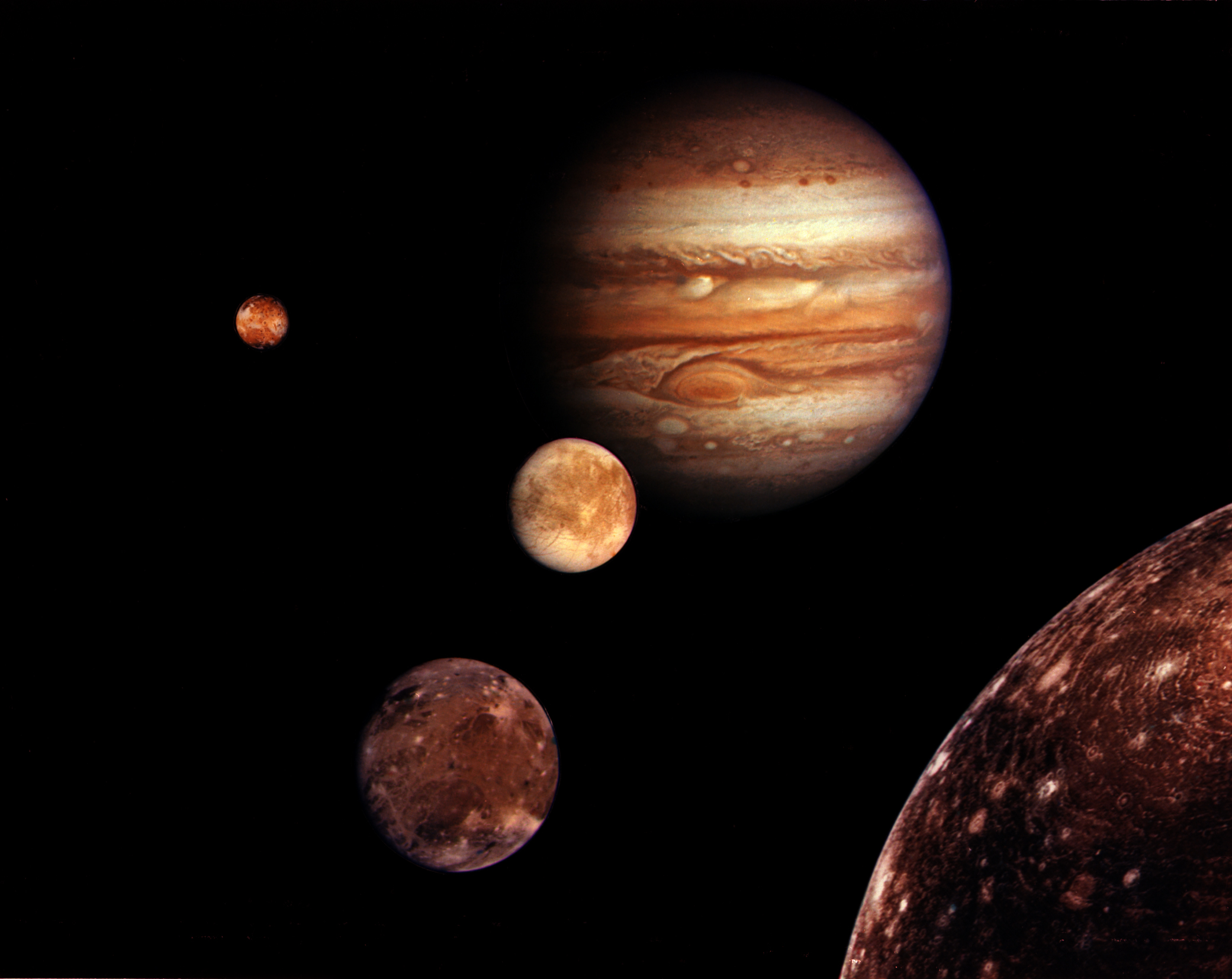
Exactly 400 years ago, Galileo Galilei trained his new telescope on the heavens, and discovered the four largest moons of Jupiter: Europa, Io, Ganymede and Callisto.

Or, as Bertolt Brecht put it in his play Life of Galileo, "January 10, 1610. Galileo Galilei abolishes Heaven."

Here is one of Galileo's early diagrams recording his observations of how the moons orbited the planet.


Four hundred years later, perhaps it's easy to forget that these four moons were the first new celestial bodies ever discovered. That's why, as Brecht says, the discovery "abolished Heaven." In the Aristotelian system, the heavens were perfect and rarefied, with each planet embedded in a crystal sphere. The spheres rotated around the Earth, but other than that, everything else in Heaven was fixed. But if Jupiter had moons rotating around it, that meant that it couldn't be stuck in a crystal sphere. And outer space was mutable. And thus, the idea of "the heavens" (outer space) had to diverge from the idea of "Heaven" (the dwelling place of God, an unreachable place of limitless perfection).

Scene Three of Life of Galileo takes place on 1/10/1610 and depicts Galileo showing his new discoveries to his friend Sagredo: the four moons of Jupiter, the mountains and craters on Earth's moon, the densely packed stars that make up the Milky Way. It is a beautiful scene, capturing the romance and danger and mystery of science. When Galileo says, "What you are seeing has been seen by no mortal except myself. You are the second," I got chills. Can you imagine what that would be like -- to be the second person in the world to apprehend these truths about the nature of the solar system?

I have always been the type of person who gets greedy, information-hungry obsessions. Perhaps the first of these, which took place when I was about 2½ years old, was an obsession with astronomy and the solar system. Therefore, I literally can't ever remember a time when I didn't know that Jupiter had dozens of moons. Because I learned this when I was a tiny child, I accepted it at once; but Galileo was in his forties when he discovered the moons of Jupiter, and this discovery directly contradicted the teachings of his Church and of the most respected philosophers and scientists, even as it helped confirm his secret suspicion that Copernicus was right and the sun did not go round the earth. How would it feel to learn that?

This scene in Life of Galileo is beautiful and inspirational because it draws our attention to Galileo's awesome discoveries. But Brecht hasn't forgotten that he is writing a human-scale drama, so there is also a somber, rueful undercurrent to the scene. Sagredo tries to warn Galileo that his discoveries may lead him to be condemned for heresy and burned at the stake. But Brecht's Galileo has a tragic flaw: his arrogance, his blind faith in science and reason. He does not understand why people may cling to old superstitions even when they are confronted with logical proofs:
I believe in Humanity, which means to say I believe in human reason. If it weren't for that belief each morning I wouldn't have the power to get out of bed. [...] Nobody who isn't dead can fail to be convinced by proof. [...] Yes, I believe in reason's gentle tyranny over people. Sooner or later they have to give in to it. No one can go on indefinitely watching me drop a pebble, then say it doesn't fall. No human being is capable of that. The lure of a proof is too great. Nearly everyone succumbs to it; sooner or later we all do. Thinking is one of the chief pleasures of the human race.
It is enough to make you cry when you recall how much more we know about astronomy and biology and chemistry and physics than Galileo did; and yet, 400 years later, huge numbers of people remain as recalcitrant as ever, rejecting scientific proof and clinging to the belief that the earth is 6000 years old and the climate is not changing...

note: I meant to write and post this on Jan. 10, but I was laboring under the misapprehension that yesterday was the 9th. Apologies!

Monday, May 25, 2009

A Year Without a Desk

It was exactly a year ago today that I graduated from college. So naturally, I'm engaged in a bit of self-reflection about what it means to have spent a year in "the real world." Or, more particularly, a year in the real world without really writing anything. (And before you say "Marissa, you've published over a hundred blog posts during that time!"--well, yes, I know. And I wonder if my blog is distracting me from what I should be doing, which is playwriting. It is a year since I've really written anything in the medium that I consider my primary medium, and that's a problem.) I can count up what I have accomplished--successfully moving to California, finding two apartments on Craigslist, being one of the few people in this entire country to get hired during October 2008--but I still feel uneasy.

I skipped first grade, as some of you know, so I was young for a college graduate, and am still pretty young now. My mother, with her trademark common sense, has therefore often said to me, "Just think, Marissa, you were supposed to graduate with the class of '09, instead of '08. So it's like you've got a whole extra year in your life that your classmates don't have. A year you can waste, no consequences--and you'll still be ahead of the game."

I told this to some friends of mine a few weeks ago (it was part of a long conversation about how to get me writing plays again) and they said "A year to waste? Don't you know that everyone in the world has about ten wasted years after college?" And I kind of see their point. But at the same time, I don't want to fall into the stereotype of the aimless college grad who takes years to figure out what they want to do in life, spends years puttering around. I am not a patient person, frankly. I'm too impatient with myself to do that.

But instead of thinking of this past year as my Wasted Year, which is too depressing, I am going to christen it with a different name: The Year Without a Desk.

If you'd asked me, before this year, what piece of furniture was most essential to make me a happy girl (excluding the obvious thing that all human beings need--a bed), I'd probably have said "Bookshelves." If I had one physical possession of which I was overweeningly proud, it was my book collection at home in Oregon. And I felt positively insulted by the fact that Vassar dorm rooms didn't come equipped with any kind of bookcase. How did they expect us to learn?

But, you know, I am a big reader, but I am not only a reader. I am someone who engages with what I read, who thinks about and responds to it, who writes. I get a kick out of displaying my book collection on a nice shelf, but frankly, probably nobody else cares about that. But I do think that other people care about my writing. And so, more than a bookshelf, I need a place in my life where I can feel like a writer. I need a desk.

And now--exactly a year after my college graduation, and just over nine months since moving to San Francisco--I finally have one.

For the foreseeable future, marissabidilla will be coming to you live from this desk right here. And yes, this is probably the least messy it will ever be.

Sunday, April 26, 2009

Happy Baptism, Billy S.!

Hundreds of years of convention dictates that we celebrate Shakespeare's birthday on April 23 (also the anniversary of the day he died) but we don't know his birthdate for a fact--all we know is that today, April 26, is the day that he was baptized. So, let's take a moment to celebrate, shall we? We have these plays, and that's so much more important in the long run than knowing the exact date their author was born, isn't it?

In 2016--just a few years away, really--I expect there will be a massive outpouring of interest in Shakespeare to commemorate the 400th anniversary of his death. Which got me thinking: this means that nearly all of Shakespeare's plays have also turned 400 within the last 15 years or so--and the remainder, such as The Tempest, will very soon follow. So why hasn't there been more of an interest in commemorating this? Why haven't I seen plays advertised as "The 400-Year Anniversary Production of Hamlet?" Sure, it sounds a bit crass and commercial to put it like that, but since the theater is a huckstering and commercial art form anyway, why not take advantage of this anniversary?

Furthermore--from a more idealistic standpoint--wouldn't it have been wonderful if at least one theater company, somewhere in the world, made an effort to produce each of Shakespeare's plays exactly 400 years after it was first performed? Yes, I know that the chronology of Shakespeare's works is disputed, so the order of performance would never be strictly accurate. But we do have a general idea of the order in which the plays were written, and it would be amazing for everyone involved--the artists and the audience--to be able to trace the evolution of Shakespeare's style in "real time," the way his original audiences did. Why didn't the Oregon Shakespeare Festival, or a similar organization, commit to this? (I assume this would have to be done by an established company, because it is a huge undertaking that would have to go on for about 20 years. Pleasant as it is to imagine a scrappy little theater company taking on this task, beginning in 1990 with an enthusiastic production of Henry VI part I, they'd probably fold by 1998 and the Henry IV plays.)

Maybe there is some theater company that's doing this--but if so, I haven't heard of it. Or maybe it's just a lost opportunity that I'm acknowledging too late to do anything about it.

As I said, I've never seen a "400th anniversary" production of any Shakespeare play, but I did see a 100th-anniversary production of Chekhov's The Cherry Orchard in 2004. In nearly every respect, it was a dreadful and misconceived endeavor, but the one part of it that really moved me is the speech where Gaev pays homage to the family bookcase:
But Lyuba, do you know how old this bookcase is? I pulled out the bottom drawer last week, and I looked, and there were some numbers burnt into the wood with a poker. This bookcase was built exactly one hundred years ago. So how about it? We could celebrate its centenary. It’s an inanimate object, but all the same, whichever way you look at it, it’s still a bookcase. […] Dear bookcase! Most esteemed bookcase! I salute your existence, which for more than a hundred years now has been directed toward the shining ideals of goodness and of truth. For a hundred years your unspoken summons to fruitful labor has never faltered, upholding, through all the generations of our family, wisdom and faith in a better future, fostering within us ideals of goodness and of social consciousness. (source)
Naturally, I could not help thinking about the one hundred years that Chekhov's play had endured and how it, too, is a monument to truth and to fruitful labor. I can only imagine that the effect would be similar if one was to hear some of Shakespeare's beautiful poetry that deals with the nature of time and memory and existence (e.g. "Age cannot wither her...") exactly four hundred years after it was first written...

Monday, November 5, 2007

Into the Woods: Now and Hence and Ever After

There's a wonderful tribute post on Into the Woods up at Edward Copeland on Film right now. The show opened 20 years ago today and, while it was somewhat overshadowed that season by The Phantom of the Opera, the intervening years have shown it for the truly clever, entertaining, moving work of art that it is. Woods will be around for a long time to come...Phantom has already turned into a joke.

And Into the Woods will always hold a special place in my heart because just a year ago, I played "Lucinda" (one of the stepsisters) in the Vassar production. It was a thrill to fulfill my dream of performing in a Sondheim show before I give up acting to focus wholly on playwriting. In a way, I don't want to act in any other show, because it would feel anticlimactic after Into the Woods. I like the idea of going out on a high note surrounded by knotty Sondheim harmonies. I don't want the magic to vanish!