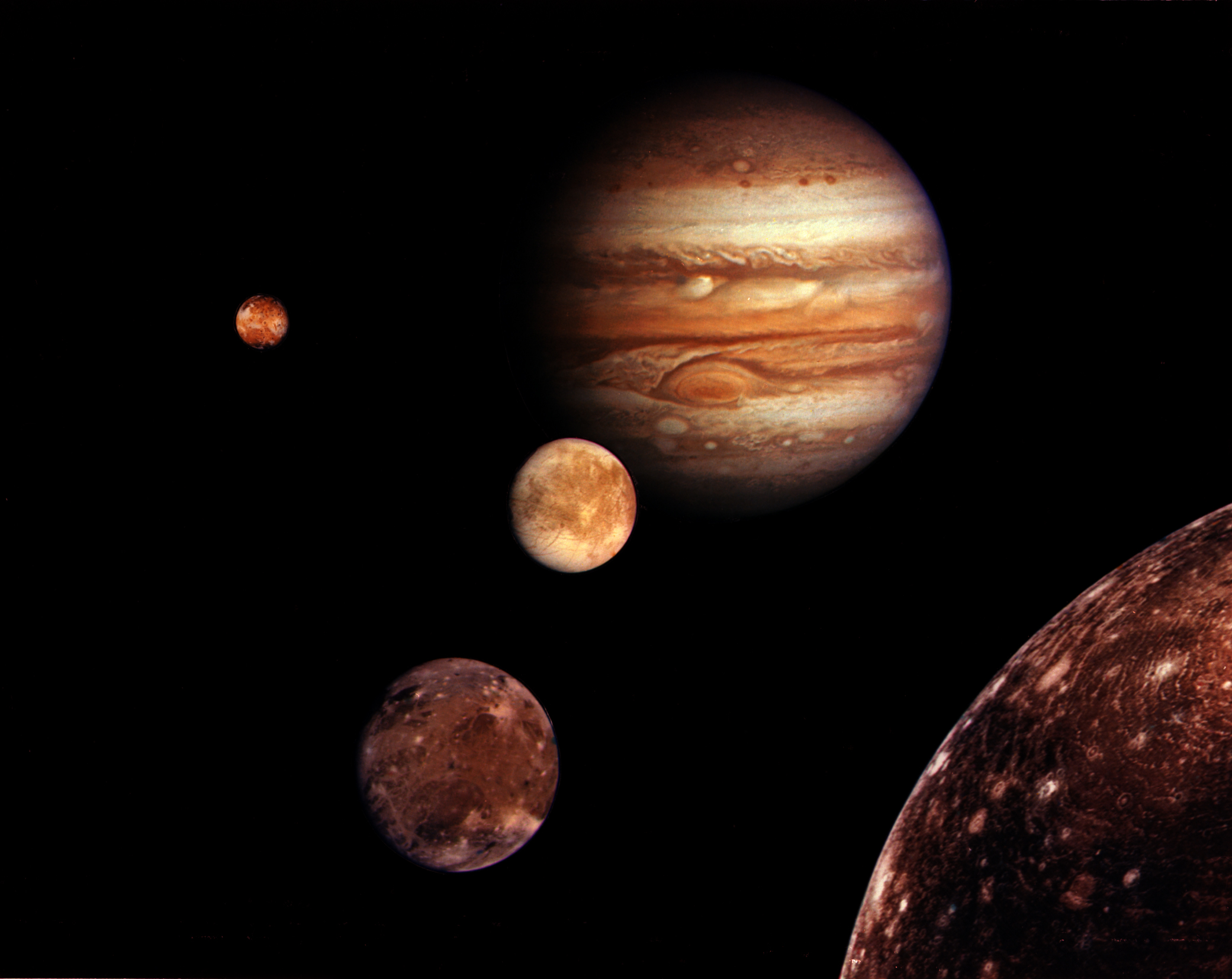
Exactly 400 years ago, Galileo Galilei trained his new telescope on the heavens, and discovered the four largest moons of Jupiter: Europa, Io, Ganymede and Callisto.
Or, as Bertolt Brecht put it in his play
Life of Galileo, "January 10, 1610. Galileo Galilei abolishes Heaven."
Here is one of Galileo's early diagrams recording his observations of how the moons orbited the planet.
Four hundred years later, perhaps it's easy to forget that these four moons were the first new celestial bodies
ever discovered. That's why, as Brecht says, the discovery "abolished Heaven." In the Aristotelian system, the heavens were perfect and rarefied, with each planet embedded in a crystal sphere. The spheres rotated around the Earth, but other than that, everything else in Heaven was fixed. But if Jupiter had moons rotating around it, that meant that it couldn't be stuck in a crystal sphere. And outer space was mutable. And thus, the idea of "the heavens" (outer space) had to diverge from the idea of "Heaven" (the dwelling place of God, an unreachable place of limitless perfection).
Scene Three of
Life of Galileo takes place on 1/10/1610 and depicts Galileo showing his new discoveries to his friend Sagredo: the four moons of Jupiter, the mountains and craters on Earth's moon, the densely packed stars that make up the Milky Way. It is a beautiful scene, capturing the romance and danger and mystery of science. When Galileo says, "What you are seeing has been seen by no mortal except myself. You are the second," I got chills. Can you imagine what that would be like -- to be the second person in the world to apprehend these truths about the nature of the solar system?
I have always been the type of person who gets greedy, information-hungry obsessions. Perhaps the first of these, which took place when I was about 2½ years old, was an obsession with astronomy and the solar system. Therefore, I literally can't ever remember a time when I didn't know that Jupiter had dozens of moons. Because I learned this when I was a tiny child, I accepted it at once; but Galileo was in his forties when he discovered the moons of Jupiter, and this discovery directly contradicted the teachings of his Church and of the most respected philosophers and scientists, even as it helped confirm his secret suspicion that Copernicus was right and the sun did not go round the earth. How would it feel to learn that?
This scene in
Life of Galileo is beautiful and inspirational because it draws our attention to Galileo's awesome discoveries. But Brecht hasn't forgotten that he is writing a human-scale drama, so there is also a somber, rueful undercurrent to the scene. Sagredo tries to warn Galileo that his discoveries may lead him to be condemned for heresy and burned at the stake. But Brecht's Galileo has a tragic flaw: his arrogance, his blind faith in science and reason. He does not understand why people may cling to old superstitions even when they are confronted with logical proofs:
I believe in Humanity, which means to say I believe in human reason. If it weren't for that belief each morning I wouldn't have the power to get out of bed. [...] Nobody who isn't dead can fail to be convinced by proof. [...] Yes, I believe in reason's gentle tyranny over people. Sooner or later they have to give in to it. No one can go on indefinitely watching me drop a pebble, then say it doesn't fall. No human being is capable of that. The lure of a proof is too great. Nearly everyone succumbs to it; sooner or later we all do. Thinking is one of the chief pleasures of the human race.
It is enough to make you cry when you recall how much more we know about astronomy and biology and chemistry and physics than Galileo did; and yet, 400 years later, huge numbers of people remain as recalcitrant as ever, rejecting scientific proof and clinging to the belief that the earth is 6000 years old and the climate is not changing...
note: I meant to write and post this on Jan. 10, but I was laboring under the misapprehension that yesterday was the 9th. Apologies!