Marisabidilla: n., Span. A know-it-all girl with an answer for everything. Marissabidilla: n., Amer-Span. The blog of a girl with an answer for some things and a question for most things.
Showing posts with label fairy tales. Show all posts
Monday, December 3, 2012
White Magic: "The White Snake" at Berkeley Rep
Mary Zimmerman has to have one of the most passionately devoted fanbases in the American theater. At least, in the circles I move in, we've been anticipating her newest play The White Snake for over a year, ever since the Oregon Shakespeare Festival announced it for their 2012 season. There were hastily planned road trips to Ashland to see The White Snake ASAP; there was much rejoicing when Berkeley Rep announced The White Snake as their 2012 holiday show; there was me deciding to become a Berkeley Rep subscriber for fear that the show would sell out otherwise; there were my non-"theater geek" friends getting just as excited about the show as I was. Finally, after all these months of anticipating, I saw the show at the end of Thanksgiving weekend. It was worth the wait!
The White Snake is a 100-minute adaptation of a Chinese folktale about a learned snake who takes human form, marries a mortal, becomes a loyal wife and respected citizen, but arouses the suspicions of a fanatical Buddhist monk. This story is very popular in China and, although it is not so well-known in the West, it echoes other folktales about animal-women who marry mortal men, like John Keats' "Lamia" or the Japanese folktale of the Crane Wife.
Zimmerman's adaptation features a multi-ethnic cast (most of whom did the show in Ashland), Chinese-inspired music, beautifully crafted costumes and props, and her trademark innovation in staging and imagery. For instance, at the beginning of the show, the snake characters are represented by some completely adorable puppets -- snake-phobics have nothing to fear from this show -- as well as by having the ensemble, carrying painted umbrellas, form one big "snake."
In its final moments, the play does that thing that every Zimmerman show seems to do: it reaches for transcendence, for a moment of painful beauty, and achieves it. As all good folklore-based theater must, it also resonates in ways that go beyond mere narrative. The protagonist's struggle whether to tell her husband that she is really a snake in disguise echoes the fear that we all have when starting a new relationship: will my partner accept me once he knows who I really am, deep down? Or will I frighten him away?
The White Snake is a kickass heroine: a scholar, magician and herbalist who goes on a quest to save her husband's life and engages in an epic battle with the monk -- and does it all while pregnant. She also has a sidekick, her stubborn, outspoken, and fiercely devoted friend the Green Snake, who takes human form as servant "Greenie." Indeed, The White Snake might be an excellent show for getting girls interested in theater. They'll initially be attracted to the romance and magic of the folktale, and along the way they'll hear a story of strong female characters told by a beloved female writer-director. Take your daughters/nieces/pre-teen friends! (When I saw the show on Sunday the 25th, the audience was mostly full of Berkeley retirees. I wish there'd been more young people and children there!)
Unlike the other Zimmerman works that I'm familiar with, The Arabian Nights (which I saw in Berkeley in 2009) and Metamorphoses (which I've read), The White Snake tells just one story, rather than a collection of them. Yes, it's a story with several twists and turns -- like a snake! -- but there were a few moments where the pace seemed to slacken or my interest flagged, which is something that I never felt in The Arabian Nights. For this reason, and also because my first encounter with the theatrical magic of Mary Zimmerman will forever have a place in my heart, I probably would rank The Arabian Nights slightly higher than the new show. Nonetheless, The White Snake is a beautiful piece of theater that will surely expand the Zimmerman fanbase even more.
The White Snake plays at Berkeley Rep until December 30. Top photo by Alessandra Mello. Bottom photo by Jenny Graham. Featuring Amy Kim Waschke as White Snake and Tanya Thai McBride as Green Snake.
Labels:
berkeley rep,
fairy tales,
mary zimmerman,
theatre reviewed
Friday, December 16, 2011
Rapunzel's Existential Crisis
I know I have been blogging infrequently. I've been busy. I've also been confused -- undergoing some of that "I'm three and a half years out of college; now what?" angst. In some ways I feel remarkably tied down: I have a job that keeps me busy, plenty of extracurricular stuff going on, there's always something hanging over my head. But in other ways, I feel "the unbearable lightness of being": I am single and childless, I am not really beholden to anyone, if I chose to abandon some of my responsibilities and do something else (or even do nothing), would it really matter? I suppose that this truly is an "existential crisis"-- in the sense that existentialism is a philosophy that starts from the idea "I'm free; now what?"
In such moments, I convince myself that maybe I'd be happier if I gave up some of my freedom and followed "the rules." Not that rules exist these days the way they did fifty or a hundred years ago (especially in an anything-goes town like San Francisco), but if I went looking for rules and order, I'm sure I could find them. Settle down. Marry a nice man. Build your character. Stop whining so much. Volunteer to help the unfortunate. Stop wasting time on the Internet. Listen to classical music. Read great literature. Stand up straight. Make your bed. Stop questioning things, stop brooding. Stop insisting on freedom; it's only making you unhappy. You spoiled, selfish Millennial girl, who are you to think that you can live so heedlessly?
So I feel confused a lot, and guilty a lot, in that existential way.
I feel guilty that I haven't written about Ladies in Waiting, the latest No Nude Men show, which is closing this weekend -- as many of my friends are involved in it and I really do have things to say about it.
Ladies in Waiting is an evening of three short plays by women: "Woman Come Down" by Claire Rice, "Night in Jail" by Alison Luterman, and "Oily Replies" by Hilde Susan Jaegtnes. Specifically, I wanted to talk about "Woman Come Down," which really gets at all the issues I was discussing above: the existential terror of freedom; the tension between wanting to play by the rules and wanting to break them; the need for every young woman to negotiate her own way of being in the world.
All that, in the form of a fractured fairy tale.
In Claire's play, Little Red Riding Hood, rather than being a child, is a somewhat aimless young woman. She's dating the woodsman, Henry, but feels ambivalent about the relationship; she may not want to settle down and get married, but she finds it hard to articulate what she actually wants. Then, as in the original tale, Red goes to visit her grandmother, encounters a wolf (here portrayed as a rather sleazy traveling salesman with secrets of his own), and ends up taking a different path from the one she planned. Specifically, the wolf tells her about a nearby tower which imprisons a beautiful maiden -- Rapunzel!
Rapunzel has been indoctrinated to hate and fear anyone who isn't her "mother," the witch. She has never questioned her imprisonment. So it takes Red a while to break through to Rapunzel, but eventually the two women have what amounts to a philosophical debate about security and freedom, imprisonment and choice. And Red helps free Rapunzel. And later, at Grandmother's house, Rapunzel helps free Red.
It is a beautiful play, telling me what, deep down, I know to be true: I don't want to follow rules I don't believe in just for the sake of an easier life. "Down is complicated," says Rapunzel, but isn't it better than being isolated in a tower? The play acknowledges that imprisonment can be seductive and that achieving freedom can require pain and sacrifice. (Rapunzel has to cut off all her hair -- her most salient feature -- in order to make the rope ladder to free herself.) But doing only what society tells you to do, and not what you know you must do, is a recipe for a life of quiet desperation. While I must develop a set of rules for living in this world (because I do not want my present state of confusion to last forever!), I need not conform to some externally imposed list of rules.
"Woman Come Down" is directed by Stuart Bousel, with Kirsten Broadbear as the hip, bike-riding Red and Theresa Miller as the daffy, stubborn Rapunzel.
As for the other Ladies in Waiting plays, "Night in Jail" features a flamboyant performance by Broadbear as Marie Antoinette, but this character tends to overshadow the other two characters in the piece: a modern-day "celebutante" who has been arrested for drunk-driving, and the prison guard assigned to her cell. "Oily Replies" is an experimental play, a twisted ontological detective story that takes place on an oil rig. (I find it hilarious that Jaegtnes, who is Norwegian, wrote a play about an oil rig.) Fortunately, it's an experimental play that has a sense of humor about it, including a narrator who keeps losing control of the story, body parts that mysteriously go missing, and three virgins who may or may not have dandruff. Special mention to Karen Offereins for enacting a drowning-by-proxy on dry land (this will make more sense, albeit not total sense, if you see the show).
But mostly, it's "Woman Come Down," and its feminist interpretation of Red and Rapunzel, that will stick with me. It's funny, speaking of revisionist fairy tales, I love Sondheim's Into the Woods. But that show has a conservative, community-oriented message: "No one is alone." "Woman Come Down," on the other hand, proposes that everyone is alone, individual, free -- so now what?
Ladies in Waiting plays through tomorrow night (December 17) at the Exit Theater, San Francisco. Photo of Red (Broadbear) and Rapunzel (Miller) by Claire Rice.
In such moments, I convince myself that maybe I'd be happier if I gave up some of my freedom and followed "the rules." Not that rules exist these days the way they did fifty or a hundred years ago (especially in an anything-goes town like San Francisco), but if I went looking for rules and order, I'm sure I could find them. Settle down. Marry a nice man. Build your character. Stop whining so much. Volunteer to help the unfortunate. Stop wasting time on the Internet. Listen to classical music. Read great literature. Stand up straight. Make your bed. Stop questioning things, stop brooding. Stop insisting on freedom; it's only making you unhappy. You spoiled, selfish Millennial girl, who are you to think that you can live so heedlessly?
So I feel confused a lot, and guilty a lot, in that existential way.
I feel guilty that I haven't written about Ladies in Waiting, the latest No Nude Men show, which is closing this weekend -- as many of my friends are involved in it and I really do have things to say about it.
Ladies in Waiting is an evening of three short plays by women: "Woman Come Down" by Claire Rice, "Night in Jail" by Alison Luterman, and "Oily Replies" by Hilde Susan Jaegtnes. Specifically, I wanted to talk about "Woman Come Down," which really gets at all the issues I was discussing above: the existential terror of freedom; the tension between wanting to play by the rules and wanting to break them; the need for every young woman to negotiate her own way of being in the world.
All that, in the form of a fractured fairy tale.
In Claire's play, Little Red Riding Hood, rather than being a child, is a somewhat aimless young woman. She's dating the woodsman, Henry, but feels ambivalent about the relationship; she may not want to settle down and get married, but she finds it hard to articulate what she actually wants. Then, as in the original tale, Red goes to visit her grandmother, encounters a wolf (here portrayed as a rather sleazy traveling salesman with secrets of his own), and ends up taking a different path from the one she planned. Specifically, the wolf tells her about a nearby tower which imprisons a beautiful maiden -- Rapunzel!
Rapunzel has been indoctrinated to hate and fear anyone who isn't her "mother," the witch. She has never questioned her imprisonment. So it takes Red a while to break through to Rapunzel, but eventually the two women have what amounts to a philosophical debate about security and freedom, imprisonment and choice. And Red helps free Rapunzel. And later, at Grandmother's house, Rapunzel helps free Red.
It is a beautiful play, telling me what, deep down, I know to be true: I don't want to follow rules I don't believe in just for the sake of an easier life. "Down is complicated," says Rapunzel, but isn't it better than being isolated in a tower? The play acknowledges that imprisonment can be seductive and that achieving freedom can require pain and sacrifice. (Rapunzel has to cut off all her hair -- her most salient feature -- in order to make the rope ladder to free herself.) But doing only what society tells you to do, and not what you know you must do, is a recipe for a life of quiet desperation. While I must develop a set of rules for living in this world (because I do not want my present state of confusion to last forever!), I need not conform to some externally imposed list of rules.
"Woman Come Down" is directed by Stuart Bousel, with Kirsten Broadbear as the hip, bike-riding Red and Theresa Miller as the daffy, stubborn Rapunzel.
As for the other Ladies in Waiting plays, "Night in Jail" features a flamboyant performance by Broadbear as Marie Antoinette, but this character tends to overshadow the other two characters in the piece: a modern-day "celebutante" who has been arrested for drunk-driving, and the prison guard assigned to her cell. "Oily Replies" is an experimental play, a twisted ontological detective story that takes place on an oil rig. (I find it hilarious that Jaegtnes, who is Norwegian, wrote a play about an oil rig.) Fortunately, it's an experimental play that has a sense of humor about it, including a narrator who keeps losing control of the story, body parts that mysteriously go missing, and three virgins who may or may not have dandruff. Special mention to Karen Offereins for enacting a drowning-by-proxy on dry land (this will make more sense, albeit not total sense, if you see the show).
But mostly, it's "Woman Come Down," and its feminist interpretation of Red and Rapunzel, that will stick with me. It's funny, speaking of revisionist fairy tales, I love Sondheim's Into the Woods. But that show has a conservative, community-oriented message: "No one is alone." "Woman Come Down," on the other hand, proposes that everyone is alone, individual, free -- so now what?
Ladies in Waiting plays through tomorrow night (December 17) at the Exit Theater, San Francisco. Photo of Red (Broadbear) and Rapunzel (Miller) by Claire Rice.
Labels:
claire rice,
fairy tales,
theatre,
theatre reviewed
Monday, July 6, 2009
There Are Faeries In My Neighborhood

No, this is not the set-up for a tired joke revolving around the "there sure are a lot of gay people in San Francisco" thing. It's a reference to a short story by Chris Adrian, called "A Tiny Feast," which is, to crib a line from Shakespeare, "something rich and strange." (And which was published in The New Yorker in April, but I only now got around to reading.)
The quote from The Tempest is especially appropriate because "A Tiny Feast" is a twist on another Shakespearean fantasy, A Midsummer Night's Dream. The premise of the story is that Oberon and Titania and their band of faeries are living beneath Buena Vista Park in San Francisco (about a mile from my house), and have stolen a human child and left a changeling in his place. When the human boy gets leukemia and cannot be cured by faerie magic, they must disguise themselves as a mortal family and get him treated at UCSF Children's Hospital. This information comes out much more gradually in the story than I have written it here, of course. And what follows is brilliantly odd and imaginative and well-written and meaningful, too. As immortal faeries, Oberon and Titania have great difficulty processing their child's illness and the doctors' diagnoses. But how different is this from the disorientation that any parent feels when his or her child gets cancer?
Chris Adrian, aka Mr. Overachiever, is a critically acclaimed fiction writer, the possessor of a divinity degree from Harvard, and a pediatric oncologist at UCSF--so he knows whereof he speaks. And according to this interview, "A Tiny Feast" is not just a standalone story: Adrian is working on a novel that retells the story of A Midsummer Night's Dream in modern San Francisco. Anticipation! Because, just reading "A Tiny Feast" has got me to see my city as a new place--a magical place. When the N-Judah train tunnels through Buena Vista Park I now think to myself "There are faeries here, living right on the other side of these tunnel walls." I can only imagine what effect a whole novel of this will have on me.
Incidentally, what is it with UCSF physicians having amazing second careers as artists? Aside from Chris Adrian, there is a great band called Rupa and the April Fishes whose frontwoman, Rupa, also works as a doctor at UCSF. My god, they put the rest of us San Franciscans to shame.
Image: "A Fairy Flew Off with the Changeling" by Arthur Rackham.
Tuesday, June 2, 2009
A Key Fairy-Tale
Stop me if you've heard this one before: A young woman marries a wealthy older gentleman and goes to live in his beautifully appointed mansion. She is given the run of the place, except that she is forbidden to go into the cellar, which her husband keeps locked. Unable to contain her curiosity, the woman steals the key to the cellar and sneaks in. There, she uncovers a dreadful secret. She quickly leaves, endeavoring to conceal the fact that she went where she was forbidden to go. But a telltale dark-red stain alerts the husband that his wife broke into the cellar and discovered what he was hiding there. He becomes enraged and is on the point of killing his wife when, at the last possible moment, a rescuer arrives and saves her life.
Obviously, this is "Bluebeard," as told by Charles Perrault, right? Yes... but isn't it also the story of Hitchcock's Notorious?
The connection hit me today with such force that I'm surprised I never noticed it before--because I love Notorious and am fascinated by "Bluebeard" (I even wrote a "Bluebeard" song once). The dark-red stain is especially remarkable--Bluebeard's magical bloodstained key vs. the traces of red wine in Alex Sebastian's sink.
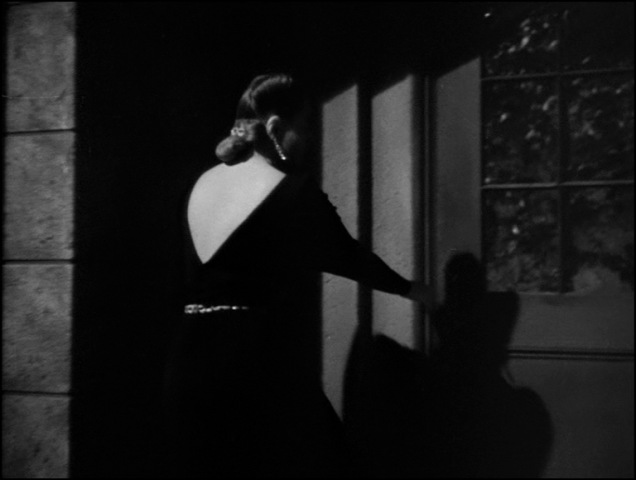
Of course there's more to the story of Notorious than this, and it functions on many more levels than Perrault's tale does; the addition of the Cary Grant character turns it into an extremely complex love triangle, rather than a fable about curiosity. I love knowing, though, that one reason the movie is so powerful is because part of its story is based on this time-tested and mythic structure...
Photo: Alicia (Ingrid Bergman) prepares to open the cellar door. Image from the 1000 Frames of Hitchcock Project.
Obviously, this is "Bluebeard," as told by Charles Perrault, right? Yes... but isn't it also the story of Hitchcock's Notorious?
Of course there's more to the story of Notorious than this, and it functions on many more levels than Perrault's tale does; the addition of the Cary Grant character turns it into an extremely complex love triangle, rather than a fable about curiosity. I love knowing, though, that one reason the movie is so powerful is because part of its story is based on this time-tested and mythic structure...
Photo: Alicia (Ingrid Bergman) prepares to open the cellar door. Image from the 1000 Frames of Hitchcock Project.
Labels:
fairy tales,
hitchcock,
movies,
weird connections
Sunday, June 22, 2008
Queen for a day
Design for Queen Elizabeth's coronation gown. Image from nga.gov.au
I know it's silly, but I was secretly hoping something exciting would happen to me yesterday. You see, as a little girl, I invented an elaborate fantasy of a parallel world in which I was royal--and yesterday, i.e., the summer solstice two weeks before my 21st birthday, was the day I had set aside for my coronation. And a small part of me would still like to believe in my parallel world, which I called "Rabildia," derived from the word "ruby" (my birthstone). What's more, it would still be nice to believe in the persona I invented for myself.
Queen Marissa Guinevere was brave and strong and good at archery and had a beautiful gray horse and a pet owl named Mistwing. What's more, she was also extremely skilled at performing magic. And she was gorgeous (I spent a significant amount of time designing gowns for her to wear), but proudly independent, and would take no guff from anyone.
I suppose all this is fairly typical. I was an only child, I read too much, I was under-challenged in school, I had an unacknowledged loneliness and anger inside me... of course I'd escape into a fantasy world. Only later have I realized just how much of a coping mechanism Rabildia was. There is a suite of stories in which Princess Marissa is locked up in a tower for several years during her adolescence, due to a misinterpretation of an ancient prophecy. I wasn't merely copying old stories like "Rapunzel." I was making a metaphor about the alienation I felt during my own adolescence.
But at age 18 or so, Princess Marissa is freed from the tower, she attends the Rabildian College of Mantic Arts, and when she is 20, her father dies and she must be crowned Queen. Since many fantasy books ascribe great importance to the summer solstice, I made it a key date in my mythos as well. It's the Rabildian national holiday--the anniversary of a day when the forces of light overcame the forces of darkness and united the country. And Marissa chooses it for her coronation.
When I was 12 I seriously planned to write a novel about Rabildia, and managed about 60 pages of disconnected stories. Here is the coronation scene, with some present-day comments in italics.
Marissa was not quite twenty-one when her father died and she became ruler. Her mother had died some years before, so she had little help in setting out on the journey of ruling and righting a kingdom. (When I was 12, I loved phrases that sounded grandiose even if they don't make sense. Like "ruling and righting"--when Marissa inherits the kingdom, she doesn't really need to "right" it; her father was a good leader.)Well, nothing exciting happened yesterday--no crowns or ermine or magically self-propagating rubies--and while I feel ready, I guess, to get a job and enter the "real world," I certainly can't imagine feeling ready to rule a country. But then, the point of Queen Marissa is that she's an idealized version of me, stronger and more capable. And I guess that's why I still want to believe she's out there, somewhere, sitting newly-crowned on her throne.
On his deathbed, the king said to Marissa, “I know you can rule Rabildia well...”
Between her tears, Marissa said “Thank you, Daddy...this really means a lot to me...knowing you believe in me...”
“...but your destiny is not here!” finished the king as emphatically as his weak voice could speak.
The tears suddenly stopped flowing from Marissa's face. This was so shocking: she would be the queen. And how could a queen’s destiny not be in her land? After a little consideration, Marissa thought she figured out what her father meant. It was actually pretty obvious. All her life, she’d been groomed for finding a husband, and that destiny her dying father talked about would be where her husband lived. She’d marry some old king, join Rabildia to his lands, and stay in his country.
While Marissa was contemplating, her father had died. (Reflecting my level of self-obsession, I'm writing about a character, based on myself, who is so self-involved she isn't even paying attention at the moment of her own father's death! By the way, the king's deathbed prophecy was meant to foreshadow a later development in the story, which is that Queen Marissa travels to our world and meets me, the girl from the Portland suburbs--so her destiny lies elsewhere.)
The coronation took place on Midsummer’s Day, the most important day in all the land. Midsummer Day is the longest day of the year when the folk celebrate the sun, the anniversary of the unification of Rabildia, and the halfway-point of the Rabildian year (which begins on what we’d call December 21, the shortest day of the year). Incidentally, Midsummer’s Day that year was a fortnight before Marissa would be twenty-one. Many people thought she should be coronated on her birthday, as twenty-one is the customary coming-of-age, but she convinced them that Midsummer held so much more significance for the people of the land. (I now know that "coronated" is not a word. And I love that although this is supposed to take place on a totally different PLANET, the length of a year and the date of the solstice is the same as it is on Earth.)
Marissa's coronation dress was another sore point. All the old dukes wanted her to wear red silk in honor of Rabildia, but red is not the best color for a blonde. Finally, they settled on a purple silk with green silk trimmings and many rubies. She thought it was lovely. (See what I mean about being obsessed with my character's clothing? My tastes in coronation dresses have changed now, though. Maybe I'm unduly influenced by Queen Elizabeth's dress above, but I'd want a heavy ivory satin richly embroidered with gold threads and rubies. Purple is regal, yes, but the dress I designed looked too much like a ball gown, not ceremonial enough.)
With trembling hand and the appearance of a deer (noble but with an ever-present sad fear) Marissa walked up the throne room of the forest castle. The ermine robe of state trailed long behind her, but still she was cold. Her guts hurt and she had a sinking feeling that something bad would happen. Her magic gave her a strong front and stiff upper lip, but inside she was falling apart. She wanted to throw off the robe, race to the throne, and get it all over with. But she had to be-–etiquette demanded it--dignified. (Boo hoo, it's so hard to be Queen!)
The crown was placed on her head, and the worst part was over, or so she thought. Marissa was queen.
As she took the gold scepter into her hands, the ruby at the top kindled and emitted a spark, which drifted down the aisle, fell to the center of the room, and became a miniature version of the scepter’s ruby. In unison, the crowd gasped.
Some few superstitious folk fled, while the older people shook their heads. "Marissa is so young, poor girl, she doesn’t even know she’s possessed by a Nemwi’hymat,” they whispered, but loud enough for the worried new queen to hear. Yet the wisest person in the throne room did not shake his head: Vatewté, Marissa's second father. From his honored seat, he turned back down the aisle. Many assumed he would flee as well. His footsteps echoed from the marble floors and Gothic ceiling. (Explanations: A Nemwi'hymat is a kind of demon, and Vatewté is a wise old wizard who tutored Marissa--she loves him more than she loved her real father.)
As he reached the little ruby, Vatewté stopped, picked it up-–again the crowd gasped-–strolled leisurely to the throne, and presented it to Marissa.
“It’s not to worry,” he whispered in her ear. “Those fools out there don’t know it, but nothing bad can spark the ruby on a scepter that has only been touched by good hands. I want you to take the little stone it produced, and wear it as a charm, because it came from the scepter and will forever link you with it, and the magic of Rabildia.”
From the inside of the royal robe, Marissa ripped a silken thread, tied a sturdy knot, and hung the little jewel around her neck, where it fit in the hollow of her throat. Soon, everyone admired her new necklace and forgot about the gem’s “curse.”
Labels:
childhood,
clothing and costume,
fairy tales,
holidays
Monday, November 5, 2007
Into the Woods: Now and Hence and Ever After
There's a wonderful tribute post on Into the Woods up at Edward Copeland on Film right now. The show opened 20 years ago today and, while it was somewhat overshadowed that season by The Phantom of the Opera, the intervening years have shown it for the truly clever, entertaining, moving work of art that it is. Woods will be around for a long time to come...Phantom has already turned into a joke.
And Into the Woods will always hold a special place in my heart because just a year ago, I played "Lucinda" (one of the stepsisters) in the Vassar production. It was a thrill to fulfill my dream of performing in a Sondheim show before I give up acting to focus wholly on playwriting. In a way, I don't want to act in any other show, because it would feel anticlimactic after Into the Woods. I like the idea of going out on a high note surrounded by knotty Sondheim harmonies. I don't want the magic to vanish!
Labels:
anniversaries,
fairy tales,
musical theatre,
sondheim
Subscribe to:
Posts (Atom)