For this year's San Francisco Olympians Festival, whose sub-theme was mythology and deities related to The Wine-Dark Sea, I thought about how many artists have found inspiration in the sea, and decided to put together a playlist of ocean-themed music. Each night of the festival, I posted a video on Facebook and Twitter and tagged it #Oceansongs. Now that the festival is over, I thought I'd post the whole playlist here so that it's preserved and accessible in a slightly less ephemeral medium.
The first year of the Olympians Festival (2010), when I served as box-office manager, I themed my outfit to each night's play. I am trying to figure out what it says about me and my growth (?) over the last five-plus years that I've switched from curating outfits to curating playlists.
One. "Fuor del mar" by Mozart from Idomeneo. Starting off with an old-school classic! ""Saved from the sea, I have an even more fearsome sea raging in my breast, and Neptune does not cease to threaten me." Also, Idomeneo is all about fathers and sons, and so was the Olympians show that night, Triton.
Two. "Surfer Girl," by the Beach Boys. The Olympians Festival show that night was "Bevy of Beauties," a series of short plays about minor sea goddesses and nymphs, so a love song to a beach bunny felt appropriate.
Three. "Under the Sea," from The Little Mermaid. I'm no Disney fangirl, but being a child of the '90s, I couldn't forgive myself if I made an ocean-themed playlist and neglected to include Howard Ashman's clever maritime rhymes.
Four. "The Shipwreck Coast," by the Lucksmiths. This song has no particular connection to that evening's Olympians Festival show, but I love this band and will take any opportunity to promote them, and as Australian indie pop, they bring some musical and geographical diversity to the playlist.
Five. "The Mariner's Revenge Song," by the Decemberists. The show that night was "The Crew" so I posted the sea chantey to end all sea chanteys. I previously wrote about why I think this song is so brilliantly written and constructed (in the context of explaining why I don't think the Decemberists' rock opera The Hazards of Love is so brilliant).
Six. "Seafarer," by Tennis. The show that night, Allison Page's Jasons, was a comic, pop-culture-crazed interpretation of the story of Jason and the Argonauts -- who definitely broke a lot of female hearts as they sailed the seas. Thus, this love song to a sailor.
Seven. "The Tide is High," by Blondie. Because Medea (subject of that evening's show) is not the kinda girl who gives up ju-ust like tha-at. Oh no-o-o-o! Also, this video is amazing. Debbie Harry can't dance, and yet she seems like the essence of timeless cool. The backup dancers move gracefully, and yet they seem tacky and cheesy. One could ponder this paradox for hours.
Eight. "Sloop John B," by the Beach Boys. The show that night was about the ship, the Argo, itself, so here's my favorite song about a boat. This was also the day after the Paris attacks, when everyone I knew was feeling gloomy and hopeless, and it is in such moments that we need the piercing, transcendent beauty of the Beach Boys' a capella harmonies.
Nine. "La Mer," by Charles Trenet. That evening, I was playing a French woman in Delphin: Christian Teen Dolphin-Sex Beach Party, so I had to post a classic French chanson.
Ten. "Never Let Me Go," by Florence + the Machine. One of the Olympians Festival shows that night was based on the sorceress Circe, so Florence's witchy, mystical persona seemed to fit.
Eleven. "The Island," by the Decemberists. This was the night of the staged reading of my own Tethys, or You'll Not Feel the Drowning -- whose spooky subtitle is taken from a lyric in this Decemberists prog-rock opus.
Twelve. "Octopus's Garden," by the Beatles. Another obvious choice for the playlist. I posted it the day of the staged reading of Meg O'Connor's play Pontos, or High Tide, because I have fond memories of singing Beatles songs with Meg and her husband.
Thirteen. "Sittin' on the Dock of the Bay," by Otis Redding. A special bonus song posted the day after the Festival ended, to make this a baker's dozen, to include Redding's bittersweet and thoughtful tribute to the San Francisco Bay, to thank everyone who participated in and attended this year's San Francisco Olympians Festival.
By the way, the subjects for next year's Olympians Festival have already been announced, and they are underworld and chthonic deities, including a week of Egyptian gods. Which means I'm already thinking about next year's playlist. Hashtag #Deathsongs.
Showing posts with label opera. Show all posts
Showing posts with label opera. Show all posts
Monday, November 23, 2015

Thursday, March 17, 2011
The OTHER Catholic European Country That Begins with an "I"
It may be Saint Patrick's Day, but an Italian friend of mine posted on Facebook that it is also the 150th anniversary of the unification of Italy! I know they say that everyone is part Irish on Saint Patrick's Day... but the rest of the year, I am 0% Irish and 25% Italian.
In honor of my heritage, and so that this significant anniversary does not pass by overlooked, here is "Va, pensiero" (The Hebrew Slaves' Chorus) from Verdi's Nabucco, which became an anthem for the Risorgimento patriots.
Sentimental Irish songs like "Danny Boy" don't make me cry, but when I hear Verdi's big crescendo on the line "O mia patria, si bella e perduta!" (O my country, so lovely and so lost), it gets me every time.
Performed by the Metropolitan Opera Chorus, 2002. I remember watching this production on TV when I was in high school!
Wednesday, January 19, 2011
Midwinter Music Mania
Coming to an iPod near me in the very near future:
- The King is Dead, by the Decemberists (downloading it as I type this). As I wrote at the time the last Decemberists album came out, "I am a pretentious theater-nerd from Portland, so I am contractually obliged to love the Decemberists." And I am on record as preferring the Decemberists in literate pop-song mode to the Decemberists in heavy rock-opera mode. The King is Dead -- ten folk-inspired songs in forty minutes -- is exactly the kind of music I was hoping the band would make after the excesses of The Hazards of Love, and I look forward to listening to it tomorrow.
- Cleopatra: Arias from Giulio Cesare, by Natalie Dessay (to be released February 8). Man, I was looking forward to this as far back as two and a half years ago, when the word first surfaced that Dessay would add the role of Cleopatra to her repertoire. She's my favorite opera singer, and Cleopatra's "V'adoro, pupille" is perhaps my favorite Handel aria. And now she's recorded it!
- Dessay is also currently performing in a production of Giulio Cesare in Paris, at the Palais Garnier. Must resist the urge to look up cheap flights to France...
Monday, October 11, 2010
R.I.P. Joan Sutherland
When I heard this morning that Joan Sutherland had died, I fired up the following -- Joan Sutherland & Marilyn Horne singing the "Mira, O Norma" duet -- on my iPod:
Granted, Joan Sutherland is a singer I find it easier to admire than to love. Her technique was impeccable, but the problem is that when I watch videos of her singing, I am always aware of how impeccable it is -- how her mouth is carefully positioned just so to form every note. The obituary in The Independent praises Sutherland's glowing high notes and coloratura, but also criticizes her for "amorphous diction" and "lack of brightness of tone." Truth to be told, that's kind of how I've always felt.
But still, a voice with Sutherland's kind of power and control and agility doesn't come along often -- a voice that makes people want to produce difficult and neglected works in order to give that voice a chance to shine. It is thanks to Sutherland that operas such as I Puritani got rediscovered and are now part of standard operatic repertoire. And for that, I am truly grateful.
Moreover, this music is part of my childhood. My mom saw Sutherland and Horne perform Norma in the early '80s in SF, and I grew up listening to their version of the Norma duet. As with Pavarotti's death a few years ago, this brings up some of my earliest memories.
Sunday, November 1, 2009
Les Voix, Les Voici: Damrau and Flórez in "Fille du Régiment"
 In 2008, I watched Laurent Pelly's production of La Fille du Régiment, starring Natalie Dessay and Juan Diego Flórez, as a Metropolitan Opera TV broadcast... so why did I go see it when it came to the San Francisco Opera last week? First, because Flórez came with the production to San Francisco, and I couldn't pass up the chance to hear him live. And second, because I was curious how soprano Diana Damrau would fare in a staging that had been built around Natalie Dessay's talents and persona. So much of Pelly's production relied on the fact that Dessay is kooky and athletic and a petite gamine Frenchwoman. What would it be like with Damrau--who sings many of the same roles as Dessay and is known as a good actress, but looks stereotypically German and might bring a different energy to the role?
As it turns out, Dessay and Damrau seem to approach the role of Marie, "the daughter of the regiment," from opposite directions. Dessay starts out as a bundle of manic energy, singing forcefully and doing physical comedy tricks; and just when you think that's all there is to her, she dials it back and breaks your heart. Damrau executes the same gestures and choreography as Dessay, but in a much more controlled ("regimented"?) way. Her Marie is tomboyish, but never kooky. Her singing is more controlled too--so maybe it is closer to ideal bel canto style, and it's proof of her skill that she can sing softly during elaborate coloratura passages. All the same, there were times when Damrau was almost too quiet--and it's not that she has a tiny voice, because there were moments when she let it out and easily filled the auditorium. And those were the moments that you tended to notice and want more of.
There is a lot of spoken dialogue in Fille du Régiment, where Dessay probably has the advantage, being a native French speaker. Damrau's pronunciation wasn't bad, but she lacked Dessay's comic timing (e.g. the scene where Marie reads a letter aloud, sounding the words out because she hasn't had any formal schooling). I could also tell that Damrau and Flórez faked the kiss after their love duet--but, as I learned from the New Yorker profile of Dessay last spring, she insisted that Flórez had to really kiss her, or it wouldn't look believable.
Overall, I think that this production still works best as The Natalie Dessay Show--but in a more traditional production of Fille du Régiment, one that treated its heroine as a more conventional ingénue, I might prefer to see Damrau. This was Damrau's first attempt at the role of Marie, but I do hope it isn't her last!
 Juan Diego Flórez is the real deal, and I will count myself lucky to have heard him perform the role of Tonio in person. No, we couldn't get him to encore "Pour mon âme," but his joyful rendition of it is something to treasure. (He also has perfected his French pronunciation: when I watched the telecast it annoyed me that he sang "J'y sa flamme" instead of "J'ai sa flamme," but he didn't do that last week!) And we gave Flórez another thunderous ovation, welcoming him into our hearts, after his tender Act II aria. He sings with brilliant musicality, looks good onstage, and makes everything seem effortless. I also like that he was unafraid to give Tonio an endearingly dorky quality, especially in his first scenes. I can't imagine opera divos of the past, like Pavarotti or Domingo, allowing themselves to act so goofy.
As for the supporting cast, Meredith Arwady was delightful in the role of the Marquise de Berkenfield--acting like Margaret Dumont and singing with a huge contralto voice. I do not think that Bruno Praticò was an ideal choice to play Sergeant Sulpice, however: Sulpice does not have a lot of difficult singing, but he does have a lot of French dialogue, and Praticò's thick Italian accent rendered him almost incomprehensible when speaking French. It seems like it wouldn't be too hard to find a bass-baritone who sang just as well but could handle the dialogue better.
Photos from San Francisco Opera. Top: Marie saves Tonio from certain death. Bottom: Marie, Tonio, and Sulpice reunited.
Monday, October 19, 2009
"The Abduction from the Seraglio": A not-so-great escape
 In the modern world, where etiquette handbooks are passé, and there is always a surfeit of choices of entertainment or food or clothing, a girl has to have a few principles to live by, or else she'll go crazy. Some of my guiding principles: "When in doubt, order a gin gimlet." And, "Life's too short to wear underwear you hate." And, "Don't ever miss a Mozart opera."
The thing about having principles, though, is that they can conflict with the facts of reality. For instance, some bartenders make a really terrible gimlet. Or, you may hate wearing a strapless bra, but maybe that's the only undergarment that works with your new favorite dress. Or, because of the vicissitudes of the opera-house schedule in the city where you live, the first two Mozart operas you see may be lesser works of his, staged and cast in such a way that they feel even more like afterthoughts--pretty little things to fill out the season, rather than highlights of it.
At least, that's what happened to me regarding Mozart at the San Francisco Opera--Idomeneo last season, and The Abduction from the Seraglio this season. No, these aren't Mozart's most profound works (I realized, while talking to my roommate, that the plot of Seraglio would make an excellent Bollywood movie--that's the level of complexity we're talking about), but they contain great music, and I'm sure that in both cases, the productions I saw were not the best possible stagings of these operas.
The Seraglio production took place, for no discernible reason, on a set that resembled an eighteenth-century theater, complete with box seats and painted backdrops (very similar to the Seraglio backdrops seen in the film of Amadeus). I really don't know what this was supposed to represent, though. Nothing else in the staging pointed up the idea of a "play-within-the-play", so why make this choice?
Seraglio is a Singspiel: a proto-musical-comedy that alternates musical numbers with passages of spoken dialogue. The SF production chose to leave the singing in German but translate the dialogue to English--and while I understand the reasoning behind this, the translation was really poor. It alternated contemporary slang ("What's up?" "Whoa there!") with pseudo-classical thee-thou-thy stuff, for an awkward and hard-to-perform hybrid. I also wanted it to be funnier. The author of this translation is one Philip Kuttner, who a Google search reveals is primarily a conductor*; I wish it had been entrusted instead to a professional writer with an ear for dialogue. There are a lot of underemployed playwrights in this town, and I bet some of them even know German!
 Because of the English dialogue, a cast of American and British singers performed the opera. No superstars, but a few good voices, most notably tenor Matthew Polenzani as Belmonte. It's just a pity that he had to play the least interesting character in the opera!--Belmonte has lots to sing, but it gets dramatically inert. Mary Dunleavy, as the heroine Constanze, had really unpleasant high notes in her first aria, so instead of looking forward to her performance of the magnificent Act II aria "Martern aller Arten," I dreaded it. Though it turned out not to be as badly sung as I feared (and I liked her acting, which showed Constanze starting out unsure of herself but gaining in power as the aria progressed), I still don't think that this is an ideal role for her. In the role of Blonde, the soprano Anna Christy fared better: her voice is small but pleasant, and her sassy soubrette characterization charmed the audience.
The Pasha, a non-singing role, was performed by local actor Charles Shaw Robinson, who also failed to impress me. His speaking voice sounded gruff and hoarse, and he was saddled with most of the awkward thee-thou-thy dialogue. To my surprise, the audience spontaneously applauded the Pasha when he announced, at the end, that he would forgive the four lovers and not perpetuate the cycle of hatred. But then the final moment of the production tried to make us feel sorry for the Pasha, proposing that he genuinely loved Constanze but nobly renounced her--the wrong way to conclude an opera about silly antics in a Turkish harem, methinks.
*OK, my search revealed that Kuttner also writes supertitles for the SF Opera--but I'd argue that there's a big difference between writing supertitles (which need to convey the general meaning of an opera's libretto, but never need to be spoken aloud) and writing dialogue that will be performed.
Images from SF Opera. Top: Anna Christy, with "eunuchs." Bottom: Matthew Polenzani.
Tuesday, October 6, 2009
Patricia Racette in "Il Trittico": Me Piace, È Bella, Bella
As of 7:30 PM last Wednesday, I had seen Patricia Racette in just one operatic role: Leslie Crosbie in the world premiere of The Letter. As of 11 PM Wednesday, I had seen her in a total of four roles. How is that possible? Answer: because she played all three leading soprano roles in a production of Il Trittico at San Francisco Opera!
After this, I'm convinced that Racette can do anything. I don't think her voice has an instantly recognizable timbre, but her musicianship, the effects she creates with her singing, and her emotional commitment to her characters are what make her such a valuable artist. She even looked completely different in every role!
 As Giorgetta, the adulteress of Il Tabarro, she was a hot mama in a skintight dress. And I might add, her portrayal of Giorgetta was very different from her portrayal of Leslie Crosbie this summer, even though the two characters have some things in common--their sexual frustration and willingness to cheat on their unloved husbands. But Giorgetta seemed younger and more hopeful than the ice-cold Leslie.
 In the title role of Suor Angelica, she epitomized the modest nun with the overburdened heart. Vocally and dramatically, this is probably the most intense role of the three; Angelica is alone onstage for the last part of the opera and going through some extreme emotional states. The final notes of her aria "Senza mamma" sounded off to me, as if Racette didn't have the breath to sustain them--though considering the wrenching pain that Angelica is feeling, at least this flub fit the emotional palette of the role.
 And in as Lauretta in Gianni Schicchi--really a cameo role with one unforgettable aria--she was an extremely cute '50s ingenue, cutting loose and playing up the comedy. She sang "O mio babbino caro" as a petulantly pleading Daddy's-girl; at the end, she burst into hilariously fake sobs.
But, though Racette was the star, she had a very strong production and cast surounding her. I am now convinced that Il Tabarro is an underrated opera: it has great atmospheric music, a beautiful Puccini love duet, a crude but effective plot, and excellent pacing. The box-like set of the SF production was kind of weird, but inside of it, the singers were well directed to embody the love triangle. There was some dirty dancing between Giorgetta and her lover Luigi (the brooding tenor Brandon Jovanovich--I loved his voice at Opera at the Park, but there I sat too far away to realize that he's also a good-looking fellow!), and a complex rapport between Giorgetta and her cuckolded husband Michele (baritone Paolo Galvanelli). Galvanelli made Michele's wounded rage palpable, and shared Racette's talent for transformation: later, he was funny and jovial as the title character of Gianni Schicchi.
Unlike my dear sainted grandmother, I do not have a high tolerance for nuns, so the scenes of convent life in Suor Angelica just bored me. But beginning with the scene with the Princess (sung here by powerful contralto Ewa Podles), when the opera shifts its focus to Angelica's personal crisis, it does have some good moments of drama.
Recently, since the new Tosca at the Met was such a failure, there has been a lot of hoopla in the press asking whether that production violated Puccini's intentions by eliminating some traditional stage business, debating how much of an update is too much, etc. What's interesting is that the SF Suor Angelica production undoubtedly violated Puccini's intentions, but no one booed, and, in fact, the director's choice probably made this sentimental work more palatable to a modern-day audience. At the end of the opera, a distraught Angelica takes poison, hoping to join her dead son in Heaven--then realizes that suicide is a mortal sin and she will be damned to Hell. Then, the Virgin Mary provides a miracle: traditionally, the final image of the opera has Angelica's little boy appearing and welcoming his mother to Heaven.
For Italians of a certain age, this works like a charm; for many other people, it's just glurge. So the SF production found a different solution. First, instead of setting the opera in a traditional convent, it updated the time period to the mid-20th-century and had the nuns running a children's hospital. (During one of the early scenes, several little kids in hospital gowns came onstage and the nuns fed them.) Therefore, when Sister Angelica, in her final moments, dimly sees a little boy out in the corridor, and reaches toward him... is it really her dead son, or just a hospital patient who happens to be passing by? Rather than being left with the thought that God is merciful and took pity on Sister Angelica, we are left with the thought that miracles and/or God do not exist; and while Angelica might have been comforted, as she died, by thinking that this boy was the phantom of her son, he was really nothing of the sort.
So, some people might call this sacrilege against God and Puccini both, but it didn't feel that way to me. It wasn't gleefully shocking; it was thought-provoking and, in its own way, moving. While it didn't elicit the sentimental tears that Puccini wanted, neither did it elicit a reaction of "Give me a break! That's so cheesy!" Instead, it left you feeling pity for Angelica's lonely death.
As for Gianni Schicchi, it must be hard to write a good short comic opera (or there'd be a lot more of them in the repertoire) but Puccini makes it look easy. The production was appropriately cartoonish, with several funny gags; my favorite was when the enormous, buzzy-voiced bass Andrea Silvestrelli lit the funeral candles by holding them up to the cigarette that dangled from his mouth!
Photos from SF Opera. Tenor David Lomelí is the guy accompanying Racette in the Gianni Schicchi picture.
Monday, September 28, 2009
"Trovatore" at the Ballpark: A Distanced Viewing

Saturday the 19th, my friend Chanelle and I went to AT&T Park, where the Giants play, to see the live broadcast of San Francisco Opera's Il Trovatore. The ballpark atmosphere was relaxed and convivial, despite the chilly San Francisco night. Chanelle and I sat in the bleachers above third base and shared chicken tenders, garlic fries, and an ice cream sundae while waiting for the opera to start.
Trovatore has a famously nonsensical plot, and I'm not even talking about the whole "throwing the wrong baby on the fire" business, because Stephanie Blythe was so good at portraying a deranged Gypsy woman that you believed she could've gone into a delusional trance and killed her own child. No, what bothers me is how the characters must behave in increasingly illogical ways in order to prolong the plot, when a simpler solution is often staring them in the face. Act I ends with Manrico and Count di Luna dueling beneath Leonora's window. In the next scene, Azucena asks Manrico, "Why didn't you kill Luna?"
"Yeah, why didn't he kill him?" I said to Chanelle. "Oh, that's right. He can't kill him because then the opera would be over."
"Maybe it's because killing him would've been too dangerous," Chanelle suggested. "Manrico is already a wanted man and if he killed a Count, he'd probably be in even more trouble."
But unfortunately, Chanelle's explanation is far too logical for an opera like Trovatore. Instead, Manrico sings, "My sword was poised above Luna's throat--and then I heard a voice from Heaven say 'Do not kill him!'" Talk about a deus ex machina!
A similar problem crops up at the end of Act II. Leonora is about to enter a convent and Luna arrives with his soldiers to kidnap her--only to discover that Manrico and his band of Gypsies have also arrived to bust Leonora out of there! There is a clash and Manrico's group wins, so as the curtain falls, we see Luna surrounded by Gypsies who point guns and knives at him. But in the next act, with no explanation given, he's free, back with his own soldiers. I wish that the staging of the Act II finale had shown how Luna escaped from the Gypsies. Otherwise, it's just another lapse of logic.
Other than that, I thought the production (directed by David McVicar, seen at the Met last season) was OK, if not dazzling. Updating the era from medieval times to the early 1800s respected the opera's Romantic/melodramatic atmosphere, while also making the costumes more flattering and less laughable than medieval doublets would be. The Anvil Chorus, despite the presence of bare-chested men with big hammers, even managed to avoid campiness.
 It was a solid cast, too, especially on the female side. I already said that Stephanie Blythe made a terrific Azucena. Sondra Radvanovsky (Leonora) reminded me a bit of Marcia Gay Harden, looks-wise--a "handsome" woman, not a flighty young girl. Her voice is well-controlled and (at least as broadcast in the ballpark) loud; unfortunately, she was totally upstaged during her Act I aria by a little boy who slipped under the ropes surrounding the baseball diamond and started running around the field, quite agilely evading capture. Marco Berti's acting did not illuminate any hidden depths in the character of Manrico (he stuck to typical "Romantic Opera Hero" poses) but his voice navigated the challenges of this role. As for Dmitri Hvorostovsky, who played Count di Luna, I can't decide whether I'm glad he resisted the temptation to act like a Snidely Whiplash villain, or whether he should have taken a less subtle approach. I'm inclined to say the latter, though--the story is so melodramatic that old-fashioned stage villainy would fit right in, and besides, since Hvorostovsky is much handsomer than Berti, the audience needs a clear reason to hate him!
All the same, I'm not describing these performers with as much detail as I sometimes would--and that's because I still don't feel like I saw the opera. Overall I found Opera at the Ballpark a frustrating experience--my vision constrained by the shots and camera angles that the director of the broadcast chose; my ears uncertain whether these singers would really sound this way in the theater; and, though the screen was indeed as big as advertised, I was sitting much further from it than I would typically sit from the stage of the opera house. I've seen opera broadcasts on TV and even once in a movie theater and been cool with that, so I wasn't expecting this experience to frustrate me so much--but somehow, perhaps because of the sheer number of people in the ballpark and my extreme distance from the screen, it did. (Furthermore, with the Sonnambula broadcast last spring, my reaction was "Cool, I get to see something that is happening 3000 miles away!"--whereas Trovatore provoked the question "Why am I watching this as a broadcast? It's happening only two miles away!")
Maybe this speaks more to my own personal issues than to anything else, but I have recently been fetishizing the immediate experience--and Opera at the Ballpark, obviously, is a heavily mediated event. Sometimes I feel like I am wandering through life in a fog (ok, I live in San Francisco, so I literally wander through fog on a regular basis--but you know that's not what I meant)--I fret that I intellectualize things too much, that I see things through the prism of books, that I am too guarded and cynical, that I do not live life to the fullest or allow life to permeate and astound me. Big, idealistic words, I know! But I can't help feeling that it would be easier to be astounded if I were seeing the performance live. Our reactions in the ballpark felt muted: though we cheered after the big arias, our applause never lasted as long as it did in the opera house. We were sheepish; the people who were there in person were moved, transported, enthralled.
Chanelle said she liked being able to watch opera in a relaxed, unpretentious environment, junk food at the ready. But I have never been one of those people who is uncomfortable with formality; rubbing elbows with wealthy opera patrons doesn't intimidate me, and if anything, I like the opportunity to wear a nice dress! Then I tried to think of Opera at the Ballpark as a throwback to Rossini's or Mozart's time, where opera audiences ate and chatted throughout the performance. But then, when I did talk during the opera (engaging Chanelle in that conversation about why Manrico didn't kill Luna), our neighbors shushed us! This seemed to me like the worst of both worlds: you couldn't experience the opera as well as you could in the opera house, and yet you still had to be on your best behavior.
I don't want to make it sound like I hate Opera at the Ballpark or think it should be discontinued. I recognize its utility and would certainly recommend it for people who want to learn more about opera or introduce their kids to it, people who can't afford tickets, and/or people who are put off by opera's "high-culture" trappings. But at the same time, for someone like me--who already knows she likes opera, and can afford to buy tickets, and doesn't mind putting on nice shoes and going to the opera house--it is not so useful.
Images from San Francisco Opera. Top: Manrico and Azucena. Bottom: Leonora pleads with Count di Luna.
Monday, September 14, 2009
Sunday in the Park with Puccini, Verdi, and the Homeless
Only in San Francisco can you attend Opera in the Park and find yourself next to a homeless man who yells "Bravissimo!" after every aria and sometimes in the middle of them too, whistles and hums along with "Che gelida manina," and, when the announcer says something about "pasta e fagiole," yells back at the stage, "It's pasta fazool!" (To which I couldn't help adding, "I agree!") Local color for what has become a treasured city tradition.
 This year's concert introduced Nicola Luisotti, San Francisco Opera's new music director, who is expected to raise the company's standards in the core Italian repertory. To that effect, he led an all-Italian program: lots of Rossini, Puccini and Verdi, plus one Italian-language Mozart aria. Luisotti is a slim and animated presence at the podium. At the end of the concert, he gave an impromptu speech about how "San Francisco may not be close to Europe but we can make it the center of the universe for Italian singing," then brought out the singers for a surprise rendition of "O Sole Mio."
At that point the clouds covered Golden Gate Park and a few drops of rain were falling, but it still felt very appropriate. Opera should be communal and joyous and unpretentious. There should be an Italian music director who gives a slightly rambling but very passionate speech and then conducts "O Sole Mio" complete with schmaltzy ritardandos, and the tenor and the soprano trying to outsing each other, and a tambourine banging away in the background.
Luisotti's first production as music director is Il Trovatore, so the concert featured several excerpts from that opera, sung by Sondra Radvanovsky (as Leonora), Marco Berti (Manrico), and Quinn Kelsey (Count di Luna). (In the full production, Radvanovsky and Berti play those roles, while di Luna is played by Dmitri Hvorostovsky.) I will probably have more to say about this opera and these singers after I see the "Opera at the Ballpark" simulcast screening of Trovatore next Saturday. I didn't love Berti's voice in the more lyrical music but he sang a rousing "Di Quella Pira"--which I am sure will be even better with a male chorus to back him up! Radvanovsky passed quite near me as I left the concert and she is certainly a striking-looking woman: very tall, wearing bright red lipstick to match her big red evening gown. She just got a rave in the San Francisco Chronicle.
The program contained a very amusing, but, I'm afraid, far too common typo: Puccini's famous soprano aria was listed as "O Mio Bambino Caro." The idea of the virginal, unmarried Lauretta singing "O My Dear Baby" instead of "O My Dear Daddy" just makes me laugh! However, it was nicely sung by Leah Crocetto.
The final aria (before "O Sole Mio" and the traditional "Libiamo ne'lieti calici" conclusion) was a really beautiful rendition of "E lucevan le stelle," sung by Brandon Jovanovich. I think I preferred him to the guy that starred in SFO's Tosca this summer!
Image: Maestro Luisotti is all smiles. Photo from sfgate.com
Saturday, August 15, 2009
"The Letter": notes on an opera's world premiere

Exactly three weeks ago, I was at the world premiere of the opera The Letter, in Santa Fe. As I mentioned before, the main reason I was excited to see this is because I'm friends with Terry Teachout, the librettist. Because of this personal connection, and also because so much time has elapsed, I'm not "reviewing" it in my usual fashion. Instead, here are some notes, impressions, things that stuck with me...
- The morning of the day the opera premiered, I attended a symposium hosted by Terry and Paul Moravec, the composer. Their collaborative process is really inspirational for anyone who hopes to work in the arts. Following Sondheim's dictum "before you start to write a show, make sure you're all writing the same show!" they spent a long time just figuring out what kind of opera they wanted to write, what its antecedents and stylistic hallmarks would be. And thus, during the writing process, they never had a single fight! They sum up The Letter with the phrase "opera noir": it is based on Somerset Maugham's tale of adultery and murder in entre-les-guerres Malaysia, and the goal was to make it as emotional as an opera and as swift and deadly as a film noir. "This is not an egghead opera!" Terry said repeatedly.
- Even so, I know I'm not really qualified to discuss Paul's music because of my lack of experience with modern opera and modern classical music in general. (But yes, I am qualified to call Paul by his first name, since Terry introduced us after the symposium.) I would say that it's the kind of music where you can remember the general contours of the vocal lines, but not any distinct melodies. For instance, I remember that Leslie's first aria ends with her shrieking the word "Blood!" on a very high note, and the Chinese Woman's aria ends on low mezzo notes, rueful and meditative. The text-setting was generally intutitive; it wasn't hard to make out the words. At the symposium, Paul said that he used a twelve-tone scale for Leslie, the liar and murderess (thus making her a "serial killer," ha-ha) and a diatonic scale for Robert, her cuckolded husband. And it's true that when Robert began his first extended passage of music (singing to Leslie to comfort her after the murder), you could feel everyone sort of relax into it, because it was the first diatonic section of the opera. The twelve-tone or chromatic music puts you more on edge, but why shouldn't it? Murky music for an opera about murky people.
- A vicarious thrill: I am 99% sure that Peter Gelb, General Manager of the Metropolitan Opera, walked past me twice as I stood outside the opera house, waiting to take my seat! I recognized him from photographs--in a dark suit, bald, with glasses, he looked rather like an "egghead" himself! I wondered, too, if he carried an invisible aura of celebrity and power about him--something that caused me to notice him in the crowd in the first place, even though he is not a very distinctive-looking man. He ought to have that aura--he's probably the most important man in American opera!
- My mom and I also got a vicarious thrill from seeing Tom Ford, the opera's costume designer, take his bow wearing one of his natty suits with an open-necked shirt. His work on the opera was very stylish--requiring lots of tailored white linen or tropical-weight wool suits for all of the male characters. There are only two females in the opera, but I loved the frilly pink net pegnoir that Leslie wore at the start of the opera, as well as the Chinese Woman's platform shoes and extra-long fingernails!
- The sets and lighting also looked great--and worked in conjunction because of the ceiling fans that rotated and cast noirish shadows across the stage. Stories about despicable people are always better when they're placed in an attractive setting--I guess because we get seduced by the setting for a while, only to get a jolt when we realize the true awfulness that lies below the stylish surface...
- In The Letter, this awfulness isn't just Leslie's adultery, lies, and murder; it's the white characters' casual and unthinking racism toward Asians. This is brought to the fore in a scene that takes place in a men's club, where the men sing a jaunty ditty saluting Leslie and insulting Geoff, who had taken an Asian mistress--"It was a daaamn good thing she shot him!" I believe this is the only section of the opera that uses rhyme and a conventional foursquare meter, so again, it lulls you into laughing and tapping your foot, until you realize what you're laughing at...
- Yet at the same time, the opera is not about "the evils of racism" or anything like that. That would make it an intellectualized, moralizing, "egghead opera"--just what Terry and Paul didn't want to write. The Colonial Malaysia setting lends the opera a stylish atmosphere and helps provide motivations for some of the characters--for instance, they're poisoned by racism, or they're frustrated to be so far from England. But deep down, the story is a very basic one--change a few details and you could easily transfer it to a different place and time. This seems to me to be a feature of many of the most enduring operas--e.g. we don't go to see Tosca because of all that Napoleonic-era political stuff, but because of the human interactions between Tosca, Scarpia and Cavaradossi.
- One of my favorite bits of characterization came in the last scene of the opera. Throughout the other scenes, Robert has been an endlessly trusting and supportive husband, with his emotions under control. But at the end, he starts to get suspicious of Leslie (even though she's been acquitted), and his personality changes: he becomes kind of dangerously cheerful, angry, possibly drunk. In other words, you've gotten to know Robert well enough over the course of the opera (through both the music and the acting) that you immediately recognize this shift in his personality--and this leads to a sense of foreboding. Sure enough, something really bad happens to finish out the opera...
- As for the singers, Patricia Racette did a great job with Leslie's challenging music, as well as showing the different sides of her character: someone who knows how to behave like a poised, stiff-upper-lip planter's wife, but is actually sexually frustrated, passionate, and very self-centered. Anthony Michaels-Moore played Robert and, as I said in my paragraph above, his acting contributed a great deal to the success of the final scene. Also there was good support from James Maddalena, as Leslie's lawyer, and Roger Honeywell, as Leslie's deceased lover, a haunting voice calling from offstage in several of the scenes.
P.S. I don't feel like taking the time to add multiple images to this post, but if you want to see the costumes and sets, go here; and here for video excerpts of the opera. The photo at the top is of Patricia Racette.
Monday, August 3, 2009
Natalie Dessay in "Traviata": A More-Than-Viable Violetta
 Two years ago, when I was starting this blog, and dressing up as La Dame aux Camélias for Halloween, and discovering the amazing talent of opera singer Natalie Dessay, could I have possibly imagined that I'd get to see her in her first run of performances as Violetta Valéry--my favorite soprano taking on this iconic character? No, I wouldn't have dared! But yet--un di felice!--I did just that on July 24.
The role of Violetta, Dessay has said in interviews, is at the edge of her range as a singer, normally sung by women whose voices are a little heavier and more dramatic than hers is. It also gives her an opportunity to move beyond playing the virginal ingenues that are the stock-in-trade for her voice type. She is debuting it at the Santa Fe Opera, a smaller, friendlier opera house, in a new production directed by her frequent collaborator Laurent Pelly.
What I liked best about Pelly's production is that it worked around the limitations of the Santa Fe Opera House (outdoor theater, no fly space) and proved you don't need ostentatious Second Empire décor to effectively produce Traviata. That's not to say that every moment was perfect. The emotional impact of the finale to Flora's party was completely undermined when the chorus started swaying side to side in what looked like bad community-theater choreography.
But when Dessay burst onto that stage at the top of Act I, dressed in a magenta tulle concoction and fishnet stockings, leaping between the different levels of the set, screaming in wild exhilaration, and doing her trademark "be hoisted by the male chorus" thing, nothing could dim her luster. She played the opening scene feverish and manic and very, very drunk. Her flaming orange hair wasn't particularly flattering, but it fit her portrayal of Violetta as someone trying too hard to hold onto her giddy party-girl lifestyle.
 At the end of Act I comes Violetta's great soliloquy, from "Ah fors'e lui" through to "Sempre libera." I was curious to see Dessay's take on this piece because it has so much subtext, so many pitfalls for the actor. In most opera arias, the character fervently believes whatever he or she is singing about. But in "Sempre libera," Violetta is trying to convince herself that she believes what she's singing, while stifling her deeper instincts, which are telling her the opposite thing. At first the aria may sound bubbly and lighthearted; but I think that underneath it is really quite angry.
And Dessay got that. She rolled the "r" in the word "gioir" and snapped it off with vicious determination, showing us that Violetta is willing herself to "gioir" (have fun, live it up). She hit the final E-flat loudly and in tune, but it wasn't exactly a pretty sound. Yet in the context of the aria and the character, it worked. It was Violetta screaming out one final time in defiance of her fate, not Natalie Dessay trying to hit a high note.
Alfredo gets his big moment at the top of Act II, but I was not too impressed with the singer, Saimir Pirgu. Some of his high notes were flat, and Dessay upstaged him during "De miei bollenti spiriti" by swinging her feet back and forth as he sang. I thought this was a bit rude of her; then again, a tenor ought to have the presence and acting skills to draw the focus to himself during his big aria!
 Fortunately, Dessay had an excellent scene partner in Laurent Naouri, who played Giorgio Germont-- and, offstage, is her husband! He had the most powerful voice of any of the singers, and a memorable stage presence: already much taller than the petite Dessay, his ramrod posture and silk top hat made him even more imposing. Knowing that Naouri and Dessay are married in real life, my greatest fear was that they'd have the wrong kind of chemistry--it would not be appropriate for Violetta and Germont to look like they want to jump in bed together! But they remained perfectly convincing and in character: Naouri the bourgeois father-figure blind to his own failings; Dessay vulnerable, childlike, clinging to his lapels. Yet Naouri was not merely stern and stentorian: he sang a beautiful, tender "Di Provenza."
The best singing in the second half of the opera--and a moment I hope never to forget--was Dessay's "Addio del passato." She hunched on the bed, no longer trying to amaze us with acrobatics or big gestures--just intensely felt, intensely focused, piano singing. She held the final note for an astoundingly long time, and the audience held its breath along with her; when it was over I could sense the whole theater exhaling and taking a brief moment to say "Wow" to ourselves before we burst into applause.
 Certainly, I could see how Verdi probably intended some of his more dramatic outbursts to be sung with a fuller, juicier voice than Dessay's small-but-precise instrument. Nonetheless, she was always perfectly audible, and scoring a knockout "Sempre libera," duet with Germont, and "Addio del passato" is a triumph for any soprano--so does it matter if she couldn't declaim a few passages with the proper strength?
Most importantly, Dessay's performance made me realize something that had never occurred to me despite my familiarity with this story. La Traviata is not just about how piteously Violetta coughs or how pathetically she dies; it's about how hard she fights, every moment along the way. Fighting with herself about whether to accept love (Act I); fighting to hold onto the love she has won (Act II); fighting to keep her dignity (Act III); and finally, most nakedly, fighting for her life (Act IV). At every turn, she is defeated, but there is something heroic in the struggle. From what I've read of Natalie Dessay, I get the impression that she sees herself as a fighter--crusading for better opera productions, pushing herself to be a better actress, struggling against the limitations of her own voice. Perhaps she drew upon this quality when creating her interpretation of this musically and dramatically challenging role. And--unlike Violetta--she was not defeated.
All photos Ken Howard, Santa Fe Opera.
Wednesday, July 22, 2009
On the Way to Santa Fe
Yes, it's another "there will be no new posts for several days" announcement. BUT! that usually means I have something exciting to do (and the promise of exciting posts when I return), doesn't it?
In this case, that's exactly what's happening! Tomorrow through Sunday, I will be in New Mexico to see the Santa Fe Opera! My parents are already there, and together we will see two productions: La Traviata and The Letter.
Don't ask me to pick which of these makes me more excited. Traviata has Natalie Dessay in her role debut as Violetta, and if you've been reading this blog for a while, you know how much I love Natalie Dessay. It will also be my first time at a live performance of a Verdi opera!
Meanwhile, The Letter is a world premiere opera (based on the classic Maugham story and Bette Davis film) with music by Paul Moravec and libretto by Terry Teachout. I guess now's the time to mention that a few years ago, I e-mailed Terry in response to one of his Wall Street Journal reviews, and that led us to strike up a correspondence/ friendship. So I know one of the instigators of this project--and I'll get to applaud my friend as he becomes a creator of theater, not just a critic and commentator. He's been blogging and tweeting up a storm this past week as the premiere approaches--it's really whetted my appetite!
I'm sure I'll write about both these important operatic events next week.
Sunday, June 21, 2009
Trompe L'Oeil "Tosca"
 I saw Tosca at San Francisco Opera over a week ago, but I haven't written about it yet mainly because it did not affect me that deeply--and because I can't figure out why it left me so unmoved, I wasn't sure what to say about it. Yet I wanted it to touch me--the way it did Harvey Milk in the last scenes of Milk!
It was a very traditional staging, but since thousands of people have been moved by traditional productions of Tosca over the last century, I can't pin the blame on that. All right, the scenery, which mostly consisted of trompe l'oeil painted flats, was rather too old-fashioned for my taste. If an opera house cannot afford to construct or store full sets for an opera like Tosca, I would prefer some tastefully minimalist scenery to these huge walls of trompe l'oeil--and I think many operagoers my age would agree with me. As for the direction, I thought Tosca's leap could have been more impressive, but I really liked the moment in Act I when Scarpia's minions arrived on the scene. Somehow, they managed to slide onstage silently and appear among the crowd of priests and altar boys before you realized how they'd arrived there--it was really scary!
 The cast was not as starry as the one Harvey Milk saw in 1978, but Adrianne Pieczonka (Tosca), Carlo Ventre (Cavaradossi), and Lado Ataneli (Scarpia) were all suited to their roles. I can see how Tosca could be played as an imperious diva, but Pieczonka stressed her neurotic, insecure side; she really seemed vulnerable when Scarpia made her believe that Cavaradossi was cheating on her. This interpretation--with its emphasis on a weakness or sickness in Tosca's soul--also made you understand why she cracks under Scarpia's pressure in Act II, something that a more domineering Tosca might have trouble conveying. Ventre was an appropriately passionate painter, especially when using the last ounces of his strength to shout out a ringing "Vittoria!" in Act II. Ataneli was not a physically overpowering Scarpia, but he was very sly and slimy. He was also quite charming at the curtain call: his eyes twinkled, the embroidery on his coat twinkled, and he smiled as if to say "See? I'm not really a nasty bastard!"
This was my first time seeing Tosca, and though it's known for its melodrama, I was surprised how much humor is in it--the Sacristan's comments that undercut the romanticism of "Recondita armonia," Tosca's crazy jealousy, and her later efforts to teach Cavaradossi how to "play dead." I also thought about how amazingly fast-paced the story is--Tosca begins her day as a rather self-absorbed artist, and ends it as a murderess, a revolutionary, a martyr. And I noticed the themes of art, life, theatricality and ritual that run though the opera. The hero and heroine are artists, and Scarpia manipulates everyone around him, like a particularly evil playwright or stage manager. The Te Deum mass is an elaborate pageant, and after Tosca kills Scarpia, she arranges the body in a ritualistic fashion. The big arias all deal with the themes of art and life. (Indeed, in a more "conceptual" production, the use of blatantly artificial, painted scenery could reinforce these themes. But somehow I don't think that this was the case here.)
But these are all intellectual responses. And I wanted to have an emotional response.
Photos from San Francisco Opera. Top: Act One. The trompe l'oeil nature of the scenery was much more evident in the opera house than it is in this photo.
Bottom: Pieczonka and Ataneli, Act Two.
Wednesday, June 10, 2009
Summertime, And the Opera is Splendid
The summer season at San Francisco Opera is now in session, and yesterday, I managed to get a standing-room ticket to the opening night of Porgy and Bess. Then, as I stood at the back of the auditorium waiting for the opera to start, a woman came up to me and offered an extra ticket she had in Row E! I was a little hesitant to take it (I'm an able-bodied young person who wouldn't have much trouble standing for three hours; some of my fellow standees were much older) but really, what else could I do? So I ended up paying $10 and sitting in a seat that normally costs $200. I was so close I had to crane my neck to read the surtitles (fortunately this opera is in English); so close that when the singers came over to my side of the stage, their voices really boomed out.
I'd been wanting to see Porgy and Bess for a long time: I love Gershwin and the 1930s and works that can be considered either unusually sophisticated musicals or unusually unpretentious operas. (To give you some idea of how hard Porgy and Bess is to classify: Stephen Sondheim has said that he is really not a fan of opera or through-sung musicals--and also says that Porgy and Bess is his all-time favorite score. Go figure.) And I came away thoroughly impressed. "Bess, You Is My Woman Now" is as great a love duet as has ever been written for either an opera or a musical. During intermission I walked around the opera house hallways humming that, and "I Got Plenty Of Nothin'," and "It Ain't Necessarily So"--I couldn't help myself!
Occasionally I thought that there were a few too many scenes of "local color" in Porgy and Bess, which got in the way of the storytelling (when a woman came onstage selling strawberries, I thought "enough with the street vendors already"). And I agree also with the program note that says that the role of Bess is a bit vague--defined by whatever man she happens to be with at the time, not by her own innate personality. But these are minor quibbles for what really is a great work. Can you believe that the same man who churned out perky '20s ditties like "I've Got a Crush on You" could also write the very complex choral work and orchestrations of Porgy and Bess? Or that he could so well imitate African-American spirituals--not just their melodic characteristics, but their stirring sense of faith? The final moments are wonderfully bittersweet and inspiring.
This production moved the setting to the 1950s, I'm not quite sure why. So some of the stage pictures ended up reminding me of West Side Story, of all things: the stylized, balletic knife fights, and the garishly colored lights that lit up the stage when Bess put on her Anita-esque orange dress and ran off to New York with Sportin' Life. (At curtain call, the director, Francesca Zambello, came out wearing an orange blouse that I was sure she had chosen to match Bess's costume!) Overall it was a fine production, except for some movement depicting Jake and Clara's deaths in the hurricane, which didn't really work. Also, why was the hurricane represented by strobe lights and thunderclaps? We should all know by now that a hurricane is not a thunderstorm!
The singing was very strong and everyone seemed well suited to their parts, physically as well as vocally. Eric Owens, who played Porgy, has a kindly face that made him instantly sympathetic; there is also something touching about seeing such a big and powerful man hobble around on a crutch. Laquita Mitchell, in a role debut as Bess, made sense of this victimized woman and sang in a rich voice. Chauncey Packer gave a wonderfully physical performance as Sportin' Life--I loved his dance moves in this scene-stealing part. Angel Blue had a beautiful voice with which to sing "Summertime" and begin the opera. Question: people always say that Rodgers and Hammerstein revolutionized musical theater by beginning Oklahoma! with a cowboy singing a gentle ballad, not with a big flashy production number--but didn't Gershwin get there the previous decade, beginning Porgy and Bess with a young black woman singing a lullaby to her baby?
Porgy and Bess is all sold out, so if you want to see it, you'll have to be like me and try for standing room. May you be as lucky as I was, and may you enjoy it as much as I did!
Wednesday, March 25, 2009
"Sonnambula" in HD: Perchè non posso odiarti
 Saturday morning I went to see one of the Met's Live in HD cinema transmissions for the first time. The opera was La Sonnambula--no surprise that it would be the one to get me out of bed early on a weekend, since you know how I adore Natalie Dessay and how much I loved Mary Zimmerman's The Arabian Nights. I had conflicted feelings, then, when I learned that this production got booed at its Met premiere. On one hand, I was excited I'd get to judge a controversial production for myself. Booing is so rare these days, and this Sonnambula didn't even have any outwardly scandalous trappings like nudity, debauchery or bloodshed! On the other hand, if I didn't like the production, I'd have to reevaluate my attitudes toward Dessay and Zimmerman. And while it's not a bad thing to learn that your favorite artists are only human and can make mistakes, it's never a fun lesson to learn, either.
And my verdict? Well, I don't see a point in seething with outrage over this production, but that's not to say that it works. There were some inspired moments, and the performers were committed and engaging; but there were also many dull, muddled, or over-done passages. I appreciate the risk that Zimmerman took, but it needed more rigorous thought behind it. Perhaps Dessay is partly to blame for this--according to The New Yorker, Zimmerman had been planning a much more conventional staging until Dessay challenged her to come up with something more creative. All the same, Zimmerman has been working with this concept for over a year, and it's still muddled, so... Too bad it had to be such a high-profile failure, but at Mary Zimmerman's level it's impossible to fail quietly.
La Sonnambula, composed by Bellini in 1831, tells the simple tale of young Amina, who, unbeknownst to everyone in her village, is a sleepwalker. The night before her wedding to a man named Elvino, she sleepwalks into the room of a visiting Count, and when she is discovered, her reputation is ruined. But by the end of Act II, all is set to rights again. Obviously this plot lacks a certain pizzazz, so Zimmerman's production added a postmodern layer on top of it. Rather than taking place in 19th-century Switzerland, it took place in a contemporary NYC rehearsal space where a company of singers, rehearsing Sonnambula, find their relationships mirroring those of the characters they play.
The concept worked best in the first scene, which is exactly where it's most needed. I think the worst thing about the Sonnambula libretto, even more than the thinness of the plot, is how long said plot takes to get going. (Which I realize is a very "Terrible food! And such small portions!" kind of complaint, but oh well.) For the first half hour, Sonnambula is one big lovefest: the villagers love Amina, Amina and Elvino love each other, the Count loves the beautiful countryside. Only when the Count flirts with Amina and Elvino gets jealous does the situation become infused with human drama.
But Zimmerman's concept, and the audience's curiosity about how she'd make it work, lent surprise and interest to these early scenes. She evokes the rehearsal environment with vivid specificity. I loved seeing this production in HD because of the amazingly detailed set--it looks exactly like a lived-in, slightly shabby rehearsal space, with chipped paint on the walls and used paper cups scattered carelessly on a table--but it is a stage set that must be struck after every performance! The characters also become more interesting. Dessay gets to sing Amina's first aria in the persona of an opera diva trying on costumes and shoes, which caters to her comedy skills and love of complex characters. And it makes Amina charming in a 21st-century way rather than a 19th-century one. Furthermore, in the first scene, the line between rehearsal and real life is always very clear. First, the opera company's Diva and Leading Man rehearse the scene of Amina and Elvino's betrothal; then the rehearsal pauses and the Leading Man proposes to the Diva in real life. It's logical and it works.

But after this scene, things get muddled. Who is the Count's counterpart in the modern-day story, and why does he need to bunk down on an old cot in the rehearsal room? And when Amina sleepwalks onto his cot and we're supposed to think that it is the Diva sleepwalking (i.e. it is not merely a rehearsal), why is she wearing an old-fashioned white nightgown such as no 21st-century woman would choose to wear? Why does the chorus sometimes behave like modern-day individuals, and sometimes like a traditional 19th-century opera chorus? (At the top of Act II, as Elvino sings an anguished aria, the chorus behind him performs lyrical gestures. It's a moving moment, as though the whole world is feeling Elvino's grief, but it doesn't mesh with how the chorus was set up to behave in Act I.) Indeed, for much of Act II, Zimmerman seems to be out of ideas. The contrast between rehearsal and real life disappears, and apart from the modern clothes and scenery, the production becomes very traditional.
The biggest problem, though, is the extreme disarray of the finales of both acts. Even though I just accused Zimmerman of lacking ideas, that means she sometimes lets well enough alone--giving Juan Diego Flórez and Natalie Dessay the spotlight for their big solos, rather than doing anything directorial to interfere with the singers. However, in the finales, there is too much going on, too many ideas, and it's distracting. In the Act I finale, the chorus gets so upset at the Diva and the Leading Man's breakup that they trash the rehearsal room, flinging papers and costumes about. In the middle of it all, Flórez and Dessay stand on a spinning bed, straining to be seen and heard above the din. The Act II finale puts everyone in "traditional" Sonnambula costumes (Swiss dirndls, funny little vests) for a big choral song-and-dance. But it's so busy and hectic that it does not grant the emotional release that the end of the opera demands. You can admire Dessay's technical skill in singing "Ah, non giunge" while hopping around and being hoisted into the air, but you can't feel Amina's joy.
 It's the singers who made it possible for me to enjoy the broadcast, and who provide a justification for producing this opera. Juan Diego Flórez is indisputably a great talent, but he has a very particular kind of voice that is not suited to a huge variety of roles. So despite the flaws of La Sonnambula, it makes sense for him to perform it, because Elvino has some terrific stuff to sing, and the role covers an especially wide range of emotions. He performed his two Act II arias splendidly, including a blistering "Perche non posso odiarti," in which his character bitterly rejects Amina. (Listen to it here.)
Now, it's difficult for me to complain about Natalie Dessay, but I don't think the role of Amina is made-to-measure for her. If I had to name the one thing I love best about Natalie, it is her intensity, which comes across when she is interviewed and in her signature roles. But the role of Amina is the opposite of intense--the whole point of the opera is that she's a sweet, dreamy girl who's asleep during two of her big scenes! This is not to fault what Dessay actually did in this more toned-down mode, however. And after her lovely and delicate "Ah non credea mirarti" (she's so petite--where does she get the lung capacity for those long phrases?!) the camera zoomed in on her face and revealed a genuine tear-stain beneath one of her eyes.
More important, she and Flórez are really adorable together. Perhaps they're not quite as cute in Sonnambula as in La Fille du Régiment, and perhaps when they sing in harmony his voice is a size larger than hers. But they have real chemistry in their love duets, and sing with passion and commitment. It was fun to see them laughing and joking together, too, when Deborah Voight interviewed them following Act I.
I enjoyed the acting of Jennifer Black as Lisa, who secretly loves Elvino. Black's redheaded good looks showed up well in HD, and her facial expressions told you everything you needed to know about this frustrated young woman, who, although she is our heroine's rival, isn't a traditional villainness. (This production gave Lisa a nice moment of redemption when she saved the sleepwalking Amina from falling off a ledge.) I just don't think that Lisa's Act II aria suited Black's voice very well; she sounds like she'd do better in stuff that requires less coloratura.
Dessay has suggested that Sonnambula is a silly story, offending some opera-goers in the process. There's a reactionary element at work here, people who claim that modern audiences have become too cynical and nasty to accept Bellini's pastoral romance, and that audiences in the olden days knew "better." Well, perhaps I am a cynic, because whenever I hear people talking like this I suspect them of romanticizing the past--and in this case I have proof! I stumbled upon a New York Times review of Sonnambula from 1916 that states "Of course no listener of today finds either Amina or Elvino a figure of any interest whatever. La Sonnambula is one of the most faded operas of the Italian list, and the doings of all its personages...are of the most conventional operatic sort." So much for the good old days!
Anyway, it's not outrageous to say that Sonnambula lacks a really intriguing libretto; surely Dessay is not the only opera singer who thinks this. Furthermore, many of the singers in this production must realize that Zimmerman's staging is a muddled mixed bag. (Even Dessay, though partly responsible for Zimmerman's concept, sounds guardedly diplomatic when discussing it in The New Yorker: "At the beginning, I felt that the concept didn't carry all the way through--it was just an idea to wrap it in beautiful paper. But after three weeks of rehearsals I think we are going to make it work.") But watching her and Flórez and the others perform, you'd never guess that anyone dislikes this story and/or this production. At the end of Act I, when they're spinning around on that bed, yes, the staging is chaotic and illogical, but Dessay and Flórez sang their hearts out nonetheless, keeping intense eye contact, trusting in each other and in Bellini's music. And I do find that inspiring.
Saturday, February 28, 2009
Referential but not reverential
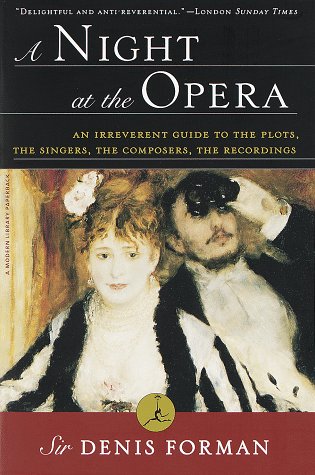 Whole categories of books--encyclopedias, dictionaries--are becoming obsolete because the information they contain can now be found for free on the Internet. So why, then, did I buy a book of opera synopses the other week, when Wikipedia and the Metropolitan Opera website should've sufficed for all my opera-summary needs?
Answer: Because the book in question, A Night at the Opera by Sir Denis Forman, is a lot more than just a collection of summaries, and I wanted to have his distinctive voice in my library. (Indeed, this proves that good writers will become more, not less, valuable as the Internet takes over everything.) It's subtitled "An Irreverent Guide to the Plots, the Singers, the Composers, the Recordings," which is a fairly accurate description of what it contains. However, one should note that this book was first published in 1992, so the mini-biographies of opera singers focus mostly on stars of the '70s and '80s. And the parts of the book that discuss "recordings" are not a recommendation of which CDs to buy, but rather a rundown of the musical highlights of each opera, should you listen to it while reading along with Forman.
For introductory purposes, each opera in the book is given a two-word descriptor of its genre, ranging from the sober (Don Carlos is a "Historical Drama") to the silly (Magic Flute is a "Masonic Extravaganza"). I do think Forman could have paid a bit more attention to these descriptors, however. For instance, both Lucia di Lammermoor and Maria Stuarda are categorized as "Historical Tragedies," but all of the characters in Lucia are fictitious while those in Maria are based, however fancifully, on real persons. That makes a big difference, in my view. Each opera also receives a letter grade, ranging from alpha-plus to gamma. Because the book covers 83 of the world's most popular operas, the vast majority of them rate alpha-plus or alpha, though there are some noteworthy exceptions. Forman thinks that Ariadne auf Naxos has terrific music but is an absolute mess onstage, and that Verdi's Falstaff "has no sex appeal and no heart, and opera demands both those qualities." Disagree? Well, that's what makes horse races.
The operas in this book were chosen because each of them had three or more recordings listed in the Gramophone catologue of 1992; an imperfect standard, but perhaps the only objective way to decide which operas are canonical enough to be included here. Still, there are enough odd choices here to make me think that the British canon, circa 1992, is slightly different than the American canon, circa 2009. For instance, the book includes Attila (never performed at the Metropolitan Opera) and Khovanschina (an opera I had literally never heard of before), while omitting such favorites as Lohengrin (over 600 Met performances), Roméo et Juliette (over 300) and Manon (over 250).
The opera summaries are the most irreverent parts of this book, written in a rushed and slangy style, as if Forman was telling them to you over a couple of beers at the pub. Example from his La Bohème synopsis:
Rodolfo stays behind to meet the deadline for his TV script: he is interrupted by a knock on the door: it's a stranger: a young girl Mimi seeking a light for her candle: she drops her key, and Rodolfo's candle also goes out: both grope on the floor for the key: their hands touch: Mimi's tiny hand is frozen!: Rodolfo seizes it: he gives Mimi an extensive C.V. also some poetic come-on stuff hoping for a closer relationship: Mimi responds with her C.V.: she works in a rag-trade sweatshop, she's fond of flowers, has a small bedsit. The three call outside window--"Hey! Rodolfo!": he shouts "Just coming": he tells Mimi he loves her: mutual says she (seven minutes from their first hand touch).The joke about Rodolfo's "TV script" is of course a bit too cutesy, but the rest of the way this summary is written makes it very memorable, and proves that you can acknowledge the illogical aspects of an opera's plot while still adoring it for other reasons: Boheme rates an alpha from Forman.
What really makes this book valuable are the aforementioned sections about the musical highlights in each opera. These are almost like a second summary, and are usually longer than the initial description of the plot. Forman goes through each opera scene by scene, briefly notating and analyzing the most memorable bits of music. Here, for instance, is his musical analysis for the La Boheme scene summarized above:
Che gelida manina: One of the most famous tenor pieces in the opera rep.*** Rodolfo fancies Mimi: he tells her a romantic yarn about himself--as young artistic persons are apt to do.The three-star ratings here correspond to Forman's assessment of "Stunning, brilliant." This scene is unusual for its succession of three-star arias/duets; scenes less overwhelming than La Boheme's Act One finale mostly get one star ("Worth looking out for") or two ("This is really good"). One thing I especially like is that Forman doesn't just pay attention to the Big Famous Arias that are the first thing that neophytes come to love about opera. He also highlights great choruses, ensembles, and instrumental passages--ensuring that everyone who reads his book will get a well-rounded idea of the potential of this art form.
Mi chiamano Mimi: Seamstress Mimi responds:*** her account of her work is more prosaic but nevertheless touching: then her aria flowers and takes wing as she tells Rodolfo how she longs for spring.
O soave fanciulla: The love duet:*** Rodolfo: At last I've found my dream girl; Mimi: I've fallen for him. Snatches from the earlier solos: Puccini at his most intense: a dreamy ending as they drift off arm in arm to the Cafe Momus and their voices fade into the distance.
The musical highlights are followed by a short discussion of the opera's genesis and performance history, and then by Forman's overall opinion of the work, concluding with his letter grade. These sections may contain unorthodox opinions, as I have said, but they lack the jokey tone of the opera summaries, and they serve less as a final judgment than as a jumping-off point for further discussion. Special mention must be given to the 85 pages that Forman devotes to Wagner's Ring Cycle, including a layman's introduction to the musical leitmotifs. I know my own personality, and know that if I am to have any hope of loving Wagner, I need to learn about his music from someone who has a well-developed sense of humor and the absurd, even as he also genuinely recognizes Wagner's greatness. Forman's tone in this section fits the bill.
I'm going to consider this one of the most valuable reference-works on my bookshelf now; and while I wouldn't normally count reference works on my "Books I Read in 2009" list, and though I certainly haven't read every word of A Night at the Opera (it is almost 1000 pages), I have stayed up late with it enough nights, curious to learn Forman's opinions on this or that work, that I think it merits an honorary spot on my list.
Sunday, November 16, 2008
But That's All Over Now, I'm Twenty-One
Being young, and creative, and prone to putting undue pressure on myself, I am perennially fascinated by those artists who became famous while still very young--who took cities by storm at the age of nineteen or twenty, who created art with a wisdom that belied their tender years! And if the young people in question didn't only make transcendent art, but also happened to lead wildly exciting and passionate lives, have famous paramours, etc., my envy only increases. (Secretly I yearn to have the kind of life that a biographer would find fascinating 100 years from now.) I come up with increasingly unlikely plans both to improve the quantity/quality of my writing, and to bring myself to the attention of cultural gatekeepers.
And lately, I feel like I've seen/read a spate of works that set me off thinking this way. Both operas I saw this fall--Die Tote Stadt and Idomeneo--were composed by men in their early 20s. Idomeneo wasn't even Mozart's first opera (though it was his first great success, and the earliest of his operas to be performed with any frequency nowadays)--he wrote it at the age of 24, after already having written about seven other operas! No wonder it is such a self-assured piece of work. Though hampered by a mediocre libretto, Mozart still did his best with what he had.
If anything, Die Tote Stadt, by 23-year-old Erich Wolfgang Korngold, is even more incredible. Korngold was writing for a much larger and more richly colored orchestra than Mozart used; his 20th-century harmonic language is obviously much more complex; and he wasn't writing a Classical score of recitative followed by da capo aria followed by ensemble number, but a dreamlike opera where every sequence flows into the next. Furthermore, Korngold treats his subject with great depth and maturity--how could a 23-year-old have such insight into the psychology of a middle-aged man driven crazy by the death of his wife?
While waiting for the bus after Die Tote Stadt, I talked to a lady who told me that Erich Korngold had a very controlling father who wouldn't allow his son to get married till he was 27. "But, seeing that opera," said the woman, "I feel sure that he must have sneaked out of his house at night."
Then, around Halloween, I decided that I should read a classic scary novel: Frankenstein. Since this book was published, people have been amazed that a 19-year-old girl could write such a haunting horror story. Indeed Mary Shelley had already led quite an eventful life before writing Frankenstein: a famous father, an elopement with Percy Shelley, the birth and death of a child, a lot of touring Europe in the company of other Romantic writers. "How is it possible that she did all this before turning 20?" I asked myself, old and dried-up at the age of 21.
After finishing Frankenstein I wasn't sure what to read next, and browsed the sale table at Green Apple Books. I rejected many books out of hand...but ah, okay, here was something I really ought to read, especially since I was a French major and should be more familiar with this author... and he certainly was a fascinating personality...
Only when I walked out of the store did the full truth hit me.
I'd bought The Complete Poems of Arthur Rimbaud. AKA The Complete Poems of a Visionary Boy-Genius Who Stopped Writing at Age 21.
"Damn it, Marissa," I said to myself, "you've done it again."
Fortunately I found some solace in a recent New Yorker article by Malcolm Gladwell, explicating why some artists peak early and others peak late. No use envying the precocious geniuses if your mind is simply formed another way--preferring trial-and-error to flashes of infallible insight. Not that it's easy for artists who are late bloomers--they can experience self-doubt, despair, lack of motivation in a way that early-bloomers don't. (And they don't seem to have the wildly exciting lives, either.) But at least that's preferable to the thought that an artist must be precocious in order to be worthwhile at all.
Title of this post comes from my favorite obscure Cole Porter song, "What a Joy To Be Young."
Subscribe to:
Posts (Atom)