For my dad's birthday last month, I gave him a copy of the new book The Most Human Human: What Talking With Computers Teaches Us About What It Means to Be Alive, by Brian Christian. When Adam Gopnik, in The New Yorker, called the book "terrific" and "one of the rare successful literary offspring of Gödel Escher Bach," I knew that this would be a perfect gift for my computer-geek, philosophically inclined Dad. Upon further research, I liked how the author, Brian Christian, has degrees in computer science, philosophy and poetry, and was born in 1984. He's an overachieving Millennial, in short, and it makes me proud that my generation has reached the point where we are writing erudite books that get rave reviews in The New Yorker and can be given to our baby-boomer parents.
So I purchased the book, read the introduction for kicks, and was sufficiently intrigued that I ended up reading the whole thing before giving it to Dad (I knew he wouldn't mind).
As the New Yorker comparison to Gödel Escher Bach would imply, The Most Human Human is a difficult book to sum up and covers a wide range of topics. Fundamentally, it is an investigation into what intellectual processes humans can still do better than computers, and how that can help us to understand our place in the world and get the most out of being alive. If our humanity does not lie purely in our intellectual capacity, where does it lie?
I should note, for those of you who are put off (rather than encouraged) by the comparison to Gödel Escher Bach, that The Most Human Human is much shorter than Gödel Escher Bach and probably more accessible -- it will make you think, but does not require you to understand symbolic logic. In addition, The Most Human Human has a moral-philosophical-humanistic component that I don't remember being present in Gödel Escher Bach. (Some indication of Brian Christian's tone can be discerned from the fact that one of the book's epigraphs comes from David Foster Wallace and Wallace is quoted several times in the text. How Millennial of Christian!) It's a warmer and more inviting book, I think.
The Most Human Human covers a lot of ground, so people with a wide variety of interests and concerns are likely to get something out of it. Clearly, one of the big themes of the book is human verbal and non-verbal communication -- and clearly, that's something I also think about a lot, because I write plays. Christian even cites the work of playwrights in his text -- discussing David Mamet, for instance, in a section on how human dialogue tends to be far more circuitous and discursive and filled with interruptions than computers are capable of. I love the fusion of art and science!
The Most Human Human, therefore, has given me some ideas on how to be a better playwright -- not just a better human being. In one fascinating section, Christian explains that chatbots these days excel at "stateless conversation," that is, conversation where their response depends only on the last thing that you said. But they're not so good at taking into account the overall arc of the conversation, and even worse at taking into account the conversation they had with you yesterday.
One of the earliest chatbots (late 1980s) was MGonz, which was designed to be verbally abusive, belligerent, and argumentative -- and succeeded in fooling a lot of people into thinking it was a human being.
"As becomes painfully clear from reading the MGonz transcripts, argument is stateless," Christian notes. "I've seen it happen between friends: 'Once again, you've neglected to do what you've promised.' 'Oh, there you go right in with that tone of yours!' 'Great, let's just dodge the issue and talk about my tone instead! You're so defensive!' 'You're the one being defensive! This is just like the time you x!' 'For the millionth time, I did not even remotely x! You're the one who...' And on and on. A close reading of this dialogue, with MGonz in mind, turns up something interesting, and very telling: each remark after the first is only about the previous remark. The friends' conversation has become stateless, unanchored from all context. [... Thus] there's a sense in which verbal abuse is simply less complex than other forms of conversation."
When I read Christian's invented sample of "stateless argument," I realized that if I read this same dialogue in a play, I would consider it terrible playwriting. I know this sort of thing happens in real life, but it seems to happen even more often in the work of bad or inexperienced playwrights. Being taught that "drama is conflict," some newbie playwrights confuse endless argument or bickering with genuine dramatic conflict. Their plays tend to consist of two relatively generic characters quibbling with and criticizing and insulting one another in generic -- in stateless -- ways.
But if you know exactly who these characters are, their relationship to one another and their prior history, the deeper reasons why they are arguing, you can write a good dialogue scene that doesn't degenerate into mindless bickering.
Good playwriting (and good chatbots) take prior conversation and prior history into account, the way that human beings do, unconsciously, in real life; bad playwriting (and bad chatbots) is stateless.
And that's just one of the many things that The Most Human Human made me think about.
Showing posts with label science. Show all posts
Showing posts with label science. Show all posts
Monday, May 2, 2011

Monday, January 11, 2010
"January 10, 1610. Galileo Galilei abolishes Heaven."
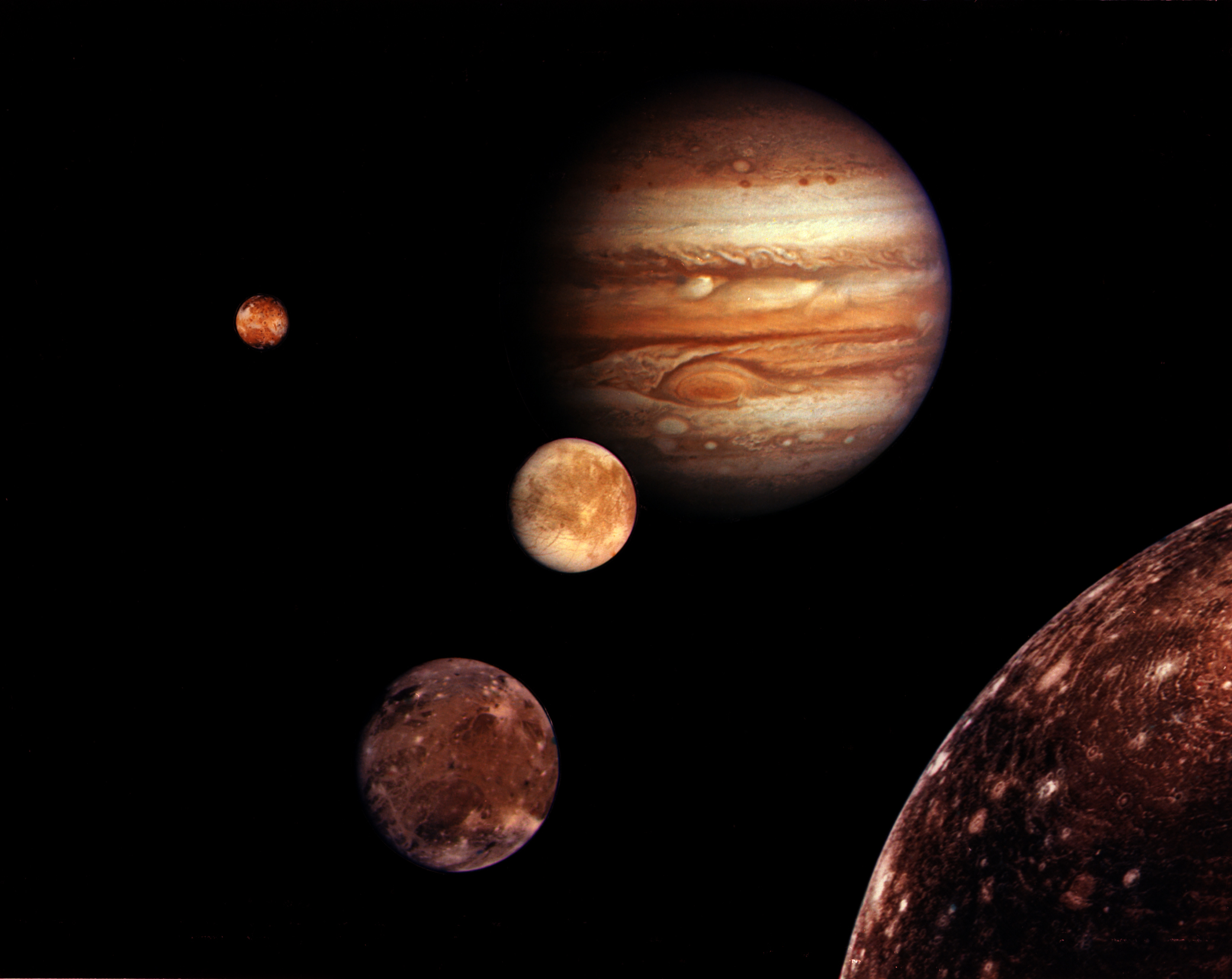
Exactly 400 years ago, Galileo Galilei trained his new telescope on the heavens, and discovered the four largest moons of Jupiter: Europa, Io, Ganymede and Callisto.
Or, as Bertolt Brecht put it in his play Life of Galileo, "January 10, 1610. Galileo Galilei abolishes Heaven."
Here is one of Galileo's early diagrams recording his observations of how the moons orbited the planet.

Four hundred years later, perhaps it's easy to forget that these four moons were the first new celestial bodies ever discovered. That's why, as Brecht says, the discovery "abolished Heaven." In the Aristotelian system, the heavens were perfect and rarefied, with each planet embedded in a crystal sphere. The spheres rotated around the Earth, but other than that, everything else in Heaven was fixed. But if Jupiter had moons rotating around it, that meant that it couldn't be stuck in a crystal sphere. And outer space was mutable. And thus, the idea of "the heavens" (outer space) had to diverge from the idea of "Heaven" (the dwelling place of God, an unreachable place of limitless perfection).
Scene Three of Life of Galileo takes place on 1/10/1610 and depicts Galileo showing his new discoveries to his friend Sagredo: the four moons of Jupiter, the mountains and craters on Earth's moon, the densely packed stars that make up the Milky Way. It is a beautiful scene, capturing the romance and danger and mystery of science. When Galileo says, "What you are seeing has been seen by no mortal except myself. You are the second," I got chills. Can you imagine what that would be like -- to be the second person in the world to apprehend these truths about the nature of the solar system?
I have always been the type of person who gets greedy, information-hungry obsessions. Perhaps the first of these, which took place when I was about 2½ years old, was an obsession with astronomy and the solar system. Therefore, I literally can't ever remember a time when I didn't know that Jupiter had dozens of moons. Because I learned this when I was a tiny child, I accepted it at once; but Galileo was in his forties when he discovered the moons of Jupiter, and this discovery directly contradicted the teachings of his Church and of the most respected philosophers and scientists, even as it helped confirm his secret suspicion that Copernicus was right and the sun did not go round the earth. How would it feel to learn that?
This scene in Life of Galileo is beautiful and inspirational because it draws our attention to Galileo's awesome discoveries. But Brecht hasn't forgotten that he is writing a human-scale drama, so there is also a somber, rueful undercurrent to the scene. Sagredo tries to warn Galileo that his discoveries may lead him to be condemned for heresy and burned at the stake. But Brecht's Galileo has a tragic flaw: his arrogance, his blind faith in science and reason. He does not understand why people may cling to old superstitions even when they are confronted with logical proofs:
I believe in Humanity, which means to say I believe in human reason. If it weren't for that belief each morning I wouldn't have the power to get out of bed. [...] Nobody who isn't dead can fail to be convinced by proof. [...] Yes, I believe in reason's gentle tyranny over people. Sooner or later they have to give in to it. No one can go on indefinitely watching me drop a pebble, then say it doesn't fall. No human being is capable of that. The lure of a proof is too great. Nearly everyone succumbs to it; sooner or later we all do. Thinking is one of the chief pleasures of the human race.It is enough to make you cry when you recall how much more we know about astronomy and biology and chemistry and physics than Galileo did; and yet, 400 years later, huge numbers of people remain as recalcitrant as ever, rejecting scientific proof and clinging to the belief that the earth is 6000 years old and the climate is not changing...
note: I meant to write and post this on Jan. 10, but I was laboring under the misapprehension that yesterday was the 9th. Apologies!
Subscribe to:
Posts (Atom)