Showing posts with label galileo. Show all posts

Monday, January 27, 2014

The Starry Messenger takes just two months to arrive

I very much enjoyed Nicholas Schmidle's recent New Yorker article about a forged copy of Sidereus Nuncius ("Starry Messenger"), the groundbreaking treatise in which Galileo described the craters of the Moon, the moons of Jupiter, and the new stars that he had discovered with his telescope.

(And not only because my post about Galileo's discovery of the moons of Jupiter, as portrayed in Brecht's Life of Galileo, is in my top 5 most-read posts of all time. Or because Galileo was the first person to look at the Pleiades through a telescope.)

Mainly, I enjoyed the article for its account of shady dealings in the rare-book world, complete with a talented but completely unscrupulous con man with a terrific Italian name (Marino Massimo De Caro).

But also, I was intrigued to learn the publication history of Sidereus Nuncius. Galileo discovered the moons of Jupiter in early January 1610, and two months later, he had written up his observations in Latin, found a publisher, had the book typeset, commissioned copperplate etchings as illustrations, reviewed the proof copies, and published the book. Two months to publish a book that would change the course of science! Granted, Sidereus Nuncius is only 60 pages long... but still.

People say that culture moves much faster in the digital age than it ever did before; we have this idea that, in the olden days, writers were more careful and thoughtful than they are now. And, sure, in the 21st century you can publish something instantaneously on a blog and have it available to the entire world, rather than dealing with the slower processes (production and distribution) of print media.

However, for anything to get published in a scientific journal these days, it must go through a lengthy peer-review process. And even if you're self-publishing, two months is an awfully quick turn-around time to write, illustrate, proofread, and publish a book. In some ways, then, the culture seems slower than it was in Galileo's time. It's the same thing I was writing about in my Theater Pub column earlier this month: we think it was fine for Shakespeare to write and produce two plays a year, but there's an expectation that modern playwrights will spend years workshopping a single play. And, we think it was fine for Galileo to publish his scientific observations two months after he made them (without any peer review), but modern scientists would never get away with having so little data.

Image: the pages of Sidereus Nuncius that depict Galileo's drawings of Orion and the Pleiades, cropped from the original image at the Linda Hall Library of Science, Engineering & Technology. So cool! I've just adapted it as my Facebook and Twitter cover photo.

Monday, January 11, 2010

"January 10, 1610. Galileo Galilei abolishes Heaven."


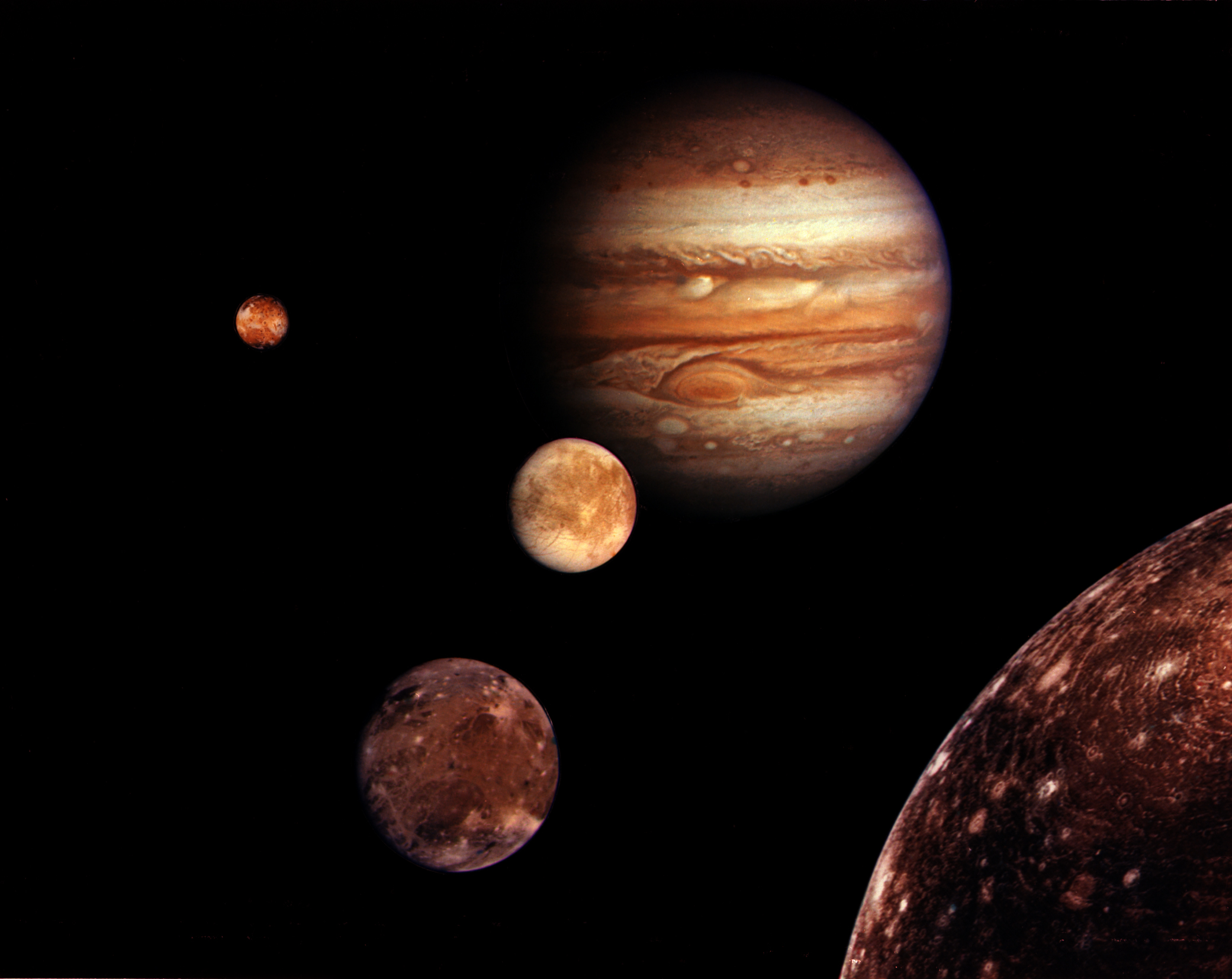
Exactly 400 years ago, Galileo Galilei trained his new telescope on the heavens, and discovered the four largest moons of Jupiter: Europa, Io, Ganymede and Callisto.

Or, as Bertolt Brecht put it in his play Life of Galileo, "January 10, 1610. Galileo Galilei abolishes Heaven."

Here is one of Galileo's early diagrams recording his observations of how the moons orbited the planet.


Four hundred years later, perhaps it's easy to forget that these four moons were the first new celestial bodies ever discovered. That's why, as Brecht says, the discovery "abolished Heaven." In the Aristotelian system, the heavens were perfect and rarefied, with each planet embedded in a crystal sphere. The spheres rotated around the Earth, but other than that, everything else in Heaven was fixed. But if Jupiter had moons rotating around it, that meant that it couldn't be stuck in a crystal sphere. And outer space was mutable. And thus, the idea of "the heavens" (outer space) had to diverge from the idea of "Heaven" (the dwelling place of God, an unreachable place of limitless perfection).

Scene Three of Life of Galileo takes place on 1/10/1610 and depicts Galileo showing his new discoveries to his friend Sagredo: the four moons of Jupiter, the mountains and craters on Earth's moon, the densely packed stars that make up the Milky Way. It is a beautiful scene, capturing the romance and danger and mystery of science. When Galileo says, "What you are seeing has been seen by no mortal except myself. You are the second," I got chills. Can you imagine what that would be like -- to be the second person in the world to apprehend these truths about the nature of the solar system?

I have always been the type of person who gets greedy, information-hungry obsessions. Perhaps the first of these, which took place when I was about 2½ years old, was an obsession with astronomy and the solar system. Therefore, I literally can't ever remember a time when I didn't know that Jupiter had dozens of moons. Because I learned this when I was a tiny child, I accepted it at once; but Galileo was in his forties when he discovered the moons of Jupiter, and this discovery directly contradicted the teachings of his Church and of the most respected philosophers and scientists, even as it helped confirm his secret suspicion that Copernicus was right and the sun did not go round the earth. How would it feel to learn that?

This scene in Life of Galileo is beautiful and inspirational because it draws our attention to Galileo's awesome discoveries. But Brecht hasn't forgotten that he is writing a human-scale drama, so there is also a somber, rueful undercurrent to the scene. Sagredo tries to warn Galileo that his discoveries may lead him to be condemned for heresy and burned at the stake. But Brecht's Galileo has a tragic flaw: his arrogance, his blind faith in science and reason. He does not understand why people may cling to old superstitions even when they are confronted with logical proofs:
I believe in Humanity, which means to say I believe in human reason. If it weren't for that belief each morning I wouldn't have the power to get out of bed. [...] Nobody who isn't dead can fail to be convinced by proof. [...] Yes, I believe in reason's gentle tyranny over people. Sooner or later they have to give in to it. No one can go on indefinitely watching me drop a pebble, then say it doesn't fall. No human being is capable of that. The lure of a proof is too great. Nearly everyone succumbs to it; sooner or later we all do. Thinking is one of the chief pleasures of the human race.
It is enough to make you cry when you recall how much more we know about astronomy and biology and chemistry and physics than Galileo did; and yet, 400 years later, huge numbers of people remain as recalcitrant as ever, rejecting scientific proof and clinging to the belief that the earth is 6000 years old and the climate is not changing...

note: I meant to write and post this on Jan. 10, but I was laboring under the misapprehension that yesterday was the 9th. Apologies!