Friday, October 12, 2007
Wending my way to the Windy City
That's it from me for a few days...it's October break here at Vassar (where did the semester go?) and I am off to Chicago. I've never been there before and I have tickets to Sarah Ruhl's epic Passion Play at the Goodman Theater, so I am quite excited! (And I'll be sure to tell you all about it.)

Thursday, October 11, 2007
Scottish Tragedy
 "The Bride of Lammermoor" by John Everett Millais. Photo from bridgemanartondemand.com.
By the way, it seems that my posts on Macbeth and Natalie "Lucia di Lammermoor" Dessay have made this Scottish Tragedy Day on my blog. I see that this season, the Met is presenting a new production of Verdi's Macbeth in addition to their new Lucia... I wonder if the connection is intentional?
After all, it's not just that both works are tragedies... but both feature an innocent man being stabbed to death in his bed, an event that takes place offstage, upstairs. And a murderous woman who gets covered in blood and has a really famous mad scene. Still, it's probably not such a bizarre coincidence--I'd wager that Sir Walter Scott was just heavily influenced by Shakespeare as he wrote The Bride of Lammermoor. Plenty of writers have tried, and failed, to get out of Shakespeare's shadow.
Soprano on a mission
My new favorite opera singer got interviewed on Charlie Rose the other night, and I think it makes interesting viewing for anyone who cares about opera's relevance to the modern world. It also includes some breathtaking clips of Lucia's Mad Scene (near the beginning, near minute 17, and at the end, if you want to skip right to them.)
Dessay is articulate about her artistic goals and deals well with Charlie, who treats some of what she says with incredulity. Also, she's fun to watch--even when she's not playing a role, she has a very expressive face with huge eyes. The Lucia advertisements all over NYC--Dessay looking distraught, her mascara running, alongside the quasi-clever slogan YOU'D BE MAD TO MISS IT--are quite arresting. (Dessay to Rose: "I own the buses in this city!") A lot of the women I met in France--especially my two host mothers--could be described as "intense," and Natalie Dessay seems like another of these intense French women.
Indeed, the interview shows her as ambitious, perfectionistic, determined--I apologize for the semi-snarky "maybe it's her press agent" comment in my earlier post. No, it's clear that Dessay sees herself as carrying a heavy responsibility on her slender shoulders: making opera fresh and relevant and above all, theatrical. It's like she's read Peter Brook: "My dream would be an empty stage. Empty. One chair. And, bodies. The bodies of the singers, but, singers able to act and to play as actors."
For more proof that Dessay really knows what she's talking about, she provides a concise and accurate definition of what you need to be good at comedy: Energy, rhythm, and taking everything seriously (that is, it never works if you try to "be funny"). Couldn't have said it better myself.
Dessay names Maria Callas as her greatest inspiration in her quest to bring theater to opera, and says that if she could play any role in a movie, she'd tackle Sophie's Choice ("I love so much Meryl Streep, it's my favorite actress"). Oddly enough, I've mentioned both Callas and Streep here in the past week. Natalie, are you a covert reader of marissabidilla?
Dessay is articulate about her artistic goals and deals well with Charlie, who treats some of what she says with incredulity. Also, she's fun to watch--even when she's not playing a role, she has a very expressive face with huge eyes. The Lucia advertisements all over NYC--Dessay looking distraught, her mascara running, alongside the quasi-clever slogan YOU'D BE MAD TO MISS IT--are quite arresting. (Dessay to Rose: "I own the buses in this city!") A lot of the women I met in France--especially my two host mothers--could be described as "intense," and Natalie Dessay seems like another of these intense French women.
Indeed, the interview shows her as ambitious, perfectionistic, determined--I apologize for the semi-snarky "maybe it's her press agent" comment in my earlier post. No, it's clear that Dessay sees herself as carrying a heavy responsibility on her slender shoulders: making opera fresh and relevant and above all, theatrical. It's like she's read Peter Brook: "My dream would be an empty stage. Empty. One chair. And, bodies. The bodies of the singers, but, singers able to act and to play as actors."
For more proof that Dessay really knows what she's talking about, she provides a concise and accurate definition of what you need to be good at comedy: Energy, rhythm, and taking everything seriously (that is, it never works if you try to "be funny"). Couldn't have said it better myself.
Dessay names Maria Callas as her greatest inspiration in her quest to bring theater to opera, and says that if she could play any role in a movie, she'd tackle Sophie's Choice ("I love so much Meryl Streep, it's my favorite actress"). Oddly enough, I've mentioned both Callas and Streep here in the past week. Natalie, are you a covert reader of marissabidilla?
Macbeth: Good, Bad, and Ugly
I have been fortunate to see excellent productions of many Shakespeare plays, but up until a week ago, I hadn't seen a Macbeth that I thought was any good at all.
My first experience with Macbeth came at the Oregon Shakespeare Festival in spring 2002: the show opened the New Theater. And it was a big disappointment--most of all in the actor playing Macbeth. At Ashland, he excels in funny roles like Falstaff or Trinculo--but carried his mugging mannerisms into the role of Macbeth. Whenever a prophecy came true or he otherwise had to show fear, he'd bug his eyes out of his head like a cartoon character. The nadir came at "Tomorrow and tomorrow and tomorrow," some of the most mannered acting I've ever witnessed. The actor shouted the first TOMORROW!, then delivered the second two "tomorrow"s in an ominous, low monotone. It made no emotional sense and disrupted Shakespeare's rhythm.
Macbeth is Shakespeare's shortest tragedy, but Ashland made it even shorter and more headlong, even cutting the Witches' "Double, double, toil and trouble." Also, there were just six actors: Macbeth, Lady M, Banquo, and three actresses who played all the other roles. There was too much switching back-and-forth of roles for most audience members to understand, especially because Macbeth is full of minor thanes, etc., who come on for a scene and then leave. The only doubling that was really interesting involved having the same woman play both Macduff and Lady Macduff.
The entire production was kind of dark and gloomy, on a bare stage with a pool of stage blood in the center (so the fights consisted of people flinging blood at one another). But the pacing was too fast, and I never succumbed to the magic of the theater. Really, I got nothing out of this version.
Even worse, however, was the production of Macbeth at my high school the next autumn. I got to witness the debacle firsthand because I appeared in it as an extra. The director didn't do any gender-blind casting, which annoyed me, because I, a junior, had no lines, while a bunch of freshman guys with no acting experience got roles like Ross, Banquo, and Lennox.
Mostly, this production suffered from the "Wouldn't it be cool if..." school of directing. Wouldn't it be cool if the witches ran around with a video camera and there were TV monitors in the set to project what they were filming? Wouldn't it be cool if the guys wore modern clothes but carried giant broadswords? Wouldn't it be cool if Lady Macbeth was over-the-top sexy? But none of these ideas has anything to do with the other, or worse, with Shakespeare's text.
To make matters worse, the guy we cast as Macbeth was very good in contemporary plays, but had no sense of Shakespeare's language and was notoriously bad at memorizing lines. The only emotion he displayed in "Tomorrow and tomorrow and tomorrow" was wishing the damn speech would be over.
The only way to make up for this mess was to stage an awesome sword fight at the end (swords purchased for $40 at BargainBlades.com--I kid you not), and it was pretty great, except for the fact that each night Macbeth and Macduff got more aggressive, and sloppier. On the last night the handle of Macbeth's sword got knocked askew from the blade--if we'd run another weekend, there would've been some major injuries. (This, by the way, is the reason behind the "Curse of the Scottish Play": people think they can perform Macbeth without much rehearsal, but there are too many scenes with the potential to cause accidents!)
Twice burned, four times shy... so I was a little uncertain what I'd think of Vassar's Macbeth, which ran last weekend. Still, I had reason to be hopeful: Vassar is usually good at straight-up, respect-the-text Shakespeare, and eight senior girls (that is, a ton of my friends) had all the major roles. Yes, it was an all-female Macbeth!
I doubt that Macbeth will ever be one of my favorite Shakespeare plays--it doesn't seem to have the depth of Hamlet or Lear--but of course there's great stuff in it. Besides the passages that everyone mentions, I believe that Act 4, Scene 3, where Macduff learns of the murder of his family, must be some of the most emotionally moving writing that Shakespeare ever did.
My friend who played Macduff was perfectly cast--her greatest skill as an actress is to combine vulnerability and deep inner strength. I cast her in a staged reading of one of my plays because of this, and it's also what Macduff needs.
This scene ("Dispute it like a man." "I shall do so/But I must also feel it as a man") also gets at a theme of Macbeth that this production highlighted: what it means to be a man. With women in all the roles, you paid more attention when the characters talked about being men, or when Lady Macbeth cried "Unsex me here" and suggested that Macbeth was a sissy if he wouldn't kill Duncan. Not that this part of the play was over-emphasized--but it gave you something to think about after it was done.
The theatre was set up in the round, with very few props; still, there were some amazing stage pictures. The gigantic doors at one end of the theatre (wide enough to drive a car through) were used to great effect in the Porter scene, and also for the parade of Banquo's kingly descendants. (This scene did not appear in the other two Macbeth productions I've seen, but was chilling here.) The witches' cauldron was a trap door that glowed with unearthly light. There is also a spiral staircase in one corner of the theatre leading to an elaborate system of catwalks above, which meant that Macbeth could do "If 'twere done when 'tis done" hanging spotlit from a ladder, Macduff could come clattering down the staircase after discovering Duncan's murder, and Lady Macbeth could appear as a haunting white-clad figure on the catwalks for her sleepwalking scene. (However, I wished I didn't have to crane my neck so much, and could see her facial expressions better!)
The battle scenes, with short swords and heavy shields, were awesome--every actress participated, and at the cast party they wore their bruises, and newfound muscles, with pride.
My friend who played Macbeth has been impressing everyone since freshman year. Two years ago, she was a magnificent Juliet: she has an instinct for Shakespeare, a melting and lyrical voice, and carries herself beautifully. So in one sense, she's a counterintuitive choice for the role of Macbeth, but on the other hand, she's the only girl in our year who could've done it. And she's the first Macbeth I've seen treat the play as a tragedy. Her "Tomorrow and tomorrow and tomorrow" (obviously, my litmus test for Macbeths) was full of aching sorrow and regret...though maybe a little too delicate to be "ideal" for this warrior-king.
I still have a few issues with Macbeth, though more with the script than this generally thoughtful and well-acted production. There are just so many thanes running around, delivering exposition or filling out the crowd, but not developing character. Say "Rosencrantz," "Osric," "Fortinbras," and you get a clear mental image of the character's personality. Say "Ross," "Lennox," even "Malcolm," and you can identify the scenes in which they appear, but not what kind of person they are.
Still, congrats to all the Macbeth ladies--you've left me, finally, with a pleasant memory of this play!
My first experience with Macbeth came at the Oregon Shakespeare Festival in spring 2002: the show opened the New Theater. And it was a big disappointment--most of all in the actor playing Macbeth. At Ashland, he excels in funny roles like Falstaff or Trinculo--but carried his mugging mannerisms into the role of Macbeth. Whenever a prophecy came true or he otherwise had to show fear, he'd bug his eyes out of his head like a cartoon character. The nadir came at "Tomorrow and tomorrow and tomorrow," some of the most mannered acting I've ever witnessed. The actor shouted the first TOMORROW!, then delivered the second two "tomorrow"s in an ominous, low monotone. It made no emotional sense and disrupted Shakespeare's rhythm.
Macbeth is Shakespeare's shortest tragedy, but Ashland made it even shorter and more headlong, even cutting the Witches' "Double, double, toil and trouble." Also, there were just six actors: Macbeth, Lady M, Banquo, and three actresses who played all the other roles. There was too much switching back-and-forth of roles for most audience members to understand, especially because Macbeth is full of minor thanes, etc., who come on for a scene and then leave. The only doubling that was really interesting involved having the same woman play both Macduff and Lady Macduff.
The entire production was kind of dark and gloomy, on a bare stage with a pool of stage blood in the center (so the fights consisted of people flinging blood at one another). But the pacing was too fast, and I never succumbed to the magic of the theater. Really, I got nothing out of this version.
Even worse, however, was the production of Macbeth at my high school the next autumn. I got to witness the debacle firsthand because I appeared in it as an extra. The director didn't do any gender-blind casting, which annoyed me, because I, a junior, had no lines, while a bunch of freshman guys with no acting experience got roles like Ross, Banquo, and Lennox.
Mostly, this production suffered from the "Wouldn't it be cool if..." school of directing. Wouldn't it be cool if the witches ran around with a video camera and there were TV monitors in the set to project what they were filming? Wouldn't it be cool if the guys wore modern clothes but carried giant broadswords? Wouldn't it be cool if Lady Macbeth was over-the-top sexy? But none of these ideas has anything to do with the other, or worse, with Shakespeare's text.
To make matters worse, the guy we cast as Macbeth was very good in contemporary plays, but had no sense of Shakespeare's language and was notoriously bad at memorizing lines. The only emotion he displayed in "Tomorrow and tomorrow and tomorrow" was wishing the damn speech would be over.
The only way to make up for this mess was to stage an awesome sword fight at the end (swords purchased for $40 at BargainBlades.com--I kid you not), and it was pretty great, except for the fact that each night Macbeth and Macduff got more aggressive, and sloppier. On the last night the handle of Macbeth's sword got knocked askew from the blade--if we'd run another weekend, there would've been some major injuries. (This, by the way, is the reason behind the "Curse of the Scottish Play": people think they can perform Macbeth without much rehearsal, but there are too many scenes with the potential to cause accidents!)
Twice burned, four times shy... so I was a little uncertain what I'd think of Vassar's Macbeth, which ran last weekend. Still, I had reason to be hopeful: Vassar is usually good at straight-up, respect-the-text Shakespeare, and eight senior girls (that is, a ton of my friends) had all the major roles. Yes, it was an all-female Macbeth!
I doubt that Macbeth will ever be one of my favorite Shakespeare plays--it doesn't seem to have the depth of Hamlet or Lear--but of course there's great stuff in it. Besides the passages that everyone mentions, I believe that Act 4, Scene 3, where Macduff learns of the murder of his family, must be some of the most emotionally moving writing that Shakespeare ever did.
My friend who played Macduff was perfectly cast--her greatest skill as an actress is to combine vulnerability and deep inner strength. I cast her in a staged reading of one of my plays because of this, and it's also what Macduff needs.
This scene ("Dispute it like a man." "I shall do so/But I must also feel it as a man") also gets at a theme of Macbeth that this production highlighted: what it means to be a man. With women in all the roles, you paid more attention when the characters talked about being men, or when Lady Macbeth cried "Unsex me here" and suggested that Macbeth was a sissy if he wouldn't kill Duncan. Not that this part of the play was over-emphasized--but it gave you something to think about after it was done.
The theatre was set up in the round, with very few props; still, there were some amazing stage pictures. The gigantic doors at one end of the theatre (wide enough to drive a car through) were used to great effect in the Porter scene, and also for the parade of Banquo's kingly descendants. (This scene did not appear in the other two Macbeth productions I've seen, but was chilling here.) The witches' cauldron was a trap door that glowed with unearthly light. There is also a spiral staircase in one corner of the theatre leading to an elaborate system of catwalks above, which meant that Macbeth could do "If 'twere done when 'tis done" hanging spotlit from a ladder, Macduff could come clattering down the staircase after discovering Duncan's murder, and Lady Macbeth could appear as a haunting white-clad figure on the catwalks for her sleepwalking scene. (However, I wished I didn't have to crane my neck so much, and could see her facial expressions better!)
The battle scenes, with short swords and heavy shields, were awesome--every actress participated, and at the cast party they wore their bruises, and newfound muscles, with pride.
My friend who played Macbeth has been impressing everyone since freshman year. Two years ago, she was a magnificent Juliet: she has an instinct for Shakespeare, a melting and lyrical voice, and carries herself beautifully. So in one sense, she's a counterintuitive choice for the role of Macbeth, but on the other hand, she's the only girl in our year who could've done it. And she's the first Macbeth I've seen treat the play as a tragedy. Her "Tomorrow and tomorrow and tomorrow" (obviously, my litmus test for Macbeths) was full of aching sorrow and regret...though maybe a little too delicate to be "ideal" for this warrior-king.
I still have a few issues with Macbeth, though more with the script than this generally thoughtful and well-acted production. There are just so many thanes running around, delivering exposition or filling out the crowd, but not developing character. Say "Rosencrantz," "Osric," "Fortinbras," and you get a clear mental image of the character's personality. Say "Ross," "Lennox," even "Malcolm," and you can identify the scenes in which they appear, but not what kind of person they are.
Still, congrats to all the Macbeth ladies--you've left me, finally, with a pleasant memory of this play!
Tuesday, October 9, 2007
Voila La Chanson Mignonne
I've had a lot of homework this week, and in my spare time (that is, the time I ought to be doing homework), I've been watching opera videos on YouTube. Hey, at least I'm learning something! Can't explain why I've been bitten by the opera bug just now, but I'm letting it take its course.
I took voice lessons during high school (and am kind of regretting giving them up) but still don't know enough about the nuances of opera singing to play favorites based on vocal quality. These are world-class singers--they all sound pretty great to me! So, especially when I can watch videorecordings of singers, I find myself preferring the ones with the best acting skills. Here are some of my discoveries.
The great Maria Callas's fame derives in large part from her acting. It's generally agreed that she may not have had the most perfect voice, but in performance she was a wholly captivating actress. I couldn't find too many Callas videos on YouTube, but this, her version of "Una voce poco fa" from The Barber of Seville, shows how she got her reputation. She makes a great Rosina: feisty but warm, with great comic timing.
One of my housemates is learning the beautiful "Song to the Moon" from Dvorak's Rusalka for her voice lessons. This is Renée Fleming's signature aria and this video shows why: when she performs it, every note and gesture is filled with the palpable yearning that the song requires.
But my favorite discovery, so far, has been the French soprano Natalie Dessay, who just opened the Metropolitan Opera season as Lucia di Lammermoor. Dessay (or her press agent) has made a niche for herself as "the coloratura who acts." The roles she plays have traditionally required nothing more than an agile and pure high soprano voice, but she adds psychological complexity that justifies every note she sings. Originally trained as an actress, she is known for her humor and her highly physical interpretations. And she has a truly gorgeous coloratura voice--I am in awe of her ability to sing high notes pianissimo!
To get a sense of her acting ability, compare these two performances in the role of Olympia, the mechanical singing doll from The Tales of Hoffmann. In the first, she is cute and funny and seems about 8 years old, moving just as you'd expect a little-girl doll to move. She even takes her bows in character! As well as coping with a blustery night and gigantic puppets:
In the second version, Dessay hits even more impressive notes and cadenzas, despite the tempo being a whole lot slower (and thus more difficult). Moreover, she portrays Olympia as a much more tragic, human figure--a fragile and nearly catatonic young woman, not a wind-up doll.
I don't even know of many stage actors who, playing the same role in two separate productions, would give two such different but equally committed and honest interpretations. Natalie Dessay is a truly modern and fearless performer--a rare thing in opera! If these videos have piqued your interest, there are plenty more where they came from--you won't be disappointed!
I took voice lessons during high school (and am kind of regretting giving them up) but still don't know enough about the nuances of opera singing to play favorites based on vocal quality. These are world-class singers--they all sound pretty great to me! So, especially when I can watch videorecordings of singers, I find myself preferring the ones with the best acting skills. Here are some of my discoveries.
The great Maria Callas's fame derives in large part from her acting. It's generally agreed that she may not have had the most perfect voice, but in performance she was a wholly captivating actress. I couldn't find too many Callas videos on YouTube, but this, her version of "Una voce poco fa" from The Barber of Seville, shows how she got her reputation. She makes a great Rosina: feisty but warm, with great comic timing.
One of my housemates is learning the beautiful "Song to the Moon" from Dvorak's Rusalka for her voice lessons. This is Renée Fleming's signature aria and this video shows why: when she performs it, every note and gesture is filled with the palpable yearning that the song requires.
But my favorite discovery, so far, has been the French soprano Natalie Dessay, who just opened the Metropolitan Opera season as Lucia di Lammermoor. Dessay (or her press agent) has made a niche for herself as "the coloratura who acts." The roles she plays have traditionally required nothing more than an agile and pure high soprano voice, but she adds psychological complexity that justifies every note she sings. Originally trained as an actress, she is known for her humor and her highly physical interpretations. And she has a truly gorgeous coloratura voice--I am in awe of her ability to sing high notes pianissimo!
To get a sense of her acting ability, compare these two performances in the role of Olympia, the mechanical singing doll from The Tales of Hoffmann. In the first, she is cute and funny and seems about 8 years old, moving just as you'd expect a little-girl doll to move. She even takes her bows in character! As well as coping with a blustery night and gigantic puppets:
In the second version, Dessay hits even more impressive notes and cadenzas, despite the tempo being a whole lot slower (and thus more difficult). Moreover, she portrays Olympia as a much more tragic, human figure--a fragile and nearly catatonic young woman, not a wind-up doll.
I don't even know of many stage actors who, playing the same role in two separate productions, would give two such different but equally committed and honest interpretations. Natalie Dessay is a truly modern and fearless performer--a rare thing in opera! If these videos have piqued your interest, there are plenty more where they came from--you won't be disappointed!
Jane Morris or Jane Russell?
As soon as I saw this photo of actress Jane Russell on the great if charlie parker was a gunslinger... blog:

I immediately thought of the painting Persephone by Dante Gabriel Rossetti, an idealized portrait of Jane Morris:
 Photo from bigcitylit.com
Strange to think of Hollywood sex symbol Russell as a pre-Raphaelite goddess...but don't you think that Rossetti would have loved to use her as a model?

I immediately thought of the painting Persephone by Dante Gabriel Rossetti, an idealized portrait of Jane Morris:
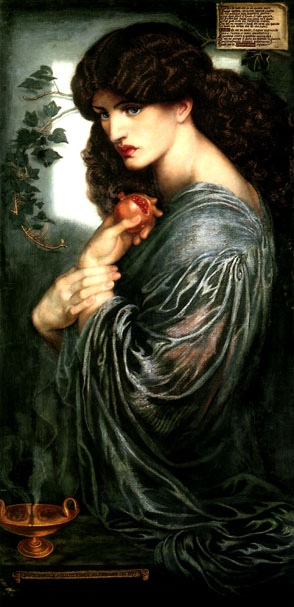 Photo from bigcitylit.com
Strange to think of Hollywood sex symbol Russell as a pre-Raphaelite goddess...but don't you think that Rossetti would have loved to use her as a model?
Monday, October 1, 2007
Pet Peeves
A few things that irk me:
- Movies that show somebody reading a book, but don't allow you to see the book's title. But the kind of books people read tell you so much about their personalities--they're a valuable tool for characterization! Besides, I'm always looking for recommendations, especially when I think the character might have similar tastes as me.
- Movies that feature a newborn baby, but don't reveal what the parents named the baby (recent offender: Knocked Up). I'm a bit obsessed with naming things--maybe it's part of being a writer--and always want to know what names other people choose. If you're like this too, you'll enjoy the Baby Name Wizard Blog, which discusses name trends throughout the decades.
- People who use the word "unbelievable" to mean "unbelievably or astoundingly good." As in, "Meryl Streep gave an unbelievable performance in Sophie's Choice!" No, she gave a completely believable performance, which is what makes it so praiseworthy. I suppose the word "incredible" is almost as bad, considering its etymology, but at least it seems to have been used in this context for longer than "unbelievable" has. But you know what? There are plenty of synonyms for "unbelievable" and "incredible," so from now on, I promise to try to avoid those words in my writing. Let's try these on for size: amazing, astonishing, sensational... See? Easy.
Subscribe to:
Posts (Atom)