Showing posts with label high school. Show all posts

Saturday, February 22, 2014

Revisiting Christopher Durang

Anyone else do the thing where you buy someone a book for their birthday or Christmas, and then the book you choose looks so interesting that you end up reading it yourself before giving it to them? My youngest cousin turned 15 this month, and he's a theater kid, so I decided I ought to give him some Christopher Durang. (I absolutely love having a teenage theater fan in the family and I am relishing my self-appointed role as "cool twenty-something cousin.") But then I couldn't resist reading the book myself before I sent it off to my cousin -- being careful not to get it dirty or break the spine, of course.

Laughing Wild and Baby with the Bathwater: Two PlaysLaughing Wild and Baby with the Bathwater: Two Plays by Christopher Durang
My rating: 3 of 5 stars

I first encountered these plays when I was in high school and Christopher Durang was a favorite among the theater kids. I laughed at the irreverent, naughty absurdities of "Baby with the Bathwater," and a friend of mine did the "Laughing Wild" tuna fish monologue in acting class. Returning to these plays ten years later, I am no longer so enchanted by their kooky irrationality, but I am more attuned to their undercurrents of sorrow and outrage. I can also see their flaws a little more clearly: as Durang notes in his afterword, both of these plays were originally written as one-acts and then expanded into full-lengths, and especially in the case of "Baby with the Bathwater," the seams show.

View all my reviews

Saturday, February 16, 2013

The Kids Are All Right @ SF Theater Pub Blog

Funny sometimes how life works. It'd been years since I saw any high school theater productions, and then last weekend, I saw two of them in two days. Schoolteacher friends of mine invited me to both In and Out of Shadows, performed by the Marsh Youth Theater, and The Boy Friend, produced by the Bay School.

I wrote about the experience in my latest column for San Francisco Theater Pub's blog, and got a little sentimental about youth theater in the process.

BONUS: here's a photo of the cast and crew of my high school production of Little Shop of Horrors. It must've been taken almost exactly 10 years ago: we performed the show in late February of 2003. I am second from the right, in the pink dress and platinum blonde wig. I don't think it suits me.

Monday, December 26, 2011

Vaclav Havel's Ethical Politics

In the wee hours of December 18, 2003, I was finishing up a research paper on Vaclav Havel for my high-school English class. Eight years later, in the wee hours of December 18, 2011, I came home from an evening of theater- and party-going to read the breaking news headline that Mr. Havel had passed away. For obvious reasons, Havel was one of my heroes, and I am working on a new blog post in response to his death. In the meantime, though, I'm posting my old research paper. I went back and reread it this week and, considering that I wrote it as a teenager, I still think it's a pretty good piece of work. The last paragraph, especially, stands as a fitting memorial to Havel's legacy. But because it's long and because it's from my high school days, I've put most of it after the jump.

Differing Reactions To Václav Havel’s Ethical Politics 
by Marissa Skudlarek, 2003
In addition to his role as the first post-Communist president of both Czechoslovakia (from 1989-1992) and the Czech Republic (1993-2003), Václav Havel has been an award-winning absurdist playwright, a dissident activist, a political prisoner, and an instrumental figure in Czechoslovakia’s “Velvet Revolution.”  Indeed, his help in winning Czechoslovakia’s independence from the Soviet satellite system launched him to the presidency.  A further factor was that he had become much admired—by both his compatriots and the Western intellectual community—for the many essays he had written summarizing his thoughts on the ideal role of politics. Seeing the post-totalitarian Communist government as full of lies and lacking legitimacy, he encouraged the Czechoslovak people to “live in the truth,” performing morally obligated acts of civil disobedience.  This ethical perspective on politics led the Czechoslovaks to believe that Havel would be their ideal first president.  Yet while leading Western figures continued to admire Havel’s morally-based policies, these same principles caused him to lose popularity in his native land.

Tuesday, April 1, 2008

The shoures soote

"Wheat Field in Rain" by Vincent Van Gogh. Image from vggallery.com

I seem to be developing a habit of shouting defiantly into the face of rainstorms. It combines several of my passions: for quotations, for heightened emotions, and for wet weather (blame my Oregon heart). Here are two examples I recall:

Between my junior and senior years of high school, I participated in the Oregon Shakespeare Festival's Summer Seminar, a 2-week program that taught 70 or so kids about the inner workings of a big repertory theater. We lived in dormitories and had to walk about a mile to get to town. On our second or third evening there, we were walking to see Richard II in the outdoor (Elizabethan) theater, when the skies opened and it started pouring down rain. So, naturally, as the high-school theater geeks we were, we started quoting.

The Seminar had made us memorize a choral speech from a Greek tragedy, and it felt appropriate to shout that out as the winds and rain raged: "Come, Furies, dance! Link arms for the dancing hand-to-hand." Then we switched to King Lear: "Blow, winds, and crack your cheeks! Rage, blow!"

But it only rained harder, and perhaps spurred on by our Greek, Zeus even started hurling his thunderbolts. We decided we needed to appease the gods. That's when I got my brilliant idea. My voice loaded with irony, I yelled at the top of my lungs, "Shall I compare thee to a SUMMER'S day? Thou art more LOVELY and more TEMPERATE!"

The rain stopped eventually, though I don't know if my plea for temperance did much good: the show didn't get canceled and we spent a damp and chilly evening watching it.

Now, today, April 1, in Poughkeepsie, was a warm, muggy day--very unpleasant. But thunderstorms were predicted for tonight, and I was grateful--they're the only compensation for East Coast humidity, in my opinion. I love how the temperature will suddenly plummet and the skies release torrents of rain. You understand where that phrase, "the weather broke," came from. And tonight, during rehearsal, we had a real humdinger of a storm. The drumming rain and whistling wind echoed through the theater. When we took five, some of the guys took their shirts off and frolicked in the rain. One of them began singing an art song by Tosti, called "Aprile."


"Aprile," I thought, "that's like Aprill..." and the words I had to memorize in a high-school Chaucer class flooded back. I stood under the awning of the theater and shouted as loud as I could:
Whan that Aprill with his shoures soote
The droghte of March hath perced to the roote
And bathed every veyne in swich licour
Of which vertu engendred is the flour!
The shouting made me feel strong and defiant, as if the rain were running fast through my veins too; or perhaps it was Chaucer's language, still powerful after 400 years. Ah yes, rain on, you shoures soote, you.

Sunday, February 3, 2008

Remembering Wendy Wasserstein

If you had told me in, say, 2004, that Arthur Miller, August Wilson, and Wendy Wasserstein would all die within a twelve-month period, I would have said you were crazy. Sure, Miller was almost 90 years old, but Wilson was in his late 50s and Wasserstein was five years younger than that. However, that sad prediction turned out to be the truth. Wilson never got the chance to show us what he would do after he completed his impressive Century Cycle. Wasserstein's death deprived baby-boomer women of the playwright most devoted to chronicling their stories.

Wasserstein belongs to my mother's generation, but because there still aren't a lot of successful American female playwrights, I looked up to her too. It seems that no one ever had a bad thing to say about her, and I imagined that if I became a playwright, I might get to meet her, thank her, chat with her... So her death really saddened me. I wrote a paper that spring on The Heidi Chronicles, as a homage.

I meant to post this entry on January 30, the second anniversary of Wasserstein's death, but was too busy polishing up a play of my own. Though that's appropriate, too. It's even an instance of my life coming full circle. I just discovered an e-mail I wrote to my adviser two years ago, expressing my sadness about Wasserstein and my excitement to start researching a new play. My adviser wrote back:
I was also shocked to learn of Wendy Wasserstein's death, although I did know that she was seriously ill. Wendy delivered an address in the chapel at Vassar at one point, and it was a huge success. She was very honest and very funny. Sometimes I think the two things go together. And she was also, I think, a significant playwright. She knew what life is about and how to dramatize it. You should write your paper on The Heidi Chronicles. More importantly, however, you should keep writing plays yourself. Show Wendy's spirit the stuff Marissa is made of. Get inside Hallie Flanagan. She will bounce you around a bit, both intellectually and emotionally.
Of course, this "new play" turned into my senior thesis play--the one about Hallie Flanagan and the 1930s. But I doubt any of us knew that it would take me exactly two years to find the structure for this play--two years since I started researching it, two years since Wendy's death.

I'll admit sometimes I'm a little annoyed at Wasserstein's plays for their lack of "theatricality"--they do not use the stage in innovative ways, and her most famous play, The Heidi Chronicles, is episodic. I wouldn't really call the events of her plays "gripping," and even her celebrated wit makes you chuckle, not guffaw; nor does she pierce you with black humor. There's a very interesting article in The Boston Globe that relates to this--whether it's OK to criticize Wasserstein's work for its style and narrowness of scope, in light of all the good she did for female playwrights. I agree with a lot of what this article says.

Despite the baby-boomer focus of her plays, I do relate to Wasserstein's characters. This year, I've thought a lot about Uncommon Women and Others, because it concerns a group of girls in their senior year of college. One of my housemates is a driven pre-law student, just like the character of Kate; another is a funny, self-deprecating Jewish girl, like Holly.

My high school almost produced Uncommon Women my senior year, at my suggestion. Originally, our theater teacher planned to produce the all-female play Vital Signs, which is a collection of about 30 short monologues. I read it and found it boring, so my teacher challenged me to come up with something better. The next morning, I invaded his homeroom and thrust Uncommon Women under his nose. He agreed to produce it, and for the next few weeks we thought about the play, watched the TV version repeatedly, discussed the pop-culture references, etc.

At the time, I wanted to play Kate, Rita, or Leilah--and I can still see aspects of those three characters within me. Kate is my driven, determined side--the part of me that knows I am going to be a playwright and will let nothing stand in my way. Rita is the part of me that likes to make people laugh--the part of me that enjoys crazy costume parties and oddball theories and acting like a loopy drama major. And Leilah is my insecurities and neurosis and feeling like an eternal runner-up.

We ended up not producing Uncommon Women, because most of the females who auditioned were high-school freshmen, and it wouldn't be right to see them discuss sex and orgasms and menstruation. It still remains one of my favorite Wasserstein plays, perhaps because her characters are youngest and I can relate to them best, perhaps because it's less tied to seminal baby-boomer events than The Heidi Chronicles is, perhaps because it's one of the few plays I know that celebrates female friendship above all other relationships.

Indeed, Wasserstein said, she wrote Uncommon Women because she wanted to see an all-female curtain call on the stage of the stodgy old Yale School of Drama. That's what I love about her. That's what still inspires me.

Friday, December 28, 2007

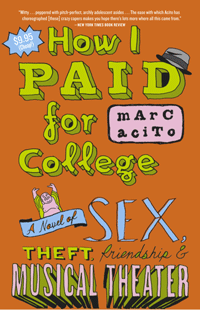
Sex, Theft, Friendship and Musical Theater

That's the accurate subtitle of Marc Acito's comic novel How I Paid for College, which I zipped through over the past few days.

Acito lives in Portland and I have met him a few times, when he's emceed Portland Center Stage's "Commission Commission!" benefit. He's just as hilarious on the fly as he is in the pages of this novel. How I Paid for College also won the Oregon Book Award as "Best Novel" in 2005, which is pretty cool, especially when you consider that usually they give this prize to the kind of "typical literary fiction that is made to win prizes": thick and serious and weighty, with bonus points if it takes place in some dull little town in rural Oregon. For them to give it to a fast and funny novel about a teenager in the New Jersey suburbs is a welcome change.

How I Paid for College takes place in 1983 and is narrated by Edward Zanni, a 17-year-old aspiring singer/dancer/actor. (Vocab lesson of the day: zanni is the Italian word for "the crazy servant characters in a commedia dell'arte play" and it is where our English word zany comes from.) Edward is convinced that he'll never be happy unless he goes to Juilliard, but his father refuses to pay for Edward to do anything except major in business. So Edward and his friends team up to embezzle, blackmail, defraud, and generally steal the tuition money any way they can. As a narrator, Edward provides laughs when you realize how his inflated perception of himself differs from the way he appears to others, but he also makes some very witty observations. I fell in love with the book on page 10, when Edward writes "I duck in through a side door that only the Play People know about. (Play People. Like we're not real. We're the realest people in this preppy prison.)" Every high-school theater nerd has felt the same way.

The style of the novel is like an '80s teen movie with a twist. For instance, as befits a teen hero, Edward has a girlfriend, Kelly, who is both sweet and gorgeous. But Kelly likes sex more than the average girl-next-door heroine does, and furthermore, Edward isn't sure he wants a hot girlfriend after all--maybe he wants a hot boyfriend instead. Someone like Doug, the sensitive and totally-heterosexual jock who has started to do theatre. Meanwhile, the nerd (Nathan Nudelman--great name) takes almost sadistic glee in coming up with crazy illegal schemes, and the hot foreign student (Ziba) is Persian, an ethnicity underrepresented in teen movies.

One of my favorite characters is Paula, Edward's best friend, who is starting her first year at Juilliard. Big-bosomed, big-hearted, and wildly self-dramatizing, Paula is the kind of girl who can be found in every drama club and she perks up the book whenever she appears.

These kids feel the typical teen angst over their love lives and their futures, but one great and refreshing thing is how they never feel ashamed or guilty about having sex, or about breaking the law. And they do a lot of both. So much so that although the movie rights have been sold, I don't know how this can be made into a film that won't offend half of America, unless they seriously change the narrative. Though Edward's sexual confusion is handled in what seems to me a sensitive and realistic (if humorous) manner, you can't deny that he is hungry for experience with both girls and guys, and likes it that way. And then, there's all the illegal activity: funny and entertaining as this novel is, it makes you root for a teenager to pull off increasingly complex federal crimes!

Acito overuses a few of his running gags, but also includes some very funny ones (Edward gets mistaken for a waiter whenever he goes to a restaurant, but he's still convinced that he's destined to be a Broadway star). There are also lots of jokes and references that are bound to appeal to the theatre crowd. The storyline, which at first seems as easygoing and ambling as Edward himself, soon becomes much tighter: characters and locations that were introduced early on will pop up again with surprising results. Even the sex scenes are usually necessary to the narrative, redefining character relationships and not just livening up a dull chapter with some titillation. Because there's hardly a dull moment in How I Paid for College--and I'll be excited to read the sequel, Attack of the Theater People, when it comes out in 2008!

Visit Marc Acito's official website for more information.

Image from northwestauthorseries.wordpress.com

Thursday, December 13, 2007

Whoa-oh-oh-oh, Da Doo Ron Ron

On Saturday I'll be in NYC again to see Doris to Darlene at Playwrights Horizons (and maybe do some Christmas shopping). I'm excited: not only is playwright Jordan Harrison a great guy and a talented writer, but the subject of this play sounds right up my alley. It interweaves 3 stories: Richard Wagner writing Tristan and Isolde, a 1960s girl-group singer's career, and a contemporary gay man's coming of age. Y'all know that I'm in an opera phase right now (though I'm no Wagnerian) but it might surprise you that I absolutely love girl-group pop!

Probably this has something to do with playing a doo-wop girl in Little Shop of Horrors in high school and getting to sing Ashman & Menken's pastiche songs. Really, it's a great score; the choice to use girl-group music is just so perfect for the show's humor and its 1950s/1960s setting. And it parodies its sources just enough, never too much. In the opening number, we sang "Shing-a-ling, what a creepy thing to be happening. Look out! Look out! Look out! Look out!" Only a few years later did I realize that that parodied the Shangri-Las' shouts in "Leader of the Pack."

This kind of music has also been heard on Broadway in Hairspray and Dreamgirls. Hairspray's "Mama I'm a Big Girl Now," with its three girls singing harmony and I-vi-iv-V chord structure, perfectly evokes the girl-group sound. It's one of my favorite songs in the score. However, I did not think that any of The Dreams' hit songs in Dreamgirls were as catchy or brilliant as the real deal from the Supremes. (More Dreamgirls carping here.)

Girl-group songs are a lot of fun, obviously, but their sweetness and innocence and adolescent heartbreak can also be quite affecting. When I went through my first quasi-relationship/quasi-breakup (eh, it was complicated) one thing that helped was listening to "Where Did Our Love Go?" and "You Can't Hurry Love" on repeat. Sounds clichéd, I know...but better than listening to emo.

It's funny that these songs should be this powerful, because they're the very definition of commercial music--written not from the depths of an artist's soul, but by teams of songwriters hoping to score a big hit. Much of the time, white adults wrote songs for young urban black girls to sing, which is a little creepy/exploitative (especially when said white man was Phil Spector!). At Motown the songwriters as well as the singers were black, but if anything, the "hitmaking machine" mentality was even more in effect.

Some people may scorn girl-group music because it's so commercial, but there's a lot of distinguished girl-group aficionados, too. They include:

Amy Winehouse: Her Grammy-nominated album (congrats Amy!) is heavily based around the classic girl-group sound: "Back to Black" might be the greatest Phil Spector song that Phil Spector never produced. But her voice gives it a modern twist: paradoxically, she's both more tough and more vulnerable than the typical poppy girl-group singer (the Shangri-Las excepted).


The Pipettes: A trio from the UK who is also contributing to the girl-group revival. Pretty, peppy, and polka-dotted, "Pull Shapes" ought to cheer you up if you just watched that funerary "Back to Black" video...


Martin Scorsese: Ever since seeing Goodfellas last summer I can't listen to "And Then He Kissed Me" without thinking of how it underscores the astounding tracking shot where Henry and Karen make their way into the Copacabana Club through the kitchen. Just ecstatically good filmmaking and music.


Tom Stoppard: His quasi-autobiographical character Henry, in The Real Thing, knows he "should" love difficult classical music, but really only likes the '60s pop hits from his youth. In one scene, he is trying to choose eight songs that are personally significant to him for the BBC radio show Desert Island Discs--but, ashamed of his musical tastes, is hunting for some more obscure tracks than the ones he usually listens to:
HENRY: I'm supposed to be one of your intellectual playwrights. I'm going to look like a total prick, aren't I, announcing that while I was telling Jean-Paul Sartre and the post-war French existentialists where they had got it wrong, I was spending the whole time listening to the Crystals singing "Da Doo Ron Ron."
That's one way of looking at it, Henry...or you could've been like Jordan Harrison, and put both your intellect and your love of girl-group music into one of your plays!

Tuesday, November 27, 2007

A Yearbook Photo is Forever

In the next week or so I have to select a photograph of myself for my college yearbook. I'm always interested in how people choose to immortalize themselves in photos--how they choose to be remembered--so I'm probably agonizing far too much about the matter.

You know, I want a photo that's something more than me mindlessly grinning at a camera--a portrait that captures my true facial expressions and personality. I want to stand out, but without looking too wacky--since I'm not "that wacky girl" in real life. I want my photo to be better than a cheap candid, but not so perfect that people will assume I'm a raging egomaniac. The background will have to be nice, but not obtrusive; the lighting and angles will have to be right; and it'll need to look good in black and white.

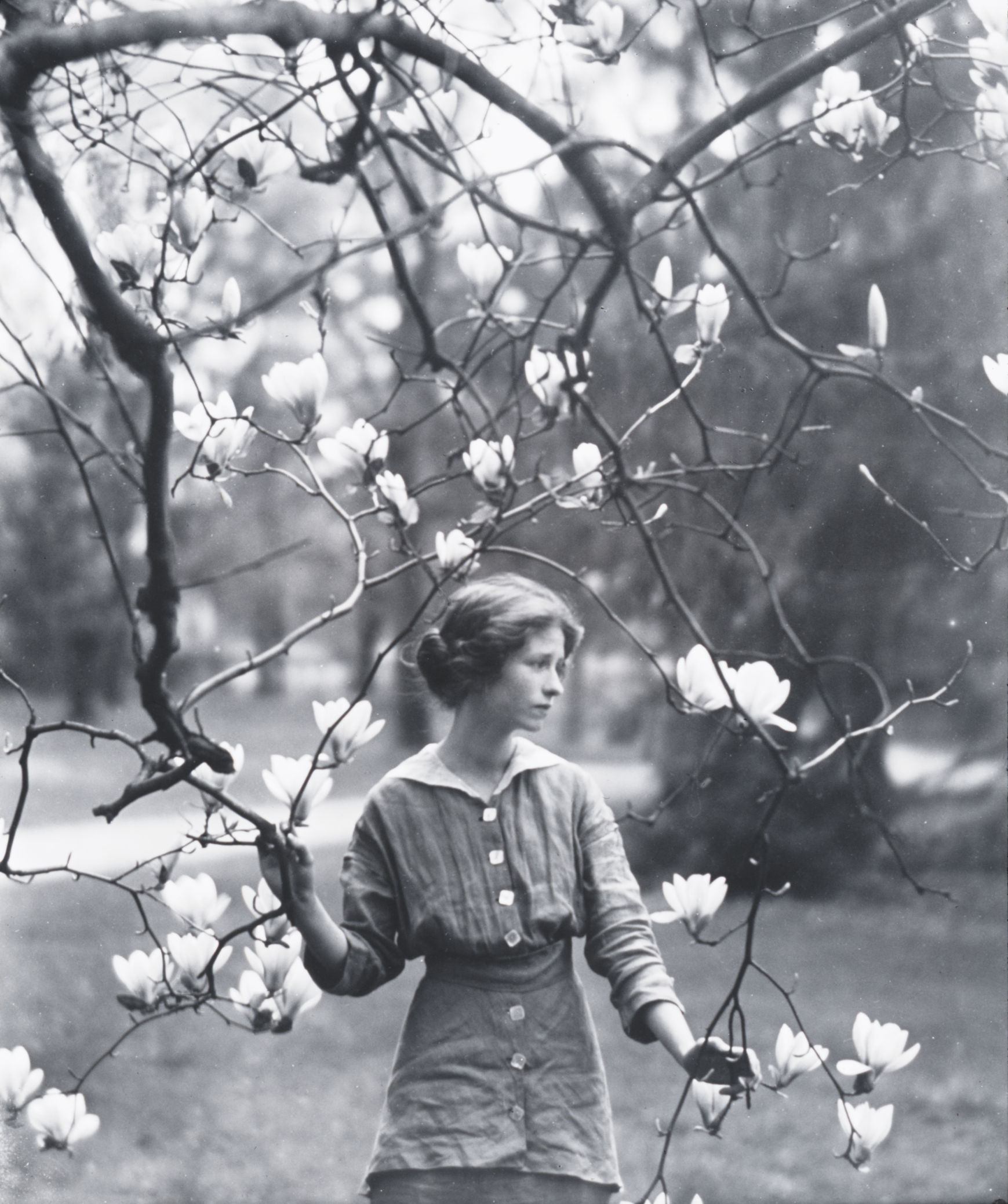
My favorite photo of any Vassar student, ever, is the famous one of Edna St. Vincent Millay, taken by Arnold Genthe. She poses with a magnolia tree, delicate and pensive and wood-nymphy. It is almost like a Japanese print:


Four years ago I had to go through this same shenanigans of choosing a photo for my high-school yearbook. My dad took a lot of pictures of me in a local garden, and while I doubt I was consciously thinking of this Millay photo, that's definitely the image I was going for. (In high school I romanticized melancholy. I thought all my smiles looked fake.) I ended up choosing one where I posed next to a white birch tree, looking fragile and wistful.

Four years later, I want something with a little more oomph--my mood now is more confident, striding toward my future with determination. So my photo needs to capture that feeling--and needs to work as an aesthetic object, but, as I said, it can't work too well, or people will start to call me pretentious. This is a situation where my perfectionistic tendencies plus my sense of aesthetics plus my respect for posterity--for printed images that will endure--combine to make something difficult when it should be easy.

Photo from Wikipedia.

Thursday, October 11, 2007

Macbeth: Good, Bad, and Ugly

I have been fortunate to see excellent productions of many Shakespeare plays, but up until a week ago, I hadn't seen a Macbeth that I thought was any good at all.

My first experience with Macbeth came at the Oregon Shakespeare Festival in spring 2002: the show opened the New Theater. And it was a big disappointment--most of all in the actor playing Macbeth. At Ashland, he excels in funny roles like Falstaff or Trinculo--but carried his mugging mannerisms into the role of Macbeth. Whenever a prophecy came true or he otherwise had to show fear, he'd bug his eyes out of his head like a cartoon character. The nadir came at "Tomorrow and tomorrow and tomorrow," some of the most mannered acting I've ever witnessed. The actor shouted the first TOMORROW!, then delivered the second two "tomorrow"s in an ominous, low monotone. It made no emotional sense and disrupted Shakespeare's rhythm.

Macbeth is Shakespeare's shortest tragedy, but Ashland made it even shorter and more headlong, even cutting the Witches' "Double, double, toil and trouble." Also, there were just six actors: Macbeth, Lady M, Banquo, and three actresses who played all the other roles. There was too much switching back-and-forth of roles for most audience members to understand, especially because Macbeth is full of minor thanes, etc., who come on for a scene and then leave. The only doubling that was really interesting involved having the same woman play both Macduff and Lady Macduff.

The entire production was kind of dark and gloomy, on a bare stage with a pool of stage blood in the center (so the fights consisted of people flinging blood at one another). But the pacing was too fast, and I never succumbed to the magic of the theater. Really, I got nothing out of this version.

Even worse, however, was the production of Macbeth at my high school the next autumn. I got to witness the debacle firsthand because I appeared in it as an extra. The director didn't do any gender-blind casting, which annoyed me, because I, a junior, had no lines, while a bunch of freshman guys with no acting experience got roles like Ross, Banquo, and Lennox.

Mostly, this production suffered from the "Wouldn't it be cool if..." school of directing. Wouldn't it be cool if the witches ran around with a video camera and there were TV monitors in the set to project what they were filming? Wouldn't it be cool if the guys wore modern clothes but carried giant broadswords? Wouldn't it be cool if Lady Macbeth was over-the-top sexy? But none of these ideas has anything to do with the other, or worse, with Shakespeare's text.

To make matters worse, the guy we cast as Macbeth was very good in contemporary plays, but had no sense of Shakespeare's language and was notoriously bad at memorizing lines. The only emotion he displayed in "Tomorrow and tomorrow and tomorrow" was wishing the damn speech would be over.

The only way to make up for this mess was to stage an awesome sword fight at the end (swords purchased for $40 at BargainBlades.com--I kid you not), and it was pretty great, except for the fact that each night Macbeth and Macduff got more aggressive, and sloppier. On the last night the handle of Macbeth's sword got knocked askew from the blade--if we'd run another weekend, there would've been some major injuries. (This, by the way, is the reason behind the "Curse of the Scottish Play": people think they can perform Macbeth without much rehearsal, but there are too many scenes with the potential to cause accidents!)

Twice burned, four times shy... so I was a little uncertain what I'd think of Vassar's Macbeth, which ran last weekend. Still, I had reason to be hopeful: Vassar is usually good at straight-up, respect-the-text Shakespeare, and eight senior girls (that is, a ton of my friends) had all the major roles. Yes, it was an all-female Macbeth!

I doubt that Macbeth will ever be one of my favorite Shakespeare plays--it doesn't seem to have the depth of Hamlet or Lear--but of course there's great stuff in it. Besides the passages that everyone mentions, I believe that Act 4, Scene 3, where Macduff learns of the murder of his family, must be some of the most emotionally moving writing that Shakespeare ever did.

My friend who played Macduff was perfectly cast--her greatest skill as an actress is to combine vulnerability and deep inner strength. I cast her in a staged reading of one of my plays because of this, and it's also what Macduff needs.

This scene ("Dispute it like a man." "I shall do so/But I must also feel it as a man") also gets at a theme of Macbeth that this production highlighted: what it means to be a man.  With women in all the roles, you paid more attention when the characters talked about being men, or when Lady Macbeth cried "Unsex me here" and suggested that Macbeth was a sissy if he wouldn't kill Duncan. Not that this part of the play was over-emphasized--but it gave you something to think about after it was done.

The theatre was set up in the round, with very few props; still, there were some amazing stage pictures. The gigantic doors at one end of the theatre (wide enough to drive a car through) were used to great effect in the Porter scene, and also for the parade of Banquo's kingly descendants. (This scene did not appear in the other two Macbeth productions I've seen, but was chilling here.) The witches' cauldron was a trap door that glowed with unearthly light. There is also a spiral staircase in one corner of the theatre leading to an elaborate system of catwalks above, which meant that Macbeth could do "If 'twere done when 'tis done" hanging spotlit from a ladder, Macduff could come clattering down the staircase after discovering Duncan's murder, and Lady Macbeth could appear as a haunting white-clad figure on the catwalks for her sleepwalking scene. (However, I wished I didn't have to crane my neck so much, and could see her facial expressions better!)

The battle scenes, with short swords and heavy shields, were awesome--every actress participated, and at the cast party they wore their bruises, and newfound muscles, with pride.

My friend who played Macbeth has been impressing everyone since freshman year. Two years ago, she was a magnificent Juliet: she has an instinct for Shakespeare, a melting and lyrical voice, and carries herself beautifully. So in one sense, she's a counterintuitive choice for the role of Macbeth, but on the other hand, she's the only girl in our year who could've done it. And she's the first Macbeth I've seen treat the play as a tragedy. Her "Tomorrow and tomorrow and tomorrow" (obviously, my litmus test for Macbeths) was full of aching sorrow and regret...though maybe a little too delicate to be "ideal" for this warrior-king.

I still have a few issues with Macbeth, though more with the script than this generally thoughtful and well-acted production. There are just so many thanes running around, delivering exposition or filling out the crowd, but not developing character. Say "Rosencrantz," "Osric," "Fortinbras," and you get a clear mental image of the character's personality. Say "Ross," "Lennox," even "Malcolm," and you can identify the scenes in which they appear, but not what kind of person they are.

Still, congrats to all the Macbeth ladies--you've left me, finally, with a pleasant memory of this play!

Thursday, July 26, 2007

Summer Reading: Special Topics in Calamity Physics


Blue Van Meer's "self-portrait"--she's the "apologetically owl-like" girl with glasses. Image: USA Today

If not for the fact that the only books I read in hardcover are Harry Potter, I would have devoured Special Topics in Calamity Physics as soon as it came out last summer. My mom, after reading the back cover and the blurbs, said "This is the book you should have written," and I see what she meant (though I have no interest in writing novels). Calamity Physics got promoted as a brainy, erudite, mystery/coming-of-age novel narrated by a verbally dexterous teenage girl, and there are few things I like better than that. As I read the novel this month, I got a kick out of coincidental parallels between its heroine, Blue Van Meer, and myself. Blue's birthday, 6/18/87, is less than a month away from mine. And she, precocious thing, is 16 years old throughout her senior year of high school, just as I was. It's weird--it even makes me feel a little old--to read a book where the main character is from my generation, born the same year as me, her life overlapping mine in a way. (Then again, it also makes me feel old to realize I'm six years older than Juliet, two years older than Jane Eyre, and the same age as Elizabeth Bennet.) Also, author Marisha Pessl's first name is just one letter away from mine--and "Marissa" (or "Marisha"?) comes from Latin for "of the sea," and "Van Meer" means "of the sea" in German. Coincidence? I think not.

Most importantly, Blue is a girl after my own heart. As the sexy Latino gardener Andreo Verduga might say behind Blue's back, she is one hell of a marisabidilla. A sixteen-year-old who's read the whole Western Canon, plus innumerable detective novels, self-help books, and Hollywood memoirs, she has a citation for every situation and a simile for every smile. She's an outsider, more an observer than a participant (like all great detective characters), her little-brown-mouse social awkwardness mixed with a feeling of superiority toward most of the people she encounters. I'll admit that her voice can get tiresome--too keen to show off her smarts, and too scornful of the everyday middle-Americans she meets traveling around the country with her brilliant Dad. Sentences like "The restaurant with its shines and clinks, its fanned napkins and resplendent forks (in which you could identify microscopic things lodged in your teeth), its dowager duchess hanging there, desperate to be let down to go dance a quadrille with an eligible man of society-it all felt indifferent and damned, hopeless as a Hemingway short story teeming with mean conversations, hopes lost between their bullet point words, voices voluptuous as rulers" (183) are a little dense, don't you agree?

Indeed, Special Topics in Calamity Physics takes a bit long to get going, as Blue tells how she got inducted into the exclusive clique the Bluebloods--five high school seniors and their charismatic Film teacher, Hannah Schneider. This is standard prep-school stuff, even if vividly described, and the Bluebloods' characterizations are not deepened enough. Fortunately, Weird Stuff starts happening a bit later. Page 1 offers the instant hook that Blue discovered Hannah dead, hanged by an electrical cord deep in the woods. There's also a mysterious drowning, Hannah's bizarre one-night stands, etc. A Gothic tone takes hold, and after Hannah's death, the book becomes a real page-turner. I actually dreamed about it last night because it excited me so much--that never happens to me! Its most delightful surprise is that beneath the incredibly clever, verbose language lies an incredibly clever, well-formed plot.

Marisha Pessl has stated in interviews that her favorite author is Nabokov, and reviews have compared Calamity Physics to Lolita or Ada, but I think that's a little hyped up. Lolita (the only Nabokov novel I've read) is full of wordplay and allusion, but less showoffy, less interrupted by its own cleverness. I also wouldn't count Calamity Physics as a book that truly, deeply reveals the joy of reading and learning--Pessl's allusions act as a kind of shorthand, rather than offering new insights into her sources. It's not like Arcadia or Possession, where two characters can have a brilliant literary/intellectual discussion that also is loaded with subtextual emotions. No, for me Calamity Physics is more like The Shadow of the Wind--another classy, page-turning mystery novel that gets promoted as more intellectual than it is.

Am I quibbling too much? Really, I genuinely loved most of Calamity Physics, enjoying the similes and literary references that weren't too far-fetched, as well as Blue's attempts to fit in and her amateur sleuthing. And the twist is so good that it virtually requires a re-reading! If you're wondering whether to read this book, check out pages 56 and 57, which is what completely won me over: a scene where Hannah introduces herself to Blue and her dad by announcing, "Humphrey Bogart wore platform shoes throughout the filming of Casablanca." If this appeals at all to your sense of humor and style, buy it!

I'll admit, I love detective and mystery novels--thanks to a course at my own eccentric private high school. (Our schools are another similarity between me and Blue. At mine, after sophomore year, English classes were not general survey courses, but focused "electives," like in college. One topic was even Film--the same class that Hannah Schneider teaches. I've never heard of Film being taught at any other high school.) Before I took "The Detective in Literature," I had a snobbery toward detective novels, "genre" fiction. But this class turned me on to the prose stylings of Dashiell Hammett and Raymond Chandler. Inspired me to read Borges. Made me laugh, then made me think, about the thesis that Oedipus Rex is just a detective story. Most importantly, I was taught that I could be a snob about detective fiction as well--by touting "metaphysical" detective stories over "epistemological" ones. Basically, an epistemological detective story = a whodunit, animated by the question of who committed a crime, and why. Think Conan Doyle, Christie, the noir detectives--you're never in doubt that a crime has taken place and that the detective will solve it by the end. The metaphysical detective story twists this formula, leaves the plot open-ended, pokes fun at the idea that life ties up neatly and all mysteries get solved. Maybe the detective completely misreads the evidence (The Name of the Rose). Maybe a crime wasn't actually committed (In the Lake of the Woods). The theme becomes we can never really know anyone or anything.

And Calamity Physics is a metaphysical detective novel par excellence. For me, it was most reminiscent of Pynchon's The Crying of Lot 49, which I read in my high school class. *SPOILERS* Both novels feature a woman finding more and more evidence for a huge, shadowy conspiracy, but in the end, not knowing whether her conclusions are true, whether someone is playing an elaborate joke on her, or whether she's imagined the whole thing. (And stylistically, both novels employ lots of extended metaphors that can be exhausting to decipher.) Special Topics in Calamity Physics derives its literary excellence not from its incessant allusion-making, but from its plot that simultaneously ties everything up, pulls the rug out from under you, and leaves everything open. That's the thing about a marisabidilla. She can think she knows it all, then learn that she doesn't know a thing. Or, she can really know the truth, but not be able to tell or convince anyone of it. Either way, it's a lonely world.