Showing posts with label natalie dessay. Show all posts

Wednesday, January 19, 2011

Midwinter Music Mania

Coming to an iPod near me in the very near future:
  • Cleopatra: Arias from Giulio Cesare, by Natalie Dessay (to be released February 8). Man, I was looking forward to this as far back as two and a half years ago, when the word first surfaced that Dessay would add the role of Cleopatra to her repertoire. She's my favorite opera singer, and Cleopatra's "V'adoro, pupille" is perhaps my favorite Handel aria. And now she's recorded it!
    Dessay is also currently performing in a production of Giulio Cesare in Paris, at the Palais Garnier. Must resist the urge to look up cheap flights to France...
I'm so excited about both of these albums! I feel as though I'm back in college! -- the era when I discovered both of these artists. Blissful afternoons of sitting on my dorm-room quilt and listening to the Decemberists and Dessay -- I really don't do that often enough, these days.

Sunday, November 1, 2009

Les Voix, Les Voici: Damrau and Flórez in "Fille du Régiment"

In 2008, I watched Laurent Pelly's production of La Fille du Régiment, starring Natalie Dessay and Juan Diego Flórez, as a Metropolitan Opera TV broadcast... so why did I go see it when it came to the San Francisco Opera last week? First, because Flórez came with the production to San Francisco, and I couldn't pass up the chance to hear him live. And second, because I was curious how soprano Diana Damrau would fare in a staging that had been built around Natalie Dessay's talents and persona. So much of Pelly's production relied on the fact that Dessay is kooky and athletic and a petite gamine Frenchwoman. What would it be like with Damrau--who sings many of the same roles as Dessay and is known as a good actress, but looks stereotypically German and might bring a different energy to the role?

As it turns out, Dessay and Damrau seem to approach the role of Marie, "the daughter of the regiment," from opposite directions. Dessay starts out as a bundle of manic energy, singing forcefully and doing physical comedy tricks; and just when you think that's all there is to her, she dials it back and breaks your heart. Damrau executes the same gestures and choreography as Dessay, but in a much more controlled ("regimented"?) way. Her Marie is tomboyish, but never kooky. Her singing is more controlled too--so maybe it is closer to ideal bel canto style, and it's proof of her skill that she can sing softly during elaborate coloratura passages. All the same, there were times when Damrau was almost too quiet--and it's not that she has a tiny voice, because there were moments when she let it out and easily filled the auditorium. And those were the moments that you tended to notice and want more of.

There is a lot of spoken dialogue in Fille du Régiment, where Dessay probably has the advantage, being a native French speaker. Damrau's pronunciation wasn't bad, but she lacked Dessay's comic timing (e.g. the scene where Marie reads a letter aloud, sounding the words out because she hasn't had any formal schooling). I could also tell that Damrau and Flórez faked the kiss after their love duet--but, as I learned from the New Yorker profile of Dessay last spring, she insisted that Flórez had to really kiss her, or it wouldn't look believable.

Overall, I think that this production still works best as The Natalie Dessay Show--but in a more traditional production of Fille du Régiment, one that treated its heroine as a more conventional ingénue, I might prefer to see Damrau. This was Damrau's first attempt at the role of Marie, but I do hope it isn't her last!

Juan Diego Flórez is the real deal, and I will count myself lucky to have heard him perform the role of Tonio in person. No, we couldn't get him to encore "Pour mon âme," but his joyful rendition of it is something to treasure. (He also has perfected his French pronunciation: when I watched the telecast it annoyed me that he sang "J'y sa flamme" instead of "J'ai sa flamme," but he didn't do that last week!) And we gave Flórez another thunderous ovation, welcoming him into our hearts, after his tender Act II aria. He sings with brilliant musicality, looks good onstage, and makes everything seem effortless. I also like that he was unafraid to give Tonio an endearingly dorky quality, especially in his first scenes. I can't imagine opera divos of the past, like Pavarotti or Domingo, allowing themselves to act so goofy.

As for the supporting cast, Meredith Arwady was delightful in the role of the Marquise de Berkenfield--acting like Margaret Dumont and singing with a huge contralto voice. I do not think that Bruno Praticò was an ideal choice to play Sergeant Sulpice, however: Sulpice does not have a lot of difficult singing, but he does have a lot of French dialogue, and Praticò's thick Italian accent rendered him almost incomprehensible when speaking French. It seems like it wouldn't be too hard to find a bass-baritone who sang just as well but could handle the dialogue better.

Photos from San Francisco Opera. Top: Marie saves Tonio from certain death. Bottom: Marie, Tonio, and Sulpice reunited.

Monday, August 3, 2009

Natalie Dessay in "Traviata": A More-Than-Viable Violetta

Two years ago, when I was starting this blog, and dressing up as La Dame aux Camélias for Halloween, and discovering the amazing talent of opera singer Natalie Dessay, could I have possibly imagined that I'd get to see her in her first run of performances as Violetta Valéry--my favorite soprano taking on this iconic character? No, I wouldn't have dared! But yet--un di felice!--I did just that on July 24.

The role of Violetta, Dessay has said in interviews, is at the edge of her range as a singer, normally sung by women whose voices are a little heavier and more dramatic than hers is. It also gives her an opportunity to move beyond playing the virginal ingenues that are the stock-in-trade for her voice type. She is debuting it at the Santa Fe Opera, a smaller, friendlier opera house, in a new production directed by her frequent collaborator Laurent Pelly.

What I liked best about Pelly's production is that it worked around the limitations of the Santa Fe Opera House (outdoor theater, no fly space) and proved you don't need ostentatious Second Empire décor to effectively produce Traviata. That's not to say that every moment was perfect. The emotional impact of the finale to Flora's party was completely undermined when the chorus started swaying side to side in what looked like bad community-theater choreography.

But when Dessay burst onto that stage at the top of Act I, dressed in a magenta tulle concoction and fishnet stockings, leaping between the different levels of the set, screaming in wild exhilaration, and doing her trademark "be hoisted by the male chorus" thing, nothing could dim her luster. She played the opening scene feverish and manic and very, very drunk. Her flaming orange hair wasn't particularly flattering, but it fit her portrayal of Violetta as someone trying too hard to hold onto her giddy party-girl lifestyle.

At the end of Act I comes Violetta's great soliloquy, from "Ah fors'e lui" through to "Sempre libera." I was curious to see Dessay's take on this piece because it has so much subtext, so many pitfalls for the actor. In most opera arias, the character fervently believes whatever he or she is singing about. But in "Sempre libera," Violetta is trying to convince herself that she believes what she's singing, while stifling her deeper instincts, which are telling her the opposite thing. At first the aria may sound bubbly and lighthearted; but I think that underneath it is really quite angry.

And Dessay got that. She rolled the "r" in the word "gioir" and snapped it off with vicious determination, showing us that Violetta is willing herself to "gioir" (have fun, live it up). She hit the final E-flat loudly and in tune, but it wasn't exactly a pretty sound. Yet in the context of the aria and the character, it worked. It was Violetta screaming out one final time in defiance of her fate, not Natalie Dessay trying to hit a high note.

Alfredo gets his big moment at the top of Act II, but I was not too impressed with the singer, Saimir Pirgu. Some of his high notes were flat, and Dessay upstaged him during "De miei bollenti spiriti" by swinging her feet back and forth as he sang. I thought this was a bit rude of her; then again, a tenor ought to have the presence and acting skills to draw the focus to himself during his big aria!

Fortunately, Dessay had an excellent scene partner in Laurent Naouri, who played Giorgio Germont-- and, offstage, is her husband! He had the most powerful voice of any of the singers, and a memorable stage presence: already much taller than the petite Dessay, his ramrod posture and silk top hat made him even more imposing. Knowing that Naouri and Dessay are married in real life, my greatest fear was that they'd have the wrong kind of chemistry--it would not be appropriate for Violetta and Germont to look like they want to jump in bed together! But they remained perfectly convincing and in character: Naouri the bourgeois father-figure blind to his own failings; Dessay vulnerable, childlike, clinging to his lapels. Yet Naouri was not merely stern and stentorian: he sang a beautiful, tender "Di Provenza."

The best singing in the second half of the opera--and a moment I hope never to forget--was Dessay's "Addio del passato." She hunched on the bed, no longer trying to amaze us with acrobatics or big gestures--just intensely felt, intensely focused, piano singing. She held the final note for an astoundingly long time, and the audience held its breath along with her; when it was over I could sense the whole theater exhaling and taking a brief moment to say "Wow" to ourselves before we burst into applause.

Certainly, I could see how Verdi probably intended some of his more dramatic outbursts to be sung with a fuller, juicier voice than Dessay's small-but-precise instrument. Nonetheless, she was always perfectly audible, and scoring a knockout "Sempre libera," duet with Germont, and "Addio del passato" is a triumph for any soprano--so does it matter if she couldn't declaim a few passages with the proper strength?

Most importantly, Dessay's performance made me realize something that had never occurred to me despite my familiarity with this story. La Traviata is not just about how piteously Violetta coughs or how pathetically she dies; it's about how hard she fights, every moment along the way. Fighting with herself about whether to accept love (Act I); fighting to hold onto the love she has won (Act II); fighting to keep her dignity (Act III); and finally, most nakedly, fighting for her life (Act IV). At every turn, she is defeated, but there is something heroic in the struggle. From what I've read of Natalie Dessay, I get the impression that she sees herself as a fighter--crusading for better opera productions, pushing herself to be a better actress, struggling against the limitations of her own voice. Perhaps she drew upon this quality when creating her interpretation of this musically and dramatically challenging role. And--unlike Violetta--she was not defeated.

All photos Ken Howard, Santa Fe Opera.

Wednesday, March 25, 2009

"Sonnambula" in HD: Perchè non posso odiarti

Saturday morning I went to see one of the Met's Live in HD cinema transmissions for the first time. The opera was La Sonnambula--no surprise that it would be the one to get me out of bed early on a weekend, since you know how I adore Natalie Dessay and how much I loved Mary Zimmerman's The Arabian Nights. I had conflicted feelings, then, when I learned that this production got booed at its Met premiere. On one hand, I was excited I'd get to judge a controversial production for myself. Booing is so rare these days, and this Sonnambula didn't even have any outwardly scandalous trappings like nudity, debauchery or bloodshed! On the other hand, if I didn't like the production, I'd have to reevaluate my attitudes toward Dessay and Zimmerman. And while it's not a bad thing to learn that your favorite artists are only human and can make mistakes, it's never a fun lesson to learn, either.

And my verdict? Well, I don't see a point in seething with outrage over this production, but that's not to say that it works. There were some inspired moments, and the performers were committed and engaging; but there were also many dull, muddled, or over-done passages. I appreciate the risk that Zimmerman took, but it needed more rigorous thought behind it. Perhaps Dessay is partly to blame for this--according to The New Yorker, Zimmerman had been planning a much more conventional staging until Dessay challenged her to come up with something more creative. All the same, Zimmerman has been working with this concept for over a year, and it's still muddled, so... Too bad it had to be such a high-profile failure, but at Mary Zimmerman's level it's impossible to fail quietly.

La Sonnambula, composed by Bellini in 1831, tells the simple tale of young Amina, who, unbeknownst to everyone in her village, is a sleepwalker. The night before her wedding to a man named Elvino, she sleepwalks into the room of a visiting Count, and when she is discovered, her reputation is ruined. But by the end of Act II, all is set to rights again. Obviously this plot lacks a certain pizzazz, so Zimmerman's production added a postmodern layer on top of it. Rather than taking place in 19th-century Switzerland, it took place in a contemporary NYC rehearsal space where a company of singers, rehearsing Sonnambula, find their relationships mirroring those of the characters they play.

The concept worked best in the first scene, which is exactly where it's most needed. I think the worst thing about the Sonnambula libretto, even more than the thinness of the plot, is how long said plot takes to get going. (Which I realize is a very "Terrible food! And such small portions!" kind of complaint, but oh well.) For the first half hour, Sonnambula is one big lovefest: the villagers love Amina, Amina and Elvino love each other, the Count loves the beautiful countryside. Only when the Count flirts with Amina and Elvino gets jealous does the situation become infused with human drama.

But Zimmerman's concept, and the audience's curiosity about how she'd make it work, lent surprise and interest to these early scenes. She evokes the rehearsal environment with vivid specificity. I loved seeing this production in HD because of the amazingly detailed set--it looks exactly like a lived-in, slightly shabby rehearsal space, with chipped paint on the walls and used paper cups scattered carelessly on a table--but it is a stage set that must be struck after every performance! The characters also become more interesting. Dessay gets to sing Amina's first aria in the persona of an opera diva trying on costumes and shoes, which caters to her comedy skills and love of complex characters. And it makes Amina charming in a 21st-century way rather than a 19th-century one. Furthermore, in the first scene, the line between rehearsal and real life is always very clear. First, the opera company's Diva and Leading Man rehearse the scene of Amina and Elvino's betrothal; then the rehearsal pauses and the Leading Man proposes to the Diva in real life. It's logical and it works.

But after this scene, things get muddled. Who is the Count's counterpart in the modern-day story, and why does he need to bunk down on an old cot in the rehearsal room? And when Amina sleepwalks onto his cot and we're supposed to think that it is the Diva sleepwalking (i.e. it is not merely a rehearsal), why is she wearing an old-fashioned white nightgown such as no 21st-century woman would choose to wear? Why does the chorus sometimes behave like modern-day individuals, and sometimes like a traditional 19th-century opera chorus? (At the top of Act II, as Elvino sings an anguished aria, the chorus behind him performs lyrical gestures. It's a moving moment, as though the whole world is feeling Elvino's grief, but it doesn't mesh with how the chorus was set up to behave in Act I.) Indeed, for much of Act II, Zimmerman seems to be out of ideas. The contrast between rehearsal and real life disappears, and apart from the modern clothes and scenery, the production becomes very traditional.

The biggest problem, though, is the extreme disarray of the finales of both acts. Even though I just accused Zimmerman of lacking ideas, that means she sometimes lets well enough alone--giving Juan Diego Flórez and Natalie Dessay the spotlight for their big solos, rather than doing anything directorial to interfere with the singers. However, in the finales, there is too much going on, too many ideas, and it's distracting. In the Act I finale, the chorus gets so upset at the Diva and the Leading Man's breakup that they trash the rehearsal room, flinging papers and costumes about. In the middle of it all, Flórez and Dessay stand on a spinning bed, straining to be seen and heard above the din. The Act II finale puts everyone in "traditional" Sonnambula costumes (Swiss dirndls, funny little vests) for a big choral song-and-dance. But it's so busy and hectic that it does not grant the emotional release that the end of the opera demands. You can admire Dessay's technical skill in singing "Ah, non giunge" while hopping around and being hoisted into the air, but you can't feel Amina's joy.

It's the singers who made it possible for me to enjoy the broadcast, and who provide a justification for producing this opera. Juan Diego Flórez is indisputably a great talent, but he has a very particular kind of voice that is not suited to a huge variety of roles. So despite the flaws of La Sonnambula, it makes sense for him to perform it, because Elvino has some terrific stuff to sing, and the role covers an especially wide range of emotions. He performed his two Act II arias splendidly, including a blistering "Perche non posso odiarti," in which his character bitterly rejects Amina. (Listen to it here.)

Now, it's difficult for me to complain about Natalie Dessay, but I don't think the role of Amina is made-to-measure for her. If I had to name the one thing I love best about Natalie, it is her intensity, which comes across when she is interviewed and in her signature roles. But the role of Amina is the opposite of intense--the whole point of the opera is that she's a sweet, dreamy girl who's asleep during two of her big scenes! This is not to fault what Dessay actually did in this more toned-down mode, however. And after her lovely and delicate "Ah non credea mirarti" (she's so petite--where does she get the lung capacity for those long phrases?!) the camera zoomed in on her face and revealed a genuine tear-stain beneath one of her eyes.

More important, she and Flórez are really adorable together. Perhaps they're not quite as cute in Sonnambula as in La Fille du Régiment, and perhaps when they sing in harmony his voice is a size larger than hers. But they have real chemistry in their love duets, and sing with passion and commitment. It was fun to see them laughing and joking together, too, when Deborah Voight interviewed them following Act I.

I enjoyed the acting of Jennifer Black as Lisa, who secretly loves Elvino. Black's redheaded good looks showed up well in HD, and her facial expressions told you everything you needed to know about this frustrated young woman, who, although she is our heroine's rival, isn't a traditional villainness. (This production gave Lisa a nice moment of redemption when she saved the sleepwalking Amina from falling off a ledge.) I just don't think that Lisa's Act II aria suited Black's voice very well; she sounds like she'd do better in stuff that requires less coloratura.

Dessay has suggested that Sonnambula is a silly story, offending some opera-goers in the process. There's a reactionary element at work here, people who claim that modern audiences have become too cynical and nasty to accept Bellini's pastoral romance, and that audiences in the olden days knew "better." Well, perhaps I am a cynic, because whenever I hear people talking like this I suspect them of romanticizing the past--and in this case I have proof! I stumbled upon a New York Times review of Sonnambula from 1916 that states "Of course no listener of today finds either Amina or Elvino a figure of any interest whatever. La Sonnambula is one of the most faded operas of the Italian list, and the doings of all its personages...are of the most conventional operatic sort." So much for the good old days!

Anyway, it's not outrageous to say that Sonnambula lacks a really intriguing libretto; surely Dessay is not the only opera singer who thinks this. Furthermore, many of the singers in this production must realize that Zimmerman's staging is a muddled mixed bag. (Even Dessay, though partly responsible for Zimmerman's concept, sounds guardedly diplomatic when discussing it in The New Yorker: "At the beginning, I felt that the concept didn't carry all the way through--it was just an idea to wrap it in beautiful paper. But after three weeks of rehearsals I think we are going to make it work.") But watching her and Flórez and the others perform, you'd never guess that anyone dislikes this story and/or this production. At the end of Act I, when they're spinning around on that bed, yes, the staging is chaotic and illogical, but Dessay and Flórez sang their hearts out nonetheless, keeping intense eye contact, trusting in each other and in Bellini's music. And I do find that inspiring.

Sunday, July 20, 2008

V'adoro!

Two things about me:

1. Currently the most-played song on my iPod is Natalie Dessay singing "Tornami a vagheggiar," from Handel's Alcina. Her effortlessly tossed-off coloratura pyrotechnics, which perfectly express the aria's theme of being head-over-heels in love, just make me happy whenever I hear them.

2. Other than that, my favorite Handel aria is "V'adoro pupille," written for the role of Cleopatra in Giulio Cesare. I don't have a favorite recorded version of this one--I love it for the delicate, sensual beauty of the music itself. And now I have a personal association with it as well, having incorporated it into my play The Rose of Youth.

I already posted this interview with Ms. Dessay about a week ago--but reading it again, she says that she is planning to star in Giulio Cesare at the end of 2009. In Paris, no less!

My favorite opera singer and my favorite Handel aria. Oh lord, somebody had better stop me before I get so excited that I start singing jubilant coloratura myself.

Friday, July 11, 2008

It's not ALL about the soprano

Part II of my post on Lucia di Lammermoor.

Thoughts on the production:

As you can see from the pictures, this was a fairly traditional Lucia, with 17th-century Scottish costumes that used the convenient device of tartan plaids to distinguish the rival families: Enrico is blue, Edgardo red. Though it's implausible that every guest at Enrico's wedding would be wearing blue-toned clothing, it made for a nice contrast when Edgardo burst in! Despite the fact that he was wearing a really terrible wig that looked like it cost $5 at a Halloween-costume store.

Sets were minimalist, and probably looked worse from my balcony vantage point than from the orchestra section--I could see how the floor panels making up the "moor" interlocked, for instance. As I said in my earlier post, the big pairs of sliding walls seemed inexplicable until I saw them do that wonderful iris effect at the top of the Mad Scene. I was surprised that they used real water onstage in the "fountain" (more like a spring) where "Regnava nel silenzio" takes place. Natalie Dessay, in a girlish moment, splashed it around.

The lead male roles were taken by Italian singers--Giuseppe Filianoti as Edgardo and Gabriele Viviani as Enrico. I'm still trying to learn what opera fans mean when they describe singing as "Italianate", but judging from these two men, it means "declamatory." Filianoti did not always succeed in coloring and shading his voice. At the end of the opera, after he stabbed himself in the gut, he delivered his next line in a strained falsetto voice that almost made me want to laugh; fortunately, he didn't keep it up. Still, compare the way that Natalie Dessay could sing a whole aria while cutting her arms with a sword, and color her voice to suggest the pain of that, yet avoid overdoing it the way that Filianoti did with his falsetto moment.

I did think it was touching, at the end, when Edgardo took off his signet ring and placed it on Lucia's finger before dying beside her. Even if it was a little implausible that the dead Lucia would be such a vision of purity and loveliness, considering the way that she had mutilated herself with that sword.

I liked the bass Oren Gradus as Raimondo, who seemed to be the most sensitive of the male singers.

The Financial Times review described the Enrico/Lucia dynamic as weirdly incestuous, and I think it's because the opera and the performers conveyed something about the way that abusers work. I don't remember any overt sexuality between the brother and sister (except when Lucia goes mad and mistakes Enrico for Edgardo) but the way that Enrico lies to Lucia, bullies and demoralizes her, and then claims that he is the only person who really cares for her, is exactly the way that an abusive husband would treat his wife. It was nice to see this kind of psychological acuteness from a 170-year-old opera.

We also laughed at Enrico's hypocrisy when he leads a weeping Lucia to her wedding ceremony and explains "She is crying for her dead mother." Not a laugh of mirth, of course--more akin to hissing the villain in an old melodrama--which is what Lucia is, I guess.

Thoughts on the opera itself:

Going in, I knew the plot of Lucia di Lammermoor, could hum the Mad Scene and "Verrano a te sull'aure", had heard the Sextet a few times, but couldn't remember ever listening to the opera as a whole. Hearing it, I was surprised at how jaunty many of Donizetti's tunes sound, despite the tragic subject matter. Apart from the mad scene, I think my favorite musical passage was the bit right before Lucia signs the marriage contract--the music wonderfully builds up the tension. The Sextet that follows is justly famous, of course.

I had thought about the kinship of Lucia di Lammermoor to Macbeth (Scottish tragedy, woman kills man under cover of night, gets all bloody, loses her mind), but seeing it, it actually reminds me of Wuthering Heights. The thing that scares me the most about Wuthering Heights, whenever I read it, is how isolated the characters are, on that lonely moor--how insular their world is, and how nothing around them can check their passions. The female characters are trapped and their doomed love affairs feel foreordained. The same goes for Lucia.

My mother noticed another connection, to La traviata: she thought the scene where Raimondo urges Lucia to make a sacrifice, do her duty, "and God will reward you in heaven," is just like the Traviata scene where Germont uses similar logic to convince Violetta to give up Alfredo.

But this also got me thinking about the role of religion in Lucia di Lammermoor...I don't quite know what to make of it. Religion (Raimondo's misguided advice, the "Christian virtue" of self-sacrifice) is partly to blame for the tragedy that occurs. And the opera also raises the perennial question of how a benevolent God could allow such a terrible fate to happen to an innocent young woman. Yet Lucia and Edgardo are both convinced of God's goodness till the end, singing that they will reunite in Heaven. I feel like a 19th-century audience would find bittersweet and romantic the idea that Lucia and Edgardo are united in the afterlife--but a 21st-century agnostic such as myself can read it as just another tragic delusion. After all, when Lucia sings about heaven, she is deep in the throes of her madness.

'Cause I'm a musical-theater geek at heart: The scene where Lucia and Edgardo secretly exchange wedding vows = "One Hand, One Heart" from West Side Story.

I spoof because I love: There needs to be a parody version of Lucia di Lammermoor where Lucia sings her cadenza accompanied by bagpipes!

And to finish up, here is a very recent interview with Natalie Dessay by Norman Lebrecht. It paints her as slightly nuts, but in a good way--thinking seriously about her art form and arriving at unorthodox answers. She says that she does not like playing the same role too often and just turned down an offer to play Lucia in London. Hmm...since I was at the last of the San Francisco shows, I wonder if that will be her last performance ever of Lucia?

All photos by Terrence McCarthy, San Francisco Opera

Wednesday, July 9, 2008

The "Dolce Suono" of Natalie Dessay

I'm back from seeing Natalie Dessay in Lucia di Lammermoor at San Francisco Opera. Lots to say about this, so I'm splitting it into two posts: one about Dessay's performance and the other with my remaining thoughts about the opera.

I viewed Lucia di Lammermoor from the Balcony Circle, in kind of a multitasking fashion. I rented opera glasses to get a better view of the singers' expressions, plus, if I craned my neck, I could see the high-definition "OperaVision" screens that hung from the balcony ceiling to provide close-up views to the people seated far in the back. I tried to avoid looking at the screens much, though--it was too reminiscent of watching the Met opera broadcasts on TV. I wanted the kind of experience you can only get in the opera house.

People have claimed that Dessay's voice is on the decline, especially after her surgeries to remove vocal nodes--and, for instance, she has some problems on her latest album, Italian Opera Arias (an ugly high E at the end of "Merce diletti amici"). Still, I was reserving judgment till I heard her in person. And I have to say, I'm no expert on the intricacies of bel canto style, but I had only one problem with her voice: in the aria "Quando rapito in estasi," which has several quick upward runs, Dessay seemed to consistently miss the first note or two of each phrase. I don't mean they were off-key, just inaudible. But other than that, I am still completely bowled over by the way that Dessay can sing a soft legato line and still be heard. As well as her musical and theatrical intelligence in general.

Dessay first appeared roaming around the heather and rocks, awaiting her secret lover Edgardo. When Alisa (Lucia's friend) tries to dissuade her, Lucia says something to the effect of "No, I must warn Edgardo of the terrible danger!" On the word peligro (danger), Dessay made a big gesture demonstrating that Lucia was actually excited by the risk involved. This same mood carried over to her singing of the ghost-story aria "Regnava nel silenzio," which I doubt has ever been performed so playfully.

Dessay displayed this same spiritedness at the beginning of Act Two: when Enrico asked her to "come closer," she instead turned away and sat pertly on a chair. But then the following scene depicts the systematic wearing-away of poor Lucia's self-confidence; by the end, Dessay huddled in her chair or clung to Raimondo for dear life. And I loved that after reading the forged letter claiming that Edgardo is unfaithful, her voice seemed to come out in little sobs.

For the wedding scene, Dessay changed from her soft floral-printed cotton dress into a stiff satin gown--hemmed in by duty, no longer the girl who freely romped around the moors. By this point, Lucia is so depressed and powerless that she can barely react even when Edgardo crashes her wedding. As the curtain fell, Dessay was crumpled on the ground while Arturo strode arrogantly to claim her. She made a belated attempt to scramble away, but got tangled in her skirts. This image reinforced the specifically sexual horror of Lucia's story--forced to go to bed with a man she does not love.

The scenery in this production was dominated by two big pairs of walls, one that slid open horizontally, the other vertically. Though they didn't do much for me the rest of the opera, they stunningly introduced the Mad Scene. Like an "iris" effect in cinema, all 4 walls slid open at the same speed to reveal Lucia in her bloody wedding dress, standing in a field of red flowers, in front of a full moon. Very cool.

The chorus drew to the shadows at the sides of the stage, giving Dessay free rein to "do her thing." Early on she tore off her wedding dress and performed the rest of the scene in a plain white bodice and petticoat. She pulled out Edgardo's red tartan shawl from behind a rock, wrapped herself in it, and used it as an altar when envisioning her marriage to him (which recalled the blocking from the earlier Lucia/Edgardo scene). The Mad Scene had haunting glass harmonica accompaniment, including an original cadenza, which Dessay performed sitting on the edge of the stage. This is the ultimate example of her ability to make coloratura meaningful. The impression I got was that Lucia wanted to sing joyful roulades as she pictures her life with Edgardo, but the glass harmonica pulled her in a different direction--minor-key, blue-note melancholy. At the end, the tension between Lucia's imagined happiness, and her dawning awareness (represented by the glass harmonica) that something was amiss, became too much for her, and she ended the cadenza laughing nervously.

Lucia's delusion became even more eerie when she mistook Enrico for Edgardo--clinging to him and earnestly insisting that she always loved him. But when she realized her error, she completely lost her mind. She let out a scream so bloodcurdling that it was amazing she could sing in her pretty lyric voice just a few seconds later.

For "Spargi d'amaro pianto" she picked up a sword and began cutting deliberately at her arms, face, and shoulders while singing the coloratura. This was a great choice on many levels. For one, we know Dessay's top register has lost some of its richness and fullness, but would anyone's voice sound rich when they are slicing their arms open? Fuller-voiced Lucias often perform this aria as a mournful lament, but Dessay's more piercing voice communicates searing pain, alienation, and true insanity. She thus used her vocal limitations to dramatic effect. Furthermore, the swordplay fit this Lucia's personality--the young girl from Act 1 who was attracted to danger, who lived on the edge.

Also, Lucia's self-mutilation justifies her sudden death after this scene. It's always rather cheesy when opera heroines die of "a broken heart"; and though Lucia has lost her mind, many people go insane and still live. (Donizetti himself got dementia, caused by syphilis, in 1843 but didn't die till 1848.) But considering the wounds that Dessay's Lucia gave herself, no wonder she died.

I had my opera-glasses tightly focused on Dessay's face as she finished this aria--because she's the opposite of someone who merely opens her mouth and sings. Moments before she was to sing her final "ah-ah" phrase, you could see her get the idea to do it. She widened her already large eyes to a full-on raving stare, slowly spread a creepy smile on her face, raised her sword-arm, and only then sang the "ah-ah-ah!" while cutting into her shoulder or her collarbone. Then she fell down and writhed on the floor, laughing hysterically, toying with the sword, as we gave her a huge ovation.

In short, this was a fierce performance. The first thing my dad said to me as we left the opera was "That woman is amazing! She still had energy at the end!" (Yep, I think he's Natalie's newest fan.) And I overheard this conversation between two other men as we walked to the BART station:
MAN 1: "I'm just saying, you would've thought someone would've tried to take the sword away from her."

MAN 2 (a big broad-shouldered fellow with a shaved head): "I wouldn't have wanted to get NEAR her!"
Though the sets, costumes, and staging of the production I saw are over 10 years old, every soprano still gets a chance to make Lucia her own. By way of comparison, I've embedded a video of June Anderson singing "Spargi d'amaro pianto" in this same production, and you can go to the SFO website for some brief clips of Dessay. I like Anderson's interpretation, but she's much more of a traditionally gentle, lost, heartbroken Lucia. With her, you're really likely to wonder why no one takes the sword away--she wouldn't fight back. Whereas Natalie Dessay wielded that sword with masochistic glee, and wielded her voice fearlessly throughout--she's tiny, but made of steel.


All photos by Terrence McCarthy, San Francisco Opera.

Wednesday, July 2, 2008

Upcoming: vocal fireworks!

Fireworks over the Sydney Opera House. Photo from whitehouse.gov, of all places.

Exciting news that I have been dying to share: there won't be any new posts for several days, because I will be in San Francisco celebrating my 21st birthday at a performance of Lucia di Lammermoor--starring the one and only Natalie Dessay!

This plan has been a long time in the making. Longtime readers will recall that I got into an opera phase last fall, kick-started by some YouTube videos of Dessay. Prior to that, I'd mostly thought of opera as beautiful music that conveyed a generalized wash of emotion. I had never seen anyone like Dessay, who makes specific, pointed acting choices on every line she sings. I revised all my ideas about what to look for in opera--and because singer/actors like Dessay make opera into truly compelling theater, I found myself liking it more and more.

Then I saw that Dessay would be performing in San Francisco this summer, and started developing one of my Crazy Marissa Schemes. (I get these fairly often, having an overactive imagination and all.) See, I was born in San Francisco, and Dessay's final performance there coincides with my 21st birthday--and if I was there, that would be just too perfect and memorable, wouldn't it? I doubted that my parents would go along with the idea, or maybe I just didn't want to get my hopes up--but they love the Bay Area, and the arts, and they consented!

And after watching the PBS broadcast of La Fille du Régiment starring Natalie Dessay, my parents might be even more excited than I am. I mean, they liked her voice when I played some of her CDs for them, but seeing her in action takes things to a new level. I think my father, especially, had never seen such a physical and funny and un-pretentious opera singer. "I can't believe they let her peel potatoes onstage--with a knife!" he kept saying.

Of course, in Lucia she'll be using a knife in a much different context, and avoiding comedy antics. But her performance of "Il faut partir" on the broadcast was very sincere and touching, so if she can do that in the middle of a silly comedy, imagine what she can do in a real tragedy!

I got an idea for an opera spoof, though, while watching La Fille du Régiment and anticipating Lucia. Both are Donizetti operas where the coloratura heroine despairs of being forced to marry a man she does not love. So, what if Tonio didn't arrive in time to save Marie at the end of La Fille? Well, I imagine her marrying the Duchesse de Krakenthorp's nephew, stabbing him in his bed (with military precision, naturally), and singing a mad scene. Then Tonio, unlike the wimpy Edgardo in Lucia, avenges Marie by killing the Marquise de Berkenfeld, who forced her into this marriage. After all, he's learned courage and marksmanship since joining the Army.

Links to amuse, in my absence: check out the blog of Sarah Noble, a fellow Dessay fan who just saw the San Francisco Lucia; learn the connection between Hitchcock and Lucia di Lammermoor; and, if you haven't already, search for Natalie Dessay on YouTube. May I recommend "Tornami a vagheggiar" to put a smile on your face, and for something more moving, "Adieu notre petite table".

And of course, happy 4th of July!

Thursday, February 14, 2008

Les folies d'amour


Isn't this a lovely picture? And perfect for Valentine's Day too, I think.

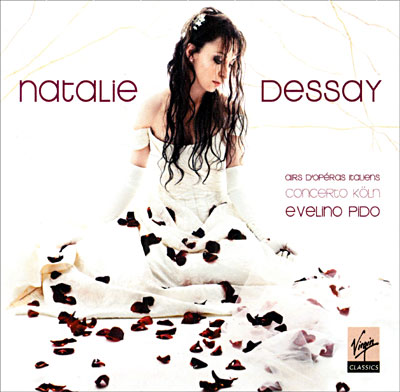
It's the cover of the latest CD from one of my favorite opera singers, Natalie Dessay. The repertoire is all bel canto and Verdi--six long scenes and arias:
  1. E strano! - Ah fors'e lui - Sempre libera (La Traviata)
  2. Elvira's Mad Scene (I Puritani)
  3. Oh nube che lieve - Nella pace del mesto riposo (Maria Stuarda)
  4. Caro nome (Rigoletto)
  5. Eccomi in lieta vesta - Oh quante volte (I Capuleti e i Montecchi)
  6. Lucia's Mad Scene (Lucia di Lammermoor)
I bought the album last week from iTunes and have only listened to it once, but so far am really enjoying it. Dessay puts a very personal touch on the Lucia scene, and her coloratura really does sound like crazy laughter when she sings Elvira's "Vien diletto." You also get a sense of how these arias function onstage, not just as showy recital pieces, because they have been produced with full orchestra, chorus, and other soloists as needed. I love in "Vien diletto" where the two baritone men sing "Il suo dolor, il suo dolor!" (Her sadness, her sadness!) while Dessay's voice soars above them. How diva-ish can one aria get?


Here is a promo video for this album, which bears the prosaic title Italian Opera Arias. This video gives some more enticing alternatives: Six portraits d'heroïnes legendaires (Six Portraits of Legendary Heroines) or my favorite, Natalie Dessay chante les folies de l'amour (Natalie Dessay Sings of Love's Madness).

Photo from fnac.com

Thursday, October 11, 2007

Soprano on a mission

My new favorite opera singer got interviewed on Charlie Rose the other night, and I think it makes interesting viewing for anyone who cares about opera's relevance to the modern world. It also includes some breathtaking clips of Lucia's Mad Scene (near the beginning, near minute 17, and at the end, if you want to skip right to them.)


Dessay is articulate about her artistic goals and deals well with Charlie, who treats some of what she says with incredulity. Also, she's fun to watch--even when she's not playing a role, she has a very expressive face with huge eyes. The Lucia advertisements all over NYC--Dessay looking distraught, her mascara running, alongside the quasi-clever slogan YOU'D BE MAD TO MISS IT--are quite arresting. (Dessay to Rose: "I own the buses in this city!") A lot of the women I met in France--especially my two host mothers--could be described as "intense," and Natalie Dessay seems like another of these intense French women.

Indeed, the interview shows her as ambitious, perfectionistic, determined--I apologize for the semi-snarky "maybe it's her press agent" comment in my earlier post. No, it's clear that Dessay sees herself as carrying a heavy responsibility on her slender shoulders: making opera fresh and relevant and above all, theatrical. It's like she's read Peter Brook: "My dream would be an empty stage. Empty. One chair. And, bodies. The bodies of the singers, but, singers able to act and to play as actors."

For more proof that Dessay really knows what she's talking about, she provides a concise and accurate definition of what you need to be good at comedy: Energy, rhythm, and taking everything seriously (that is, it never works if you try to "be funny"). Couldn't have said it better myself.

Dessay names Maria Callas as her greatest inspiration in her quest to bring theater to opera, and says that if she could play any role in a movie, she'd tackle Sophie's Choice ("I love so much Meryl Streep, it's my favorite actress"). Oddly enough, I've mentioned both Callas and Streep here in the past week. Natalie, are you a covert reader of marissabidilla?

Tuesday, October 9, 2007

Voila La Chanson Mignonne

I've had a lot of homework this week, and in my spare time (that is, the time I ought to be doing homework), I've been watching opera videos on YouTube. Hey, at least I'm learning something! Can't explain why I've been bitten by the opera bug just now, but I'm letting it take its course.

I took voice lessons during high school (and am kind of regretting giving them up) but still don't know enough about the nuances of opera singing to play favorites based on vocal quality. These are world-class singers--they all sound pretty great to me! So, especially when I can watch videorecordings of singers, I find myself preferring the ones with the best acting skills. Here are some of my discoveries.

The great Maria Callas's fame derives in large part from her acting. It's generally agreed that she may not have had the most perfect voice, but in performance she was a wholly captivating actress. I couldn't find too many Callas videos on YouTube, but this, her version of "Una voce poco fa" from The Barber of Seville, shows how she got her reputation. She makes a great Rosina: feisty but warm, with great comic timing.


One of my housemates is learning the beautiful "Song to the Moon" from Dvorak's Rusalka for her voice lessons. This is Renée Fleming's signature aria and this video shows why: when she performs it, every note and gesture is filled with the palpable yearning that the song requires.


But my favorite discovery, so far, has been the French soprano Natalie Dessay, who just opened the Metropolitan Opera season as Lucia di Lammermoor. Dessay (or her press agent) has made a niche for herself as "the coloratura who acts." The roles she plays have traditionally required nothing more than an agile and pure high soprano voice, but she adds psychological complexity that justifies every note she sings. Originally trained as an actress, she is known for her humor and her highly physical interpretations. And she has a truly gorgeous coloratura voice--I am in awe of her ability to sing high notes pianissimo!

To get a sense of her acting ability, compare these two performances in the role of Olympia, the mechanical singing doll from The Tales of Hoffmann. In the first, she is cute and funny and seems about 8 years old, moving just as you'd expect a little-girl doll to move. She even takes her bows in character! As well as coping with a blustery night and gigantic puppets:


In the second version, Dessay hits even more impressive notes and cadenzas, despite the tempo being a whole lot slower (and thus more difficult). Moreover, she portrays Olympia as a much more tragic, human figure--a fragile and nearly catatonic young woman, not a wind-up doll.


I don't even know of many stage actors who, playing the same role in two separate productions, would give two such different but equally committed and honest interpretations. Natalie Dessay is a truly modern and fearless performer--a rare thing in opera! If these videos have piqued your interest, there are plenty more where they came from--you won't be disappointed!