Showing posts with label paintings. Show all posts

Monday, October 31, 2016

On Broomsticks

"The Old Hall, Fairies by Moonlight; Spectres & Shades, Brownies and Banshees,"
by John Anster Fitzgerald
"Here were the young women of the highest intelligence, and the most daring and ingenious of them, coming out of the chiaroscuro of a thousand years, blinking at the sun and wild with desire to try their wings. I believe that some of them put on the armor and the halo of St. Joan of Arc, who was herself an emancipated virgin, and became like white-hot angels. But most women, when they feel free to experiment with life, will go straight to the witches' Sabbath. I myself respect them for it, and do not think that I could ever really love a woman who had not, at some time or other, been up on a broomstick."

--Isak Dinesen, from "The Old Chevalier" (Seven Gothic Tales)

Happy feminist Halloween!

Thursday, November 17, 2011

The secret miracle of Charlotte Salomon

Last month I attended an extraordinary art exhibit at the Contemporary Jewish Museum, on loan from the Netherlands Jewish Historical Museum: some 200 gouache illustrations by Charlotte Salomon from her Leben? oder Theater? (Life? Or Theater?) magnum opus.

Salomon was a playwright without a stage. A graphic novelist before such a thing existed. A young woman struggling to find and claim her voice, to affirm herself and her existence. It is no surprise that her work -- with its themes of theater, creativity, love, feminism, identity, and history -- should resonate with me; these are things that I think about a lot.

Salomon was born into an upper-class Jewish family in Berlin in 1917, part of that wonderful cultured Mitteleuropean milieu of the early 20th century. Her father was a surgeon; her stepmother was an opera singer; and Charlotte attended art school. But, needless to say, by the 1930s, Berlin was a very bad place to be a Jew. Salomon's father lost his medical license, Charlotte had a school prize taken away from her on account of her religion, and shortly before she turned 21, her family sent her to the south of France for safety.

What makes Salomon's story really interesting, though, is its more personal details. Not only did she live in a dangerous and tumultuous era, but her family had its own tragedy: virtually all of the women on her mother's side of the family killed themselves. This information was concealed from young Charlotte until she was an adult (she had always been told that her mother died of influenza). When she learned the truth, she wondered if she too was destined to commit suicide. In a state of shock and crisis, she decided that she had only two options: either to kill herself, or to "undertake something eccentric and mad." She chose the latter option. She holed herself up in a hotel on the French Riviera and spent several months creating the hundreds of illustrations of Leben? oder Theater?

The narrative starts with Salomon's family history (the suicide of her mother's sister; her parents' meeting) and continues through her childhood and young womanhood, up until the moment she undertakes the Leben? oder Theater? project. Much of the narrative concerns Salomon's love for her stepmother's voice teacher, Alfred Wolfson, or "Amadeus Daberlohn" as he is called in the paintings (all of the Leben? oder Theater? characters have thinly disguised pseudonyms). Wolfson/Daberlohn was a World War I veteran whose philosophies about art, creativity, and finding one's voice had a great influence on Salomon. She paints his face obsessively, but also seems able to view him with a certain objectivity and humor -- you get the impression that he was a brilliant but also a pompous man. There's a memorable series of gouaches where Daberlohn is stretched out on a couch, pontificating on art and life:

"It is part of my nature as a man among men to remind them of suffering, which in our day we like to pretend does not exist. Yet I have never forgotten to emphasize that I love life and affirm it threefold. In order to love life completely, one must also embrace and comprehend its other side, death, including suffering. This is how my oft-repeated words must be understood those whom I love to undergo bitter experiences so that they will be forced to follow the path into their own depths."

These ideas would come back to Charlotte Salomon when she was at her lowest point and influence the creation of Leben? oder Theater? For, in the end, she followed the path into her own depths, learned about the death and suffering that haunted her family, and rather than being swallowed up by the darkness, made the choice to love and affirm life. The final panels of Leben? oder Theater? remind me of the closing scenes of a Chekhov play, where the young woman (Nina in The Seagull, Sonia in Uncle Vanya) clings to optimism and hope despite all the suffering that has befallen her.

Charlotte urges her grandmother: "Look at the flowers in the meadow. So much beauty, so much joy. Look at the mountains up there, so much sun, so much light."
As with Chekhov's plays, Salomon's paintings gain an extra bittersweetness because we know that their creator ultimately died far too young. After Salomon had completed Leben? oder Theater? and entrusted it to a friend, the Vichy France authorities discovered her. She was transported to Auschwitz, and killed at the age of 26.

Charlotte Salomon's story is a tragedy, but also, somehow, weirdly inspiring. They killed her. She didn't kill herself. Despite her family history of suicide, despite the grave dangers that she faced, she chose to self-create rather than self-destruct. She attempted to understand and redeem her family history, to break the cycle rather than perpetuate it.

The thought of Salomon, hiding out in the Riviera hotel, obsessively painting her gouaches, knowing that her life was in danger and time was perhaps running out (you can see the brushstrokes get wilder and more frantic as the series progresses) reminds me of a real-life version of Borges' story "The Secret Miracle." In that tale, a Czech-Jewish playwright is condemned to die before a Nazi firing squad, and his only regret is that he never finished the verse drama that he was writing. At the moment the bullets are fired, God grants the playwright's wish: he stops time and allows the playwright to take as long as he needs to compose the play in his head. So, too, by some miracle, Salomon was granted the time and the resources and the energy she needed to make Leben? oder Theater?  (She already had the artistic skill.) It is also miraculous that the work survived, and that it holds interest from so many points of view -- artistic, narrative, historical, feminist. I confess I was less interested in the portions of the work that focus on Hitler's rise to power and the persecution of Jews, and more interested in the parts of it that reveal Salomon creating art, finding her voice, falling in love.  A lot of art, up to the present day, deals with the Holocaust and the historical events surrounding it. It seems far rarer to view a museum exhibition about a young woman's coming of age.

Clearly, my blog post can't do justice to the full richness of Salomon's achievement. I'd tell you to see it for yourself, but the San Francisco exhibition closed two days after I saw it.  However, the Dutch museum that owns it has scanned and posted every page online, and even included English translations of the text -- an amazing resource and well worth your time to browse.

Images from the website of the Joods Historisch Museum.

Tuesday, January 6, 2009

I remember sky, it was blue as ink

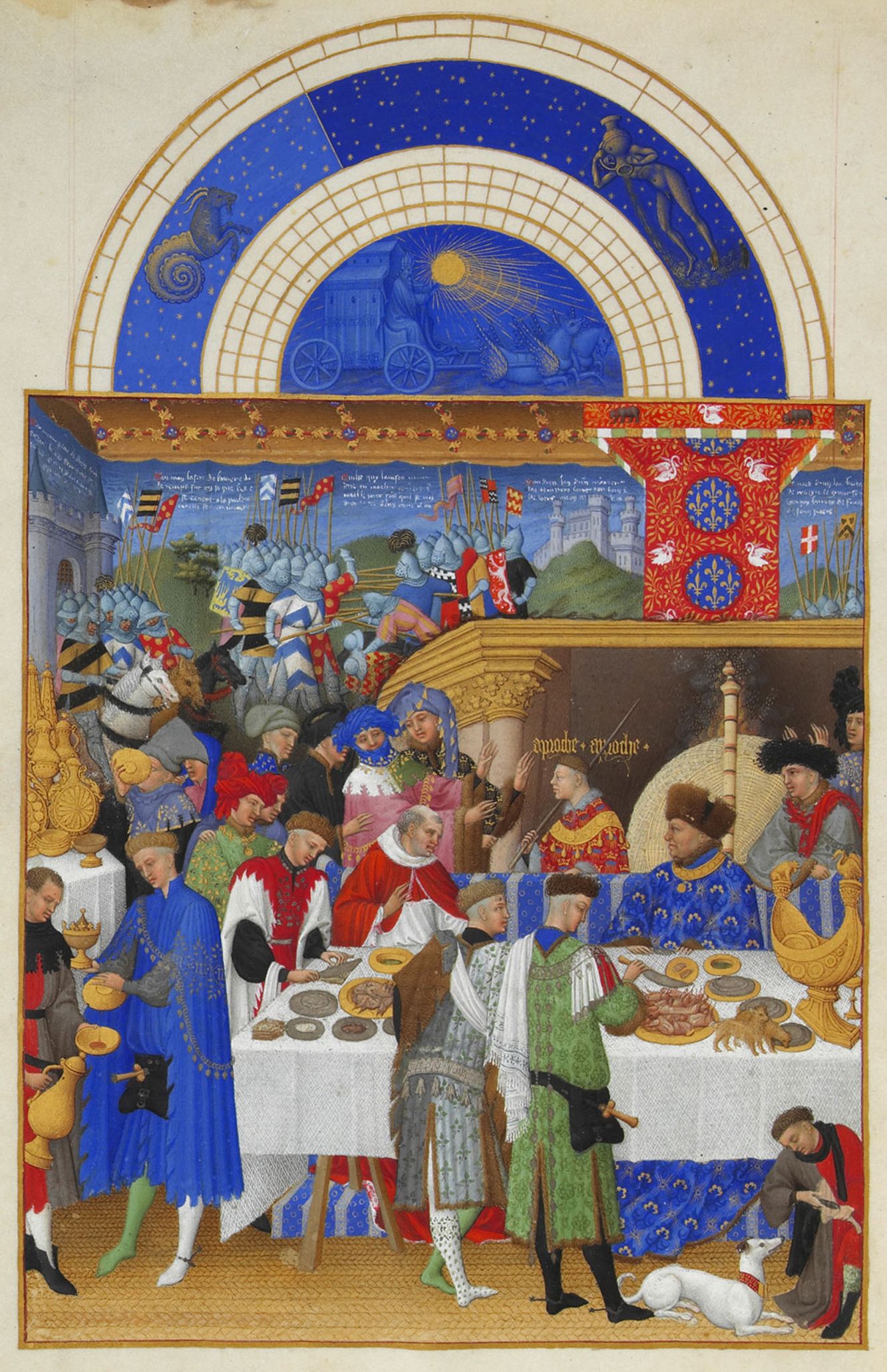
Les Tres Riches Heures du Duc de Berry, the medieval book of hours crafted by the Limbourg Brothers, has probably the most famous, historically significant, and beautiful calendar illustrations in all of Western art. Those delicate details, surrounded by that pure lapis-lazuli blue!

So riddle me this: with 9000 calendars for sale on Calendars.com, why does not a single one of them feature the illustrations from Les Tres Riches Heures?
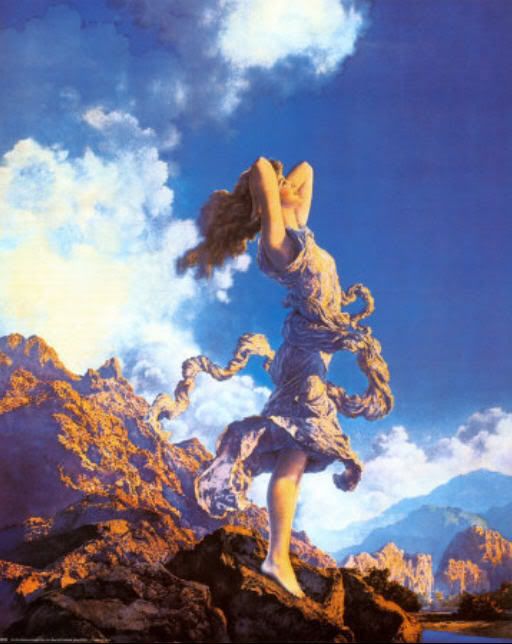
I would've thought that, on the contrary, every modern calendar manufacturer would produce a Limbourg brothers calendar. And before you ask "but who would buy it?", I totally would! Specifically, I'd have bought it for my father for Christmas. Dad has a thing for paintings that feature striking skies, à la Maxfield Parrish...


or Albert Bierstadt...


so I wanted to acquaint him with the less dramatic, but equally sumptuous, skies of the Limbourg Brothers.

Images: "January" from Les Tres Riches Heures (high-res images of all 12 paintings available on Wikipedia); "Ecstasy" by Parrish; "The Oregon Trail" by Bierstadt.

Sunday, October 19, 2008

Bleedin' Frida

One of my favorite guilty-pleasure pop songs of recent vintage is Leona Lewis' "Bleeding Love." It always amuses me when a song with such morbid and disturbing lyrics becomes a mainstream hit... and I'm not trying to imply that that's a bad thing, since I love over-the-top music (opera, Broadway, girl-group melodrama, The Decemberists).

So, well, maybe I have more of a taste for the macabre than the average person does, but I am very disappointed in the two music videos Lewis taped for "Bleeding Love"--they're so tame! Not a splash of blood anywhere to be found! In the UK version, Lewis writhes around in a jeweled gown, her sultry eyes an incongruous fit with her sobbing vocals; in the US version, her boyfriend leaves her and she's sad, but it doesn't come near the crazy, obsessive, bleeding love described in the lyrics.

Personally, after seeing the Frida Kahlo exhibit last month, I think the music video should have gone for a Kahlo-inspired aesthetic:


"My heart's crippled by the vein that I keep on closing / You cut me open / And I keep bleeding / I keep, keep bleeding love" indeed.

Friday, September 19, 2008

Frida and Lee: Must a Female Artist Suffer?

When I went to the SF MoMA last week, the Frida Kahlo exhibit occupied the most prominent gallery space (and it was crowded, even at 11 AM on a Thursday!) but I also looked forward to visting the exhibition of Lee Miller's photography. I first became interested in Miller's work after seeing this photograph last summer at the Maryhill Museum of Art--one of the most striking photos I have ever seen.


Miller, though less famous than Frida Kahlo, is also an interesting character: a blonde American beauty who started out as a model, became an acclaimed Surrealist photographer, and then was the only female combat photographer in World War II.

Seeing the Kahlo and Miller exhibits on the same day made me think about the different perspectives they provided on the life of a female artist in the first half of the twentieth century. There's a number of rather striking similarities between these women: both were born in 1907, both produced work associated with the Surrealist movement, both had romantic relationships with famous male artists, both were little-known during their lifetimes and then rediscovered circa 1980. Kahlo died in 1954; Miller lived till 1977 but gave up photography by the mid-1950s.

After seeing the Kahlo exhibit, if I had to pick just one word to describe her art, it would be "suffering." Her famous self-portraits have a mildly grotesque air, what with her emphasis on her unibrow and mustache, but many of her other paintings are less often reproduced because they are so viscerally disturbing.

Indeed, it has been suggested that our present-day adulation of Frida Kahlo and other women who suffered (Sylvia Plath, Virginia Woolf) leads to thinking that a woman must suffer in order to be a great artist. (See this very interesting article by Stephanie Mencimer.) As a woman with artistic ambitions, I say this had better be just a pernicious myth!

And the work of Lee Miller seems to offer a more hopeful alternative. Here I will have to disagree with Robert Zaller, who wrote that Miller lived with "a wound perhaps no less painful than any of Frida Kahlo's." I'm not saying that Miller had a hunky-dory life: she was sexually abused as a child and suffered post-traumatic stress disorder after photographing World War II. But in contrast to Kahlo, whose physical and psychological pain emanates from every brushstroke, the tragedies of Miller's life seem incidental to her art, not an integral part of it. "Suffering" is not the first word I think of when I consider Miller's work.

As a war photographer, Miller took it upon herself to observe and record the suffering of others. She could have refused to look at the horrors of the concentration camps, or turned back when it got too grisly, but she kept on nonetheless--out of a sense of a higher duty. Whereas Kahlo used the suffering of others as a metaphor for her own pain, constantly reinscribing her own emotional turmoil even when she wasn't painting self-portraits.

Here is Kahlo's A Few Small Nips, ostensibly based on a news story about a man who stabbed his girlfriend--but Kahlo chose this subject because she had just learned that Diego Rivera was cheating on her with her own sister, and felt stabbed in the gut by the news.

And here is Miller's photograph of a young German woman who killed herself upon her country's defeat in the war. This image is also disturbing, but in a quieter way than Kahlo's. It's almost an example of the "banality of evil"--at the same time we register the girl's death, Miller also wants us to notice the button that's hanging loose from the tufted couch, or the position of her pale hands in the light.

And most of Miller's 1930s work doesn't have to do with suffering at all--just studies of light and shadow and how everyday objects can look strange when you view them from a different angle, such as this image of a nude woman bent forward.

Frida Kahlo looked into herself, while Lee Miller looked out at the world. Of course, this might have something to do with the artistic media they chose--Kahlo smearing colored fluids onto a canvas, Miller looking through a machine made of metal and glass. Is painting, by its very nature, more emotional than photography? And, if more emotional, more stereotypically "feminine"?

Friday, October 19, 2007

How is a cricket bat like a play?

When I was writing yesterday's post about Tom Stoppard I checked out his Wikipedia page, which, among other things, informed me that he is a participant in the One Million Masterpiece project. This is a charity effort that aims to be "the world's largest collaborative arts project," asking each person who signs up to create a square-shaped painting using a computer graphics program. This is Stoppard's artwork:

The One Million Masterpiece Arts Project

Simple, but effective graphic of a cricket bat and ball. I laughed out loud, though, when I saw it. You see, it's not just that Stoppard is a cricket fan. Instead, I'm almost certain that he's alluding to his famous "cricket bat" monologue from The Real Thing. In it, Henry, a playwright, uses a cricket bat as a metaphor to explain just why an amateurish play by a young political prisoner is so awful.
HENRY: This thing here, which looks like a wooden club, is actually several pieces of particular wood cunningly put together in a certain way so the whole thing is sprung, like a dance floor. It's for hitting cricket balls with. If you get it right, the cricket ball will travel two hundred yards in four seconds, and all you've done is give it a knock like knocking the top off a bottle of stout, and it makes a noise like a trout taking a fly... (He clucks his tongue to make the noise) What we're trying to do is to write cricket bats, so that when we throw up an idea and give it a little knock, it might...travel... (He clucks his tongue again and picks up the script) Now, what we've got here is a lump of wood of roughly the same shape trying to be a cricket bat, and if you hit a ball with it, the ball will travel about ten feet and you will drop the bat and dance about shouting "Ouch!" with your hands stuck into your armpits. (Indicates the cricket bat) This isn't better because someone says it's better, or because there's a conspiracy by the MCC to keep cudgels out of Lords. It's better because it's better. You don't believe me, so I suggest you go out to bat with this (the script) and see how you get on.
Yay for craftsmanship and uncompromising high standards! Yay for playwrights!

Tuesday, October 9, 2007

Jane Morris or Jane Russell?

As soon as I saw this photo of actress Jane Russell on the great if charlie parker was a gunslinger... blog:

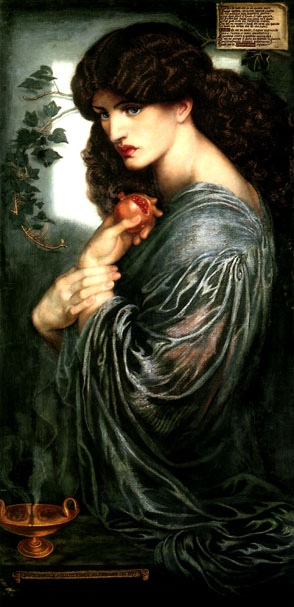
I immediately thought of the painting Persephone by Dante Gabriel Rossetti, an idealized portrait of Jane Morris:

Photo from bigcitylit.com

Strange to think of Hollywood sex symbol Russell as a pre-Raphaelite goddess...but don't you think that Rossetti would have loved to use her as a model?