Showing posts with label osf. Show all posts

Saturday, April 12, 2008

Infinite variety, boundless bounty

The production of Antony and Cleopatra that started it all (OSF, 2003). Photo found at paulb.com.

My Dynamo project is--hard to believe--over with, after two performances of my play The Rose of Youth yesterday. You know how it is when you anticipate something for so long and it finally arrives, and after that you aren't sure what to do with yourself? That's where I'm at right now. I can't even see the big picture yet, but can only isolate small moments. Here's one of them: about my friend Rachel, the founder of Dynamo, and someone I've known for a really long time, but never so closely as now.

I first met Rachel nearly five years ago, at the OSF Summer Seminar for high-schoolers. Among the plays we saw that summer was a really terrific, intimate production of Antony and Cleopatra, which made a big impression on me. Indeed, I wouldn't have written The Rose of Youth if that production of A&C hadn't alerted me to the play's beauty and power.

That summer, OSF also had a copy of Shakespeare's First Folio on loan from Paul Allen's collection. A curator lectured to us on the history of the Folio and then invited us, in small groups, to gaze upon this priceless book. It was kept in a secured, controlled environment, in a plexiglass case, resting upon a special stand that could hold it open without straining its binding. It was open to Enobarbus' famous speech from Antony and Cleopatra:
Age cannot wither her, nor custom stale
Her infinite variety. Other women cloy
The appetites they feed, but she makes hungry
Where most she satisfies.
The curator told us that he'd done this on purpose: though these lines refer to Cleopatra, they work equally well to describe the bounty, the timelessness, the richness of Shakespeare's oeuvre. It was a moment of awe.

After that summer, Rachel and I lost touch, but we both ended up at Vassar--I still remember the shock of recognition when I ran into her at freshman registration. We both did a lot of theater--together and separately--until she invited me to be a playwright/collaborator on Dynamo a year ago. All last fall, we and the other two founders (Thane and Molly) worked closely on this project, getting to know one another better--and though I knew Rachel liked my play, I was still so grateful and flattered when she offered to direct its world premiere in early March.

When we read my play out loud for the first time, there was one scene that simply did not work. I had had Antony's death scene as a play-within-the-play, but that made things too slow and tragic. I needed a different Shakespeare scene, and promised to find one by the next day--praying that something else in Antony and Cleopatra would work. To my great relief, I found one: Act 4 Scene 4, where Cleopatra arms Antony before he goes off to battle. It is shorter than Antony's death scene, lighter in tone, and altogether better. I emailed the new scene to Rachel and the other company members before I went to bed that night.

The next day, I ran into Rachel in the cafeteria. While she went to buy food, I sat at a table musing on my great good fortune to have found a scene to substitute for Antony's death. I silently thanked Shakespeare for the gift of his writing, from which I can continually draw new pleasure and insight. This reminded me of those beautiful lines from Romeo and Juliet:
My bounty is as boundless as the sea,
My love as deep; the more I give to thee
The more I have, for both are infinite.
And this, in turn, reminded me of "infinite variety" and the Enobarbus speech, and as I pondered these two quotes--two among thousands of Shakespeare's gifts to us--I found myself tearing up. Thoughts of seeing the First Folio at Ashland led to thoughts of meeting Rachel, and how that summer we never could have predicted we'd wind up here, founding a theater ensemble, her directing a play I'd written... I thought of Rachel's generosity, and our ensemble's, but most of all Shakespeare's. So I sat there in the cafeteria, getting all verklempt, then looked up, wiped my eyes, and waved to Rachel--who sat down, and began discussing the nuts-and-bolts of staging my play.

I think that that is how I would like to remember this project.

Tuesday, April 1, 2008

The shoures soote

"Wheat Field in Rain" by Vincent Van Gogh. Image from vggallery.com

I seem to be developing a habit of shouting defiantly into the face of rainstorms. It combines several of my passions: for quotations, for heightened emotions, and for wet weather (blame my Oregon heart). Here are two examples I recall:

Between my junior and senior years of high school, I participated in the Oregon Shakespeare Festival's Summer Seminar, a 2-week program that taught 70 or so kids about the inner workings of a big repertory theater. We lived in dormitories and had to walk about a mile to get to town. On our second or third evening there, we were walking to see Richard II in the outdoor (Elizabethan) theater, when the skies opened and it started pouring down rain. So, naturally, as the high-school theater geeks we were, we started quoting.

The Seminar had made us memorize a choral speech from a Greek tragedy, and it felt appropriate to shout that out as the winds and rain raged: "Come, Furies, dance! Link arms for the dancing hand-to-hand." Then we switched to King Lear: "Blow, winds, and crack your cheeks! Rage, blow!"

But it only rained harder, and perhaps spurred on by our Greek, Zeus even started hurling his thunderbolts. We decided we needed to appease the gods. That's when I got my brilliant idea. My voice loaded with irony, I yelled at the top of my lungs, "Shall I compare thee to a SUMMER'S day? Thou art more LOVELY and more TEMPERATE!"

The rain stopped eventually, though I don't know if my plea for temperance did much good: the show didn't get canceled and we spent a damp and chilly evening watching it.

Now, today, April 1, in Poughkeepsie, was a warm, muggy day--very unpleasant. But thunderstorms were predicted for tonight, and I was grateful--they're the only compensation for East Coast humidity, in my opinion. I love how the temperature will suddenly plummet and the skies release torrents of rain. You understand where that phrase, "the weather broke," came from. And tonight, during rehearsal, we had a real humdinger of a storm. The drumming rain and whistling wind echoed through the theater. When we took five, some of the guys took their shirts off and frolicked in the rain. One of them began singing an art song by Tosti, called "Aprile."


"Aprile," I thought, "that's like Aprill..." and the words I had to memorize in a high-school Chaucer class flooded back. I stood under the awning of the theater and shouted as loud as I could:
Whan that Aprill with his shoures soote
The droghte of March hath perced to the roote
And bathed every veyne in swich licour
Of which vertu engendred is the flour!
The shouting made me feel strong and defiant, as if the rain were running fast through my veins too; or perhaps it was Chaucer's language, still powerful after 400 years. Ah yes, rain on, you shoures soote, you.

Thursday, January 24, 2008

Bawd, Beard, Bard

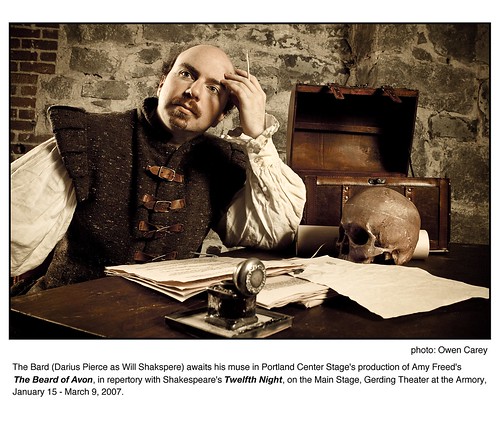
Ooh, I've fallen behind on my blogging. I saw The Beard of Avon at Portland Center Stage on Tuesday the 15th--now it's the 24th and I'm up to my ears in stuff at Vassar, though it's only the beginning of the semester.

Thoughts on the play before it vanishes from my memory:

I was so excited when I heard that Darius Pierce was going to play Will Shakspere (yes, that's how it spelled). I had a great time working with him last summer on Marie Antoinette and seeing him play King Louis XVI as a put-upon, insecure "little guy." And that's just the way that Shakspere is in Amy Freed's play--not a lofty historical figure, but a provincial farmer who comes to London, his eyes as shiny as his bald pate (but don't mention that to him, he's very self-conscious about it). Darius is very funny but also very sympathetic in these underdog roles. Maybe it's because I'm a writer myself, but I really feel for Shakspere in The Beard of Avon--the little guy with big dreams. The moral of the play, if you will, is "Everything from nothing comes to those who love"--and Shakspere loves. He is, literally, an amateur.

And this isn't the kind of love found in Shakespeare in Love, either--where he only needs a good woman to make his pen start flowing again (how's that for a double entendre?). Writing is never that easy, and The Beard of Avon recognizes that--the struggle to put one's thoughts down on paper, and then, the struggle to see them produced.

Speaking of Shakespeare in Love, Brian Thompson, playing Henry Condel, looks so much like Geoffrey Rush as Philip Henslowe that it had to have been intentional. (Henslowe and Condel were both theater managers of the time.)

The play has lots of fun with language, written in mock-Elizabethan style, and sometimes it goes by too fast--you want to savor the way the words sound and the jokes are constructed. Most of the Shakespeare allusions got laughs, but I was disappointed to be the only person in the entire theater who laughed at "Wilt thou assault me with dramaturgy?" (Maybe it would help if more people knew what a dramaturg does.)

Really, The Beard of Avon is a strong comedy script--using language in interesting ways, amusing you but making you think about things like the creative process, and inspiring at least some members of the audience (i.e. my dad) to want to learn more about Shakespeare. Still, I am bothered by some flaws and inconsistencies: Shakspere is the smartest guy in Stratford but the dumbest guy in London. When Lord Edward De Vere first presents his "beard" scheme to the theater managers (noblemen can't be professional playwrights, so De Vere will find another name to put on his scripts), Shakspere at first seems to catch on quickly. He calls himself "Honest Will Shakspere... trustworthy-to-death Will Shakspere!" as if positioning himself to be chosen as the beard. But two minutes later, he is so dense that De Vere must explain the scheme to him in great detail. It seems like Amy Freed wants to cram in as many jokes as possible, riffing on both the "Shakspere is a frustrated genius!" idea and the "Shakspere is a silly country bumpkin!" idea, but you can't have it both ways.

It was nice to see Oregon Shakespeare Festival actors Catherine Lynn Davis, Ken Albers, and Brent Harris in this Shakespeare-inspired comedy...and after all Portland Center Stage started as an outgrowth of OSF. Davis is funny as Shakspere's put-upon wife, Anne Hathaway, who, in a scene right out of a Shakespeare mistaken-identity comedy, pretends to be a prostitute so that her husband will finally pay attention to her. Albers takes on some smaller roles like another theater manager, Heminge. And Harris plays Edward De Vere, the archetypal world-weary, debauched nobleman. Great fun!

I thought Carol Halstead's British accent was a little too much as Queen Elizabeth, but she has some great scenes where she writes The Taming of the Shrew and then watches it performed (and what a delicious idea on Amy Freed's part! Of course Elizabeth would identify with Kate!). And although it would have been nice to be able to see Twelfth Night, which is playing in repertory with Beard at PCS, I've already seen some great productions of Twelfth Night in my life. So I'm glad I got introduced to a new comedy by this great set of actors, instead.

Thursday, October 11, 2007

Macbeth: Good, Bad, and Ugly

I have been fortunate to see excellent productions of many Shakespeare plays, but up until a week ago, I hadn't seen a Macbeth that I thought was any good at all.

My first experience with Macbeth came at the Oregon Shakespeare Festival in spring 2002: the show opened the New Theater. And it was a big disappointment--most of all in the actor playing Macbeth. At Ashland, he excels in funny roles like Falstaff or Trinculo--but carried his mugging mannerisms into the role of Macbeth. Whenever a prophecy came true or he otherwise had to show fear, he'd bug his eyes out of his head like a cartoon character. The nadir came at "Tomorrow and tomorrow and tomorrow," some of the most mannered acting I've ever witnessed. The actor shouted the first TOMORROW!, then delivered the second two "tomorrow"s in an ominous, low monotone. It made no emotional sense and disrupted Shakespeare's rhythm.

Macbeth is Shakespeare's shortest tragedy, but Ashland made it even shorter and more headlong, even cutting the Witches' "Double, double, toil and trouble." Also, there were just six actors: Macbeth, Lady M, Banquo, and three actresses who played all the other roles. There was too much switching back-and-forth of roles for most audience members to understand, especially because Macbeth is full of minor thanes, etc., who come on for a scene and then leave. The only doubling that was really interesting involved having the same woman play both Macduff and Lady Macduff.

The entire production was kind of dark and gloomy, on a bare stage with a pool of stage blood in the center (so the fights consisted of people flinging blood at one another). But the pacing was too fast, and I never succumbed to the magic of the theater. Really, I got nothing out of this version.

Even worse, however, was the production of Macbeth at my high school the next autumn. I got to witness the debacle firsthand because I appeared in it as an extra. The director didn't do any gender-blind casting, which annoyed me, because I, a junior, had no lines, while a bunch of freshman guys with no acting experience got roles like Ross, Banquo, and Lennox.

Mostly, this production suffered from the "Wouldn't it be cool if..." school of directing. Wouldn't it be cool if the witches ran around with a video camera and there were TV monitors in the set to project what they were filming? Wouldn't it be cool if the guys wore modern clothes but carried giant broadswords? Wouldn't it be cool if Lady Macbeth was over-the-top sexy? But none of these ideas has anything to do with the other, or worse, with Shakespeare's text.

To make matters worse, the guy we cast as Macbeth was very good in contemporary plays, but had no sense of Shakespeare's language and was notoriously bad at memorizing lines. The only emotion he displayed in "Tomorrow and tomorrow and tomorrow" was wishing the damn speech would be over.

The only way to make up for this mess was to stage an awesome sword fight at the end (swords purchased for $40 at BargainBlades.com--I kid you not), and it was pretty great, except for the fact that each night Macbeth and Macduff got more aggressive, and sloppier. On the last night the handle of Macbeth's sword got knocked askew from the blade--if we'd run another weekend, there would've been some major injuries. (This, by the way, is the reason behind the "Curse of the Scottish Play": people think they can perform Macbeth without much rehearsal, but there are too many scenes with the potential to cause accidents!)

Twice burned, four times shy... so I was a little uncertain what I'd think of Vassar's Macbeth, which ran last weekend. Still, I had reason to be hopeful: Vassar is usually good at straight-up, respect-the-text Shakespeare, and eight senior girls (that is, a ton of my friends) had all the major roles. Yes, it was an all-female Macbeth!

I doubt that Macbeth will ever be one of my favorite Shakespeare plays--it doesn't seem to have the depth of Hamlet or Lear--but of course there's great stuff in it. Besides the passages that everyone mentions, I believe that Act 4, Scene 3, where Macduff learns of the murder of his family, must be some of the most emotionally moving writing that Shakespeare ever did.

My friend who played Macduff was perfectly cast--her greatest skill as an actress is to combine vulnerability and deep inner strength. I cast her in a staged reading of one of my plays because of this, and it's also what Macduff needs.

This scene ("Dispute it like a man." "I shall do so/But I must also feel it as a man") also gets at a theme of Macbeth that this production highlighted: what it means to be a man.  With women in all the roles, you paid more attention when the characters talked about being men, or when Lady Macbeth cried "Unsex me here" and suggested that Macbeth was a sissy if he wouldn't kill Duncan. Not that this part of the play was over-emphasized--but it gave you something to think about after it was done.

The theatre was set up in the round, with very few props; still, there were some amazing stage pictures. The gigantic doors at one end of the theatre (wide enough to drive a car through) were used to great effect in the Porter scene, and also for the parade of Banquo's kingly descendants. (This scene did not appear in the other two Macbeth productions I've seen, but was chilling here.) The witches' cauldron was a trap door that glowed with unearthly light. There is also a spiral staircase in one corner of the theatre leading to an elaborate system of catwalks above, which meant that Macbeth could do "If 'twere done when 'tis done" hanging spotlit from a ladder, Macduff could come clattering down the staircase after discovering Duncan's murder, and Lady Macbeth could appear as a haunting white-clad figure on the catwalks for her sleepwalking scene. (However, I wished I didn't have to crane my neck so much, and could see her facial expressions better!)

The battle scenes, with short swords and heavy shields, were awesome--every actress participated, and at the cast party they wore their bruises, and newfound muscles, with pride.

My friend who played Macbeth has been impressing everyone since freshman year. Two years ago, she was a magnificent Juliet: she has an instinct for Shakespeare, a melting and lyrical voice, and carries herself beautifully. So in one sense, she's a counterintuitive choice for the role of Macbeth, but on the other hand, she's the only girl in our year who could've done it. And she's the first Macbeth I've seen treat the play as a tragedy. Her "Tomorrow and tomorrow and tomorrow" (obviously, my litmus test for Macbeths) was full of aching sorrow and regret...though maybe a little too delicate to be "ideal" for this warrior-king.

I still have a few issues with Macbeth, though more with the script than this generally thoughtful and well-acted production. There are just so many thanes running around, delivering exposition or filling out the crowd, but not developing character. Say "Rosencrantz," "Osric," "Fortinbras," and you get a clear mental image of the character's personality. Say "Ross," "Lennox," even "Malcolm," and you can identify the scenes in which they appear, but not what kind of person they are.

Still, congrats to all the Macbeth ladies--you've left me, finally, with a pleasant memory of this play!

Saturday, June 23, 2007

OSF '07

Last week I went to the Oregon Shakespeare Festival, seeing 4 plays in 3 days. This was one of my favorite seasons ever: no duds and lots to think about!


The Taming of the Shrew: Obviously, a difficult play to present these days, but I really liked director Kate Buckley's approach. (How cool is it to have "Shrew" directed by a woman named Kate?) She did not burden the play with too much comic shtick or anachronism, and she took a psychological approach to the characters. You might not agree with what they did, but you understood why they did it. This way, the play became thought-provoking rather than just offensive. It also helped that they established that Kate is instantly attracted to Petruchio--the first man who isn't afraid of her--but she's too proud to admit it, and too afraid of love. So she keeps acting shrewish, and you agree that Petruchio needs to jolt her out of it. And when subjected to Petruchio's ill-treatment, this Kate was never timid or cringing. Her final speech is still a little hard to hear...but I got the sense that she is proudly enjoying her new reputation as "most obedient" where before she was "most curst." And she gets to chastise her sister again--in a civilized way.

In this day and age, though, it's also hard to like Lucentio, who falls in love with a girl simply because she is beautiful and docile. Isn't that anti-feminist too?

The production was fairly traditional, with an extra passionate-Mediterranean flavor by a literal emphasis on the Italian setting. The actors playing Petruchio and Kate (Michael Elich and Vilma Silva) were perfect for their roles and I also really liked the wily-servant character, Tranio (Jeff Cummings). And "The Taming of the Shrew" is not a completely hidebound, conservative work. Any play with so many servants impersonating masters, and vice versa, gives some hope for overturning old hierarchies.

Photo of Kate and Petruchio by T. Charles Erickson.


The Cherry Orchard: Libby Appel's swan song as artistic director, a play about the sad end of old ways and the need to go on. The audience was really terrific and focused. What I love is that this play has so much truth to it, different audience members react to different emotional moments or lines of dialogue. But every moment of the play--in the writing and the acting--resonates deeply with multiple people. How many works of art can you say that for?

A theme I noticed for the first time was insiders vs. outsiders. The relations between the 12 characters constantly shift, so you wonder, Who belongs in the inner circle? Why do the outsiders not find common ground in their isolation? Or, is everyone an outsider? Many characters express admiration for "hard work," but very few of them actually want to work, and they can't see how this unites them. They all have deep and visible flaws, except for Anya, but can't recognize their own failings. (Is Anya meant to symbolize hope for the younger generation? Wouldn't that be too obvious for Chekhov?) Yet no one is a villain.

Libby Appel chose a great cast of OSF veterans who brought out the humor and idiosyncrasies and flaws and, again, truth of each character. I stayed for the talkback with actor Gregory Linington, who played Trofimov--he's getting typecast as shy, uncomfortable nebbishes, since last year I saw him as Mr. Marx in "Intimate Apparel." (And the actor who played Esther in "Intimate Apparel" played Varya here--another hard-working, emotionally closed-off woman.) Seeing this play, I also thought that the character of Trofimov must have influenced Tom Stoppard when he wrote the role of Belinsky in "The Coast of Utopia." Billy Crudup's portrayal of Belinsky ranks as one of the best performances I've ever seen; while no individual cast member of "The Cherry Orchard" gets on my "best performances ever" list, together they make up one of the best ensembles I've seen.

Photo of Lopakhin, Firs and Ranevskaya by David Cooper.


On the Razzle: I adore Stoppard, but this is one of his lesser efforts. The old Austrian play that he adapted has a sturdy farce structure, and he added lots of his trademark wit and ridiculous puns, the lies and misunderstandings pile up, the ridiculous stereotypes and silly costumes get trotted out... It's all very fast and entertaining, and OSF performed it well, but I wanted more. I'd rather laugh at something because it's true and recognizable (as I did in "Cherry Orchard" and "Shrew") than because it involves a crazy pun or wacky physicality. Any attempts to give "On the Razzle" a deeper message, like Weinberl's speech on the value of the merchant class, feel shoehorned in. File this one with Steve Martin's "The Underpants" under "Adaptations of old German-language sex farces that have lots of surface wit but no social value or empathy."

Photo of Christopher and Weinberl by Jenny Graham.


Rabbit Hole This is a powerful, moving play: I would say that it, too, feels truthful, but there are many scenes I know I cannot truly understand until I am married or have a child. I was gripped and wrenched, even, but did not sniffle along with the rest of the audience. Robin Goodrin Nordli, who played Becca, can do no wrong, in my book. Izzy (Tyler Layton) was charismatic and funny, Howie (Bill Geisslinger) and Nat (Dee Maaske) also splendid. However, I thought the actor playing Jason (Jeris Schaefer) was one-note and forced.

As a play, "Rabbit Hole" is almost great, but is ultimately too easily plumbed to be a masterpiece. I don't get why Shakespeare and Chekhov made the choices they did in the same way that I get David Lindsay-Abaire's play construction. He's following the modern playwriting rules, and I can see the skeleton a little too obviously. "OK, this is a play about a grieving mother, sympathetic, sober, upper-middle-class--so to provide conflict, contrast, and comic relief, let's give her an irresponsible sister who gets pregnant! Also, let's give the sisters an older brother who died, to underline the theme of losing a child..." As a comparison, it feels right, and mysterious, and not over-explained, for Ranevskaya in "Cherry Orchard" to have lost a son...for his absence to gently haunt the play. But it feels too transparent, in "Rabbit Hole," that Becca and her mother Nat have both lost children.

Photo of Izzy and Becca by David Cooper.