I have not one, but two posts on SF Theater Pub's blog this week, because my production of Jean Cocteau's Orphée is happening there on Monday night, April 15!
First, Stuart conducted an email interview with me about translating and producing Orphée. I got to discuss why I decided to translate Orphée in the first place, why it's such a crazy play, my other favorite adaptations of the Orpheus and Eurydice myth, and additional fun topics. I really had a good time doing the interview -- it's so much easier to write when you have someone else asking you questions or giving you prompts!
Then, in my column this week, I noted that Cocteau disowned his first two books of poetry, and used that as the jumping-off point for a discussion of whether it's healthy for artists to disown work that they made when they were younger. I also mention my recent experience directing the staged reading of The Rose of Youth, which I wrote five years ago. (I'll never disown that play, but there are certain passages that now strike me as embarrassingly bad.) The comments to this post, on the blog and on Facebook, mostly involve my friends confessing the embarrassing things they wrote or directed when they were teenagers -- and now I wish I could read these works in all of their awful, naive, teenage glory. Don't disdain your younger self! Embrace her!
Showing posts with label the rose of youth. Show all posts
Showing posts with label the rose of youth. Show all posts
Saturday, April 13, 2013

Sunday, March 17, 2013
Upcoming: "The Rose of Youth," "Orphée," "Pleiades"

It's slightly odd to return to my translation of Orphée after I first translated it two years ago. The initial translation project might be one of my favorite bits of writing I've ever done, though, just because I accomplished it in such a stress-free, orderly fashion. Every night, I would translate one page of the script, and in a little over a month (it's not a long play) I had a finished translation. Instead of making me insane, it actually made me feel saner and smarter. Though I don't like admitting it to myself, I need routines and patterns. Maybe I should do more translations; maybe I should just be better at setting aside a dedicated time to write.
Moreover, because it's a translation, I feel less of an emotional connection to the writing than I usually do, so it isn't too difficult to go back and revise it. Often, what I write is intimately linked to my emotional state at the time, so revisiting a work years later means I must make an effort to remember my mindset when I first wrote it. With Orphée, though, returning to the work does not mean dredging up the past, because I've always viewed the work rather objectively.
Perhaps one theme of 2013 is seeing artistic projects come to fruition years after I first conceived them. I decided in 2010 to translate Orphée, worked on the translation in early 2011, and only now am I actually getting to present it publicly.
Furthermore, I have my staged reading of The Rose of Youth coming up in less than two weeks, on March 29. And, as I've said before, I wrote that play during the 2007-2008 school year, saw it as the culmination to a great four years studying drama at Vassar, and never expected anything more to come of it. But here I am, five years later, directing a staged reading of it.
I also wanted to announce something else exciting that I have coming up this spring. Atlantic Stage, a theater company in Myrtle Beach, SC, will present a staged reading of my play Pleiades on the second weekend of April, as part of their New Voices PlayFest! (I wrote Pleiades in 2011, if you're counting.) This marks the first time my work will be seen in the South, and makes Pleiades one of the many San Francisco Olympians Festival plays that have gone on to have a continued life. And I kind of love that the play, which takes place in the Hamptons, will be performed in a different East Coast beach town. I practically danced around my room when I learned that Atlantic Stage had selected my play, and I hope to have more information soon. Unfortunately, I can't jet off to Myrtle Beach to see the reading -- I could really use a beach vacation after the busy month I've been having!
Image: Jarvis Cocker, holding a French dictionary. Yeah, one reason I wrote this post is to have an excuse to use this picture.
Friday, March 1, 2013
I Am My Own Director @ SF Theater Pub Blog
Announcing my upcoming staged reading of The Rose of Youth (March 29!) here on this blog, I confessed I was a little nervous about directing it myself.
In my latest Theater Pub column, I delve a little deeper into the stress and worry that comes with directing your own work. Including some musings on whether gender comes into the equation — are women more hesitant to take on the authoritative role of the director?
I had a minor freakout a few days ago when I fully grasped that February is a short month, meaning that my staged reading is happening in just four weeks. If any of you more experienced directors have words of wisdom for a newbie like me, especially when it comes to dealing with this kind of stress, feel free to leave them in the comments of my column.
In my latest Theater Pub column, I delve a little deeper into the stress and worry that comes with directing your own work. Including some musings on whether gender comes into the equation — are women more hesitant to take on the authoritative role of the director?
I had a minor freakout a few days ago when I fully grasped that February is a short month, meaning that my staged reading is happening in just four weeks. If any of you more experienced directors have words of wisdom for a newbie like me, especially when it comes to dealing with this kind of stress, feel free to leave them in the comments of my column.
Wednesday, February 20, 2013
"Rose of Youth" Staged Reading on March 29
Mark your calendars, 'cause I have exciting news! My full-length play, The Rose of Youth, will be presented in a staged reading at the EXIT Theatre in San Francisco on March 29.

If you're a longtime reader of my blog, you might recognize that play title — though I haven't mentioned it, or thought about it, in years. The Rose of Youth was my senior thesis play at Vassar. I wrote it in fall 2007, and it received a production as part of the Drama Department's Dynamo Theater Lab project in spring 2008.
And after that incredible experience, I honestly expected that I'd put the play in a drawer and forget about it. I had written it specifically for my college: it's a backstage drama about Vassar's 1934 production of Antony and Cleopatra. But its huge cast means that no professional or indie theater company would consider producing it, and even if cast size were no obstacle, I thought it was just too "Vassar" for anyone else to care about it.
Well, never say never. Or something like that. The Rose of Youth will be one of three staged readings on the last weekend of March, as part of a mini-festival of backstage comedies that we're calling "Behind the Curtain."
The festival came about when my friend Stuart Bousel posted on Facebook that he'd written a new backstage comedy about a theater company producing Arcadia. Another friend of ours, Meg O'Connor, congratulated Stuart and added that she'd written a backstage comedy as her senior thesis play in college. "How funny, Meg," I wrote in response, "I also wrote a backstage play as my senior thesis. We should trade."
But where my instinct is just to say to Meg "Let's read each other's scripts," Stuart's instinct is to say "Let's put on a festival!" (This is why we love him.) He secured the EXIT Theatre for the weekend of March 28-30, and now "Behind the Curtain" is happening. Meg's In the Wings is the Thursday show, and Stuart's Pastorella is Saturday. Here's the festival poster (by Cody Rishell):

So this is going to be a trip and a half. It will be so strange and wonderful to return to The Rose of Youth, five years and three thousand miles later. This also marks the first time that I'm directing my own work in God knows how long. I mean, having produced the play five years ago, I already know that the script works and I'm not planning to make any changes or revisions to it. All the same, I'm a little bit nervous about directing! I'll be the only person to blame if things go wrong!
Casting is still in progress, but so far, Patrick Barresi, Jan Carty Mash, Travis Howse, Theresa Miller, and Jonathon Brooks are lined up to appear.
Look for more updates as March 29 draws closer.

If you're a longtime reader of my blog, you might recognize that play title — though I haven't mentioned it, or thought about it, in years. The Rose of Youth was my senior thesis play at Vassar. I wrote it in fall 2007, and it received a production as part of the Drama Department's Dynamo Theater Lab project in spring 2008.
And after that incredible experience, I honestly expected that I'd put the play in a drawer and forget about it. I had written it specifically for my college: it's a backstage drama about Vassar's 1934 production of Antony and Cleopatra. But its huge cast means that no professional or indie theater company would consider producing it, and even if cast size were no obstacle, I thought it was just too "Vassar" for anyone else to care about it.
Well, never say never. Or something like that. The Rose of Youth will be one of three staged readings on the last weekend of March, as part of a mini-festival of backstage comedies that we're calling "Behind the Curtain."
The festival came about when my friend Stuart Bousel posted on Facebook that he'd written a new backstage comedy about a theater company producing Arcadia. Another friend of ours, Meg O'Connor, congratulated Stuart and added that she'd written a backstage comedy as her senior thesis play in college. "How funny, Meg," I wrote in response, "I also wrote a backstage play as my senior thesis. We should trade."

So this is going to be a trip and a half. It will be so strange and wonderful to return to The Rose of Youth, five years and three thousand miles later. This also marks the first time that I'm directing my own work in God knows how long. I mean, having produced the play five years ago, I already know that the script works and I'm not planning to make any changes or revisions to it. All the same, I'm a little bit nervous about directing! I'll be the only person to blame if things go wrong!
Casting is still in progress, but so far, Patrick Barresi, Jan Carty Mash, Travis Howse, Theresa Miller, and Jonathon Brooks are lined up to appear.
Look for more updates as March 29 draws closer.
Sunday, April 27, 2008
Lesbians, Tomboys, and a Queen
Overt the weekend I saw/heard three different shows, one about lesbians, one about a tomboy, one about a queen. Witches and bitches also made an appearance. Read on...
On Friday I saw a student production of Lillian Hellman's The Children's Hour. Though in one sense, it's a 1930s melodrama with a retrograde view of lesbianism, I was amazed that much of it still felt relevant. It's funny that I wrote the other day about girl-on-girl bullying being a good subject for a play, because for me, that was the most powerful part of The Children's Hour. The words and methods used by bullies may have changed since 1934 (no little girl in 2008 is going to ask other girls to swear loyalty to her "with the solemn oath of a knight," as Mary Tilford does), but the underlying motivations have not. And even though every woman knows that 13-year-old girls can be downright vicious, it's still almost a taboo subject--seeing it represented onstage is still surprising. As is the fact that The Children's Hour has just one male character in it, and otherwise completely concerns itself with female points-of-view! Makes me wonder how far we've really come since 1934...
The other thing that surprised me about The Children's Hour was its language: several "goddamns" and one character referred to as an "old bitch." When writing The Rose of Youth, which takes place in 1934, I consciously tried not to use swear words. I had one (male) character say "goddamn," in a scene with another man, and wondered if even that was too strong. Guess I shouldn't have worried so much!
Still, it was a challenge to write a whole play without using 21st-century locutions such as "like," "y'know," and "I mean." And a challenge to keep the actors from inserting "y'know" and "I mean" into the script where it didn't belong! No playwright likes to hear actors add or change words, but it's even more jarring when the additions seem to come from a whole different decade than the rest of the script!
On Saturday afternoon I listened to the Met opera broadcast of La Fille du Régiment, starring two of my favorite singers, Juan Diego Flórez and Natalie Dessay. Really great work all around, though I was disappointed to miss most of Flórez's Act II aria "Pour me rapprocher de Marie" when the streaming audio on my computer decided to misbehave. And after studying French for nearly four years, it is a real thrill to be able to listen to an opera and understand the singers! I've known the melody of "Pour mon âme" since I was 4 years old, but the words only recently...
La Fille du Régiment, with its spoken dialogue, also made me see the kinship of comic opera and musical comedy. When Tonio, Marie, and Sulpice launched into the energetic trio "Tous les trois réunis" (The three of us reunited) in Act II, it reminded me of nothing so much as those cheery musical-comedy songs pledging friendship and happiness. "Together Wherever We Go" from Gypsy or "Old Friends" from Merrily We Roll Along...that kind of thing. And during Marie's music lesson, as her aunt instructs her to sing "plus fort!" then "plus doux!" (Louder! Sweeter!) how could I help being reminded of "Anything you can sing, I can sing louder"? Come to think of it, Marie has a lot in common with Annie Oakley...an illiterate tomboy, delighting in simple pleasures, kind and loyal to a fault.


Don't they look similar? Reba McEntire as Annie, Natalie Dessay as Marie.
My operatic day continued when I went to see the Vassar music department's production of Dido and Aeneas. This is an odd little piece, with Aeneas perhaps the most under-characterized hero of any opera ever written. The Vassar production tried to remedy that by interpolating another Purcell aria ("What shall I do to show how much I love her?") for him at the end of Act 2.
The singers performed in real Restoration-theater style, which means lots of poses and gestures to accompany the singing. A few of the singers were skilled enough to infuse emotion into these gestures; most looked merely like they were striking attitudes. But, I realized, if you are a singer who can't really act, it's better to aim for dignity and simplicity, than to try to do too much. During the final chorus after Dido's death, the girl who played Belinda (Dido's handmaiden) switched positions every five seconds, grimacing, dabbing at her eyes, burying her face in her hands, in an attempt to convince us of Belinda's sadness. But it was distracting, and seemed as if she was flailing around, unsure of what to do. Much better to find one pose and hold it.
My favorite part of Dido and Aeneas is the witches' "ho-ho-ho" chorus. It amuses me to know that the stereotype of gleefully cackling witches has been around since 1689.
On Friday I saw a student production of Lillian Hellman's The Children's Hour. Though in one sense, it's a 1930s melodrama with a retrograde view of lesbianism, I was amazed that much of it still felt relevant. It's funny that I wrote the other day about girl-on-girl bullying being a good subject for a play, because for me, that was the most powerful part of The Children's Hour. The words and methods used by bullies may have changed since 1934 (no little girl in 2008 is going to ask other girls to swear loyalty to her "with the solemn oath of a knight," as Mary Tilford does), but the underlying motivations have not. And even though every woman knows that 13-year-old girls can be downright vicious, it's still almost a taboo subject--seeing it represented onstage is still surprising. As is the fact that The Children's Hour has just one male character in it, and otherwise completely concerns itself with female points-of-view! Makes me wonder how far we've really come since 1934...
The other thing that surprised me about The Children's Hour was its language: several "goddamns" and one character referred to as an "old bitch." When writing The Rose of Youth, which takes place in 1934, I consciously tried not to use swear words. I had one (male) character say "goddamn," in a scene with another man, and wondered if even that was too strong. Guess I shouldn't have worried so much!
Still, it was a challenge to write a whole play without using 21st-century locutions such as "like," "y'know," and "I mean." And a challenge to keep the actors from inserting "y'know" and "I mean" into the script where it didn't belong! No playwright likes to hear actors add or change words, but it's even more jarring when the additions seem to come from a whole different decade than the rest of the script!
On Saturday afternoon I listened to the Met opera broadcast of La Fille du Régiment, starring two of my favorite singers, Juan Diego Flórez and Natalie Dessay. Really great work all around, though I was disappointed to miss most of Flórez's Act II aria "Pour me rapprocher de Marie" when the streaming audio on my computer decided to misbehave. And after studying French for nearly four years, it is a real thrill to be able to listen to an opera and understand the singers! I've known the melody of "Pour mon âme" since I was 4 years old, but the words only recently...
La Fille du Régiment, with its spoken dialogue, also made me see the kinship of comic opera and musical comedy. When Tonio, Marie, and Sulpice launched into the energetic trio "Tous les trois réunis" (The three of us reunited) in Act II, it reminded me of nothing so much as those cheery musical-comedy songs pledging friendship and happiness. "Together Wherever We Go" from Gypsy or "Old Friends" from Merrily We Roll Along...that kind of thing. And during Marie's music lesson, as her aunt instructs her to sing "plus fort!" then "plus doux!" (Louder! Sweeter!) how could I help being reminded of "Anything you can sing, I can sing louder"? Come to think of it, Marie has a lot in common with Annie Oakley...an illiterate tomboy, delighting in simple pleasures, kind and loyal to a fault.


Don't they look similar? Reba McEntire as Annie, Natalie Dessay as Marie.
My operatic day continued when I went to see the Vassar music department's production of Dido and Aeneas. This is an odd little piece, with Aeneas perhaps the most under-characterized hero of any opera ever written. The Vassar production tried to remedy that by interpolating another Purcell aria ("What shall I do to show how much I love her?") for him at the end of Act 2.
The singers performed in real Restoration-theater style, which means lots of poses and gestures to accompany the singing. A few of the singers were skilled enough to infuse emotion into these gestures; most looked merely like they were striking attitudes. But, I realized, if you are a singer who can't really act, it's better to aim for dignity and simplicity, than to try to do too much. During the final chorus after Dido's death, the girl who played Belinda (Dido's handmaiden) switched positions every five seconds, grimacing, dabbing at her eyes, burying her face in her hands, in an attempt to convince us of Belinda's sadness. But it was distracting, and seemed as if she was flailing around, unsure of what to do. Much better to find one pose and hold it.
My favorite part of Dido and Aeneas is the witches' "ho-ho-ho" chorus. It amuses me to know that the stereotype of gleefully cackling witches has been around since 1689.
Thursday, April 17, 2008
April Grab-Bag
Perhaps it was a little disingenuous at the end of my last post, to write "This is how I would like to remember this project." After all, that was just one of the many facets of Dynamo, and I don't want to privilege one aspect over another, not when I have so many worthy memories. And also, tearful Shakespeare-induced gratitude is nice, but the bigger news from this project is that The Rose of Youth won Vassar's playwriting prize, the Marilyn Swartz Seven contest! So after our first show on Friday there was a wine-and-cheese reception, and free pizza for the cast, and an award for me. Here I am (with bouquet):
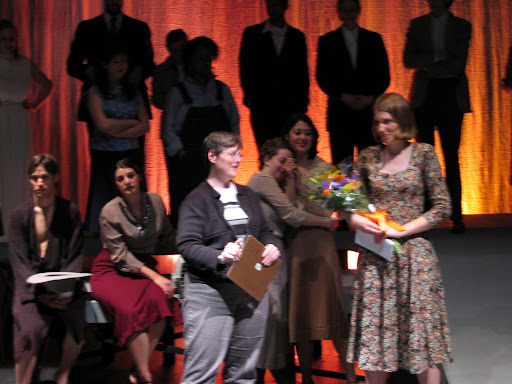 Again, it felt so strange to walk down that ramp and accept the award...ever since I first heard of the Seven Contest, I imagined winning it someday, just as I had always dreamed of seeing my play about Vassar performed at Vassar. So to have both those things happen, in an instant, on April 11, was quite surreal.
Now that Dynamo's over, it's nice to remember that, oh yeah, I have a life as a college student outside of the theater. Some of the things I've been enjoying:
 Again, it felt so strange to walk down that ramp and accept the award...ever since I first heard of the Seven Contest, I imagined winning it someday, just as I had always dreamed of seeing my play about Vassar performed at Vassar. So to have both those things happen, in an instant, on April 11, was quite surreal.
Now that Dynamo's over, it's nice to remember that, oh yeah, I have a life as a college student outside of the theater. Some of the things I've been enjoying:
- Lying in the grass in front of the Drama building, scooting further and further back as the afternoon wears on and the shadows come creeping across the grass, and reading The New Yorker. I just finished the article in this week's "Journeys" issue about the woman who went swimming in the Arctic Ocean. How nice to be warm and safe on the Vassar campus, not surrounded by icebergs and jellyfish and 30-degree water!
- Cooking for myself! I didn't feel like anything too elaborate tonight, so I made one of my quickest and easiest meals, Pseudo-Bruschetta (my own invention). Brush crusty bread with olive oil, maybe rub it with garlic, and toast it in oven. Meanwhile, heat some olive oil in a skillet, then dump in a can of cannelloni beans. Mash the beans with a potato masher, the back of a fork, whatever, while stirring them around. You want them to give up their liquid, then you want to reduce that liquid into a thicker paste. When beans are mostly thickened, add a can of tuna fish packed in oil. Then dice 2 plum tomatoes, add to the mixture, and cook until just heated through. Serve with toasted bread, drizzled with extra virgin olive oil and parmesan cheese.
- But I'm also grateful to generous relatives who take me out to dinner. My parents treated me and Rachel to a great meal on Saturday; and tomorrow my uncle and aunt are coming to Poughkeepsie to attend a wedding, and are going to take me out to eat, too!
- Having my windows open and hearing the Vassar chapel bells every day at 12:30 and 5 PM. I'm going to miss them when I go.
- Making fun of the Miscellany News, its typos, the silly things it says about drama kids, the obviously made-up questions submitted to our sex columnist. E.g. "Can you tell me about syphilis?" Though this did lead to the greatest headline I have seen in a while: "Tolstoy Contracted Syphilis, And So Could You."
- Catching up on my work for all my other classes... This week I have given a presentation on The Taming of the Shrew, another on nineteenth-century perceptions of female hysteria in France, worked on a new one-act play, and read about fin-de-siècle Vienna and Budapest.
Saturday, April 12, 2008
Infinite variety, boundless bounty
 The production of Antony and Cleopatra that started it all (OSF, 2003). Photo found at paulb.com.
My Dynamo project is--hard to believe--over with, after two performances of my play The Rose of Youth yesterday. You know how it is when you anticipate something for so long and it finally arrives, and after that you aren't sure what to do with yourself? That's where I'm at right now. I can't even see the big picture yet, but can only isolate small moments. Here's one of them: about my friend Rachel, the founder of Dynamo, and someone I've known for a really long time, but never so closely as now.
I first met Rachel nearly five years ago, at the OSF Summer Seminar for high-schoolers. Among the plays we saw that summer was a really terrific, intimate production of Antony and Cleopatra, which made a big impression on me. Indeed, I wouldn't have written The Rose of Youth if that production of A&C hadn't alerted me to the play's beauty and power.
That summer, OSF also had a copy of Shakespeare's First Folio on loan from Paul Allen's collection. A curator lectured to us on the history of the Folio and then invited us, in small groups, to gaze upon this priceless book. It was kept in a secured, controlled environment, in a plexiglass case, resting upon a special stand that could hold it open without straining its binding. It was open to Enobarbus' famous speech from Antony and Cleopatra:
Age cannot wither her, nor custom staleThe curator told us that he'd done this on purpose: though these lines refer to Cleopatra, they work equally well to describe the bounty, the timelessness, the richness of Shakespeare's oeuvre. It was a moment of awe.
Her infinite variety. Other women cloy
The appetites they feed, but she makes hungry
Where most she satisfies.
After that summer, Rachel and I lost touch, but we both ended up at Vassar--I still remember the shock of recognition when I ran into her at freshman registration. We both did a lot of theater--together and separately--until she invited me to be a playwright/collaborator on Dynamo a year ago. All last fall, we and the other two founders (Thane and Molly) worked closely on this project, getting to know one another better--and though I knew Rachel liked my play, I was still so grateful and flattered when she offered to direct its world premiere in early March.
When we read my play out loud for the first time, there was one scene that simply did not work. I had had Antony's death scene as a play-within-the-play, but that made things too slow and tragic. I needed a different Shakespeare scene, and promised to find one by the next day--praying that something else in Antony and Cleopatra would work. To my great relief, I found one: Act 4 Scene 4, where Cleopatra arms Antony before he goes off to battle. It is shorter than Antony's death scene, lighter in tone, and altogether better. I emailed the new scene to Rachel and the other company members before I went to bed that night.
The next day, I ran into Rachel in the cafeteria. While she went to buy food, I sat at a table musing on my great good fortune to have found a scene to substitute for Antony's death. I silently thanked Shakespeare for the gift of his writing, from which I can continually draw new pleasure and insight. This reminded me of those beautiful lines from Romeo and Juliet:
My bounty is as boundless as the sea,And this, in turn, reminded me of "infinite variety" and the Enobarbus speech, and as I pondered these two quotes--two among thousands of Shakespeare's gifts to us--I found myself tearing up. Thoughts of seeing the First Folio at Ashland led to thoughts of meeting Rachel, and how that summer we never could have predicted we'd wind up here, founding a theater ensemble, her directing a play I'd written... I thought of Rachel's generosity, and our ensemble's, but most of all Shakespeare's. So I sat there in the cafeteria, getting all verklempt, then looked up, wiped my eyes, and waved to Rachel--who sat down, and began discussing the nuts-and-bolts of staging my play.
My love as deep; the more I give to thee
The more I have, for both are infinite.
I think that that is how I would like to remember this project.
Thursday, March 6, 2008
It's a Sign
Gearing up for my world premiere tomorrow. Fortunately, I've been so busy this week with midterms and with simple logistical issues that I haven't had time to engage in any lengthy reflections about "the meaning of a world premiere," and thus am avoiding major bouts of neurosis. And besides--the staging looks beautiful (it is amazing what fifteen people can accomplish in four days) and several moments of the script that I wasn't sure would actually work onstage, work beautifully.
I've had the idea for this play in mind for nearly three years now, and it was all prompted by a photograph of Hallie Flanagan's production of Antony and Cleopatra. Hallie is a very important figure in theatrical history, but even at Vassar she sometimes goes overlooked. One of our theaters on campus is called "The Hallie Flanagan Davis Powerhouse Theater" which sounds so formal that when I was a freshman, I assumed it was named in honor of some wealthy benefactress. Only when I started to research this play did I learn that art--not commerce--won out this time. And that there could not be a better name for a Vassar theater. I am honored that my play will premiere there tomorrow.
And today, on that wonderful grab-bag blog if charlie parker were a gunslinger, the powers that be decided to put up this photo:

It's Hallie Flanagan herself. And check out the comment on the post: "Those wild Vassar girls." Nice to know that some people out in blogland still recognize Hallie's name. And nice to think that we wild Dynamo kids are trying to uphold her legacy.
I take this as a positive sign. I have lots of work still to do tonight, so may not sleep much--but, when I do sleep, I'll sleep contented.
I've had the idea for this play in mind for nearly three years now, and it was all prompted by a photograph of Hallie Flanagan's production of Antony and Cleopatra. Hallie is a very important figure in theatrical history, but even at Vassar she sometimes goes overlooked. One of our theaters on campus is called "The Hallie Flanagan Davis Powerhouse Theater" which sounds so formal that when I was a freshman, I assumed it was named in honor of some wealthy benefactress. Only when I started to research this play did I learn that art--not commerce--won out this time. And that there could not be a better name for a Vassar theater. I am honored that my play will premiere there tomorrow.
And today, on that wonderful grab-bag blog if charlie parker were a gunslinger, the powers that be decided to put up this photo:
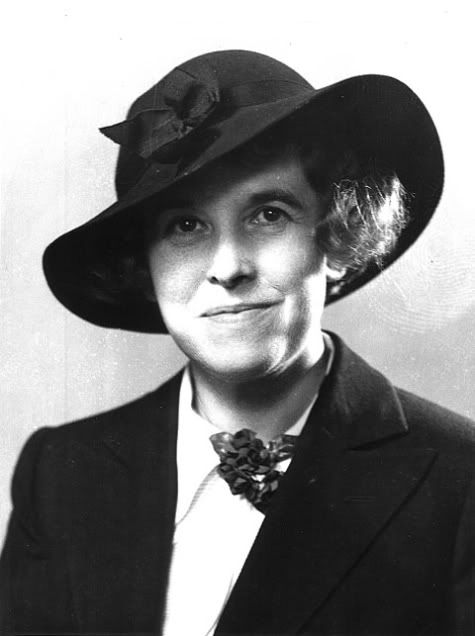
It's Hallie Flanagan herself. And check out the comment on the post: "Those wild Vassar girls." Nice to know that some people out in blogland still recognize Hallie's name. And nice to think that we wild Dynamo kids are trying to uphold her legacy.
I take this as a positive sign. I have lots of work still to do tonight, so may not sleep much--but, when I do sleep, I'll sleep contented.
Saturday, February 23, 2008
Presenting the Dynamo Theater Lab
You might have noticed that I've been posting less frequently on my blog these days... and if you're really astute, you might have noticed several of my posts concerning my new play are tagged "The Rose of Youth." What's that about? Well, I am in the middle of a very exciting theater project, which has been in its planning stages since last fall, and now has finally begun in earnest!
Dynamo Theater Lab is an experiment in presenting vibrant productions of new plays without needing to invest months of time or heaps of money in them. We will perform three shows, one the play I wrote for my senior thesis, The Rose of Youth. We are a 15-member ensemble that does everything ourselves: casting, acting, designing, directing... whatever we need to do to get these plays on their feet!
I'm one of the "original" Dynamo members, the four senior drama majors who laid the groundwork for this last fall. The idea originated with my friend Rachel, who then got the rest of us on board. What's nice is that we all approach theater from a different perspective--Thane is an actor, Rachel is a producer/director, Molly is a designer, and I'm a playwright--so we complemented each other well. We also sought variety in our three shows:
Interested in learning more? You can get tickets to Dynamo, read about us in Vassar's student newspaper, and become a fan of us on Facebook!
Dynamo Theater Lab is an experiment in presenting vibrant productions of new plays without needing to invest months of time or heaps of money in them. We will perform three shows, one the play I wrote for my senior thesis, The Rose of Youth. We are a 15-member ensemble that does everything ourselves: casting, acting, designing, directing... whatever we need to do to get these plays on their feet!
I'm one of the "original" Dynamo members, the four senior drama majors who laid the groundwork for this last fall. The idea originated with my friend Rachel, who then got the rest of us on board. What's nice is that we all approach theater from a different perspective--Thane is an actor, Rachel is a producer/director, Molly is a designer, and I'm a playwright--so we complemented each other well. We also sought variety in our three shows:
- Bastard Nation is a fast-paced satire about America, immigration, Wal-Mart, Christianity, and mad cow disease, by Hudson Valley playwright John Christian Plummer. (When the news came out on Monday about the ground beef recall and the fears of mad cow disease, this play suddenly felt prophetic!)
- There Was No Time Before the War takes place in a dystopian factory--and what's really cool is that the scenes can be performed in any order you like. It's by Jason Platt, who graduated Vassar in 2006.
- The Rose of Youth (my play) is a backstage drama with a huge cast, about Hallie Flanagan's production of Antony and Cleopatra in 1934.
Interested in learning more? You can get tickets to Dynamo, read about us in Vassar's student newspaper, and become a fan of us on Facebook!
Sunday, February 3, 2008
Remembering Wendy Wasserstein
If you had told me in, say, 2004, that Arthur Miller, August Wilson, and Wendy Wasserstein would all die within a twelve-month period, I would have said you were crazy. Sure, Miller was almost 90 years old, but Wilson was in his late 50s and Wasserstein was five years younger than that. However, that sad prediction turned out to be the truth. Wilson never got the chance to show us what he would do after he completed his impressive Century Cycle. Wasserstein's death deprived baby-boomer women of the playwright most devoted to chronicling their stories.
Wasserstein belongs to my mother's generation, but because there still aren't a lot of successful American female playwrights, I looked up to her too. It seems that no one ever had a bad thing to say about her, and I imagined that if I became a playwright, I might get to meet her, thank her, chat with her... So her death really saddened me. I wrote a paper that spring on The Heidi Chronicles, as a homage.
I meant to post this entry on January 30, the second anniversary of Wasserstein's death, but was too busy polishing up a play of my own. Though that's appropriate, too. It's even an instance of my life coming full circle. I just discovered an e-mail I wrote to my adviser two years ago, expressing my sadness about Wasserstein and my excitement to start researching a new play. My adviser wrote back:
I was also shocked to learn of Wendy Wasserstein's death, although I did know that she was seriously ill. Wendy delivered an address in the chapel at Vassar at one point, and it was a huge success. She was very honest and very funny. Sometimes I think the two things go together. And she was also, I think, a significant playwright. She knew what life is about and how to dramatize it. You should write your paper on The Heidi Chronicles. More importantly, however, you should keep writing plays yourself. Show Wendy's spirit the stuff Marissa is made of. Get inside Hallie Flanagan. She will bounce you around a bit, both intellectually and emotionally.Of course, this "new play" turned into my senior thesis play--the one about Hallie Flanagan and the 1930s. But I doubt any of us knew that it would take me exactly two years to find the structure for this play--two years since I started researching it, two years since Wendy's death.
I'll admit sometimes I'm a little annoyed at Wasserstein's plays for their lack of "theatricality"--they do not use the stage in innovative ways, and her most famous play, The Heidi Chronicles, is episodic. I wouldn't really call the events of her plays "gripping," and even her celebrated wit makes you chuckle, not guffaw; nor does she pierce you with black humor. There's a very interesting article in The Boston Globe that relates to this--whether it's OK to criticize Wasserstein's work for its style and narrowness of scope, in light of all the good she did for female playwrights. I agree with a lot of what this article says.
Despite the baby-boomer focus of her plays, I do relate to Wasserstein's characters. This year, I've thought a lot about Uncommon Women and Others, because it concerns a group of girls in their senior year of college. One of my housemates is a driven pre-law student, just like the character of Kate; another is a funny, self-deprecating Jewish girl, like Holly.
My high school almost produced Uncommon Women my senior year, at my suggestion. Originally, our theater teacher planned to produce the all-female play Vital Signs, which is a collection of about 30 short monologues. I read it and found it boring, so my teacher challenged me to come up with something better. The next morning, I invaded his homeroom and thrust Uncommon Women under his nose. He agreed to produce it, and for the next few weeks we thought about the play, watched the TV version repeatedly, discussed the pop-culture references, etc.
At the time, I wanted to play Kate, Rita, or Leilah--and I can still see aspects of those three characters within me. Kate is my driven, determined side--the part of me that knows I am going to be a playwright and will let nothing stand in my way. Rita is the part of me that likes to make people laugh--the part of me that enjoys crazy costume parties and oddball theories and acting like a loopy drama major. And Leilah is my insecurities and neurosis and feeling like an eternal runner-up.
We ended up not producing Uncommon Women, because most of the females who auditioned were high-school freshmen, and it wouldn't be right to see them discuss sex and orgasms and menstruation. It still remains one of my favorite Wasserstein plays, perhaps because her characters are youngest and I can relate to them best, perhaps because it's less tied to seminal baby-boomer events than The Heidi Chronicles is, perhaps because it's one of the few plays I know that celebrates female friendship above all other relationships.
Indeed, Wasserstein said, she wrote Uncommon Women because she wanted to see an all-female curtain call on the stage of the stodgy old Yale School of Drama. That's what I love about her. That's what still inspires me.
Thursday, January 10, 2008
Decoding the 1930s
As I continue revising my play set in 1934, I have to research and consider all kinds of odd subjects. I can spend inordinate amounts of time pondering questions like "What would a 21-year-old theater-loving girl name her new pet cat?"--even though it might seem like a throwaway line of dialogue. (I chose the name "Pandora," if you're curious.)
One of the first things I learned about 1934 was that it was the year the Production Code went into full effect, imposing a new level of censorship on American movies. In my revised draft, I have a scene for 2 characters discussing the Code after they go see a Mae West movie. Oddly enough, as I surfed the Internet while taking a break from writing this scene, I came across an essay by the Self-Styled Siren about the Code and why nostalgia for it is misguided. Go check it out--it, the other stuff she links to, and the long comment thread, is fascinating and thought-provoking. And gave me even more stuff to TRY to cram into my play.
The Mae West movie in my play, by the way, is I'm No Angel (which actually came out in 1933 but I am taking poetic license). I chose it because, in the course of some more research ("research" meaning "random Wikipedia-surfing") I learned that it has a musical number in it called "No One Loves Me Like that Dallas Man." Some of the characters in my play are from Dallas--perfect! And thanks to YouTube, you can see Mae in action:
I learned that even though I'm No Angel is "pre-code," it still came in for some censorship. The original title of Mae's song was supposed to be "No One Does It Like that Dallas Man." I also had trouble understanding some of the lyrics in this film clip, so another source revealed that they are "He's a wild horse trainer / With a special whip." I'm guessing that the censors made Mae hum and "da-da-da" over those lyrics in the final version.
But, to make this song choice even more appropriate, my play already had a whip in it...though I'll leave you guessing as to how!
One of the first things I learned about 1934 was that it was the year the Production Code went into full effect, imposing a new level of censorship on American movies. In my revised draft, I have a scene for 2 characters discussing the Code after they go see a Mae West movie. Oddly enough, as I surfed the Internet while taking a break from writing this scene, I came across an essay by the Self-Styled Siren about the Code and why nostalgia for it is misguided. Go check it out--it, the other stuff she links to, and the long comment thread, is fascinating and thought-provoking. And gave me even more stuff to TRY to cram into my play.
The Mae West movie in my play, by the way, is I'm No Angel (which actually came out in 1933 but I am taking poetic license). I chose it because, in the course of some more research ("research" meaning "random Wikipedia-surfing") I learned that it has a musical number in it called "No One Loves Me Like that Dallas Man." Some of the characters in my play are from Dallas--perfect! And thanks to YouTube, you can see Mae in action:
I learned that even though I'm No Angel is "pre-code," it still came in for some censorship. The original title of Mae's song was supposed to be "No One Does It Like that Dallas Man." I also had trouble understanding some of the lyrics in this film clip, so another source revealed that they are "He's a wild horse trainer / With a special whip." I'm guessing that the censors made Mae hum and "da-da-da" over those lyrics in the final version.
But, to make this song choice even more appropriate, my play already had a whip in it...though I'll leave you guessing as to how!
Saturday, November 24, 2007
Idyllic Childhoods and Rude Awakenings
Today in the New York Times Online, Kurt Campbell blogs about how the Republicans are now trying to impugn Bill Clinton by saying he treated his presidency like a "holiday from history," ignoring global problems in favor of a "Gatsby-like...fun-filled and frolicking interwar period." I found this article interesting and thought-provoking. Although I am a Democrat, I guess I too had thought of the 1990s as a "holiday from history." Campbell makes a good case for Clinton's real foreign policy achievements, but you have to admit that these are not as well publicized or as flashy as other events of the Clinton years.
Perhaps I can be excused for not knowing this about Clinton--I was a child, aged 5 to 13, during his presidency. And though all parents try to give their children a carefree childhood, I think that growing up in the 1990s was especially idyllic. I never had to worry about "the Commies." I never thought of America as having any real enemies, and if we got involved in a war, I was sure it would only be to help an innocent little country that was threatened by a nasty dictator (like Kuwait or Kosovo). I thought there would never be an attack on American soil, nor would America ever become the aggressor in a war. And though part of this is just childish naivete, I doubt I was the only person who felt this way. After all, the 1990s were the decade when people talked seriously about Francis Fukuyama's "End of History" theory.
I was 14, beginning my sophomore year of high school, on September 11. The external, foreign world came crashing into America and all I could think of was that old cliché "This is the first day of the rest of your life." And usually that's a positive, optimistic sentiment, but I saw it as something darker. I knew that the 1990s tranquility had vanished--for the rest of my life. And of course I was saddened and angry with the terrorists. But I have also felt increasingly betrayed by the Republican administration, whose policies make peace and tranquility even more a relic of a bygone age.
And now that I'm writing a play set in 1934, I can't help imagining that the girls I'm writing about experienced emotions similar to mine. They were born circa 1913, so the first five years of their lives were taken up by the "Great War," which probably frightened them, but they were too young to really understand it. Then, from the time they were 5 to the time they were 16, they experienced that "Gatsby-like interwar frivolity" that Campbell mentions. It was the Roaring Twenties, business boomed, the international community was basically at peace, it was just as idyllic as the 1990s were for me. But when they were about 16, the stock markets crashed, and the rest of their high school and college years were an attempt to find their way back to normalcy in an increasingly unstable world.
You can even draw further parallels, saying that in both cases, the crisis (9/11/01 or 10/29/29) occurred on a Tuesday in autumn, when the president (Bush or Hoover) hadn't even been in office for a year. This reinforces the sense that something had shifted: a new decade, a new president, a new era. Though of course, the people of the 1930s at least gained hope when they kicked Hoover out of office in 1932 and elected Roosevelt. Me, I've had to resign myself to spending my formative years, ages 13 to 21, under George Bush's presidency...and I couldn't even cast a symbolic vote against him in 2004.
Though my play is set in the past, I want it to be relevant to the present, so I'm trying to bring out this theme of an idyllic childhood suddenly shocked into brutal reality. I think my peers ought to relate. It's interesting to note that in the "Generations" theory of history, which sees things as cyclical, my generation (the Millenials) and the generation of the girls born in 1913 (the G.I or Greatest Generation) are categorized as belonging to the same point in the cycle. We are born during an Unraveling and come of age during a Crisis. Sounds pretty accurate to me.
Perhaps I can be excused for not knowing this about Clinton--I was a child, aged 5 to 13, during his presidency. And though all parents try to give their children a carefree childhood, I think that growing up in the 1990s was especially idyllic. I never had to worry about "the Commies." I never thought of America as having any real enemies, and if we got involved in a war, I was sure it would only be to help an innocent little country that was threatened by a nasty dictator (like Kuwait or Kosovo). I thought there would never be an attack on American soil, nor would America ever become the aggressor in a war. And though part of this is just childish naivete, I doubt I was the only person who felt this way. After all, the 1990s were the decade when people talked seriously about Francis Fukuyama's "End of History" theory.
I was 14, beginning my sophomore year of high school, on September 11. The external, foreign world came crashing into America and all I could think of was that old cliché "This is the first day of the rest of your life." And usually that's a positive, optimistic sentiment, but I saw it as something darker. I knew that the 1990s tranquility had vanished--for the rest of my life. And of course I was saddened and angry with the terrorists. But I have also felt increasingly betrayed by the Republican administration, whose policies make peace and tranquility even more a relic of a bygone age.
And now that I'm writing a play set in 1934, I can't help imagining that the girls I'm writing about experienced emotions similar to mine. They were born circa 1913, so the first five years of their lives were taken up by the "Great War," which probably frightened them, but they were too young to really understand it. Then, from the time they were 5 to the time they were 16, they experienced that "Gatsby-like interwar frivolity" that Campbell mentions. It was the Roaring Twenties, business boomed, the international community was basically at peace, it was just as idyllic as the 1990s were for me. But when they were about 16, the stock markets crashed, and the rest of their high school and college years were an attempt to find their way back to normalcy in an increasingly unstable world.
You can even draw further parallels, saying that in both cases, the crisis (9/11/01 or 10/29/29) occurred on a Tuesday in autumn, when the president (Bush or Hoover) hadn't even been in office for a year. This reinforces the sense that something had shifted: a new decade, a new president, a new era. Though of course, the people of the 1930s at least gained hope when they kicked Hoover out of office in 1932 and elected Roosevelt. Me, I've had to resign myself to spending my formative years, ages 13 to 21, under George Bush's presidency...and I couldn't even cast a symbolic vote against him in 2004.
Though my play is set in the past, I want it to be relevant to the present, so I'm trying to bring out this theme of an idyllic childhood suddenly shocked into brutal reality. I think my peers ought to relate. It's interesting to note that in the "Generations" theory of history, which sees things as cyclical, my generation (the Millenials) and the generation of the girls born in 1913 (the G.I or Greatest Generation) are categorized as belonging to the same point in the cycle. We are born during an Unraveling and come of age during a Crisis. Sounds pretty accurate to me.
Monday, November 5, 2007
Cleopatra in Bias-Cut Lamé
 Claudette Colbert as Cleopatra. Photo from jurgenfauth.com
One of the many cultural artifacts I am incorporating into my new play is Cecil B. DeMille's 1934 movie of Cleopatra starring Claudette Colbert. After all, the premise of my play is Hallie Flanagan and a bunch of Vassar girls performing Shakespeare's Antony and Cleopatra in 1934, so how could I not mention it?
The movie is a rather bizarre mix of tones. Sometimes it's very stilted, the dialogue clumsily "rhetorical," too much emphasis placed on DeMille's eye-popping spectacle. At other times, the characters are very modern and earthy--sometimes jarringly so. In one Roman party scene the dialogue could pass for 1930s cocktail banter and the ladies' "togas" could pass for stylish Art Deco evening gowns.
But this made me think of the intriguing website The Cleopatra Costume, which investigates what the real Cleopatra might have worn, and how she has been costumed in movie and stage versions of her story. The conclusion? Cleopatra's costume nearly always reflects the fashions of the day. Colbert's Deco-style gowns are just one example.
Hallie Flanagan definitely would have approved of this. In her 1934 production, Cleopatra wore a sleek turquoise velvet sheath dress, and the soldiers wore white uniforms based on the uniforms of Mussolini's troops in North Africa. Hallie scorned "historical or archaeological" designs, and wanted to make the play immediately accessible to her audience. She preferred to capture the essence of "Seductive Queen" or "Soldier" rather than getting trapped in irrelevant historical detail.
Sunday, November 4, 2007
NaPlWriMo?
I'd heard of NaNoWriMo before and now it seems that authors of other genres are jumping on the bandwagon. For dramatists, there's now NaPlWriMo...write a play of at least 75 pages between 12:00 AM November 1 and 11:59 PM November 30.
I'd be tempted to become an official NaPlWriMo writer, because that's basically what I need to do for my senior thesis play...write it this month. (I've been slacking off, to my chagrin.) However, I don't qualify, because I've been thinking about this play and doing research for years, I have some scenes already started, and I don't really feel like "reporting to the forums every week on my process." Maybe that's meant to be encouraging...but writing's always been a solitary activity for me. I get self-conscious. And also, paranoid that other writers are going to steal my ideas.
Think of me, then, as the "shadow" NaPlWriMo participant. It will get done--and it'll be more than 75 pages, because it needs to be that length--but I know I can do it. Last December I wrote 40 pages in 4 days. Fueled by lots of caffeine and greasy diner food.
Now I've just got to motivate myself to plug away at it. And, preferably, fall in love with my play so deeply that I can't not write it. Pep talks encouraged in the comments!
I'd be tempted to become an official NaPlWriMo writer, because that's basically what I need to do for my senior thesis play...write it this month. (I've been slacking off, to my chagrin.) However, I don't qualify, because I've been thinking about this play and doing research for years, I have some scenes already started, and I don't really feel like "reporting to the forums every week on my process." Maybe that's meant to be encouraging...but writing's always been a solitary activity for me. I get self-conscious. And also, paranoid that other writers are going to steal my ideas.
Think of me, then, as the "shadow" NaPlWriMo participant. It will get done--and it'll be more than 75 pages, because it needs to be that length--but I know I can do it. Last December I wrote 40 pages in 4 days. Fueled by lots of caffeine and greasy diner food.
Now I've just got to motivate myself to plug away at it. And, preferably, fall in love with my play so deeply that I can't not write it. Pep talks encouraged in the comments!
Subscribe to:
Posts (Atom)