Showing posts with label religion. Show all posts

Monday, March 14, 2011

More on adaptation, and the heart versus the head

A couple more thoughts that are rolling around in my head after I wrote my last post:
  • I'm amazed that, in my discussion of adapting classic works of literature and whether you can really enjoy a dramatic adaptation of a novel you've read, I didn't expand this to discuss theater --how this might apply to producing/directing classic plays. I think most theatergoers have experienced the phenomenon of going to see a production of a Shakespeare play (or other classic) where the director is so keen to put his own spin on the material that it prevents you from engaging with the play. You know, flash and dazzle productions where you can admire the artists' cleverness, but not connect on an emotional level. I'm not saying that all "concept" productions of Shakespeare are like this, and still less that no modern production of Shakespeare can succeed on an emotional level. But I do have a marked preference for productions whose goal is to "engage deeply with the text" rather than "go by the Rule of Cool."
  • In an email, my dad called me out on the following claim, "I tend to believe that art that taps into your emotional, subconscious brain is more valuable than art that welcomes cool, distanced consideration." Do I really believe that? (Or maybe I believe it more strongly than my dad does.) I think this is one reason why I have trouble appreciating contemporary conceptual art. I'm not one of those people who says that art (visual art) must be beautiful, but I do think it must be visceral -- touching you at a level beyond language. Just as with conceptual productions of classic plays, some conceptual art pieces do succeed on a visceral level as well as an intellectual one, and some don't... which is why I consider the visceral pieces to be more fully successful.
  • There's a quasi-spiritual aspect to all of this. We have a godlike omniscience when we watch an adaptation of a classic novel and know in advance what will happen, which can also lead to a godlike sense of superiority and boredom. When we watch an unfamiliar story, living and suffering along with the characters, we are not gods -- or perhaps we are like Jesus, making the characters' suffering our own.

Tuesday, December 28, 2010

Pagan Christmas, or Magic is Everywhere

My parents came to visit me over the holiday weekend. It was the first time I hosted them for Christmas, rather than going to my childhood home -- which led to some "Wow! I'm an adult!" moments.

Religion-wise, the three of us range from "Catholic-raised agnostic who wants to be more spiritual" (me) to "Attends Catholic church but is cagey whether she actually believes it" (Mom) to "Liberal, believing Catholic who also enjoys Eastern spiritual traditions" (Dad). So we didn't mind having what my mother called a "pagan Christmas." On Christmas Eve, we went to see The Arabian Nights at Berkeley Rep -- i.e., we journeyed to the People's Republic of Berkeley to see a play rife with ribaldry, based on folklore from the Muslim world. How un-American of us!

The Arabian Nights was just as good this time as it was nearly two years ago, and I was so happy to be able to share it with my parents. (That's one of the negatives of theater: as such an ephemeral art form, it is rare to be able to share your favorite theater pieces with everyone you love.) Even the prologue -- the transformation of the theater from a bare stage to a rich panoply of Oriental carpets and hanging lamps -- moved me to tears. And I cried again at the ending, a parable about the importance of telling stories and sharing one's wisdom. The moral of this tale is that stories "come from God." (And how moving, how ineffably moving, that this is the first time the word "God" is used in the play. In the other scenes, the characters consistently say "Allah" to mean "God" -- and Westerners are apt to forget that the two words are synonyms, because "Allah" sounds so exotic. Then, in the last scene, they say "God," and it socks you in the gut.)

So, maybe I'm not a pagan after all. Because theater -- intensely felt, humanistic theater -- is my religion. Mary Zimmerman's The Arabian Nights is a religious experience and the perfect show on which to end my busiest-ever year of theatergoing.

Last week I participated in the holiday Theater Pub show, a collection of monologues and scenes about "How I Learned the Truth about Santa Claus." And that got me thinking about how Santa Claus himself is a form of theater -- a costume we put on, a lie we tell, a charade we keep up, a character we portray, because it makes the world a more interesting and entertaining and happy place. We talk about "the magic of theater," but we also talk about "the magic of Christmas," and in both cases we are referring to a similar kind of emotion. The red velvet curtain of the theater bespeaks the same promise of wonder and delight as the red velvet suit of Santa Claus.

When I was a high school freshman (ten years ago!) I was in a community theater show called Holiday Magic Breakfast Theatre. We were a bunch of teenagers dressing up and singing Christmas carols and Disney songs for an audience of children ten-and-under, serving them breakfast, and concluding with a visit from Santa. At the time, I thought that the title (indeed, the whole show) was pretty cheesy. I wore a tacky calico Christmas dress and pranced around the room belting out "Winter Wonderland" while little kiddies and their parents ate soggy pancakes. But now that I'm older, I can appreciate it more, what we did -- it may not have been Great Theater, but it got such a warm response every time. And "Holiday Magic Breakfast Theater" -- are there four lovelier words in the English language?

Santa Claus is magic.
Theater is magic, and magic is theater, as Shakespeare teaches us in The Tempest. (And, theater is therapy is magic, as Cutting Ball's The Tempest taught me earlier this year.)
Theater is storytelling.
Stories come from God.
God is love.
Love is magic.
God is omnipresent.
Theater is Santa Claus is magic is love is God is omnipresent.

Happy holidays.

Friday, August 8, 2008

Crazy Eights

Everyone must be aware that today is 8/8/08, and that the Beijing Olympics began at 8:08:08 PM to further reinforce the pattern. To celebrate this numerical quirk, I thought I'd make a list of Eight Nifty Things that Come in Eights.

1. The History Boys: The titular boys are eight in number--all bright lads applying to Oxford and Cambridge. I saw the play on Broadway and really appreciated it, then saw the movie version last week and think it might be even better: it's more streamlined, and I am SO glad that all of the original cast members participated! It's also what prompted this post, as I got to thinking about other works of fiction that feature groups of eight characters...


2. ...like 8 Women, a crazy, campy, French musical-comedy-mystery-melodrama film. One of my ultimate guilty pleasure movies. But with actresses like Deneuve, Huppert and Ardant among the eight women, how can you possibly go wrong?

3. The Group: In this Mary McCarthy novel, eight women are the main characters; again, it's a bit of a guilty pleasure, but a fun read. I wrote about it last year here on my blog.

4. "Octet" from The Light in the Piazza: This song contains some of the most beautiful, soaring melodic themes in the musical, and very poetic lyrics. One of my favorite moments in the Lincoln Center production came at the end of this number, when the characters paired off in couples--Clara & Fabrizio, Franca & Giuseppe, Mr. & Mrs. Nacarelli--leaving only the Priest and Margaret. The Priest was on the sidelines, but Margaret stepped downstage center, and you suddenly realized how profoundly alone she was, even in the midst of the beautiful harmonies surrounding her.

5. The Wheel of the Year: In "Octet," the characters sing "The shock of winter / The coming on of spring / Suspended summer nights / The eager flights / That only fall can bring." So, four seasons. And if you have two holidays per season--one at its commencement, one in the middle--that gives you eight holidays, as well as the Wheel of the Year used by Wiccans. I read a lot of fantasy novels when I was younger, many written by Wiccans, so I learned a lot about the eight festivals: Samhain, Yule, Imbolc, Ostara, Beltane, Midsummer, Lughnasa and Harvest Home. Or, if you prefer a medieval Christian cycle of holidays: Halloween, Christmas, Candlemas, Lady Day, May Day, St. John's Eve, Lammas and Michaelmas. Though neither a pagan nor Christian, I am still attracted to the idea of having a festival to reconnect with the cycle of nature every month and a half.

6. Ottava rima: A stanza of eight lines that rhyme A-B-A-B-A-B-C-C. It's more often used in Italian than English, as the name suggests, but it's also the rhyme scheme that Byron chose for his long comic poem "Don Juan." The first six lines of each stanza are just long enough for Byron to set up a joke, then the final couplet serves as a zingy punchline, often with a hilarious trick rhyme involved. Here is some Byronic wit, which also happens to continue our theme of "seasons" (Canto I stanza 102):
It was upon a day, a summer's day--
Summer's indeed a very dangerous season,
And so is spring about the end of May;
The sun, no doubt, is the prevailing reason;
But whatsoe'er the cause is, one may say,
And stand convicted of more truth than treason,
That there are months which nature grows more merry in:
March has its hares, and May must have its heroine.
7. The Noble Eightfold Path: Another religion which incorporates the number eight is Buddhism. I have always thought that the Buddhists had some good things to say about the causes of suffering and the ways of alleviating it, such as the Eightfold Path to Enlightenment. It consists of: right perspective, right intention, right speech, right action, right livelihood, right effort, right mindfulness, and right concentration. That is, first you get in the right frame of mind, then you strive to live ethically, and only then can you gain insight into Existence by meditating upon it. (Note that the Eightfold Path is different from the Eight Precepts of Buddhism, which I do not like so much. They suggest that to become more holy, one should refrain from singing, dancing, and going to the theater!)

8. The solar system: Yeah, we all learned that it had nine planets, but now that Pluto has been kicked out, it's back to eight. When I was two years old I said that I wanted to become an astronaut and visit all the planets. This reduction in size of the solar system at least would make my task a little easier...

Photo of the History Boys from darkhorizons.com. Photo of "8 Women" from opalfilmlists.blogspot.com. Photo of the planets from earthhistory.org.uk

Thursday, April 17, 2008

April Grab-Bag

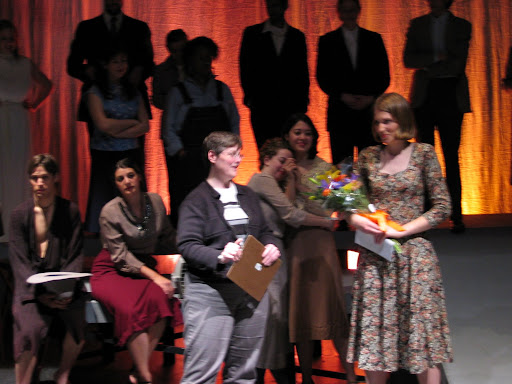
Perhaps it was a little disingenuous at the end of my last post, to write "This is how I would like to remember this project." After all, that was just one of the many facets of Dynamo, and I don't want to privilege one aspect over another, not when I have so many worthy memories. And also, tearful Shakespeare-induced gratitude is nice, but the bigger news from this project is that The Rose of Youth won Vassar's playwriting prize, the Marilyn Swartz Seven contest! So after our first show on Friday there was a wine-and-cheese reception, and free pizza for the cast, and an award for me. Here I am (with bouquet):

Again, it felt so strange to walk down that ramp and accept the award...ever since I first heard of the Seven Contest, I imagined winning it someday, just as I had always dreamed of seeing my play about Vassar performed at Vassar. So to have both those things happen, in an instant, on April 11, was quite surreal.

Now that Dynamo's over, it's nice to remember that, oh yeah, I have a life as a college student outside of the theater. Some of the things I've been enjoying:
  • Lying in the grass in front of the Drama building, scooting further and further back as the afternoon wears on and the shadows come creeping across the grass, and reading The New Yorker. I just finished the article in this week's "Journeys" issue about the woman who went swimming in the Arctic Ocean. How nice to be warm and safe on the Vassar campus, not surrounded by icebergs and jellyfish and 30-degree water!
  • Cooking for myself! I didn't feel like anything too elaborate tonight, so I made one of my quickest and easiest meals, Pseudo-Bruschetta (my own invention). Brush crusty bread with olive oil, maybe rub it with garlic, and toast it in oven. Meanwhile, heat some olive oil in a skillet, then dump in a can of cannelloni beans. Mash the beans with a potato masher, the back of a fork, whatever, while stirring them around. You want them to give up their liquid, then you want to reduce that liquid into a thicker paste. When beans are mostly thickened, add a can of tuna fish packed in oil. Then dice 2 plum tomatoes, add to the mixture, and cook until just heated through. Serve with toasted bread, drizzled with extra virgin olive oil and parmesan cheese.
  • But I'm also grateful to generous relatives who take me out to dinner. My parents treated me and Rachel to a great meal on Saturday; and tomorrow my uncle and aunt are coming to Poughkeepsie to attend a wedding, and are going to take me out to eat, too!
  • Having my windows open and hearing the Vassar chapel bells every day at 12:30 and 5 PM. I'm going to miss them when I go.
  • Making fun of the Miscellany News, its typos, the silly things it says about drama kids, the obviously made-up questions submitted to our sex columnist. E.g. "Can you tell me about syphilis?" Though this did lead to the greatest headline I have seen in a while: "Tolstoy Contracted Syphilis, And So Could You."
  • Catching up on my work for all my other classes... This week I have given a presentation on The Taming of the Shrew, another on nineteenth-century perceptions of female hysteria in France, worked on a new one-act play, and read about fin-de-siècle Vienna and Budapest.
And now, because I was just reminded that Mr. Lehrer turned 80...and because the Pope is visiting America...and because I want to prove to my dad (a Lehrer fan) that I'm not mad at him, though we have been bickering via e-mail for the last two days... here is Tom Lehrer singing "The Vatican Rag."

Sunday, January 6, 2008

Epiphanies of all sorts


Sweeney Todd's "Epiphany." Photo from vh1.com

Happy Feast of the Epiphany! This has always been one of my favorite religious holidays, for its name and the promise it brings of revelation and renewal. The Three Wise Men, the star, and the gold, frankincense and myrrh provide it with interesting imagery. And if you're in France, getting to eat delicious almond King Cake (and possibly getting crowned if you receive the lucky piece) is lots of fun, too.

"Epiphany" is also the title of one of the key songs in Sweeney Todd (saw the movie about a week ago, and enjoyed it). The former pastor at my church had a nasal tenor voice and occasionally sang something as part of his sermon. Once, oddly enough, he chose "Not While I'm Around," from that same musical. And if you divorce that song from its original context of a traumatized child singing to a cannibalistic pie-maker to warn her of a mad serial-killer barber, while meanwhile the pie-maker is plotting to kill the child... then yes, it does work rather well in a Catholic sermon. (I think the priest's point was something about God's love and care.)

A little while after that sermon, it was Epiphany. In the foyer after Mass had ended, I again told the priest how much I had enjoyed "Not While I'm Around" a few weeks earlier, then added, "But it's a good thing you didn't sing 'Epiphany' today!"

You know, the song that has one of my favorite Sondheim lyrics in it (oh, who am I kidding, I have about a hundred favorite Sondheim lyrics):
No, we all deserve to die
Even you, Mrs. Lovett, even I
Because the lives of the wicked should be made brief
For the rest of us death will be a relief
The way this quatrain sums up a whole philosophy of life (or rather, of death) is breathtaking. It divides the world neatly into two groups of people--"the wicked" and "the rest of us" who are abused by the wicked--and argues, with chilling logic, that death is the right answer for BOTH groups--it's like the thought process of a religious fanatic. "Yes, I can go on a Crusade, or a suicide bombing mission, to kill my wicked enemies...and if any innocents get killed in the process, it doesn't matter since they'll go straight to heaven!" It is incredibly rich. And all in only 32 words.

Actually, presenting the song in this context, it could form part of a sermon on fanaticism or negative utilitarianism... but otherwise, it's not something you want to hear on Sunday mornings from the pulpit.

But whether you are having an Epiphany filled with gold, frankincense, and myrrh, or more of a "they all deserve to die" Epiphany, I wish you the very best.

Thursday, December 27, 2007

Happy Holidays from Portland

I feel a little like Garrison Keillor, "It's been a quiet week in Lake Wobegon..." Because it's been a quiet week in Portland, OR, since I got back, and I'm wondering why I don't feel more energized. Sure, I've seen some movies and one piece of theatre, read some books, eaten better food than I have all month, celebrated Christmas with the family... But I'm also very lethargic, not thinking very hard about the play that consumed me during my last week at Vassar (and which I still need to finish) nor very hard about this blog, either, it seems.


Sunday was a good, Portlandy day. I went downtown to see A Christmas Carol at Portland Center Stage, adapted by my mentor, Mead Hunter. I also knew several of the cast members from various summers at JAW. The adaptation was very faithful to Dickens' novella (which I usually make a point of reading every year)--it moved swiftly and did not pad things out with extraneous local color or period detail. It understood that the heart of the show is Scrooge's journey, and once each episode had made its point, it ended. And, though I just complained about the excessive use of narration in Doris to Darlene, I did not mind its more limited use here.

The cast was big (15 adults, 5 children) and expertly choreographed/ doubled to make it look like there were even more cast members than there actually were. One standout was Julianna Jaffe playing the Ghost of Christmas Present à la Sara Ramirez in Spamalot. I saw the show on closing day and couldn't help wondering if some of the performances had gotten overly broad since opening night--especially Scrooge's (Wesley Mann). Several times, it seemed like he acted self-consciously "funny" to make the audience laugh, rather than playing the truth of the character. Musical choices and arrangements were also good--my favorite being the Middle-Eastern orchestration of "Ding Dong Merrily On High" to accompany a scene where Young Scrooge reads The Arabian Nights.

After the show I went to Powell's and bought six wonderful books using the store credit I'd amassed... Santa brought me even more books two days later, so this will be a wonderfully literary vacation. And then, my parents and I reenacted our holiday tradition of a dinner at Higgins restaurant. They are obsessed with a seasonal item on the menu called the Smoked Goose Breast Salad, and me, I don't mind Higgins' cooking either. I've only ever eaten at Higgins in December, and most years, I get the Magret and Confit of Duck with sour cherries and spaetzel. Mmm. Holidays in Portland.

On Christmas Eve, my father and I hedged our bets by going both to The Golden Compass movie (y'know, the movie that Conservative Catholics are all up in arms about) and to 10 PM Catholic Mass. After all my anticipation, you can read my thoughts about The Golden Compass here. I wasn't expecting perfection, and I ended up being mostly entertained. And even though the dialogue was careful to sidestep around Pullman's anti-religious statements, I liked how the production design didn't: the agents of the Magisterium were definitely wearing ecclesiastical robes, and the wall of the Magisterium office in Trollesund was painted with haloed saints. Still, I'm not quite sure why Catholics specifically are attacking this movie, since, even when I first read The Golden Compass as a nine-year-old who wanted to take Catholicism very seriously, I never thought of it as an attack on one specific religion. More an attack on any religion or any cult that wants to control its followers' lives.

As for Christmas mass, since I don't consider myself a Catholic anymore, I go for the singing, and to see the people at church who still remember me. I feel more spiritual when I'm singing those great old songs (and they have to be the rousing old hymns, not the newfangled gentle folky stuff) than during any other part of the ceremony.

And since then...not much. Dad and I made the Gratin Dauphinois from Jeffrey Steingarten's It Must've Been Something I Ate (which I blogged about wanting to cook last August)--turned out very well. So it's been a fat and lazy week--much appreciated after all those finals, but I do hope to shake off this lethargy sometime soon and really get out there and enjoy my vacation!