Showing posts with label hitchcock. Show all posts

Tuesday, June 2, 2009

A Key Fairy-Tale

Stop me if you've heard this one before: A young woman marries a wealthy older gentleman and goes to live in his beautifully appointed mansion. She is given the run of the place, except that she is forbidden to go into the cellar, which her husband keeps locked. Unable to contain her curiosity, the woman steals the key to the cellar and sneaks in. There, she uncovers a dreadful secret. She quickly leaves, endeavoring to conceal the fact that she went where she was forbidden to go. But a telltale dark-red stain alerts the husband that his wife broke into the cellar and discovered what he was hiding there. He becomes enraged and is on the point of killing his wife when, at the last possible moment, a rescuer arrives and saves her life.

Obviously, this is "Bluebeard," as told by Charles Perrault, right? Yes... but isn't it also the story of Hitchcock's Notorious?

The connection hit me today with such force that I'm surprised I never noticed it before--because I love Notorious and am fascinated by "Bluebeard" (I even wrote a "Bluebeard" song once). The dark-red stain is especially remarkable--Bluebeard's magical bloodstained key vs. the traces of red wine in Alex Sebastian's sink.

Of course there's more to the story of Notorious than this, and it functions on many more levels than Perrault's tale does; the addition of the Cary Grant character turns it into an extremely complex love triangle, rather than a fable about curiosity. I love knowing, though, that one reason the movie is so powerful is because part of its story is based on this time-tested and mythic structure...

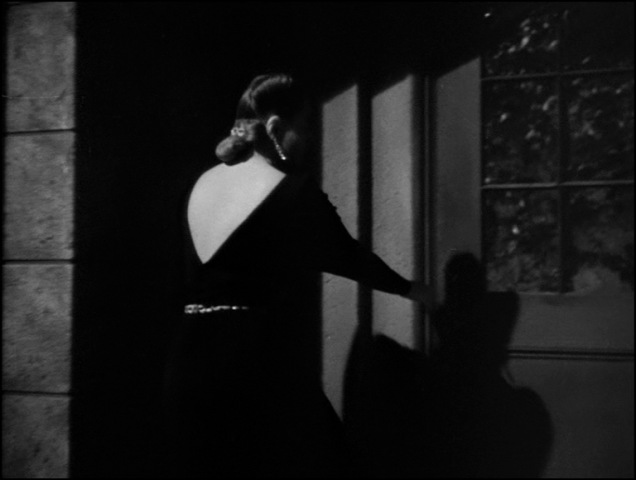
Photo: Alicia (Ingrid Bergman) prepares to open the cellar door. Image from the 1000 Frames of Hitchcock Project.

Saturday, January 17, 2009

Notable Notoriety


Makes me happy: Alfred Hitchcock's 1946 film Notorious has just been re-released on DVD! This masterpiece had been out of print for probably 5 years, much to my consternation, because I love it so much that I think everyone should see it. Before, that was a much more difficult proposition than it should have been. Now, you have no excuse!

I'll admit that in our everything-available-on-demand culture, there is something tantalizing about waiting for a favorite out-of-print movie to be screened at a local arthouse--it makes the experience more precious and valuable. And this felt especially appropriate for Notorious, a movie all about longing and yearning and thwarted sexual tension. Needless to say, it also looks gorgeous on a big screen. (Most beautiful movie-star pairing ever? Perhaps.)

The last time I saw it was at a Hitchcock film festival when I was in Paris; that's where I snapped the photo above. Though I had a brief, wicked urge to emulate the little boy in Day for Night who breaks into his local cinema and steals the lobby cards of Citizen Kane.** I mean, isn't this vintage poster incredible? The French title Les Enchaînés means The Chained Ones--a phrase that captures the film's mood of romantic fatalism.

All the same, I'm glad it's no longer a rarity, and last weekend I bought the DVD half-price at Virgin Megastore. (They are having something called the "Virgin Sacrifice Sale," a name I find hilarious, disturbing, and sad all at once.)

Makes me less happy: Yesterday a biopic about the Notorious B.I.G. was released--also titled Notorious. All right, it's a logical title to use, but I just wish that the filmmakers had thought twice before appropriating the name of an acknowledged Hollywood classic! Somehow it annoys me that for most people of my generation, this film will be what they think of when they hear "Notorious the movie"--not Hitchcock's film. I worry that the 1946 film will get superseded in the popular imagination, in a way that it wouldn't if the makers of the new movie had just used a different title.

Though this could also lead to some humorous situations: now, if people overhear me talk about how much I love Notorious, they'll start to look at me strangely, thinking "Hmm, I'd never have guessed that Marissa was a fan of gangsta rap!"

**And of course the little boy in Day for Night grows up to be François Truffaut. And Truffaut loved Hitchcock, especially Notorious--he called it "the very quintessence of Hitchcock." See, it's all linked. A chain. Les Enchaînés!

Sunday, November 16, 2008

Overheard: The "Hitchcock May Not Have Said This, But I Bet He'd Agree With It" Edition


"Filmmakers love San Francisco because it's like a beautiful woman: It has no bad angles."
--Middle-aged man waiting for a table outside the House of Nanking restaurant, a few weekends ago
Image: Kim Novak (and San Francisco) in Vertigo. Photo from the very cool 1000 Frames of Hitchcock Project.

Monday, December 31, 2007

Best of 2007

Here's my idiosyncratic "Best of 2007" list. Most of the entries here are not things that were originally published or premiered in 2007, since I'm always behind the times, reading books and seeing movies that are a year or more old. This is my own, personal year in review, with links to older blog posts when relevant.

Best book read for the first time: The Virgin in the Garden or Babel Tower. Objectively speaking, Babel is the greater achievement, but I just adore Virgin.

Best book rediscovered: Jane Eyre. I first read it when I was 12 and it didn't do a lot for me. But it was a godsend when I read it again last spring.

Best time in the theatre: Hard to choose. Seeing excellent productions of The Taming of the Shrew, The Cherry Orchard, and Rabbit Hole in the span of three days? The perfect first act of Passion Play in Chicago? Hearing the roars and applause for Cyrano de Bergerac at the Comédie Française and knowing I'd just seen a national treasure? Or, if "in the theatre" can mean working backstage, helping out with Marie Antoinette this summer?
Favorite recent movie seen: The Lives of Others (Does this count as a 2006 or a 2007 release? I don't know. All I know is, I loved it.)

Favorite old movie rediscovered: Vertigo or Strangers on a Train.
New favorite female singers: Amy Winehouse and Natalie Dessay (eclectic enough for you?)

New passions discovered: cooking, photography, opera

Best meal: My theater-themed dinner party when I was in France. Well, the party itself was a bit of a disaster, but the food--especially the pear, chocolate, and almond tart--somewhat redeemed it. Someday I'll post the menu...

Best recipes: I probably made Easy Tarte Tatin (it uses pre-bought pastry) more than anything else, and I'm awfully proud of inventing a Clafoutis recipe all by myself, in my lousy kitchen at school.

Favorite photograph taken: This was at St. Peter's Basilica, Rome. I balanced the camera against the base of a statue--and got an almost divine clarity.


Places visited for the first time: Bordeaux, Rouen, Reims, the Loire chateaux, Prague, Pisa, Florence, Siena, Rome, Cape May, Joseph (Oregon), Chicago

My first experience as an urbanite: Paris (what a way to begin, huh?)

Proudest achievement: Writing a 4,300-word essay on special effects in the films of Alfred Hitchcock--entirely in French

My motto: "It could've been a lot worse."

Wednesday, August 22, 2007

Still Life, Persona, and Meta-Art

I thought some more about A.S. Byatt's Still Life and realized the things I don't like about it are the same things I don't like about Ingmar Bergman's film Persona. That is, in the middle of a perfectly absorbing story rooted in human psychology, the author/filmmaker inserts herself/himself to point up the artifice of it all. It feels jarring--and yes, that's the point, to "shock us out of our complacency," but sometimes I like being complacent in the face of a good narrative, OK?

What annoys me even more is that these metafictional elements often win these works of art their greatest praise. One critic wrote of Still Life: "Among the best new novels I've ever read. (...) Byatt, at last, shows that a novel can think about itself without resorting to nervous Borgesian paper-puzzles, tricks, tics" (citation). Woody Allen called "the opening montage of Persona" and "the chutzpah to stop the engrossing story at intervals and let the actors explain to the audience what they are trying to do with their portrayals" "moments of showmanship at its best" (citation). These statements irk me because they imply that a work of art is automatically brilliant if it makes reference to the fact that it is a work of art. Does that mean these critics wish every work of art had a metafictional twist?

A great theme, by itself, is not enough to make a great work of art. For example, film scholars adore Rear Window because it's a metaphor for how movie-watching appeases our secret voyeuristic desires. That's true, but misses the larger point. If Hitchcock had made a movie with the theme "character's voyeurism implicates the audience's voyeurism," but it was poorly paced or badly acted or just plain dull, it would not be a brilliant film in the same way that Rear Window is a brilliant film. This hypothetical movie might be "smart," its theme might provoke discussion, but if its aesthetic qualities weren't good, it would be forgotten two weeks later. Meanwhile, the craft and narrative of the real Rear Window strengthen its point about the seductive lure of watching. It comments on itself, but much more organically than Persona does.

I should perhaps give Bergman the benefit of the doubt: maybe his meta-games were truly shocking, innovative and ingenious at the time (though don't they descend from Brecht's alienation effect?). But it's 80 years after Pirandello and 50 years after Borges: the time has come to either go a lot further in our metafictional experiments, or to give them up. Nowadays, meta gestures, no matter how stale, are just something that artists know will get their work called "smart" and thus "worthy"--cheap shortcuts to critical success. Or, they're an easy way of inserting ideas into a narrative without properly establishing and dramatizing them. For instance, it's hard to write exposition, but these days, you don't even need to try: just baldly state the necessary information, interspersed with jokes about how hard it is to write exposition. Cf. Urinetown, The Little Dog Laughed, Orson's Shadow--and more.

Oh, but there's always a flipside. How can I rail against meta-art when I've already admitted to loving Rear Window--and Adaptation and Borges and Arrested Development besides? Well, it's all subjective, but I feel like the self-referential qualities in these works don't disrupt their rhythms the way that Persona's or Still Life's do. For instance, you're always aware that Adaptation is just a movie and the screenwriter Charlie Kaufman is not the same as the character Charlie Kaufman, but the movie never needs to explicitly state this. These works of art expect you to be smart enough to identify the meta games that underlie their entire structure, rather than alternating passages of straight narrative with passages of the author's metafictional commentary.

In short, a great work of narrative art must, in addition to its themes, have great craftsmanship that will dramatize these themes and make them feel organic to the composition. Only in this way will we create art instead of essays, polemics, or propaganda.