Showing posts with label poetry. Show all posts

Wednesday, February 22, 2017

E. Gorey's Book of Practical Cats

It's Edward Gorey's birthday! The delightfully macabre writer and illustrator would have been 92 years old today. As a small token of appreciation, I'm posting my review of the edition of Old Possum's Book of Practical Cats that features Gorey's artwork.

The Rum Tum Tugger and his long-suffering owner. Illustration by Edward Gorey.
Old Possum's Book of Practical Cats by T.S. Eliot
My rating: 4 of 5 stars

I saw the musical Cats on Broadway at the age of 5, but I’d never sat down and read the T.S. Eliot poems that inspired the musical and constitute most of its lyrics. If you can banish the Andrew Lloyd Webber melodies from your head, many of the poems still make for amusing reading. Eliot is able to capture both the mischievousness and the dignity of housecats. The poems about aged cats “Old Deuteronomy” and “Gus the Theater Cat” are touching, and the characterization of “Macavity” as a cat version of Professor Moriarty is great fun.

I’d be wary of giving these poems to a 21st-century child, though: there is some racism against “foreign” animals (Siamese and Persian cats, and Pekingese dogs), and there is only one lady cat who gets a poem devoted to her (the “Old Gumbie Cat,” Jennyanydots).

The reason I bought this edition was its charming Edward Gorey illustrations: Gorey was a famed cat-lover, so this is a perfect match of illustrator and subject. (I particularly like the exasperated expressions on the faces of the Rum Tum Tugger’s owners, and the illustration of Macavity in an opium-den-like environment eating Beluga caviar.) Wouldn’t it be nice if the set and costume design of Cats had drawn inspiration from Gorey’s elegant, whimsical style, rather than going for that tacky ‘80s look?

Tuesday, July 7, 2015

Will the Burqa Be Banned in Berlin? Some Limericks

Today, The New York Times published an op-ed piece by Anna Sauerbrey titled "Will the Burqa be Banned in Berlin"?

This is a bad headline for two reasons:
  1. The article isn't talking about burqas (full-body garments, covering the whole face and eyes), it's talking about headscarves (covering the hair and neck).
  2. With its alliteration and its anapestic rhythm, it sounds more like a Dr. Seuss poem or the opening line of a limerick than like a serious newspaper headline.
So, naturally, I had to write some limericks "On German Anti-Headscarf Laws."

Will the burqa be banned in Berlin?
Will Deutsch xenophobia win?
Through secular bias,
Must girls who are pious
Uncover their necks and their chins?

Do Hamburgers hate the hijab?
Will Nuremberg nix the niqab?
Chanting atheist sermons,
Will these good Germans
Turn into a bigoted mob?

Monday, May 11, 2015

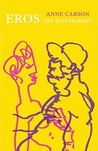
"Eros the Bittersweet" by Anne Carson: The Invention of Eros

A couple of weeks ago, I was in my local curry joint rereading Tom Stoppard's Rock 'n' Roll, and had just come to the passage where two characters discuss Sappho's invention of the word "bittersweet," when "Bittersweet Symphony" came on the restaurant stereo. Then I went home and saw that one of my Goodreads friends had put a book by Anne Carson called Eros the Bittersweet on her to-read list. What a collision of serendipity! I took it as a sign that I should read that book too.

Eros the BittersweetEros the Bittersweet by Anne Carson
My rating: 4 of 5 stars

Anne Carson’s Eros the Bittersweet begins as an examination of what classical Greek poets had to say about eros (romantic desire), but expands into a meditation on time, metaphor, imagination, the distance between self and other, and what makes life worth living. In modern times, we think of romantic love as the emotion that makes you want to settle down and create a family with somebody, but the Greeks felt very differently. To them, eros was overwhelming, disruptive, and more to be feared than welcomed. And yet, they kept desiring, and reflecting on their desire, and writing about it in poetry and prose.

Carson provides English translations of all of the Greek passages she quotes, but she also prints the original Ancient Greek text. I therefore decided to take the opportunity to teach myself how to sound out Ancient Greek. I found a chart of the Greek alphabet online, printed it out, and taped it into the back cover of the book for reference; eventually, I got to the point where I could sound out the Greek without referring to my alphabet cheat-sheet. As for the words I was sounding out, many of them remained incomprehensible, yet it was worth it for the times when I recognized Greek roots that are also used in English, and had a holy-shit-I’m-reading-and-understanding-something-that-was-written-two-millennia-ago moment. Reading a line of Aeschylus (the first playwright!) that goes “eumorphon de kolossoi,” and understanding how it means “well-shaped statues” – well, that’s an amazing feeling.

Indeed, there’s a lot of stuff in Eros the Bittersweet about the connections between eros, learning, reading, and writing. Our imaginations, and our reach that exceeds our grasp, spur us to fall in love and also to pursue academic interests. This idea really resonates with me – after all, two of my favorite authors are Tom Stoppard and A.S. Byatt, whose plays and novels often focus on the connections between eros and education. But if you don’t get a quasi-sexual pleasure out of learning and knowledge, Eros the Bittersweet is probably not the book for you.

My biggest complaint about Eros the Bittersweet is that it doesn’t devote enough attention to Greek drama. Carson extensively considers the formal qualities of ancient Greek lyric poetry, novels, and philosophical dialogues, but she does not analyze Greek theater in the same way. For a work so concerned with paradoxes and the relationship of eros to time, this seems like a major oversight. After all, theater has an inherently paradoxical relation to time: a script can endure for millennia, but a performance is ephemeral. At one point, Carson analyzes a passage of Sophocles (calling it “Sophocles’ poem,” ignoring the fact that it comes from a stage play) that compares desire to “ice-crystal in the hands / […] you can’t put the melting mass down / you can’t keep holding it.” Isn’t the ephemeral pleasure of theater similar to the ephemeral pleasure of melting ice?

It is to Carson’s credit, however, that her book inspired me to want to learn more, to forge new connections, to exercise my imagination and have new thoughts of my own. Which means that – by Carson’s own definition – it’s a book that inspires love.

View all my reviews

Saturday, May 26, 2012

Ode to the Props Master

Here's "Ode to the Props Master," my other contribution to Theater Pub's "Odes of March" show celebrating all of the different people who make theater possible.

What would Hamlet be without a skull?
What would The Seagull be without a gull?
And Hedda Gabler’s famous for her pistols,
As Laura, for her menagerie of crystal.
For farce, you need a slapstick to cause mirth;
For Sam Shepard, a buried child to unearth.
The Angel of America needs her book,
And Captain You-Know-Who must wear a hook.
What would Willy Loman be without his cases?
Or Damn Yankees sans bats and balls and bases?
R and J without a dagger is a bore,
As is Titus without gushing blood and gore.
Othello needs the fatal handkerchief,
And ingénues their smelling salts to sniff.

The Props Master takes care of all these things --
Flowers and asses’ heads and fairies’ wings.
(These are the props that you need for Midsummer;
I say this for the benefit of newcomers.)
He scrounges, cadges, buys what can be bought,
Finds everything he can, and makes what he cannot;
Brews tea, which actors then pretend is whisky,
Since real booze on the stage is far too risky.
Or he’ll take paper and dye it in more tea
So it seems from another century.
‘Tis he who knows the source to get a sword,
And fifty nifty uses for cardboard.
He sees each object’s soul; and makes it fit in
With what the director’s staged and writer’s written.

And then he lays the props upon a table
And makes for each a designated label
And a space marked by lines of masking tape
Befitting each odd item’s size and shape.
And then the props master begs and implores:
“Do not move any prop – unless it’s yours!”

If only life were like this! If only we’d
Have someone else to find the things we need
And lay them neat and tidy on a table
For us to use, and thus our acts enable;
To see to every object, trinket, token;
Keep it in trim; repair it if it’s broken.
If only we could organize our things
And place them on a table in the wings!
O world edged by these masking-tape borders!
O props master, o paragon of order!

He gives us props; let us give props to him!
For this is the whole purpose of my hymn.
I praise him for his zeal and his proclivity
For mixing discipline and creativity.
Salute him then with twenty-one fake guns
And drink his health with tea – not Jameson!
--------------
NOTES:
  • I chose to write the Ode to the Props Master because I thought it'd be fun to make rhymes about things (all of the different objects that the props master must find), mixed in with references to well-known plays and the props they require. Very quickly, I came up with the lines "What would Hamlet be without a skull? / What would The Seagull be without a gull?" and therefore, determined that the poem would need to be in heroic couplets.
  • Heroic couplets are FUN to write. I can totally see how Alexander Pope churned out line after line of them.
  • Only later did I realize that the form of the poem also suited the message I was trying to convey. Heroic couplets have a very orderly, neat and tidy feeling, and my poem is about how the props master keeps everything neat and organized. And then I felt very clever -- without even realizing it, I'd followed Sondheim's key principle of "content dictates form"!
  • As with my Costume Designer ode, the demands of poetic form superseded my desire to invert traditional gender stereotypes. Thus, I used the singular masculine pronoun "he" at all times to refer to the Props Master.
  • Surprisingly, I did not come up with the silly pun on "He gives us props; let us give props to him!" until very late in my process of writing the poem. This might be the most ridiculous line in the whole piece -- the semicolon adds to the ridiculousness, I think -- and thus it is my favorite.
  • My original idea for staging this piece at the Theater Pub show involved having one person recite the poem while two Assistants pulled props out of bags as they were mentioned, tossed them around, and engaged in general tomfoolery. This had to be toned down a bit for the actual performance -- the Cafe Royale didn't want us throwing things around, and we were not able to source all of the props mentioned -- but the general idea remained. Neil Higgins recited the poem, while several of the other actors that night brought out prop pieces and eventually put them into a masking-tape grid. Unfortunately, I was seated behind a pillar and didn't get to see any of this (!) but it got a good reaction from the crowd. Especially the rubber chicken that we used for the "seagull" and the baby doll wrapped in rags that was the "buried child." (Dead animals: great for comedy!)

Wednesday, May 23, 2012

Ode to the Costume Designer

Hey, remember when I wrote two poems for San Francisco Theater Pub's show in March? I always meant to post the poems on my blog when the "Odes of March" project was over... so here, albeit belatedly, is "Ode to the Costume Designer."
Cinderella and others got dressed in their finery
By magic, by fairies, by sprites.
In theater, our fairy’s the costume designer; she
Makes clothes to enchant and delight.

Her taste is eccentric and never generic. Her
Knowledge of costume impresses.
And many an actor first gets into character
By wearing the right shoes or dresses.

She knows how to flatter your hips, breasts, or pelvis
By artfully adding some trim
And when a director hates actors in velvet
The costumer humors his whim.

Like one of the mice in The Tailor of Gloucester
She stays up all night sewing seams
She sheds not a tear for the sleep it will cost her
Making raiment of radiant dreams.

Clothes are not silly; a character’s fashions
Can show us the depths of his heart.
So let’s pay homage to the costumer’s passions,
Her talents, her efforts, her art.
------------------------------------
NOTES:
  • I tried to be clever with the rhymes but I worry that some of them are a bit too precious ("finery" / "designer, she"). However, I will defend "Gloucester" / "cost her" till my dying day.
  • I wrote stanza #4 first, and it's still my favorite -- not only for the "Gloucester" rhyme, but for the "raiment of radiant dreams" line.
  • The rhyme on "Gloucester" and "cost her" also dictated that the costume designer in my poem is female. Which made me feel like I was reinforcing gender stereotypes, in a way that I would prefer to avoid, but my rhyme-snobbery won out over my feminism :-)
  • The reference to the velvet-hating director is an in-joke about my friend Stuart.
  • On performance night, this ode was performed by Aoife Davis as the costume designer, dressing Jessica Rudholm in a beautiful gown.

Thursday, August 18, 2011

The Radiant Sisters

Clearly, my blog has gone into abeyance while I work on Pleiades, but to tide you over, here's a poem, "On the Beach at Night" by Walt Whitman, that I found while doing research for mentions of the Pleiades in literature.
On the beach at night,
Stands a child with her father,
Watching the east, the autumn sky.

Up through the darkness,
While ravening clouds, the burial clouds, in black masses spreading,
Lower sullen and fast athwart and down the sky,
Amid a transparent clear belt of ether yet left in the east,
Ascends large and calm the lord-star Jupiter,
And nigh at hand, only a very little above,
Swim the delicate sisters the Pleiades.

From the beach the child holding the hand of her father,
Those burial-clouds that lower victorious soon to devour all,
Watching, silently weeps.

Weep not, child,
Weep not, my darling,
With these kisses let me remove your tears,
The ravening clouds shall not long be victorious,
They shall not long possess the sky, they devour the stars only in apparition,
Jupiter shall emerge, be patient, watch again another night, the Pleiades shall emerge,
They are immortal, all those stars both silvery and golden shall shine out again,
The great stars and the little ones shall shine out again, they endure,
The vast immortal suns and the long-enduring pensive moons shall again shine.

Then dearest child mournest thou only for Jupiter?
Considerest thou alone the burial of the stars?

Something there is,
(With my lips soothing thee, adding I whisper,
I give thee the first suggestion, the problem and indirection,)
Something there is more immortal even than the stars,
(Many the burials, many the days and nights, passing away,)
Something that shall endure longer even than lustrous Jupiter
Longer than sun or any revolving satellite,
Or the radiant sisters the Pleiades.
Of note: my play is about Jupiter (Zeus) and the Pleiades, and long before I read this poem, I had planned for my play to take place in a summer house on Walt Whitman's native Long Island, with some key scenes occurring "on the beach at night."

Also of note: I found two different versions of this poem online, the one above, and a version where the Pleiades are referred to as "delicate brothers" and "radiant brothers." I had heard that Whitman compulsively revised his poems, but never seen such a clear-cut example! It seems that when the poem was originally published in Leaves of Grass in 1871, it was "brothers," but twenty years later, it had changed to "sisters." Did he revise it to make it less shocking/controversial? After all, if the Pleiades are always referred to as the Seven Sisters, it's a gender reversal to portray them as brothers, and a phrase like "delicate brothers" would have served as a big sign-post pointing to Whitman's homosexuality.

Then again, according to another website I found, the Pleiades have always had an association with homosexuality -- I suppose because they are seen as such a strong feminine influence that, when they appear in a man's astrological chart, they signify effeminacy or homosexuality? But I enjoyed this astrologer's positive re-interpretation of the Pleiades (seeing them not as victims, but "divine sisters on a voyage to true individuality and rebellion against social expectations... a reminder to those who would follow in their steps of revolution, promising that all burdens endured would lead to a greater brightness that would withstand the darkness of man's own ignorance") and his discovery of an ancient text that assigned a virtue and a color to each of the seven sisters. One of my challenges while writing Pleiades has been to develop each sister as an individual character -- when the myths don't give them much in the way of individual personality. And I get a kick out of this esoteric astrological stuff.

Thursday, July 14, 2011

One Constant, If I May

A few New Yorker-ish things:

* The short story "Homage to Hemingway" by Julian Barnes from the July 4 issue was very thought-provoking. A combination of fiction, literary criticism, playful meta-textuality... good stuff, to commemorate the 50th anniversary of Hemingway's death. And I loved this little passage:
He told them his theory of writers and cooking. Novelists, who were in it for the long haul, were temperamentally equipped for stewing and braising, for the slow mixing together of many ingredients, whereas poets ought to be good at stir-fry. And short story writers? someone asked. Steak and chips. Dramatists? Ah, dramatists – they, the lucky sods, were basically mere orchestrators of the talents of others, and would be satisfied to shake a leisurely cocktail while the kitchen staff rustled up the grub.
Bonus link: Julian Barnes reads Hemingway's "Homage to Switzerland," which inspired "Homage to Hemingway."

* Paul Muldoon, the magazine's Poetry Editor, gave the commencement speech for the Bennington College writers' program -- in terza rima. Actually, this poem is a meta-textual homage too, to W. H. Auden's poem for the 1946 Harvard commencement, "Under Which Lyre". I'm not sure Muldoon's poem will endure as long as Auden's (there might be too many snarky pop-culture references in it), but I enjoyed several passages from it, especially this one:
The challenge is how to kick-start
ourselves and name some grand ambition shining there
at which we may, albeit briefly, set our caps
before throwing those same caps in the capricious air.
and the concluding advice:
think outside the frame
unless you’re a photographer; be frugal
in everything but praise; never jump a small claim;
always write “some pig” of the least porker
in the barnyard; remember those who fly far look like fair game;
refuse to pay corkage; make every line a corker;
let your main tactic be tact
and—one constant, if I may—read The New Yorker.

Friday, April 8, 2011

I Like/Love Theater/re

According to [David Orr, author of the new book Beautiful and Pointless: A Guide to Modern Poetry], poetry differs from music and stamp collecting in that people’s love for poetry is measurably greater than their love for any other activity. Poetry fans don’t just love poetry a little; they really love it.

To test that hypothesis, Orr went to Google and conducted two different searches, one for “I like X” and one for “I love X,” with X being represented by baseball, cooking, gardening and half a dozen other activities, including movies and poetry. Admittedly, the science behind this research is slightly less complicated than that required to make a lemon meringue pie, but the results are noteworthy. In every instance except two, more people “like” an activity than “love” it; for example, readers of romance novels like that art form 3.36 times more than they love it. The exceptions are poker, which splits 50-50, and — of course — poetry, whose partisans “love” it twice as much as they “like” it.

--David Kirby, The New York Times Book Review

Google hits for "I like theater" = 846,000
Google hits for "I love theater" = 1,320,000
Google hits for "I like theatre" = 867,000
Google hits for "I love theatre" = 424,000

So, like poker, theater/theatre splits 50-50: the "likes" have 1,713,000 hits and the "loves" have 1,744,000 hits. Not a surprise, really; people who enjoy theater tend to be passionate about it, and the casual theatergoer (the person who "likes" rather than "loves" theater) sometimes seems like a dying breed.

We theater artists constantly ask "How can we make other people more excited to see theater?" but it's hard for us to answer that question, because we have trouble putting ourselves in the mindset of someone who isn't excited by theater.

But maybe an analogy between theater and poetry will prove helpful. I confess to not really "getting" or liking most contemporary poetry that I see, and being intimidated by poetry lovers. They all seem to be in some kind of club with arcane rituals and secret codes, and they're not giving me the key -- that is, I feel like I don't have the tools to enjoy or understand these poems.

And, I realize, that's probably how a lot of people feel about theater -- it's a secret club, it's too hard to understand, it's a closed circle full of weirdly passionate people.

So in order to come up with good answers to the question "How can theater lovers make other people more excited to see theater?", maybe I should start by thinking honestly about the question, "What would a poetry lover have to do to make me more excited to read poetry?"

Wednesday, October 13, 2010

Billy Collins, Plagiarist?

Billy Collins has a poem in The New Yorker musing on Zeno's paradox:
Not long after we had sat down to dinner
at a long table in a restaurant in Chicago
and were deeply engrossed in the heavy menus
one of us--a bearded man with a colorful tie--
asked if any one of us had ever considered
applying the paradoxes of Zeno to the martyrdom of Saint Sebastian.

[...]
If, the man with the tie continued,
an object moving through space
will never reach its destination because it is always
limited to cutting the distance to its goal in half,

then it turns out that St. Sebastian did not die
from the wounds inflicted by the arrows.
No, the cause of death was fright at the spectacle of their endless approach.
St. Sebastian, according to Zeno, would have died of a heart attack.
Well, this is suspiciously similar to Tom Stoppard's explanation of Zeno's paradox, in his play Jumpers:
It was precisely this notion of infinite series which in the sixth century BC led the Greek philosopher Zeno to conclude that since an arrow shot towards a target first had to cover half the distance, and then half the remainder, and then half the remainder after that, and so on ad infinitum, the result was, as I will now demonstrate, that though an arrow is always approaching its target, it never quite gets there, and Saint Sebastian died of fright.
This is too strange to be a coincidence, right? Collins has to have somehow gotten the seed for his poem from Stoppard, doesn't he?

Maybe the dinner party actually happened as described in the poem, and Collins overheard "a bearded man in a tie" trying to pass Stoppard's idea off as his own original thought, but Collins wasn't aware of this, and wrote the poem in perfect innocence. Maybe the bearded man acknowledged that his Zeno-Sebastian speech was inspired by a line of Stoppard's, but Collins decided to leave that out of the poem. Or maybe there wasn't any dinner party, and the bearded man is fictitious-- a framework invented by Collins to hide the fact that he had really gotten the idea for his poem by reading or seeing Jumpers (or just by reading Stoppard's wikiquote page). What I like about this is that, even though Collins doesn't credit Stoppard, his poem still acknowledges the deeper truth: the Zeno-Sebastian idea is not original to Collins, he got it from someone else.

Some among us might simply call Collins' poem an "allusion" to Stoppard, or a work "inspired by" a line of his. And I might buy that reasoning if the Stoppard quotation were more well-known, or recognizable. (I mean, if Collins had written a poem playing off the idea of "beauty is truth, truth beauty," I wouldn't write a blog post excoriating him for plagiarizing Keats!) But, in my opinion, there is something not quite right about building an entire poem around an idea that another writer had, and then not crediting that writer.

Also, am I wrong in thinking that Stoppard's way of phrasing this idea is more snappy, more economical, more memorable, more, dare I say, poetic than Collins'? "Saint Sebastian died of fright" is much better than "No, the cause of death was fright at the spectacle of their endless approach. / St. Sebastian, according to Zeno, would have died of a heart attack." That's why I remembered the Stoppard quote, after all these years...

Tuesday, August 3, 2010

"Anguish Is the Universal Language"

What's this? I actually liked a poem published by The New Yorker? And, furthermore, it's a love poem, that most clichéd of genres?

Yep. "Claustrophilia" by Alice Fulton, in the July 2 issue. Not only is there a lot of truth to it, it is memorable, quotable... and taught me some new words, too ("moxibustion").

See also the New Yorker blog's interview with Fulton about her work.

Sunday, January 10, 2010

The Elitist Issue

Did anyone else think that the January 4 issue of The New Yorker could have been subtitled "The Elitist Issue," the Stuff White People Like issue? OK, the general POV of The New Yorker shouldn't be news to me, or to anyone, but reading this issue, it was like I suddenly understood why the Bill O'Reillys of this world deride "liberal coastal elitists" in the way that they do.

Here are the contents of the January 4 issue:
  • an article about the broken California university system, something that affects Californians of all income levels, but the article focuses on the protests and strikes at Berkeley--the system's most elite university. It shows that even though the situation is urgent, Berkeley easily gets bogged down in political-correctness-run-amok stuff: I laughed aloud when I read that the student activists had spent hours debating whether a strike is "a European tactic unsuited to students of color, who challenge the status quo simply by going to class."
  • an article about Vampire Weekend, the indie rock band that has, as the magazine puts it, polarized and offended people with their "effete, collegiate image," "the incongruity of four upper-middle-class boys channeling Third World musical traditions."
  • an article about Whole Foods, the pricey organic grocery chain that looks at "the number of college graduates in the area" to decide where to open new stores. Many paragraphs are devoted to the anguish that some liberals feel when they discover that the Whole Foods CEO is a libertarian who doesn't believe in universal health care.
  • some pieces about Dead European Males: an article about Van Gogh, Gauguin, and the modernist mindset, which comes to a rather airily philosophic conclusion; and a review of a recent theater/music piece that juxtaposes Schubert and Beckett
  • an article about Grace Kelly, the beautiful and patrician movie star who actually became a princess
True pop culture finally makes its way into the magazine only on the last two pages, with reviews of blockbuster movies Avatar and Sherlock Holmes. And even though David Denby genuinely enjoys Avatar's beauty and exhilaration, there's still a hint of elitism in his review. He writes, "Actually, life among the Na'vi, for all its physical glories, looks a little dull. True, there's no reality TV or fast food, but there's no tennis or Raymond Chandler or Ella Fitzgerald, either." Um, Mr. Denby, if you want to list good things about American culture... could you maybe try to include some things that became popular after 1950?

The short story in this issue, "Baptizing the Gun" by Nigerian writer Uwem Akpan, would seem to disprove my thesis--it adds racial diversity and focuses on a gritty subject, the corruption and danger and poverty in Lagos. But because the story is not really distinguished in an artistic sense (there's a cheap twist ending that would have been hokey in a magazine story 100 years ago), there is something unsavory about publishing it... as though The New Yorker feels we should overlook the flaws in Akpan's writing because he is saying something "important" about Africa, even though, in that case, a news article or autobiographical essay would be much more satisfactory than fiction. So it seems to have been published because it adds diversity to the issue, which is certainly a "liberal elitist" thing to do.

Still, far more unsavory is one of the poems in this issue, "The Things" by Donald Hall, which I am tempted to call the worst poem I have ever read.
When I walk in my house I see pictures,
bought long ago, framed and hanging
--de Kooning, Arp, Laurencin, Henry Moore--
that I've cherished and stared at for years,
yet my eyes keep returning to the masters
of the trivial: a white stone perfectly round,
tiny lead models of baseball players, a cowbell,
a broken great-grandmother's rocker,
a dead dog's toy--valueless, unforgettable
detritus that my children will throw away
as I did my mother's souvenirs of trips
with my dead father, Kodaks of kittens,
and bundles of cards from her mother Kate.
I just can't shake the feeling that the only reason Hall wrote this poem is because he wanted to brag about his art collection. And then he tries to convince us that he's not bragging, that he's really a sentimental guy who takes pleasure from the little things in life, and tries to make us feel upset that his children will throw these things away. But really, how upset can one get? These kids are lucky, they're inheriting De Koonings! It all leaves an extremely bad taste in my mouth.

I rather liked the other poem in the issue, though, "Only So Much" by Rachel Hadas, so go read it if you want a palate-cleanser.

Now, though the Jan. 4 issue made me more conscious of why some people in this country despise the "liberal coastal elite," that doesn't mean I agree with that. (To quote Metropolitan, my favorite self-consciously elitist movie: "I could hardly despise them, could I? That would be self-hatred.") I like Vampire Weekend, I enjoyed the Grace Kelly and Whole Foods articles, and am now convinced I should listen to Schubert's "Winterreise." But I think The New Yorker is stronger when it provides a more wide-ranging view of the world, with an article on something like politics or science thrown into the mix. It's funny: I don't always find the articles about international crises enjoyable to read, but I miss them when they're gone.

Sunday, October 4, 2009

If "Tales of the City" Were Written in Verse...

...it would be The Golden Gate, by Vikram Seth.

I know I posted a little about this book last week--how it is a novel written entirely in Onegin stanzas. Not an "epic poem," because its concerns are far more down-to-earth. Set in the Bay Area in the 1980s (Napa Valley, the Peninsula, and S.F. proper), it mostly follows the love lives of a group of yuppies. As with Tales of the City, parts of it are dated--some of the "yuppie lifestyle" satire, as well as the Cold War fear of nuclear annihilation that forms a major subplot.

All the same, it hooked me from the first stanza, in which a man has an existential crisis while walking through Golden Gate Park. And some of the San Francisco atmosphere that the book captures is truly timeless--first dates at the Cafe Trieste, the Golden Gate Bridge and the skyline itself... Here is a sample stanza (perfect for this time of year!):
They park the car by the Marina.
The surface of the cobalt bay
Is flecked with white. The moister, keener
October air has rinsed away
The whispering mists with crisp intensity
And over the opaque immensity
A deliquescent wash of blue
Reveals the bridge, long lost to view
In summer's quilt of fog: the towers,
High-built, red-gold, with their long span--
The most majestic spun by man--
Whose threads of steel through mists and showers
Wind, spray, and the momentous roar
Of ocean storms, link shore to shore.
The characters of the novel are more types than individuals, but all the same, by the end I was curious to learn how their tangled relationships got sorted out, and moved by the final chapters, when darker matters intrude on the blithe innocent California world. Another charming aspect of the novel is that the characters' pets play a role in the story and are made just as vivid as their human owners. (I can't easily think of another novel that has such good writing about animals.) One of the pets is an iguana named Arnold Schwarzenegger, which is, of course, all the funnier in light of recent California history!

The narrator is not nearly as funny and garrulous as the narrator of Eugene Onegin, but he has a few good digressions, including the beginning of Chapter 5, where he defends his decision to write a novel in verse. He ably rises to the challenge of rhyming--OK, "Oregon" doesn't rhyme with "gone," and "merely" doesn't rhyme with "really," and some of the rhymes only work when spoken in a British accent, though presumably Seth, who grew up in India, has that kind of accent. But those are just a few mishandled rhymes in a sea of thousands of perfect ones--300 pages, 13 chapters! Not to mention that the acknowledgments, chapter list, and author bio are written as Onegin stanzas too. (Seth made his task slightly easier by naming the main characters things like "John," "Liz," and "Phil"--one-syllable names that rhyme with some of the most frequently used words in our language.)

Highly recommended for anyone who is fascinated by rhyme and structure and "constrained writing"; people who want to be exposed to a different sort of contemporary poetry than that which we usually encounter (this book flatters your intelligence, rather than making you feel stupid for "not getting it," as some of the more oblique poetry these days does); and of course any proud citizens of the Bay Area!

Thursday, September 24, 2009

Onegin Stanza #1

Currently I am reading The Golden Gate by Vikram Seth, a crazy and great sui generis book: the story of a bunch of San Francisco yuppies in the 1980s, told entirely in verse. And not just any verse, but Onegin stanzas, one of the hardest verse forms to employ in English--but one which, if done well, can create stunning effects.

And, just as seeing a Shakespeare play makes me want to start speaking in iambic pentameter, reading The Golden Gate has inspired me to compose my own Onegin stanzas. Of course, iambic pentameter is relatively natural and easy to compose, while Onegin stanzas are artificially and strictly patterned--a great challenge!

When the beginning of a quatrain popped into my head the other day, I decided to develop it into a complete poem. So here, after much crossing-out of lines, and much consulting of a thesaurus, is my first-ever attempt at an Onegin sonnet.
When we are faced with disappointments,
They should not come as a surprise,
For well we know that sweetest ointments
Inexorably lure the flies.
But just as sand, within an oyster's
Shell, its secret nacreous cloister,
Is transfigured from grit and grime
Into a pearl; so can the slime
And dirt and bugs that Life provided
Transfigure, too. This may sound odd,
But flowers spring from barren sod;
And with an insect trapped inside it,
An amber lump gains an allure
More precious, even though less pure.
I'm not sure I agree with the message of my poem, nor do I like its moralizing tone, but the verse scans correctly and the images work--which is all that one can really hope for on a first attempt, right?

Thursday, January 22, 2009

Odes for Obama

Like many other people, I didn't think much of the poem that Elizabeth Alexander wrote and delivered on Inauguration Day. The Guardian has a good take-down of it, echoing many of the criticisms that I had when I first encountered it.

I'll admit that it's hard for me to get into contemporary poetry, and I have very defined prejudices about what I like in a poem--my opinions are more rigid on this matter than they are regarding plays, movies, or novels. Basically, I think poems should have structure. This could be rhyme (and unfashionable though it is, I love a well-deployed rhyme) but it doesn't have to be. It could be a systematic patterning of images, a vigorous rhythm, and/or playful use of sounds. I also like conciseness: I prefer a series of strong, vivid impressions to long abstract musings about "poetic" topics like love or death. In terms of poetic diction, I hate the self-consciously lofty and discursive, and prefer startling but precise juxtapositions of words. So generally speaking, I guess I'm an Imagist.

And, like the King of the Imagists, "Uncle Ez" Pound, I'm ambivalent about Walt Whitman, the inventor of free verse and father of American poetry. Stuff like "Song of Myself" is undeniably powerful, and it has a sense of structure and a vigor--great, swingy rhythm!--that I love. But I think that Whitman eventually became a parody of himself. I was disgusted when I first read Whitman's "The Runner" in my high school poetry textbook--I thought it anticlimactic and needlessly wordy. This is the entire poem:
On a flat road runs the well-train'd runner,
He is lean and sinewy with muscular legs,
He is thinly clothed, he leans forward as he runs,
With lightly closed fists and arms partially rais'd.
To me, this is flat and prosy--just like Ms. Alexander's Inauguration poem. E.g. "Built brick by brick the glittering edifices / they would then keep clean and work inside of" has two cliches ("brick by brick" and "glittering edifices"), plus a jarring example of ending a sentence with a preposition, all in two lines--argh! And there must be a more interesting way to express the sentiment "keep clean and work inside of," too.

So I asked myself what I'd have done in this situation, and thought about Obama, and the "O" logo so prominent in his campaign. I began playing around with that letter, its sound and its shape--patterning a poem around the "o" vowel and the idea of circles. As I've said before, I think constraints spur creativity, and I think here they helped me avoid cliches. (Indeed, my poem is almost a reverse-lipogram: only 13 of its words do not contain the letter "O.") While I realize that what I've written would never pass muster at an actual inauguration, because punning on the new President's name is too much like creating a personality cult, I'd like to share it with you. If nothing else, it's an attempt to express my idea that poetry should be concise, startling, playful, vigorous.
1/20/09
By Marissa S–

O for this bauble-blue globe, our home,
O oxygen flowing into lungs’ lobes!
O solar voltage, grown blossoms, o storms,
Ocean foam, open coasts;
O spiro, o spero.

O the rotunda and Capitol Dome!
O echoing forebears, o voices in stones!
O sound of groans, slave-holds choking close;
O loads borne, o holes torn,
O torrents of bullets.

O voyages over, beyond and below!
O circles, o cycles, coalescence in one!
O folding toward focus, no goal too remote...
Sole moment. Souls, only.
O sore, soaring hope.

Saturday, November 29, 2008

Nabokov in Oregon


To the many obvious reasons there are to love the writing of Vladimir Nabokov, I add a smaller and more personal reason: as far as I can tell, he is the most important literary figure ever to have spent time in my beautiful home state of Oregon, and to have produced significant work there.

Nabokov and his wife Vera spent the summer of 1953 in a rented house in Ashland, Oregon (the small town near the California border that is world-famous for its Shakespeare festival). It is a picturesque and peaceful town that also afforded Nabokov great opportunities for butterfly-collecting in the surrounding hills. In Ashland, he passed an "extraordinarily productive writing summer": he finished Lolita, wrote the first chapter of Pnin as a short story for The New Yorker, and composed two poems, "The Ballad of Longwood Glen" and "Lines Written in Oregon" (citation). Pretty amazing, huh?

Though Nabokov never wrote extensively about Oregon, there are some brief references to the state scattered throughout his allusion-happy oeuvre. In Pnin, a character is described as "bursting into happy tears--for all the world like little Miss Michigan or the Oregon Rose Queen." Technically, this figure is called the Portland Rose Festival Queen--but her coronation is a big deal during the month of June, and I'm guessing that Nabokov read about it in the newspaper.

And in Lolita, in the section where Humbert provides a running commentary on all the corners of America that he and Lo visit, they make a couple of stops in Oregon. One of them is "Blue, blue Crater Lake." It amuses me that even the great Nabokov could find no better word to describe Crater Lake than "blue"; his genius is deep, but Crater Lake is deeper!

Here is Nabokov's "Lines Written in Oregon"--kind of a bizarre poem, but very evocative for those of us who grew up hiking in the Oregon woods, searching for trilliums, counting how many shades of green we could see, half-convinced that this was the land where fairy tales could come true.
Esmeralda! now we rest
Here, in the bewitched and blest
Mountain forests of the West.
Here the very air is stranger.
Damzel, anchoret, and ranger
Share the woodland’s dream and danger.
And to think I deemed you dead!
(In a dungeon, it was said;
Tortured, strangled); but instead –
Blue birds from the bluest fable,
Bear and hare in coats of sable,
Peacock moth on picnic table.
Huddled roadsigns softly speak
Of Lake Merlin, Castle Creek,
And (obliterated) Peak.
Do you recognize that clover?
Dandelions, l’or du pauvre?
(Europe, nonetheless, is over).
Up the turf, along the burn
Latin lilies climb and turn
Into Gothic fir and fern.
Cornfields have befouled the prairies
But these canyons laugh! And there is
Still the forest with its fairies.
And I rest where I awoke
In the sea shade – l’ombre glauque
Of a legendary oak;
Where the woods get ever dimmer,
Where the Phantom Orchids glimmer –
Esmeralda, immer, immer.

Sunday, August 10, 2008

Russian Rhyme & Reason

You wouldn't expect an essay on the finer points of translating Russian poetry to give you your biggest laugh of the day. But, when it's written by Vladimir Nabokov...
The English rhyme [is] Echo's poor relation, a genteel pauper whose attempts to shine result merely in doggerel garishness. For if in Russian and French, the feminine rhyme is a glamorous lady friend, her English counterpart is either an old maid or a drunken hussy from Limerick.

(from Nabokov, "Problems of Translation: Onegin in English").

Friday, August 8, 2008

Crazy Eights

Everyone must be aware that today is 8/8/08, and that the Beijing Olympics began at 8:08:08 PM to further reinforce the pattern. To celebrate this numerical quirk, I thought I'd make a list of Eight Nifty Things that Come in Eights.

1. The History Boys: The titular boys are eight in number--all bright lads applying to Oxford and Cambridge. I saw the play on Broadway and really appreciated it, then saw the movie version last week and think it might be even better: it's more streamlined, and I am SO glad that all of the original cast members participated! It's also what prompted this post, as I got to thinking about other works of fiction that feature groups of eight characters...


2. ...like 8 Women, a crazy, campy, French musical-comedy-mystery-melodrama film. One of my ultimate guilty pleasure movies. But with actresses like Deneuve, Huppert and Ardant among the eight women, how can you possibly go wrong?

3. The Group: In this Mary McCarthy novel, eight women are the main characters; again, it's a bit of a guilty pleasure, but a fun read. I wrote about it last year here on my blog.

4. "Octet" from The Light in the Piazza: This song contains some of the most beautiful, soaring melodic themes in the musical, and very poetic lyrics. One of my favorite moments in the Lincoln Center production came at the end of this number, when the characters paired off in couples--Clara & Fabrizio, Franca & Giuseppe, Mr. & Mrs. Nacarelli--leaving only the Priest and Margaret. The Priest was on the sidelines, but Margaret stepped downstage center, and you suddenly realized how profoundly alone she was, even in the midst of the beautiful harmonies surrounding her.

5. The Wheel of the Year: In "Octet," the characters sing "The shock of winter / The coming on of spring / Suspended summer nights / The eager flights / That only fall can bring." So, four seasons. And if you have two holidays per season--one at its commencement, one in the middle--that gives you eight holidays, as well as the Wheel of the Year used by Wiccans. I read a lot of fantasy novels when I was younger, many written by Wiccans, so I learned a lot about the eight festivals: Samhain, Yule, Imbolc, Ostara, Beltane, Midsummer, Lughnasa and Harvest Home. Or, if you prefer a medieval Christian cycle of holidays: Halloween, Christmas, Candlemas, Lady Day, May Day, St. John's Eve, Lammas and Michaelmas. Though neither a pagan nor Christian, I am still attracted to the idea of having a festival to reconnect with the cycle of nature every month and a half.

6. Ottava rima: A stanza of eight lines that rhyme A-B-A-B-A-B-C-C. It's more often used in Italian than English, as the name suggests, but it's also the rhyme scheme that Byron chose for his long comic poem "Don Juan." The first six lines of each stanza are just long enough for Byron to set up a joke, then the final couplet serves as a zingy punchline, often with a hilarious trick rhyme involved. Here is some Byronic wit, which also happens to continue our theme of "seasons" (Canto I stanza 102):
It was upon a day, a summer's day--
Summer's indeed a very dangerous season,
And so is spring about the end of May;
The sun, no doubt, is the prevailing reason;
But whatsoe'er the cause is, one may say,
And stand convicted of more truth than treason,
That there are months which nature grows more merry in:
March has its hares, and May must have its heroine.
7. The Noble Eightfold Path: Another religion which incorporates the number eight is Buddhism. I have always thought that the Buddhists had some good things to say about the causes of suffering and the ways of alleviating it, such as the Eightfold Path to Enlightenment. It consists of: right perspective, right intention, right speech, right action, right livelihood, right effort, right mindfulness, and right concentration. That is, first you get in the right frame of mind, then you strive to live ethically, and only then can you gain insight into Existence by meditating upon it. (Note that the Eightfold Path is different from the Eight Precepts of Buddhism, which I do not like so much. They suggest that to become more holy, one should refrain from singing, dancing, and going to the theater!)

8. The solar system: Yeah, we all learned that it had nine planets, but now that Pluto has been kicked out, it's back to eight. When I was two years old I said that I wanted to become an astronaut and visit all the planets. This reduction in size of the solar system at least would make my task a little easier...

Photo of the History Boys from darkhorizons.com. Photo of "8 Women" from opalfilmlists.blogspot.com. Photo of the planets from earthhistory.org.uk

Friday, November 9, 2007

Quote(s) of the day

"If you want to build a ship, don't drum up people together to collect wood and don't assign them tasks and work, but rather teach them to long for the endless immensity of the sea."
--Antoine de Saint-Exupéry
Quote courtesy of NaPlWriMo and my dad, who noted that it echoed my statement "I'd better fall in love with my play so deeply that I can't not write it."

But, knowing how many misattributed quotations are out there, I decided to try to find the quote in the original French--that would teach me if it was authentic or not.

Seems like someone else has already done the work, dredging up Saint-Exupéry's poem "Dessine-moi une navire" ("Design me a ship") which expresses the same concept, but somewhat less evocative language.
Créer le navire,
ce n'est point tisser les toiles,
forger les clous,
lire les astres,
mais bien donner le goût de la mer.

To create a ship
is not at all to weave the sails,
forge the nails,
read the stars,
but rather to give a taste for the sea.
(my translation)
The popular English version is perhaps an improvement--but it ain't-exactély Saint-Exupéry.