OK, I'm about two weeks late in blogging about this, and I don't live in Portland anymore, and I'm sure the people involved are trying to move on... but I can't let the complete elimination of Portland Center Stage's literary department go uncommented-upon. After all, this is to some extent a theater blog, and if I know anything about American regional theaters, if I've gotten to meet certain playwrights and hear their advice, if I can talk authoritatively about script-submissions and the workshopping process, it is largely thanks to my internship in PCS' literary department in summer 2005.
When I met Mead Hunter, PCS' literary manager, I hadn't even completed my freshman year of college. Looking for something to do over the summer, I contacted him; we chatted for about fifteen minutes and then he said he'd be happy to have me as an unpaid intern. I knew that this was a great stroke of fortune, but only later did I realize just how lucky I was. Mead is one of the most respected literary managers in American theater, and no one ever has a bad word to say about him. He is the very definition of "avuncular." I've occasionally heard him take on a waspish tone about some play or playwright, but that's because he's smart as hell and smart people can't avoid thinking critically; but his default mode is that of a generous colleague and a cheerleader for innovative theater in Portland and across the country. Under his guidance, the JAW playwriting festival became a flagship PCS event--and maybe I'm biased, but I think that 2005 was its high-water mark. That was the year that Mead kicked things up to a new level by involving the whole Portland theater community, plus the four main writers were Jordan Harrison, Adam Bock, Ebbe Roe Smith and Itamar Moses--a serious supernova of talent.
And now Mead--a pillar of PCS for 7 years, the wizard of JAW, guru of PlayGroup, and the first person ever to link to marissabidilla--has been let go. Along with four other employees, including his assistant, Megan Ward, another invaluable advocate for new plays and playwrights. And thus, the entire PCS Literary Department has melted into air, into thin air.
OK, I know these are tough economic times, and I know that my feelings are colored by my personal associations with Mead and Megan, and my sense, as an aspiring playwright, that new plays must be promoted and produced. But still--isn't this a shameful and sad development? PCS is still in some ways a theater company that is finding its voice, after its expansion and move to the new Armory theater building two years ago. But I always thought that new plays were going to be an integral part of that voice, and I thought that Portland was steadily gaining respect from the theater community (third-tier city, no more!) for its commitment to new works. And now it's like all of Mead's careful work has been so quickly written out of existence...
Were there signs of trouble before these layoffs occurred? Well, I was disappointed in the '09-'10 season announcement. Two years in a row, now, PCS hasn't programmed any works from the previous year's JAW festival, which used to be a mainstay of their seasons. And I know that people, in these tough times, want the comfort of a familiar and easily-sold title, but I was disappointed that so many of the "new" plays in the '09-'10 season are adaptations: Snow Falling on Cedars, The Chosen, The 39 Steps. Now, I haven't seen or read these plays, and am aware that they may possess multiple theatrical virtues. But because they're adaptations, they are not chiefly concerned with the playwright's voice, creativity and thought. And this flight to known commodities frightens me a little, of course.
Obviously I am only a tangential observer of what happened at PCS, but every time something like this happens, and the effects of the bad economy hit someone I know, I get a sense of vertigo. What I learned about regional theaters by interning for Mead four years ago is now becoming obsolete, due to the financial crisis--that kind of thing. In a wider context, too, I feel like a generational rift has begun to open between the people who graduated college two or three years ago, when the economy was still chugging along; and the people who graduated college in my year, or will graduate next month, and have had the economy whiplash us when we had barely even joined the working world...
Showing posts with label pcs. Show all posts
Showing posts with label pcs. Show all posts
Wednesday, April 15, 2009

Tuesday, July 22, 2008
Paradise and Enchantment at JAW
It was just JAW time of year again (that's Portland Center Stage's new-plays festival, for those of you who don' t know), and for the first time since 2004, I was there merely as a spectator and not a festival intern. Even in 2004, I was pretty obsessed--using my birthday money to get tickets to all 4 JAW plays (this was before the festival was free). This year, however, even though a whopping 37 playwrights participated in JAW, the only events I went to were two of the mainstage play readings.
These are works in progress and the point of the festival is to help the playwrights, not to criticize them; so I've tried to keep my comments positive and not overly specific. Fortunately, I liked both plays I saw!
Saturday night I saw Paradise Street by Constance Congdon. This play had an all-female cast: six women of diverse ages and races. Four of them played multiple roles, and the other two played the main characters: Jane, a famous academic feminist, and T.J., a tough homeless woman who assaults Jane, steals her car, and later steals her identity. The post-show talkback got very serious, with Congdon and the audience discussing her play's main theme: that the current trends in the feminist movement do nothing to improve the lives of working-class and poor women. But the play itself is exceptionally funny, and dramatizes its ideas rather than preaching them. T.J. first seems like a one-dimensional criminal but becomes intriguingly complex; you even start rooting for her ambition and her no-bullshit attitude.
The all-female cast, class issues, and anger of Paradise Street make me want to compare it to Top Girls, but it's less self-important, more satirical, more accessible. Anyone who has gone to a liberal arts college in the last 30 years should get a kick out of the way Congdon kids academic theory and jargon, especially the overuse of the word "hegemony." (Currently she teaches at Amherst.) I often say that I want to write about women's lives in such a way that guys will go see my plays and not dismiss them as "chick plays," and I think Congdon succeeds at doing just that.
Although, I do have to say: I have seen/worked on three new American plays in the last year that include a theme of Wal-Mart Is Evil. OK, I agree with that, but it's starting to feel like preaching to the choir. Wal-Mart already has a stranglehold on America's retail economy--now it has to have a stranglehold on American playwrights' imaginations as well?!
Sunday night, I took a friend to see Enchantment, by Carson Kreitzer. This play takes as its starting point the life of Bruno Bettelheim: Holocaust survivor, author of a famous work on the hidden psychological value of fairy tales (The Uses of Enchantment), and creator of the pernicious theory that autism is caused by mothers who are too cold and uninvolved. Bettelheim appears as a character in the play; so does Temple Grandin, an autistic woman who works as a designer of more humane slaughterhouses for cattle. Patterns start to emerge: the slaughter of cattle, the slaughter of Jews, the violence found in the Brothers Grimm fairy tales...
Enchantment is mainly told as a series of monologues and tableaux, so it doesn't have a plot in the traditional sense, but it certainly offers a lot to think about. Humans are the only animals who tell stories to one another. Autistic children tend to be literalists and don't like stories. We think of the Nazis as animalistic, bestial, but they told stories that painted the Jews as bestial. The greatest fairy tales often deal with a human turning into a beast or vice versa. And so the connections ripple out...
These are works in progress and the point of the festival is to help the playwrights, not to criticize them; so I've tried to keep my comments positive and not overly specific. Fortunately, I liked both plays I saw!
Saturday night I saw Paradise Street by Constance Congdon. This play had an all-female cast: six women of diverse ages and races. Four of them played multiple roles, and the other two played the main characters: Jane, a famous academic feminist, and T.J., a tough homeless woman who assaults Jane, steals her car, and later steals her identity. The post-show talkback got very serious, with Congdon and the audience discussing her play's main theme: that the current trends in the feminist movement do nothing to improve the lives of working-class and poor women. But the play itself is exceptionally funny, and dramatizes its ideas rather than preaching them. T.J. first seems like a one-dimensional criminal but becomes intriguingly complex; you even start rooting for her ambition and her no-bullshit attitude.
The all-female cast, class issues, and anger of Paradise Street make me want to compare it to Top Girls, but it's less self-important, more satirical, more accessible. Anyone who has gone to a liberal arts college in the last 30 years should get a kick out of the way Congdon kids academic theory and jargon, especially the overuse of the word "hegemony." (Currently she teaches at Amherst.) I often say that I want to write about women's lives in such a way that guys will go see my plays and not dismiss them as "chick plays," and I think Congdon succeeds at doing just that.
Although, I do have to say: I have seen/worked on three new American plays in the last year that include a theme of Wal-Mart Is Evil. OK, I agree with that, but it's starting to feel like preaching to the choir. Wal-Mart already has a stranglehold on America's retail economy--now it has to have a stranglehold on American playwrights' imaginations as well?!
Sunday night, I took a friend to see Enchantment, by Carson Kreitzer. This play takes as its starting point the life of Bruno Bettelheim: Holocaust survivor, author of a famous work on the hidden psychological value of fairy tales (The Uses of Enchantment), and creator of the pernicious theory that autism is caused by mothers who are too cold and uninvolved. Bettelheim appears as a character in the play; so does Temple Grandin, an autistic woman who works as a designer of more humane slaughterhouses for cattle. Patterns start to emerge: the slaughter of cattle, the slaughter of Jews, the violence found in the Brothers Grimm fairy tales...
Enchantment is mainly told as a series of monologues and tableaux, so it doesn't have a plot in the traditional sense, but it certainly offers a lot to think about. Humans are the only animals who tell stories to one another. Autistic children tend to be literalists and don't like stories. We think of the Nazis as animalistic, bestial, but they told stories that painted the Jews as bestial. The greatest fairy tales often deal with a human turning into a beast or vice versa. And so the connections ripple out...
Saturday, June 7, 2008
"Doubt", guilt and innocence
 John Behlmann as Father Flynn, Jayne Taini as Sister Aloysius.
**SPOILERS ahead for those who are not familiar with Doubt by John Patrick Shanley.**
Saw Doubt at Portland Center Stage on Thursday. The play is, of course, famous for its ambiguity and refusal to reveal the "truth" about Father Flynn. Many viewers, like my parents, say that they start off thinking that Father Flynn is innocent and Sister Aloysius is overly paranoid, but by the end of the play, they come around to Sister Aloysius' view of things.
I read the script of Doubt last summer, so for me, what was interesting is that while reading the script, I thought Father Flynn was guiltier than I did when I saw the play. I believe this is because of the way the play was paced onstage, versus the fact that when I read it I could take it at my own pace. Sister Aloysius' revelation in the last scene--that she lied about having made a phone call to Father Flynn's former parish--obviously supports the "Flynn is guilty" side of things. (When Sister Aloysius told Flynn that she had phoned his former parish, his reaction was not that of an innocent man.) Reading the play, I took this revelation for the bombshell that it was; but I did not feel that the direction in the PCS production gave the proper weight to it. The moment seemed to pass too quickly, and the "guilty" side therefore lost some of its ammunition. I felt that the final scene of Doubt could have used a few more pages of dialogue, a little more space to breathe, maybe a deeper exploration of Sister Aloysius' feelings upon telling such a lie.
Indeed, the script ends kind of abruptly--Sister Aloysius admits that she has doubts, and that's the last line of the play. But one thing I really liked about this production is how it dealt with the final moment, giving it more closure. I don't believe any stage directions follow Sister Aloysius' last line, but this production had Sister James reach out her hand to Sister Aloysius, and the lights came down on the younger woman wordlessly comforting her older colleague. This was especially effective because during the rest of the production, timid little Sister James had kept her arms close to her sides and her hands folded tightly under the cape she wore--she hardly seemed like she had arms at all. So for her to reach out to Sister Aloysius is a moment of growth for her.
Thursday, January 24, 2008
Bawd, Beard, Bard
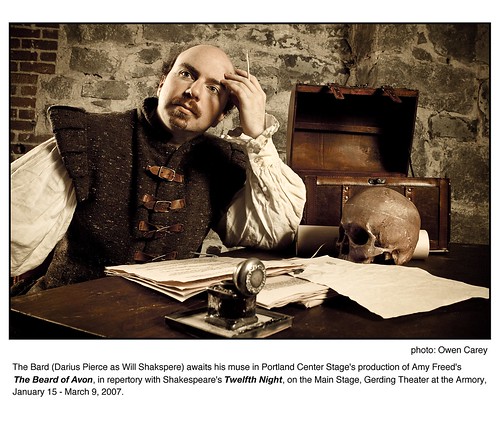 Ooh, I've fallen behind on my blogging. I saw The Beard of Avon at Portland Center Stage on Tuesday the 15th--now it's the 24th and I'm up to my ears in stuff at Vassar, though it's only the beginning of the semester.
Thoughts on the play before it vanishes from my memory:
I was so excited when I heard that Darius Pierce was going to play Will Shakspere (yes, that's how it spelled). I had a great time working with him last summer on Marie Antoinette and seeing him play King Louis XVI as a put-upon, insecure "little guy." And that's just the way that Shakspere is in Amy Freed's play--not a lofty historical figure, but a provincial farmer who comes to London, his eyes as shiny as his bald pate (but don't mention that to him, he's very self-conscious about it). Darius is very funny but also very sympathetic in these underdog roles. Maybe it's because I'm a writer myself, but I really feel for Shakspere in The Beard of Avon--the little guy with big dreams. The moral of the play, if you will, is "Everything from nothing comes to those who love"--and Shakspere loves. He is, literally, an amateur.
And this isn't the kind of love found in Shakespeare in Love, either--where he only needs a good woman to make his pen start flowing again (how's that for a double entendre?). Writing is never that easy, and The Beard of Avon recognizes that--the struggle to put one's thoughts down on paper, and then, the struggle to see them produced.
Speaking of Shakespeare in Love, Brian Thompson, playing Henry Condel, looks so much like Geoffrey Rush as Philip Henslowe that it had to have been intentional. (Henslowe and Condel were both theater managers of the time.)
The play has lots of fun with language, written in mock-Elizabethan style, and sometimes it goes by too fast--you want to savor the way the words sound and the jokes are constructed. Most of the Shakespeare allusions got laughs, but I was disappointed to be the only person in the entire theater who laughed at "Wilt thou assault me with dramaturgy?" (Maybe it would help if more people knew what a dramaturg does.)
Really, The Beard of Avon is a strong comedy script--using language in interesting ways, amusing you but making you think about things like the creative process, and inspiring at least some members of the audience (i.e. my dad) to want to learn more about Shakespeare. Still, I am bothered by some flaws and inconsistencies: Shakspere is the smartest guy in Stratford but the dumbest guy in London. When Lord Edward De Vere first presents his "beard" scheme to the theater managers (noblemen can't be professional playwrights, so De Vere will find another name to put on his scripts), Shakspere at first seems to catch on quickly. He calls himself "Honest Will Shakspere... trustworthy-to-death Will Shakspere!" as if positioning himself to be chosen as the beard. But two minutes later, he is so dense that De Vere must explain the scheme to him in great detail. It seems like Amy Freed wants to cram in as many jokes as possible, riffing on both the "Shakspere is a frustrated genius!" idea and the "Shakspere is a silly country bumpkin!" idea, but you can't have it both ways.
It was nice to see Oregon Shakespeare Festival actors Catherine Lynn Davis, Ken Albers, and Brent Harris in this Shakespeare-inspired comedy...and after all Portland Center Stage started as an outgrowth of OSF. Davis is funny as Shakspere's put-upon wife, Anne Hathaway, who, in a scene right out of a Shakespeare mistaken-identity comedy, pretends to be a prostitute so that her husband will finally pay attention to her. Albers takes on some smaller roles like another theater manager, Heminge. And Harris plays Edward De Vere, the archetypal world-weary, debauched nobleman. Great fun!
I thought Carol Halstead's British accent was a little too much as Queen Elizabeth, but she has some great scenes where she writes The Taming of the Shrew and then watches it performed (and what a delicious idea on Amy Freed's part! Of course Elizabeth would identify with Kate!). And although it would have been nice to be able to see Twelfth Night, which is playing in repertory with Beard at PCS, I've already seen some great productions of Twelfth Night in my life. So I'm glad I got introduced to a new comedy by this great set of actors, instead.
Thursday, December 27, 2007
Happy Holidays from Portland
I feel a little like Garrison Keillor, "It's been a quiet week in Lake Wobegon..." Because it's been a quiet week in Portland, OR, since I got back, and I'm wondering why I don't feel more energized. Sure, I've seen some movies and one piece of theatre, read some books, eaten better food than I have all month, celebrated Christmas with the family... But I'm also very lethargic, not thinking very hard about the play that consumed me during my last week at Vassar (and which I still need to finish) nor very hard about this blog, either, it seems.

Sunday was a good, Portlandy day. I went downtown to see A Christmas Carol at Portland Center Stage, adapted by my mentor, Mead Hunter. I also knew several of the cast members from various summers at JAW. The adaptation was very faithful to Dickens' novella (which I usually make a point of reading every year)--it moved swiftly and did not pad things out with extraneous local color or period detail. It understood that the heart of the show is Scrooge's journey, and once each episode had made its point, it ended. And, though I just complained about the excessive use of narration in Doris to Darlene, I did not mind its more limited use here.
The cast was big (15 adults, 5 children) and expertly choreographed/ doubled to make it look like there were even more cast members than there actually were. One standout was Julianna Jaffe playing the Ghost of Christmas Present à la Sara Ramirez in Spamalot. I saw the show on closing day and couldn't help wondering if some of the performances had gotten overly broad since opening night--especially Scrooge's (Wesley Mann). Several times, it seemed like he acted self-consciously "funny" to make the audience laugh, rather than playing the truth of the character. Musical choices and arrangements were also good--my favorite being the Middle-Eastern orchestration of "Ding Dong Merrily On High" to accompany a scene where Young Scrooge reads The Arabian Nights.
After the show I went to Powell's and bought six wonderful books using the store credit I'd amassed... Santa brought me even more books two days later, so this will be a wonderfully literary vacation. And then, my parents and I reenacted our holiday tradition of a dinner at Higgins restaurant. They are obsessed with a seasonal item on the menu called the Smoked Goose Breast Salad, and me, I don't mind Higgins' cooking either. I've only ever eaten at Higgins in December, and most years, I get the Magret and Confit of Duck with sour cherries and spaetzel. Mmm. Holidays in Portland.
On Christmas Eve, my father and I hedged our bets by going both to The Golden Compass movie (y'know, the movie that Conservative Catholics are all up in arms about) and to 10 PM Catholic Mass. After all my anticipation, you can read my thoughts about The Golden Compass here. I wasn't expecting perfection, and I ended up being mostly entertained. And even though the dialogue was careful to sidestep around Pullman's anti-religious statements, I liked how the production design didn't: the agents of the Magisterium were definitely wearing ecclesiastical robes, and the wall of the Magisterium office in Trollesund was painted with haloed saints. Still, I'm not quite sure why Catholics specifically are attacking this movie, since, even when I first read The Golden Compass as a nine-year-old who wanted to take Catholicism very seriously, I never thought of it as an attack on one specific religion. More an attack on any religion or any cult that wants to control its followers' lives.
As for Christmas mass, since I don't consider myself a Catholic anymore, I go for the singing, and to see the people at church who still remember me. I feel more spiritual when I'm singing those great old songs (and they have to be the rousing old hymns, not the newfangled gentle folky stuff) than during any other part of the ceremony.
And since then...not much. Dad and I made the Gratin Dauphinois from Jeffrey Steingarten's It Must've Been Something I Ate (which I blogged about wanting to cook last August)--turned out very well. So it's been a fat and lazy week--much appreciated after all those finals, but I do hope to shake off this lethargy sometime soon and really get out there and enjoy my vacation!

Sunday was a good, Portlandy day. I went downtown to see A Christmas Carol at Portland Center Stage, adapted by my mentor, Mead Hunter. I also knew several of the cast members from various summers at JAW. The adaptation was very faithful to Dickens' novella (which I usually make a point of reading every year)--it moved swiftly and did not pad things out with extraneous local color or period detail. It understood that the heart of the show is Scrooge's journey, and once each episode had made its point, it ended. And, though I just complained about the excessive use of narration in Doris to Darlene, I did not mind its more limited use here.
The cast was big (15 adults, 5 children) and expertly choreographed/ doubled to make it look like there were even more cast members than there actually were. One standout was Julianna Jaffe playing the Ghost of Christmas Present à la Sara Ramirez in Spamalot. I saw the show on closing day and couldn't help wondering if some of the performances had gotten overly broad since opening night--especially Scrooge's (Wesley Mann). Several times, it seemed like he acted self-consciously "funny" to make the audience laugh, rather than playing the truth of the character. Musical choices and arrangements were also good--my favorite being the Middle-Eastern orchestration of "Ding Dong Merrily On High" to accompany a scene where Young Scrooge reads The Arabian Nights.
After the show I went to Powell's and bought six wonderful books using the store credit I'd amassed... Santa brought me even more books two days later, so this will be a wonderfully literary vacation. And then, my parents and I reenacted our holiday tradition of a dinner at Higgins restaurant. They are obsessed with a seasonal item on the menu called the Smoked Goose Breast Salad, and me, I don't mind Higgins' cooking either. I've only ever eaten at Higgins in December, and most years, I get the Magret and Confit of Duck with sour cherries and spaetzel. Mmm. Holidays in Portland.
On Christmas Eve, my father and I hedged our bets by going both to The Golden Compass movie (y'know, the movie that Conservative Catholics are all up in arms about) and to 10 PM Catholic Mass. After all my anticipation, you can read my thoughts about The Golden Compass here. I wasn't expecting perfection, and I ended up being mostly entertained. And even though the dialogue was careful to sidestep around Pullman's anti-religious statements, I liked how the production design didn't: the agents of the Magisterium were definitely wearing ecclesiastical robes, and the wall of the Magisterium office in Trollesund was painted with haloed saints. Still, I'm not quite sure why Catholics specifically are attacking this movie, since, even when I first read The Golden Compass as a nine-year-old who wanted to take Catholicism very seriously, I never thought of it as an attack on one specific religion. More an attack on any religion or any cult that wants to control its followers' lives.
As for Christmas mass, since I don't consider myself a Catholic anymore, I go for the singing, and to see the people at church who still remember me. I feel more spiritual when I'm singing those great old songs (and they have to be the rousing old hymns, not the newfangled gentle folky stuff) than during any other part of the ceremony.
And since then...not much. Dad and I made the Gratin Dauphinois from Jeffrey Steingarten's It Must've Been Something I Ate (which I blogged about wanting to cook last August)--turned out very well. So it's been a fat and lazy week--much appreciated after all those finals, but I do hope to shake off this lethargy sometime soon and really get out there and enjoy my vacation!
Monday, November 12, 2007
A feminist wrestles with "A Feminine Ending"

Gillian Jacobs as "Amanda." Photo by Joan Marcus from broadwayworld.com
Show #2 of my Playwrights Horizons subscription was A Feminine Ending, by young Yale graduate Sarah Treem. I was very excited and happy to see this world premiere, because I had seen the play developed at Portland Center Stage's JAW: A Playwrights Festival in summer 2006. (Caveat: at that time I read the play and saw some early rehearsals, but did not see the final staged reading, since I had to go out of town.) Back then I was very fond of it. Sure, it's not an earth-shattering play, but I thought it was a nice comedy about a young woman's coming of age. I liked how it dealt with her career and her love life and her parents, rather than hitting only one or two of these important components. And Amanda, the main character, reminded me a bit of myself: an artistically inclined only child who is more the dutiful daughter than the rebel. In an interview, Treem said she wrote this play out of frustration at the fact that women playwrights seem to have it harder than men--and realizing that it's even worse for female composers. (Amanda is an oboist hoping to become a composer.) No wonder I can relate!
Portland Center Stage is going to produce A Feminine Ending this winter so when I worked in marketing there over the summer, I got to think more about the play and how to promote it. It's funny: the dynamic between me and my baby-boomer boss was a little like the dynamic between Amanda and her mother Kim in the play, with regards to our discussions about how feminism has changed from her generation to mine. My boss said, "This whole thing, in the play, with Amanda wondering what guy she'll end up with? That would never have happened in my time. We knew that another guy would always come along, but in the workplace there was that huge glass ceiling, so you would do everything you could for your career. We didn't have time to worry about guys!" (Or like Nathalie Baye says in the 1973 movie Day For Night: "I'd give up a guy for a film, but I'd never give up a film for a guy!") I liked having these conversations. It proved that the play wasn't just a romantic comedy, but was relevant to modern society.
But seeing the world premiere at Playwrights Horizons on Saturday, I felt disappointed. The play seemed more self-consciously quirky than when it was at JAW, with more cheap laughs. The characters' tics and obsessions now struck me as attempts to jazz up a conventional story. For the first time, I considered Amanda a whiner with depressingly little self-knowledge. The actress who played her, Gillian Jacobs, delivered her opening monologue as if already on the verge of hysteria, rather than charming the audience into following her on her journey toward self-actualization.
I thought it was unfair for Charles Isherwood to spend a paragraph of his review lambasting Treem for naming her heroine "Amanda Blue," but several things in this play didn't ring true for me, either. Most jarringly, the character of Billy says he studied "linguistics and women's studies" in college, so he can deliver a monologue about those subjects that tells us the theme of the play. The whole thing is way too pat, like attending a lecture instead of a dramatic performance. Does anyone really believe that this nice but underachieving kid from rural New Hampshire, who is now working as a postman, actually would have chosen to study linguistics?
What's unfortunate is that this monologue of Billy's comes right after a very good monologue of Amanda's, where she describes her choices, regrets, and confusions. Confession time: though it's probably not good protocol to audition with a monologue from an unproduced play, I liked this speech so much that I used it last fall. So I have it on my computer--and IMO, it's just good writing. (Apologies for any changes that Treem may have made to this speech in the past year--but it sounded very similar to this on Saturday.)
AMANDA: Hey Billy? If you brought me up here to catalog my dreams deferred, don’t bother. I know what they are. I’m the one that let them go— (Beat) I mean – put them on hold. Temporarily. They’re on temporary hold.So Treem can write. She can make an extended metaphor (of the "opening doors") that feels organic to the character. She can identify one of the problems of being female in this society--you're supposed to be likable above all else. She can delineate a young woman's emotions and fears. But too often in A Feminine Ending, she doesn't do this. Part of the reason the above monologue is so successful is that Amanda delivers it to Billy, and there's a strong objective behind it--the need to justify her choices to him. But the rest of Amanda's monologues are delivered directly to the audience and completely violate "show, don't tell."
BILLY: Why?
AMANDA: (Pause) When I was young, it was just me and my oboe. And then you came along. And that was fine, but then one day my parents became people. Who had a whole set of expectations. And from there, it’s just a slippery slope. Because once I realized other people existed, I suddenly saw them everywhere. I had to pay attention to them.
BILLY: Why?
AMANDA: Because I didn’t want to be a bitch, Billy. Nobody sees a girl alone with an oboe and thinks she must be brilliant. They think she must be weird or maladjusted or stuck-up. I wanted people to like me. You get all these perks when you’re a girl and people like you. You can open doors with a smile. Eventually I realized that those doors don’t open very far at all, and besides that, they’re the wrong doors and besides that, I didn’t even know what doors I should be looking for, because I was too busy watching the boys when they gave that lecture in class. But even that, I thought, was a responsible decision, to watch the boys, because there seemed to be a time crunch. And a limited supply. And everyone else was getting one…
So I started to think I’d better put the music aside and get one too. And I did. I found one. A great one. A real catch. But it wasn’t easy getting him. Because a lot of people wanted him. And it won’t be easy keeping him, no matter how much he loves me. So that means more time away from music.
I began thinking, recently…I have a few years now. Before Jack’s career…before children…of relative security. I could really…get something done. So I take a deep breath and look around for those doors… They’re gone.
It used to be the world was filled with doors. Now there are tables and closets and plenty of windows. But very few doors.
I’m not making any sense, am I?
In some sense, though, I feel guilty for criticizing Treem. The words I've used--"whiny," "hysteria," "conventional"--are the words men have always used to trivialize women's writing. If I complain that Amanda doesn't really change during the course of the play--she ends up not much further on from where she started--Treem can say, with Virginia Woolf and other feminist theorists, "Well, women's writing is circular and discursive, and only MEN want a linear narrative with characters who change!" (That's why that whole "écriture féminine" thing irks the hell out of me--but I'll save that for another post.) It's hard for me to find fault with A Feminine Ending without feeling like a self-loathing female. I'm reminded of Curtis Sittenfeld writing, "To suggest that another woman's ostensibly literary novel is chick lit feels catty, not unlike calling another woman a slut -- doesn't the term basically bring down all of us?" Maybe you should click that link and read Sittenfeld's whole piece. Maybe that's what I'm trying to say about A Feminine Ending.
P.S. After all this talk about different generations of women--A Feminine Ending provides a simple test of what generation you belong to. When Marsha Mason walks out onstage in the role of Kim, do you recognize her? Do you give her entrance applause? Or, like me, do you think her name sounds vaguely familiar but know you have never seen one of her movies? Mason did a fine job, but I just thought it was weird to hear someone get entrance applause in a theatre as small as the Peter Jay Sharp...
Wednesday, July 25, 2007
We Played Rough
Another year, another JAW: A Playwrights Festival at Portland Center Stage. After missing half of it last year, I was so glad to be a part of the whole festival again! The four main staged readings were:
I'm not really going to comment on what I thought of the plays--whether I liked them or didn't, whether they work or not--because they are still being workshopped and, after all, I'm involved with the Festival. But there were some interesting parallels and connections that I noted, which are probably fine to share.
All of the plays this year had a theme of "the responsibility that parents owe to their children." Bruise Easy is ALL about that--the main characters are children of divorce, the mom is missing, the daughter is pregnant, the Nasty Neighborhood Kids seem nasty only because they're crying out for their parents' love. In A Story about a Girl, Jessica's parents don't know how to deal with having a daughter who can't talk, and she ultimately runs away. Danae, in Box Americana, gets the job at Wal-Mart to provide for her daughter Janelle, but gets fired when she asks for time off to care for a sick Janelle. Marie Antoinette depicts Marie and her son the Dauphin, and also suggests that part of Marie's problem is that her mother neglected her and she never had a childhood--shipped off to marry Louis at the age of 14.
Three of the plays (not so much A Story about a Girl) were, self-consciously, new twists on old forms. Marie Antoinette uses contemporary language and a talking sheep, but it's not otherwise anachronistic and is true to history--a twist on the bio-play. You think "For all I know, it could have happened that way." Strip away the pop-culture references and the shocking, contemporary-seeming brutality from Bruise Easy, and you're left with something like a Greek tragedy--Dan LeFranc actually based it on Electra. (The brother and sister are Alec and Tess, not Electra and Orestes.) It is actually a very moral, ethical play, dealing with the question of how to live a good life for oneself and one's children. As a play about injustice in the workplace, Box Americana makes you think of a 1930s labor drama (Clifford Odets), until you realize that Jason Grote is avoiding simple propaganda. It reminded David Adjmi of "those '80s plays like Top Girls where you realize that everyone is caught in the system, that the system is to blame."
These same 3 plays also make use of symbolic, message-bearing characters--the revolutionary sheep in Marie Antoinette, the wise-beyond-their-years skate-punks in Bruise Easy, the spirit of Sam Walton in Box Americana. Perhaps this all comes down to Tony Kushner's influence? I think he is a really big role model for this generation of playwrights. Jason Grote's subtitle is even Kushnerian... Box Americana: A Dream of Wal-Mart versus Angels in America: A Gay Fantasia on National Themes.
Hopefully, you will see reviews of these four plays in The New York Times sometime, or better yet, at a theatre near you!
- Marie Antoinette by David Adjmi--Quirky, tragi-comic version of Marie's life. Mixture of elevated and Valley Girl dialogue. A talking sheep. Windmills. Focuses on Marie's psychology, makes you wish history was wrong.
- Bruise Easy by Dan LeFranc--Brutal, wrenching. Long, poetic, impossible stage directions. SoCal suburban wasteland. A pregnant woman. Her slacker brother. A Greek chorus of Nasty Neighborhood Kids.
- A Story about a Girl by Jacquelyn Reingold--Bittersweet. Story-theater form. Narration and retelling. A girl who has trouble learning how to talk, and her experiences with life and love.
- Box Americana: A Dream of Wal-Mart by Jason Grote--Sam Walton as diabolus ex machina. Six people, male and female, black and white, caught in our late-capitalist system. Funny but eye-opening.
I'm not really going to comment on what I thought of the plays--whether I liked them or didn't, whether they work or not--because they are still being workshopped and, after all, I'm involved with the Festival. But there were some interesting parallels and connections that I noted, which are probably fine to share.
All of the plays this year had a theme of "the responsibility that parents owe to their children." Bruise Easy is ALL about that--the main characters are children of divorce, the mom is missing, the daughter is pregnant, the Nasty Neighborhood Kids seem nasty only because they're crying out for their parents' love. In A Story about a Girl, Jessica's parents don't know how to deal with having a daughter who can't talk, and she ultimately runs away. Danae, in Box Americana, gets the job at Wal-Mart to provide for her daughter Janelle, but gets fired when she asks for time off to care for a sick Janelle. Marie Antoinette depicts Marie and her son the Dauphin, and also suggests that part of Marie's problem is that her mother neglected her and she never had a childhood--shipped off to marry Louis at the age of 14.
Three of the plays (not so much A Story about a Girl) were, self-consciously, new twists on old forms. Marie Antoinette uses contemporary language and a talking sheep, but it's not otherwise anachronistic and is true to history--a twist on the bio-play. You think "For all I know, it could have happened that way." Strip away the pop-culture references and the shocking, contemporary-seeming brutality from Bruise Easy, and you're left with something like a Greek tragedy--Dan LeFranc actually based it on Electra. (The brother and sister are Alec and Tess, not Electra and Orestes.) It is actually a very moral, ethical play, dealing with the question of how to live a good life for oneself and one's children. As a play about injustice in the workplace, Box Americana makes you think of a 1930s labor drama (Clifford Odets), until you realize that Jason Grote is avoiding simple propaganda. It reminded David Adjmi of "those '80s plays like Top Girls where you realize that everyone is caught in the system, that the system is to blame."
These same 3 plays also make use of symbolic, message-bearing characters--the revolutionary sheep in Marie Antoinette, the wise-beyond-their-years skate-punks in Bruise Easy, the spirit of Sam Walton in Box Americana. Perhaps this all comes down to Tony Kushner's influence? I think he is a really big role model for this generation of playwrights. Jason Grote's subtitle is even Kushnerian... Box Americana: A Dream of Wal-Mart versus Angels in America: A Gay Fantasia on National Themes.
Hopefully, you will see reviews of these four plays in The New York Times sometime, or better yet, at a theatre near you!
Subscribe to:
Posts (Atom)