Marisabidilla: n., Span. A know-it-all girl with an answer for everything. Marissabidilla: n., Amer-Span. The blog of a girl with an answer for some things and a question for most things.
Showing posts with label cutting ball. Show all posts
Monday, June 4, 2012
"Tenderloin" at Cutting Ball: Voices of a Neighborhood
The week that Tenderloin opened at Cutting Ball Theater, I published a column for San Francisco Theater Pub that could be seen as disparaging the Tenderloin neighborhood. (It was mostly about how having so many S.F. theaters in the Tenderloin puts our artform at a disadvantage, since it's hard to entice people to visit the neighborhood and it doesn't get good foot traffic.) The timing of my article vis-a-vis the opening of Tenderloin was purely coincidental and I hope that no one made the mistake of interpreting my piece as a veiled swipe at Cutting Ball. Nonetheless, you could say that I seemed to set myself up in opposition to their play. My article took the conventional bourgeois attitude toward the Tenderloin; Cutting Ball's play is designed to counteract this.
Tenderloin has been over a year in the making. Led by director and documentary-theater specialist Annie Elias, the six actors in the piece interviewed Tenderloin residents and other people with a connection to the neighborhood, then shaped the interviews into a theater piece. In the tradition of other documentary-theater artists such as Anna Deavere Smith, they worked to reproduce the exact phrasing, cadences, vocal tone and overall affect of the interviewees.
The result is absolutely stunning from a performance standpoint. MVPs include Tristan Cunningham, who portrays a sad-eyed homeless beatboxer, an irrepressibly cheerful Filipina motivational speaker, and a cynical street-cleaner; and Rebecca Frank, an actress in her mid-twenties who somehow manages to transform herself into 86-year-old Leroy Looper, the "Mayor of the Tenderloin." Meanwhile, David Sinaiko, a middle-aged man with gray hair, plays Leroy's doting wife Kathy. Michael Uy Kelly plays a transsexual waitress, a retired police officer, and a Tenderloin resident with a hilarious story about being asked to take care of a baby. Siobhan Marie Doherty excels at playing tenderhearted female characters (a young woman in an abusive relationship; a massage therapist who provides services to Tenderloin residents) while Leigh Shaw plays more authoritative or powerful women (an activist lawyer; a pastor at Glide Church).
I also found the piece interesting from a playwriting perspective. After all, none of it was conventionally written, but it was wrought out of dozens of interviews -- the speakers are often juxtaposed in interesting ways so that they seem to be in dialogue with one another. I found the structure of the piece effective overall. Moreover, these people speak in fascinating, idiosyncratic ways, which I see as encouragement to be bolder in my own writing. There are times when I'll write a line and then strike it out, saying, "No one would ever say that in real life -- it's too weird/too flowery/too nakedly emotional/etc." But, it turns out that when you interview real-life people, they do say weird, flowery, emotional, expressive things. And of course, this heightened language works great on stage.
As for the political and thematic messages of Tenderloin? Clearly, the piece is designed to display often-overlooked aspects of the neighborhood -- the architectural heritage, the children who are growing up there (little kids on bouncy-balls and a bubbly high-school student both appear in the play), the many acts of kindness and compassion that take place on a daily basis. The piece also comes out against city policies that have turned the Tenderloin into a "containment zone" for the poor and downtrodden and the social services that cater to them. It used to be that halfway houses and soup kitchens were scattered around the city, but starting in the '70s, they became concentrated in the Tenderloin, amplifying the neighborhood's problems. I found this point especially striking and persuasive because it parallels what I said in my Theater Pub column. I believe San Francisco would benefit if its theaters were located in neighborhoods across the city, rather than just in the Tenderloin; and I can now see how the city would benefit if there were soup kitchens or drug-rehab clinics outside of the Tenderloin, too. Moreover, if the Tenderloin has become synonymous with "everything people don't want," and the majority of San Francisco theaters are located in the Tenderloin -- does this also mean that theater is something that "people don't want," that they'd rather not have in their neighborhood? Something to think about.
Yet at the same time, I felt like Tenderloin sometimes went a bit too far in trying to make us love the neighborhood. We hear from a young woman from Palo Alto who feels safe and welcome in the Tenderloin... but we don't hear from any women complaining about getting catcalled or stared at, which has frequently been my experience. (OK, the catcalling is usually mild, along the lines of "Hey beautiful, give me a smile" rather than anything disgustingly sexual. Nor have I ever had the sense I would be physically assaulted. Nonetheless, it's not exactly fun to walk past a dozen guys loitering on the sidewalk and staring at you.) I wish that that perspective had been represented somewhere in the patchwork of stories that make up Tenderloin.
At the beginning and end of the show, the actors portray what we might think of as "typical" Tenderloin denizens -- drunks, prostitutes, the homeless and mentally ill. In the final scene of the performance that I attended, actress Rebecca Frank (whom I know somewhat) was playing one of these characters. She spotted me in the audience, caught my eye, made some comment about how tall I am, came up the aisle, and asked me to give her a hug. I complied, but at the same time, I was all too well aware that I was hugging Rebecca, a nice young woman pretending to be a homeless drunk, rather than an actual homeless drunk. Which, I think, says something about the limitations of theater. Tenderloin certainly taught me a lot, introducing me to some fascinating real-life people as channeled through the skillful performances of six talented actors. Perhaps I empathize a bit more with the Tenderloin now. But I'm not going to embrace any homeless drunkards any time soon.
Tenderloin has been playing to sellout crowds and was just extended for 2 more weeks, June 14-24. Tickets here.
Image: Rebecca Frank and David Sinaiko as Leroy and Kathy Looper. Photo by Rob Melrose.
Labels:
cutting ball,
san francisco,
theatre,
theatre reviewed
Sunday, March 27, 2011
Will Eno's Mesmerizing Meta-Theater

I loved Will Eno's Thom Pain (based on nothing) when Cutting Ball produced it two years ago, so I was excited to see the theater company's latest offering, Lady Grey (in ever lower light) and Other Plays by Will Eno. Even better, the playwright was there in person and did a "talk-forward" (i.e., a pre-show talk) with director Rob Melrose on opening night.
At the talk-forward, Eno said that he wrote Lady Grey, the evening's flagship play, at around the same time he wrote Thom Pain, because he wanted to explore similar motifs and themes, but with "feminine energy." I have said before that Thom Pain is really hard to describe to someone who's never seen it, but Lady Grey is really easy to describe -- it truly is the female version of Thom Pain. Both are one-person shows where the performer tells deadpan jokes, reminisces about lost love, and tells a disjointed story about a child who may or may not be a younger version of themself. He/she seems to enjoy the audience's discomfort, but also to detest it -- to seek the audience's approval even as he/she scorns it.
At times I wondered whether the differences between Thom Pain and Lady Grey -- between "masculine energy" and "feminine energy" -- just reinforce gender stereotypes. For instance, even though Lady Grey has an ambivalent relationship with the audience and at one point even curses everyone in the theater, she seems much more insecure, much more concerned than Thom Pain about whether the audience likes her or not. Furthermore, Thom's story has to do with the endurance of pain (he tells the story of a little boy getting stung by a swarm of bees), while Lady Grey's story is more about sexuality (she tells the story of a little girl who strips naked for Show and Tell).
But, you know, maybe these gender differences are realistic. In a society where female bodies are more sexualized than male bodies, perhaps a woman would be likelier to say "maybe you'd like me better if I took my clothes off" when in front of an audience. And in general, women are more concerned with whether other people like them. Didn't I just say the other day that male artists tend to be Bad Boys and female artists tend to be Dutiful Daughters? That's certainly an apt description of Thom Pain versus Lady Grey. Moreover, in Lady Grey, Eno draws effective parallels between physical nudity and emotional nudity/vulnerability. It's not cheap or meretricious.
After Lady Grey, there's an intermission -- and then you come back and take your seat for Intermission, a four-character play about 15 minutes long. All of the reviews have singled this play out as the highlight of Cutting Ball's production, and I have to agree -- it's a gem of a script and earns a slot on my Favorite Short Plays of All Time list. Perhaps it doesn't sound like much on paper: a younger couple and an older couple, dressed up to see a show at an ACT-type theater, spend intermission discussing the play that they're watching, and other topics such as sorrow and loss. Eno has great fun lampooning bad playwriting in the snatches of dialogue we get to hear from the play-within-the-play, a melodrama about assisted suicide (this is all the funnier because ACT actually produced a melodrama about assisted suicide, The Quality of Life, two years ago). The jokes zing, but there is also pain and wisdom and questioning here. Eno certainly doubts the value of mediocre, manipulative plays like the one seen by the characters of Intermission -- and one of the characters even seems to doubt the value of all theater, all fiction and artifice. Intermission itself, though, proves a rebuttal to Eno's doubts. It is valuable theater.
The final play of the evening, Mr. Theatre Comes Home Different, is another one-man show, worthwhile because it lets the great David Sinaiko rant, rave, be sardonic, knock over furniture, play a love scene, a mad scene, and a death scene within a 10-minute span, and greedily eat a carnation (which is one of the funniest things I've seen all year). There is more philosophizing here about the nature of theater and life, but I most enjoyed this play as an entertainment/vaudeville, and I think there's value in that, too.
Lady Grey (in ever lower light) and Other Plays is at the Cutting Ball Theater through April 10.
Image: Actors David Sinaiko, Gwyneth Richards, Galen Murphy-Hoffman, and Danielle O'Hare in Intermission.
Labels:
cutting ball,
theatre reviewed,
will eno
Saturday, November 27, 2010
"The Tempest" at Cutting Ball: A Freudian Wet Dream
The Cutting Ball Theater opened its 2010-2011 season with a three-actor version of Shakespeare's The Tempest. Taking place in a therapist's office at the bottom of a swimming pool.
Come again?
This was perhaps the most unusual directorial conceit of any Shakespeare production I've ever seen -- and I thought it was terrific.
(The usual disclaimers apply: I'm on the literary committee at Cutting Ball, think they are a fab bunch of people, and got invited to the gala opening of this production -- paid for my ticket, but still.)
As director Rob Melrose sees it, The Tempest is full of plots and subplots that reflect one another. To take an obvious example, Trinculo, Stephano, and Caliban plot to overthrow Prospero in a bumbling, comic fashion; while, fifteen years ago, Antonio and Alonzo successfully overthrew Prospero in a way that wasn't funny at all. Or, Prospero must relinquish his control over his daughter Miranda and his sprite-servant Ariel... both of whom are young, feminine figures who have grown under Prospero's care, and now clamor for freedom. Melrose writes in the playbill: "Our three-person Tempest hopes to illuminate the many connections between the characters, encouraging a reading of the play similar to Freud's reading of fairy tales, where some characters are treated as aspects of other characters."
This Tempest is a slippery production that allows resonances and double meanings; sometimes it requires you to hold two contradictory ideas in your head simultaneously. Are the characters on a Mediterranean island, or in a therapist's office? (The early scenes imply that Prospero is a psychoanalyst and Miranda is his patient -- she hallucinates the tempest that opens the play, writhing about on the therapist's couch. But this conceit seems forgotten for large chunks of the show.) Is it a story about a middle-aged patriarch (Prospero) who must relinquish his daughter (Miranda/Ariel) to the young man who loves her (Ferdinand/Caliban)? Or could all of the characters even be aspects of one person, and the whole play be the story of a man who must learn how to integrate his id (Caliban) with his superego (Ariel)?
I knew that this concept had the potential to confuse the audience -- even to confuse me, because I do not know The Tempest by heart. I've never studied it, and had seen only one prior production, at the Oregon Shakespeare Festival in 2001. (Tangent: When Julie Taymor's movie of The Tempest comes out next month, people will make a big deal that Helen Mirren plays the lead role as "Prospera." Well, OSF did this nearly 10 years ago. And it turned Prospera's usurping sibling into "Antonia.") Nonetheless, I didn't reread the play before going to Cutting Ball. I truly believe that good theater should be accessible to anyone, even if it is "experimental" theater, even if the audience hasn't "done their homework."
But I wasn't confused by the Cutting Ball production, except in the aforementioned sense of having to hold two contradictory ideas in my head simultaneously -- which is, I think, intentional confusion, a workout for the brain, rather than incoherence. The brilliance of Shakespeare's play still came across and the doubling threw certain themes into high relief, such as "is Man inherently good or inherently evil?" And I finally realized why the last words of the play are "set me free"; no other line could be more appropriate.
Much has been written about how The Tempest is Shakespeare's last play, and Prospero's magical artifice is a metaphor for the playwright's artifice, and Prospero's decision to renounce magic represents Shakespeare's farewell to the stage. The Cutting Ball production adds another layer by suggesting that therapy = magic = theatre. When I realized this, I was moved, perhaps because my roommate is in training to be a therapist and she and I have had many fruitful conversations about the intersections between therapy and theatre.
This is a very clever production, yet what amazed me the most is the way that the cleverness reinforced the themes and the emotion of the play, rather than detracting from it. One could say that Melrose has "deconstructed" The Tempest, yet "deconstruction" implies something far colder and more clinical than this production. Melrose doesn't neglect the hilarity of the Trinculo and Stephano scenes, or the sweetness of the Miranda and Ferdinand ones -- though he does imbue them with other layers, due to the double-casting. For instance, there's a scene in the original script where Trinculo hides with Caliban under his overcoat when it starts to rain. When Stephano comes across them, he is confused to see four legs sticking out from under the coat, shivering from the cold. But Melrose stages this in such a way that you wonder: are they shivering, under that coat, or are they having sex? Because Trinculo is also Miranda, and Caliban is also Ferdinand, and Stephano is also Prospero...
There are two especially dazzling moments in the second act. First is the wedding masque Prospero stages for Ferdinand and Miranda. In this production, the masque is a fragmented, sped-up version of the play we have just seen: there are audio and video snippets of the actors reciting key lines from earlier scenes. Second is the climax, which is the only moment in the entire production when one of the actors must "have a conversation with himself" (i.e. switch rapidly back and forth between two roles, playing both sides of a dialogue). It's amazing, on a technical level, that Rob Melrose was able to adapt The Tempest for three actors and only require someone to "have a conversation with himself" the one time. But it's even more amazing on an emotional level. Along with the masque scene, it reinforces the themes of coming to terms with the different aspects of one's self, integrating the many roles one plays into a coherent whole. These scenes make everything fall into place.
Still, I realize that this production might best be understood by people who are familiar with other experimental theater, or have an affinity with abstract and dream-like art. (In his director's note, Melrose name-checks David Lynch, Christopher Nolan, and Haruki Murakami.) If I were younger, I think I would have complimented the production by saying "it was really cool how the actors were able to each play so many different roles." Well, it is cool. But the point of the doubling is not just to prove that Cutting Ball's actors are virtuosos, or to do the play on the cheap--there's more to it than that.
Still, much credit is due to actors David Sinaiko (Prospero/Alonso/Stephano), Caitlyn Louchard (Miranda/Ariel/Gonzalo/Trinculo/Sebastian), and Donell Hill (Caliban/Ferdinand/Antonio). Sinaiko speaks the Shakespearean verse with great ease and naturalness; his is a more accessible, low-key Prospero than one might find in other productions. Louchard excels in a very difficult assignment: five different roles, and each one of them a character who is caught in the middle between Sinaiko and Hill. She makes each of her characters distinct, using different voices and physicalities, and also has a lovely singing voice in Ariel's songs. I found Hill most convincing when he played the genial Ferdinand (he also played the genial Mr. Martin in The Bald Soprano at Cutting Ball last year, again opposite Louchard) and didn't think he had quite enough twisted rage in him to be an ideal Caliban. But then, maybe that's the point of this production: every young man has potential to be both Caliban and Ferdinand.
I found Cutting Ball's three-actor Tempest weird and delightful, rich and strange, in the way that theater should be... and particularly in the way that any good production of The Tempest should be! O brave new world, that has such theatre in it! It is rough, but real, magic.
The Tempest has been extended at Cutting Ball through December 19.
Come again?
This was perhaps the most unusual directorial conceit of any Shakespeare production I've ever seen -- and I thought it was terrific.
(The usual disclaimers apply: I'm on the literary committee at Cutting Ball, think they are a fab bunch of people, and got invited to the gala opening of this production -- paid for my ticket, but still.)As director Rob Melrose sees it, The Tempest is full of plots and subplots that reflect one another. To take an obvious example, Trinculo, Stephano, and Caliban plot to overthrow Prospero in a bumbling, comic fashion; while, fifteen years ago, Antonio and Alonzo successfully overthrew Prospero in a way that wasn't funny at all. Or, Prospero must relinquish his control over his daughter Miranda and his sprite-servant Ariel... both of whom are young, feminine figures who have grown under Prospero's care, and now clamor for freedom. Melrose writes in the playbill: "Our three-person Tempest hopes to illuminate the many connections between the characters, encouraging a reading of the play similar to Freud's reading of fairy tales, where some characters are treated as aspects of other characters."
This Tempest is a slippery production that allows resonances and double meanings; sometimes it requires you to hold two contradictory ideas in your head simultaneously. Are the characters on a Mediterranean island, or in a therapist's office? (The early scenes imply that Prospero is a psychoanalyst and Miranda is his patient -- she hallucinates the tempest that opens the play, writhing about on the therapist's couch. But this conceit seems forgotten for large chunks of the show.) Is it a story about a middle-aged patriarch (Prospero) who must relinquish his daughter (Miranda/Ariel) to the young man who loves her (Ferdinand/Caliban)? Or could all of the characters even be aspects of one person, and the whole play be the story of a man who must learn how to integrate his id (Caliban) with his superego (Ariel)?
I knew that this concept had the potential to confuse the audience -- even to confuse me, because I do not know The Tempest by heart. I've never studied it, and had seen only one prior production, at the Oregon Shakespeare Festival in 2001. (Tangent: When Julie Taymor's movie of The Tempest comes out next month, people will make a big deal that Helen Mirren plays the lead role as "Prospera." Well, OSF did this nearly 10 years ago. And it turned Prospera's usurping sibling into "Antonia.") Nonetheless, I didn't reread the play before going to Cutting Ball. I truly believe that good theater should be accessible to anyone, even if it is "experimental" theater, even if the audience hasn't "done their homework."
But I wasn't confused by the Cutting Ball production, except in the aforementioned sense of having to hold two contradictory ideas in my head simultaneously -- which is, I think, intentional confusion, a workout for the brain, rather than incoherence. The brilliance of Shakespeare's play still came across and the doubling threw certain themes into high relief, such as "is Man inherently good or inherently evil?" And I finally realized why the last words of the play are "set me free"; no other line could be more appropriate.
Much has been written about how The Tempest is Shakespeare's last play, and Prospero's magical artifice is a metaphor for the playwright's artifice, and Prospero's decision to renounce magic represents Shakespeare's farewell to the stage. The Cutting Ball production adds another layer by suggesting that therapy = magic = theatre. When I realized this, I was moved, perhaps because my roommate is in training to be a therapist and she and I have had many fruitful conversations about the intersections between therapy and theatre.
This is a very clever production, yet what amazed me the most is the way that the cleverness reinforced the themes and the emotion of the play, rather than detracting from it. One could say that Melrose has "deconstructed" The Tempest, yet "deconstruction" implies something far colder and more clinical than this production. Melrose doesn't neglect the hilarity of the Trinculo and Stephano scenes, or the sweetness of the Miranda and Ferdinand ones -- though he does imbue them with other layers, due to the double-casting. For instance, there's a scene in the original script where Trinculo hides with Caliban under his overcoat when it starts to rain. When Stephano comes across them, he is confused to see four legs sticking out from under the coat, shivering from the cold. But Melrose stages this in such a way that you wonder: are they shivering, under that coat, or are they having sex? Because Trinculo is also Miranda, and Caliban is also Ferdinand, and Stephano is also Prospero...There are two especially dazzling moments in the second act. First is the wedding masque Prospero stages for Ferdinand and Miranda. In this production, the masque is a fragmented, sped-up version of the play we have just seen: there are audio and video snippets of the actors reciting key lines from earlier scenes. Second is the climax, which is the only moment in the entire production when one of the actors must "have a conversation with himself" (i.e. switch rapidly back and forth between two roles, playing both sides of a dialogue). It's amazing, on a technical level, that Rob Melrose was able to adapt The Tempest for three actors and only require someone to "have a conversation with himself" the one time. But it's even more amazing on an emotional level. Along with the masque scene, it reinforces the themes of coming to terms with the different aspects of one's self, integrating the many roles one plays into a coherent whole. These scenes make everything fall into place.
Still, I realize that this production might best be understood by people who are familiar with other experimental theater, or have an affinity with abstract and dream-like art. (In his director's note, Melrose name-checks David Lynch, Christopher Nolan, and Haruki Murakami.) If I were younger, I think I would have complimented the production by saying "it was really cool how the actors were able to each play so many different roles." Well, it is cool. But the point of the doubling is not just to prove that Cutting Ball's actors are virtuosos, or to do the play on the cheap--there's more to it than that.
Still, much credit is due to actors David Sinaiko (Prospero/Alonso/Stephano), Caitlyn Louchard (Miranda/Ariel/Gonzalo/Trinculo/Sebastian), and Donell Hill (Caliban/Ferdinand/Antonio). Sinaiko speaks the Shakespearean verse with great ease and naturalness; his is a more accessible, low-key Prospero than one might find in other productions. Louchard excels in a very difficult assignment: five different roles, and each one of them a character who is caught in the middle between Sinaiko and Hill. She makes each of her characters distinct, using different voices and physicalities, and also has a lovely singing voice in Ariel's songs. I found Hill most convincing when he played the genial Ferdinand (he also played the genial Mr. Martin in The Bald Soprano at Cutting Ball last year, again opposite Louchard) and didn't think he had quite enough twisted rage in him to be an ideal Caliban. But then, maybe that's the point of this production: every young man has potential to be both Caliban and Ferdinand.
I found Cutting Ball's three-actor Tempest weird and delightful, rich and strange, in the way that theater should be... and particularly in the way that any good production of The Tempest should be! O brave new world, that has such theatre in it! It is rough, but real, magic.
The Tempest has been extended at Cutting Ball through December 19.
Labels:
cutting ball,
shakespeare,
theatre reviewed
Monday, June 21, 2010
Recommended: "Krapp's Last Tape" at Cutting Ball
Over the last two weekends, I have gone to see the final entries in this year's Hidden Classics Readings Series at Cutting Ball Theater. Both were new translations and featured the actors David Sinaiko and Paul Gerrior in leading roles.
In Paul Walsh's translation of Strindberg's Storm, Sinaiko and Gerrior played brothers who are faced with the return of the woman whom one or both of them once loved. In Beatrice Basso's translation of Goldoni's The Antiquarian's Family (which has never been translated into English before), Sinaiko played an aristocrat so obsessed with collecting antiquities that he is blind to everything else around him, and Gerrior played the middle-class merchant who tries to talk some sense into him.
I mention this because these two talented men are also starring in Cutting Ball's current mainstage production, a revival of last year's Krapp's Last Tape. Gerrior plays the elderly Krapp, and Sinaiko provides the younger Krapp's recorded voice.
As you might recall, I saw this production last year and loved it. I have a lot of other things going on at the moment, so I am not sure if I will make it back to Cutting Ball to see it a second time, but believe me, I'd love to. It is an incredibly moving play. As director Rob Melrose said yesterday, "Forty-five minutes long and you get to evaluate this man's entire life! The power of theater..."
Krapp's Last Tape plays at the Cutting Ball Theater (in residence at the Exit on Taylor) through July 3.
In Paul Walsh's translation of Strindberg's Storm, Sinaiko and Gerrior played brothers who are faced with the return of the woman whom one or both of them once loved. In Beatrice Basso's translation of Goldoni's The Antiquarian's Family (which has never been translated into English before), Sinaiko played an aristocrat so obsessed with collecting antiquities that he is blind to everything else around him, and Gerrior played the middle-class merchant who tries to talk some sense into him.
I mention this because these two talented men are also starring in Cutting Ball's current mainstage production, a revival of last year's Krapp's Last Tape. Gerrior plays the elderly Krapp, and Sinaiko provides the younger Krapp's recorded voice.
As you might recall, I saw this production last year and loved it. I have a lot of other things going on at the moment, so I am not sure if I will make it back to Cutting Ball to see it a second time, but believe me, I'd love to. It is an incredibly moving play. As director Rob Melrose said yesterday, "Forty-five minutes long and you get to evaluate this man's entire life! The power of theater..."
Krapp's Last Tape plays at the Cutting Ball Theater (in residence at the Exit on Taylor) through July 3.
Wednesday, March 31, 2010
"Jesus Moonwalks the Mississippi": A Thriller of a Play

So, one of the reasons I was so eager to share with you that I am on the Cutting Ball Literary Committee is because it affects the way I discuss Cutting Ball productions on this blog. Now that I am somewhat affiliated with this institution, I can't write objectively about it, and it's fair for you to know that.
And that's important because on Saturday night I went to see the latest Cutting Ball production, the world premiere of ...and Jesus Moonwalks the Mississippi, by Marcus Gardley. Here's my attempt to discuss some elements of the production while honoring my new association with this theater company.
I came to love Cutting Ball through their productions of three plays with minimalist plots and production values: Thom Pain, Krapp's Last Tape, and The Bald Soprano. Jesus Moonwalks is kind of a departure from that; it features 12 actors and a more elaborate physical production. Cutting Ball has built a stage out of stained wooden boards, with constellations of colored buttons on the back wall--it looks wonderfully Southern and folk-arty. Miss Ssippi (the river herself, played by Nicole C. Julien) wears a beautiful blue gown with an 1860s silhouette. She and the three members of the female Chorus sing many spirituals in beautiful four-part harmony. (Anyone else think that they should have a sing-off with the three middle-aged African-American guys who are always out in front of A.C.T. singing "Down By the Riverside"?) And the incorporation of these powerful old songs into the script makes Jesus Moonwalks a communal, cathartic experience.
Furthermore, while the language of Jesus Moonwalks is highly lyrical and metaphorical, the play also has a plot in the traditional sense (something that Thom Pain, Krapp's Last Tape, and Bald Soprano lack). Actually, make that a plot and several subplots. The main story is that of the slave Damascus (Aldo Billingslea), who is traveling through the Civil-War-torn South trying to find his daughter, Po'em. Though Damascus is lynched by Confederate soldiers, Miss Ssippi resurrects him and transforms him into a woman: Demeter. The play thus refers to the myth of Persephone (and it made me wonder: why are there so many plays that treat the Orpheus and Eurydice theme, and comparitively few about Demeter and Persephone?).
I actually met Billingslea seven years ago when he was one of the actor-instructors at the Oregon Shakespeare Festival's Summer Seminar for high school students. We kids thought he was the coolest guy ever--I still remember a chant that he taught us! He does a great job in the role of Damascus/Demeter, playing a woman with intelligence and without any condescension.Eventually Demeter winds up in Louisiana on the Verse family plantation, home to several colorful characters. The plantation mistress, Cadence Verse (Jeanette Harrison) is like some kind of twisted Tennessee Williams figure--a delusional, dipsomaniacal Southern belle with some nasty secrets. Then there are two young girls underfoot: Blanche (Sarah Mitchell), a white tomboy; and Free (Erika A. McCrary), who doesn't know she's black.
Jesus Moonwalks is an ambitious play and could potentially use one more revision to work out some of the kinks. In the first part of the play, Jesus is mostly a comic figure (lots of humor arises because only one of the other characters can see and hear him, and the moment when he moonwalks is pretty amusing) but the denouement requires you to take Jesus seriously and believe that this is the almighty son of God. I thought that the shift in tone could be smoothed out. Also, the time frame of the play is a little confusing, though the elaborate program notes try their best to explain it: evidently it starts in 1863 at the Siege of Vicksburg then jumps forward two years to the very end of the Civil War, but that doesn't quite register in the script.
Still, I recommend ...and Jesus Moonwalks the Mississippi for its lyricism, its spirituals, its ability to put the Mississippi River on the stage of a small S.F. theater, its unique take on American history and heritage. It's just been extended at Cutting Ball till April 25. And I would love for the play to have a future life--some theater in the South ought to pick it up!
Sunday, March 28, 2010
If I may be allowed to brag...
...a couple of months ago, I was invited to join the Literary Committee of the Cutting Ball Theater, and I am eagerly looking forward to attending my first committee meeting!
The Cutting Ball is one of my favorite theaters in town; you might have read my blog posts where I raved about their productions of Thom Pain, Krapp's Last Tape, and The Bald Soprano. So I really consider it an honor to be asked to get involved with this organization doing what I love best (apart from playwriting): reading plays and deciding if they would be suitable for staged readings or productions!
Oh, and the week after I agreed to join the Literary Committee? Cutting Ball was profiled in American Theater magazine. Pretty sweet, no?
The other thing that amazes me is the way I got invited to join the committee. I had attended the first-ever San Francisco Theater Pub--Euripides' Cyclops, newly translated by my friend Ben Fisher--and, while socializing after the show, I kept bumping into a young woman. About the third time this happened, we decided we should just introduce ourselves. She said she was Meg O'Connor, Literary Manager of Cutting Ball, whereupon I immediately started gushing about how much I love the work at that theater.
Then she asked me, "And are you involved with theater at all?"
"Yes," I said, "I'm a playwright--I'm a friend of Ben's."
No sooner had I said this than Meg said, "Oh, then perhaps you'd like to join the Cutting Ball Literary Committee!"
Would I ever! Still, I can't get over the easiness, the friendliness of the encounter. At the time this happened, I was reading Outrageous Fortune, which, as you may know, amid all its doom-and-gloom, singles out the Bay Area as a region where the theater is actually thriving; it says that the community here is exceptionally supportive and hospitable. This event--a chance encounter at a pub night leading to my joining the literary committee at one of my favorite theaters--is San Francisco theater at its finest. And this sort of thing would never happen in New York. There, I imagine, the competition to be on the literary committee of a theater as good as Cutting Ball would be cutthroat--requiring some kind of elaborate application process, dozens of hungry young playwrights all jockeying for one slot. Here, there were no hoops to jump through.
As I said, I haven't yet been to my first literary committee meeting, but I believe our main responsibility is to find overlooked plays from thousands of years of theater history, to present in the Hidden Classics Reading Series. (This winter, I attended both Medea vs. Medea and Women Beware Women when Cutting Ball presented them as Hidden Classics.) So not only am I looking forward to the opportunity to share some of my favorite classic plays with the wider public, I also know that the other committee members will expose me to plays I've never even heard of, and I hope that this will make my own writing stronger as well...
The Cutting Ball is one of my favorite theaters in town; you might have read my blog posts where I raved about their productions of Thom Pain, Krapp's Last Tape, and The Bald Soprano. So I really consider it an honor to be asked to get involved with this organization doing what I love best (apart from playwriting): reading plays and deciding if they would be suitable for staged readings or productions!
Oh, and the week after I agreed to join the Literary Committee? Cutting Ball was profiled in American Theater magazine. Pretty sweet, no?
The other thing that amazes me is the way I got invited to join the committee. I had attended the first-ever San Francisco Theater Pub--Euripides' Cyclops, newly translated by my friend Ben Fisher--and, while socializing after the show, I kept bumping into a young woman. About the third time this happened, we decided we should just introduce ourselves. She said she was Meg O'Connor, Literary Manager of Cutting Ball, whereupon I immediately started gushing about how much I love the work at that theater.
Then she asked me, "And are you involved with theater at all?"
"Yes," I said, "I'm a playwright--I'm a friend of Ben's."
No sooner had I said this than Meg said, "Oh, then perhaps you'd like to join the Cutting Ball Literary Committee!"
Would I ever! Still, I can't get over the easiness, the friendliness of the encounter. At the time this happened, I was reading Outrageous Fortune, which, as you may know, amid all its doom-and-gloom, singles out the Bay Area as a region where the theater is actually thriving; it says that the community here is exceptionally supportive and hospitable. This event--a chance encounter at a pub night leading to my joining the literary committee at one of my favorite theaters--is San Francisco theater at its finest. And this sort of thing would never happen in New York. There, I imagine, the competition to be on the literary committee of a theater as good as Cutting Ball would be cutthroat--requiring some kind of elaborate application process, dozens of hungry young playwrights all jockeying for one slot. Here, there were no hoops to jump through.
As I said, I haven't yet been to my first literary committee meeting, but I believe our main responsibility is to find overlooked plays from thousands of years of theater history, to present in the Hidden Classics Reading Series. (This winter, I attended both Medea vs. Medea and Women Beware Women when Cutting Ball presented them as Hidden Classics.) So not only am I looking forward to the opportunity to share some of my favorite classic plays with the wider public, I also know that the other committee members will expose me to plays I've never even heard of, and I hope that this will make my own writing stronger as well...
Labels:
cutting ball,
outrageous fortune,
self-promotion,
theater pub,
theatre
Monday, February 15, 2010
Seneca = The Roman Tarantino
After Medea vs. Medea a few weeks ago, I was chatting with one of the actors. Like me, he definitely preferred Euripides' version to Seneca's.
I said, "I got the feeling that Seneca was less concerned with moving the action forward, and more with writing speeches that made allusions to all of these other myths, so that he could show off how smart he was."
"Yeah, he was basically the Quentin Tarantino of Ancient Rome," said my friend. "Sorry, I don't like Tarantino."
"Oh, I don't know, I really enjoyed Inglourious Basterds," I said. My friend hadn't seen it, but maybe he should check it out. It seems that what he objects to is Tarantino's random riffs about pop-culture oddities, but Tarantino naturally had to tone that down for Basterds, because it takes place in the '40s. (And I thought that the riff on King Kong was brilliant!)
But anyway, my friend's comparison of Seneca and Tarantino was especially apt because not only are they both known for elaborate, rhetorical, allusion-filled dialogue... they are also really fond of outrageous bloody violence. In Euripides' play (as is typical of Greek tragedy) Medea kills her children offstage, but in Seneca's, she does it right in front of the audience. Seneca, not the Greek playwrights, was the inspiration for Elizabethan and Jacobean revenge tragedy. And after Cutting Ball's staged reading of the Jacobean revenge tragedy Women Beware Women, in the finale of which nearly every character dies in a bizarrely violent way, the post-show discussion compared it to...Quentin Tarantino! It's like there's a direct through-line from the ancient Roman dramatist to the Italian-American auteur.
I always used to have trouble remembering why I should care about Seneca or what his stylistic hallmarks were, but now that I know to think of him as "the Roman Tarantino," I won't forget!
I said, "I got the feeling that Seneca was less concerned with moving the action forward, and more with writing speeches that made allusions to all of these other myths, so that he could show off how smart he was."
"Yeah, he was basically the Quentin Tarantino of Ancient Rome," said my friend. "Sorry, I don't like Tarantino."
"Oh, I don't know, I really enjoyed Inglourious Basterds," I said. My friend hadn't seen it, but maybe he should check it out. It seems that what he objects to is Tarantino's random riffs about pop-culture oddities, but Tarantino naturally had to tone that down for Basterds, because it takes place in the '40s. (And I thought that the riff on King Kong was brilliant!)
But anyway, my friend's comparison of Seneca and Tarantino was especially apt because not only are they both known for elaborate, rhetorical, allusion-filled dialogue... they are also really fond of outrageous bloody violence. In Euripides' play (as is typical of Greek tragedy) Medea kills her children offstage, but in Seneca's, she does it right in front of the audience. Seneca, not the Greek playwrights, was the inspiration for Elizabethan and Jacobean revenge tragedy. And after Cutting Ball's staged reading of the Jacobean revenge tragedy Women Beware Women, in the finale of which nearly every character dies in a bizarrely violent way, the post-show discussion compared it to...Quentin Tarantino! It's like there's a direct through-line from the ancient Roman dramatist to the Italian-American auteur.
I always used to have trouble remembering why I should care about Seneca or what his stylistic hallmarks were, but now that I know to think of him as "the Roman Tarantino," I won't forget!
Labels:
cutting ball,
greek tragedy,
seneca,
tarantino,
theatre,
weird connections
Saturday, February 13, 2010
Euripides Was Pretty Awesome
I never used to be one of those playwrights who got a lot out of Greek tragedy. I respected it, sure, but it didn't speak to me. However, a few things I've seen in 2010 have caused me to reevaluate my former judgment and gain a new appreciation for one of the three major tragedians--Euripides!
(And next weekend I'm going to see a new play called Oedipus El Rey, which everyone says is excellent, so maybe I'll find myself reevaluating Sophocles too...)
First, at the inaugural San Francisco Theater Pub, I saw a reading of my friend Ben's new translation of Euripides' Cyclops--the only surviving satyr play. Of course, it is a fluke that it was Euripides' satyr play that survived, and not one by Aeschylus or Sophocles or some other writer. Still, I enjoyed learning that Euripides had a very silly, bawdy, irreverent sense of humor; he wasn't only about choral lamentations and horrific messenger-speeches.
But then, Euripides' humor does come through in his tragedies, too. Odysseus, in Cyclops, is a total egomaniac, a burlesque of the conventional hero--but then, so is Jason in Medea. I learned this when I attended Cutting Ball Theater's Medea vs. Medea--back-to-back staged readings of Euripides' and Seneca's plays about the woman who killed her children for revenge. At the end of it, there was a discussion, followed by a vote on which play we preferred. Euripides beat Seneca by about 2 to 1! And I was firmly on Euripides' side. It seems to me that he was a dramatist, while Seneca was a poet. Euripides' version moves swiftly, integrates the Chorus into the action, and the dialogue arises out of the characters' wants and needs. Seneca is more concerned with writing lengthy choral odes that allude to other myths and legends (as though he's trying to show off how smart he is), and long philosophical speeches. Euripides' heroine is far more complex and sympathetic than Seneca's, and his play is shot through with the laughter of dramatic irony. Seneca was perhaps the underdog in this fight, because his Medea is much more rarely performed than Euripides'... but you know, it seems like there's a good reason he's the underdog.
Then, a few days later, I went to see Racine's PhĆØdre at ACT. I am very familiar with the myth of Phaedra and her love for her stepson Hippolytus, because in college, I was a member of the Chorus in a student production of Euripides' Hippolytus. And I have to say that, again, in my opinion, Euripides comes out the winner.
Part of might just be a problem with translation and with how little contemporary audience preferences have in common with Racine's style. OK, I can't read Euripides in the original, but I can read Racine's French, and understand how so much of what he has to offer is the way that he writes in balanced alexandrine couplets. But the translation that ACT used, by Timberlake Wertenbaker (who, when she's not translating, is a really terrific playwright), was in blank verse that sounded like prose, and lacked both modern vigor and classical lyricism. Greek tragedy, I think, is more translatable; at least, it has been successful all over the world, while Racine has never really been successful outside of France (unlike, say, MoliĆØre).
But I also think that Euripides' conception of character and incident was more interesting than Racine's. Racine's classicism, his "decorum," meant that he sanded the rough edges off of his characters. His Hippolytus is instantly sympathetic, because he is a handsome young lover. In his first scene, he tells us that he has fallen in love with Princess Aricie, but is forbidden to marry her. We are glad when Hippolytus fends off the incestuous advances of PhĆØdre, and we hope he can be united with the much more age-appropriate Aricie.
Conversely, Euripides' Hippolytus is really unsympathetic for about the first half of the play, and there is no Aricie character. Euripides' Hippolytus is proud and haughty; he has never been in love and appears disgusted by the idea of it. We almost hope that he will succumb to Phaedra's pleading, because we see how pained she is, and we think that it would be good for his heart to melt, for him to feel love and understand its torments. And yet, by the end of the play, Euripides has made us feel sympathy for Hippolytus: he is an unjustly accused innocent, his death is a tragedy. Only a very skillful dramatist can cause the audience to shift its opinion of a character like that; it's a challenging effect to achieve, and grants the play a greater complexity. Racine's characters may express themselves more eloquently than Euripides' do, but it turns out that as a dramatist, Racine had less to say.
(And next weekend I'm going to see a new play called Oedipus El Rey, which everyone says is excellent, so maybe I'll find myself reevaluating Sophocles too...)
First, at the inaugural San Francisco Theater Pub, I saw a reading of my friend Ben's new translation of Euripides' Cyclops--the only surviving satyr play. Of course, it is a fluke that it was Euripides' satyr play that survived, and not one by Aeschylus or Sophocles or some other writer. Still, I enjoyed learning that Euripides had a very silly, bawdy, irreverent sense of humor; he wasn't only about choral lamentations and horrific messenger-speeches.
But then, Euripides' humor does come through in his tragedies, too. Odysseus, in Cyclops, is a total egomaniac, a burlesque of the conventional hero--but then, so is Jason in Medea. I learned this when I attended Cutting Ball Theater's Medea vs. Medea--back-to-back staged readings of Euripides' and Seneca's plays about the woman who killed her children for revenge. At the end of it, there was a discussion, followed by a vote on which play we preferred. Euripides beat Seneca by about 2 to 1! And I was firmly on Euripides' side. It seems to me that he was a dramatist, while Seneca was a poet. Euripides' version moves swiftly, integrates the Chorus into the action, and the dialogue arises out of the characters' wants and needs. Seneca is more concerned with writing lengthy choral odes that allude to other myths and legends (as though he's trying to show off how smart he is), and long philosophical speeches. Euripides' heroine is far more complex and sympathetic than Seneca's, and his play is shot through with the laughter of dramatic irony. Seneca was perhaps the underdog in this fight, because his Medea is much more rarely performed than Euripides'... but you know, it seems like there's a good reason he's the underdog.
Then, a few days later, I went to see Racine's PhĆØdre at ACT. I am very familiar with the myth of Phaedra and her love for her stepson Hippolytus, because in college, I was a member of the Chorus in a student production of Euripides' Hippolytus. And I have to say that, again, in my opinion, Euripides comes out the winner.
Part of might just be a problem with translation and with how little contemporary audience preferences have in common with Racine's style. OK, I can't read Euripides in the original, but I can read Racine's French, and understand how so much of what he has to offer is the way that he writes in balanced alexandrine couplets. But the translation that ACT used, by Timberlake Wertenbaker (who, when she's not translating, is a really terrific playwright), was in blank verse that sounded like prose, and lacked both modern vigor and classical lyricism. Greek tragedy, I think, is more translatable; at least, it has been successful all over the world, while Racine has never really been successful outside of France (unlike, say, MoliĆØre).
But I also think that Euripides' conception of character and incident was more interesting than Racine's. Racine's classicism, his "decorum," meant that he sanded the rough edges off of his characters. His Hippolytus is instantly sympathetic, because he is a handsome young lover. In his first scene, he tells us that he has fallen in love with Princess Aricie, but is forbidden to marry her. We are glad when Hippolytus fends off the incestuous advances of PhĆØdre, and we hope he can be united with the much more age-appropriate Aricie.
Conversely, Euripides' Hippolytus is really unsympathetic for about the first half of the play, and there is no Aricie character. Euripides' Hippolytus is proud and haughty; he has never been in love and appears disgusted by the idea of it. We almost hope that he will succumb to Phaedra's pleading, because we see how pained she is, and we think that it would be good for his heart to melt, for him to feel love and understand its torments. And yet, by the end of the play, Euripides has made us feel sympathy for Hippolytus: he is an unjustly accused innocent, his death is a tragedy. Only a very skillful dramatist can cause the audience to shift its opinion of a character like that; it's a challenging effect to achieve, and grants the play a greater complexity. Racine's characters may express themselves more eloquently than Euripides' do, but it turns out that as a dramatist, Racine had less to say.
Labels:
cutting ball,
euripides,
greek tragedy,
racine,
seneca,
theater pub,
theatre
Thursday, November 19, 2009
"Bald Soprano": Comme C'est Absurde et Quelle Production
The Bald Soprano at Cutting Ball Theater (San Francisco's specialists in absurdism) has just been extended until mid-December! I saw the play tonight, and thought that I would have to blog about it in my typical "it's-great-but-it's-closing-sorry-I-didn't-see-it-sooner" fashion. But then I learned of the extension--so, congrats to Cutting Ball for a great start to their 10th anniversary season, and as for the rest of you--now's your chance to get tickets to the added performances before they sell out!
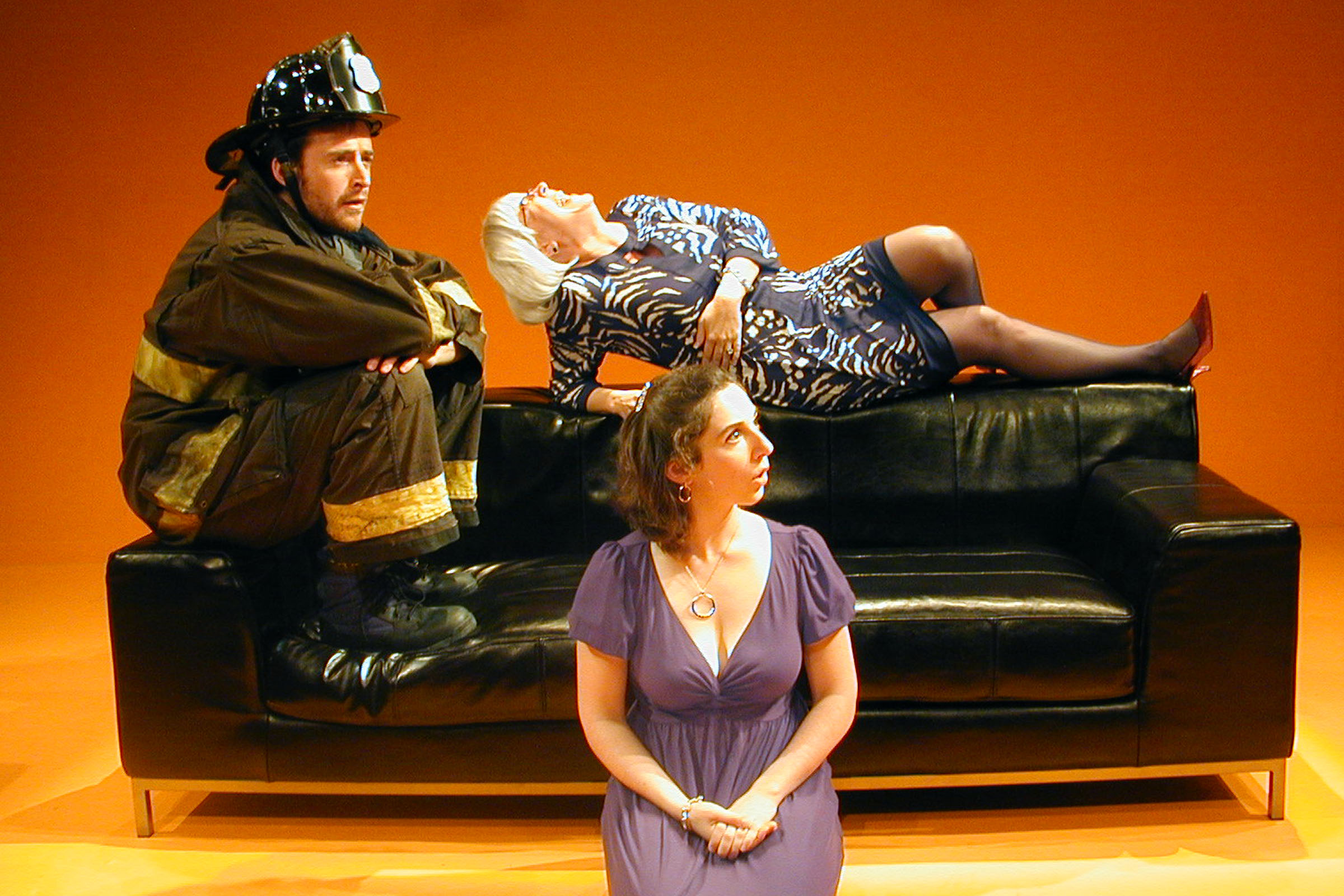
Being an absurdist play--lots of non sequitur dialogue, few stage directions--The Bald Soprano is very open to directorial interpretation. I've heard of productions that fill it with vaudeville-type gags or ones that turn it into a parody of English people and customs. It seemed that one of the goals of the Cutting Ball production was to strip away several of these "conceptual" layers and just let the text and the humor come through. I mean, of course the director, Rob Melrose, put his own ideas into it (he is also responsible for the new translation) but the stage was painted a flat yellow-orange, there weren't any props, there was no attempt to suggest "England."
It's funny: even though the text is so absurd and should offer no clues as to when the play takes place, it still seems a product of the 1950s--and it couldn't take place in the present day. In one scene, the Smiths' doorbell keeps ringing, but when someone gets up and answers the door, no one is there. It is interesting that Mr. Smith justs assumes that Mrs. Smith will answer the door, because she is a woman and the hostess--and he gets offended when Mrs. Smith suggests that he should do it himself. Perfect 1950s gender roles, in other words. It's weird how much of this kind of thing gets revealed in a text that is supposedly "meaningless." But then, The Bald Soprano was always meant to present a skewed version of our society and the language we use (as opposed to a fantasy of a completely different universe), so no wonder the mores of the time it was written show up in its subtext...
I liked how the actors found the subtext they needed, too, and how each of them created a distinct comic persona. Mrs. Smith the perky hostess, capable of saying any of Ionesco's dialogue with a straight face; Mr. Smith more voluble than his wife, jumping on furniture in frustrated bourgeois rage; Mrs. Martin the nervous younger woman, always uncertain of how to behave; and Mr. Martin placidly smiling, trying to calm his wife down.
I saw the show with a French friend, who said that she had never seen a production of the play, but that one of the oft-repeated lines from the show has passed into French parlance and tonight she finally learned where it was from. In the famous scene between Mr. and Mrs. Martin, they keep saying "Comme c'est curieux ! Comme c'est bizarre! et quelle coĆÆncidence !" ("How curious it is, how bizarre, and what a coincidence!") as the realization slowly dawns on them that they are husband and wife. Evidently this is now a famous quote among French people.
(I just thought--is the Mr. and Mrs. Martin scene intended as a parody of all of those "recognition" scenes of classical Greek drama, where Electra recognizes Orestes by his birthmark, etc.?)
Tonight the theater was mostly filled with a crowd of high-school students from Marin. They were an encouragingly enthusiastic crowd, a few of them laughing to the point of having fits, and everyone going nuts (as high-schoolers do) when the maid and the fireman started making out. At the end of the show, Cutting Ball raffled off a bottle of wine and naturally, one of the teenagers won it. Which just goes to show that life does have its absurdities.
Labels:
cutting ball,
eugene ionesco,
francophilia,
theatre reviewed
Friday, June 5, 2009
Oneiric/Minimalist
Life has a way of falling into patterns sometimes. So, just as a couple of months ago I saw a French-language play inspired by Hamlet at the school where a friend of mine teaches, followed by a minimalist one-man show at the Cutting Ball Theater... well, this week, that happened again.
The French play was called RĆŖver peut-ĆŖtre, which means, of course, Perchance To Dream. It was written by Jean-Claude Grumberg. Here is my translation of the blurb:
The actors in this production were all teachers at the lycƩe, and it seems like half the fun, for the audience, was the chance to see their teachers cut loose. One woman wore a miniskirt, another belly-danced, and the guy who directed the play also performed the role of the judge, in fishnet stockings, short-shorts, and makeup that made his face look like Jean Cocteau had sketched it. (Cocteau: another master of the oneiric.)
I can't say I totally got the play, though. My French basically suffices for me to understand the characters' words, sentences, and conversations, though I missed a few punchlines that had everyone else in the theater roaring. But on the larger level of understanding why the characters were having these conversations, why this scene followed that scene, why the play ended when it did, I was less certain. The play utilizes dream logic, after all, and when it's dream-logic in a language that isn't your native tongue, it can get difficult. (Don't they say that the moment you're become truly fluent in a language is when you start dreaming in it? And I've had dreams that include French phrases, but never a complete dream in French.) I'm not used to being so bewildered by the structure of a play. Indeed, three or four years ago I discovered I'd begun to watch plays "like a playwright," that is, with a hyper-awareness of their underlying construction and the tricks-of-the-trade used by the playwright. But I'm still uncertain what tricks Grumberg used; perhaps I should try to locate a copy of the script...

A few days after that, at five p.m. last Sunday, I went to the Exit Theater to catch a production of Krapp's Last Tape, by Samuel Beckett. I thought it was pretty nifty, how they scheduled this short play at an unorthodox time: you could be downtown shopping or whatever, pop over to the theatre, spend forty-five minutes seeing one of Beckett's major works, and when you left it would hardly even be time for dinner. (I also liked how this saved me from having to be in the Tenderloin after dark. There's a reason that the other two times I have seen a show in this neighborhood, I have been accompanied by tall men!) On the other hand, I'm not sure this is really the best way to absorb Beckett--should he really be consumed so quickly, sandwiched between more mundane or frivolous activities? Ah, well. Such is modern life.
There was a woman of about sixty at Krapp's Last Tape, pushing an older and very frail woman in a wheelchair. After the play finished, I overheard her say to her companion, "I saw this play when I was in my twenties. I knew it would be interesting to revisit it again now. Because I think it bewildered me, when I first saw it. How could it not?"
As a young twenty-something myself, I know that I probably won't get as much out of this play as an older person will, since it's all about aging and memory and regret... But because I've kept a diary since I was fourteen, I can understand how it feels to revisit the person you once were and think "How could I have ever thought this?" Or "How could I be so naive?" Or "I'd forgotten all about that--why did it seem so important at the time?"
And I could have sat in a bookstore and read Krapp's Last Tape in about fifteen minutes, but I know it wouldn't have had the same impact. Yes, it's a stripped-down little piece, but it's entirely theatrical, because every word and gesture counts. My heart ached for Krapp every time he uncorked his liquor bottle and took a swig. And mind you, this happens when Krapp is offstage, so it's not even anything in the actor's performance that created this effect--just that lonely, hollow pop as the bottle is uncorked hit me like a shot. And at the end, when, as he listened to his younger self talk about going boating with a beautiful woman and burying his face in her breasts, he cradled his old reel-to-reel tape recorder, and the two spools of it were like a poor mechanical echo of the shape of the woman's breasts--I would not have seen this beautiful image if I had only read the play.
As a writer, minimalism does not come naturally to me. But plays like Krapp's Last Tape make me wish that it did.
Photo: Paul Gerrior as Krapp. Image from the Cutting Ball Theater.
The French play was called RĆŖver peut-ĆŖtre, which means, of course, Perchance To Dream. It was written by Jean-Claude Grumberg. Here is my translation of the blurb:
The story of a sleeper in pajamas who wanders onto a stage peopled with Shakespearean characters. During the day, GƩrald B. rehearses the role of Hamlet. And at night, like all of us, he sinks into the arms of Morpheus. A highly criminal activity, according to the female gendarme who turns up in his bedroom one morning. Called before a judge, the actor is accused of having committed several murders in his dreams. Charged with "inhumanity," he finds himself commanded by his lawyer to produce, in his defense, some dreams filled with love for his fellow man. Clinging to his bed, GƩrald B. undergoes a voyage to the deepest parts of his unconscious...This premise is so very Continental, isn't it? The idea of the gendarmerie policing GƩrald's dreams is Kafkaesque, and I think Europeans have always been much more fascinated with dreams/psychoanalysis/the unconscious than Americans have. It was in my theater class in Paris that I first learned the word "oneiric" (or oneirique), in that case referring to the dream-logic employed by Pirandello--and a lot of major European art movements (Symbolism, Expressionism, Surrealism) have an oneiric quality, but this form is rarer in English and American drama.
The actors in this production were all teachers at the lycƩe, and it seems like half the fun, for the audience, was the chance to see their teachers cut loose. One woman wore a miniskirt, another belly-danced, and the guy who directed the play also performed the role of the judge, in fishnet stockings, short-shorts, and makeup that made his face look like Jean Cocteau had sketched it. (Cocteau: another master of the oneiric.)
I can't say I totally got the play, though. My French basically suffices for me to understand the characters' words, sentences, and conversations, though I missed a few punchlines that had everyone else in the theater roaring. But on the larger level of understanding why the characters were having these conversations, why this scene followed that scene, why the play ended when it did, I was less certain. The play utilizes dream logic, after all, and when it's dream-logic in a language that isn't your native tongue, it can get difficult. (Don't they say that the moment you're become truly fluent in a language is when you start dreaming in it? And I've had dreams that include French phrases, but never a complete dream in French.) I'm not used to being so bewildered by the structure of a play. Indeed, three or four years ago I discovered I'd begun to watch plays "like a playwright," that is, with a hyper-awareness of their underlying construction and the tricks-of-the-trade used by the playwright. But I'm still uncertain what tricks Grumberg used; perhaps I should try to locate a copy of the script...
A few days after that, at five p.m. last Sunday, I went to the Exit Theater to catch a production of Krapp's Last Tape, by Samuel Beckett. I thought it was pretty nifty, how they scheduled this short play at an unorthodox time: you could be downtown shopping or whatever, pop over to the theatre, spend forty-five minutes seeing one of Beckett's major works, and when you left it would hardly even be time for dinner. (I also liked how this saved me from having to be in the Tenderloin after dark. There's a reason that the other two times I have seen a show in this neighborhood, I have been accompanied by tall men!) On the other hand, I'm not sure this is really the best way to absorb Beckett--should he really be consumed so quickly, sandwiched between more mundane or frivolous activities? Ah, well. Such is modern life.
There was a woman of about sixty at Krapp's Last Tape, pushing an older and very frail woman in a wheelchair. After the play finished, I overheard her say to her companion, "I saw this play when I was in my twenties. I knew it would be interesting to revisit it again now. Because I think it bewildered me, when I first saw it. How could it not?"
As a young twenty-something myself, I know that I probably won't get as much out of this play as an older person will, since it's all about aging and memory and regret... But because I've kept a diary since I was fourteen, I can understand how it feels to revisit the person you once were and think "How could I have ever thought this?" Or "How could I be so naive?" Or "I'd forgotten all about that--why did it seem so important at the time?"
And I could have sat in a bookstore and read Krapp's Last Tape in about fifteen minutes, but I know it wouldn't have had the same impact. Yes, it's a stripped-down little piece, but it's entirely theatrical, because every word and gesture counts. My heart ached for Krapp every time he uncorked his liquor bottle and took a swig. And mind you, this happens when Krapp is offstage, so it's not even anything in the actor's performance that created this effect--just that lonely, hollow pop as the bottle is uncorked hit me like a shot. And at the end, when, as he listened to his younger self talk about going boating with a beautiful woman and burying his face in her breasts, he cradled his old reel-to-reel tape recorder, and the two spools of it were like a poor mechanical echo of the shape of the woman's breasts--I would not have seen this beautiful image if I had only read the play.
As a writer, minimalism does not come naturally to me. But plays like Krapp's Last Tape make me wish that it did.
Photo: Paul Gerrior as Krapp. Image from the Cutting Ball Theater.
Labels:
cutting ball,
francophilia,
samuel beckett,
theatre reviewed
Tuesday, March 31, 2009
Brothers in Black Suits: Hamlet and Thom Pain
The last two plays I saw were both one-man shows, and both more interesting examples of the genre than the typical "let me impersonate [insert name of dead celebrity] for two hours" thing. Also, I'm used to seeing one-man shows performed by older actors, probably due to an unspoken assumption that young actors lack the technique and/or the box-office draw to sustain a one-man show, but both these shows were performed by young, boyish-looking men, and both amply proved that they can play in the big leagues.
First, as I alluded to a couple of posts back, I went to see a one-man French adaptation of Hamlet, which sounds like it could be the punchline to a bad joke, but which I actually quite enjoyed. The full title of this show was Hamlet: la fin d'une enfance, meaning Hamlet: the end of a childhood, and the premise of it was that a modern-day young boy, whose mother has recently remarried, refuses to meet his new stepfather and instead locks himself in his room, acting out the story of Hamlet with his toys and bedroom furnishings. The adaptation thus tightly focused on the archetypal family drama of Hamlet's story--lots of prominence given to the scenes with Gertrude and Claudius and the ghost, and a major reduction in Polonius' and Laertes' stage time.
I once took a playwriting workshop with Glen Berger, who said that he tries to reduce every play he writes to a one-word gerund, in order to clarify its subject/theme. He also suggested doing this with other writers' plays. "I've even figured out the one-word gerund for Hamlet," he told us. "Acting." (How marvelously clever and smooth!)
And Hamlet: la fin d'une enfance really made that one-word gerund explicit. Thomas Marceul suggested all of the play's characters using a minimum of props and costume changes. It was pretty stylized: Ophelia was a coyly fluttering fan, Laertes an aggressive red glove, Rosencrantz and Guildenstern Lord of the Rings action figures (which is a bit too glamorous for poor R & G, I'm afraid). The best moment came at the very end. Marceul had played the whole show wearing black pants and shirt, which you took to be his "normal" clothes. But when Hamlet died, Marceul peeled off the black shirt, and you realized that this had been just another costume, that Hamlet is just a role, no more "real" than any of the others.
If the one-word, two-meanings gerund of Hamlet is "acting," then the one-word two-meanings gerund of Will Eno's Thom Pain (based on nothing) is probably "trying." "I am trying. I am a trying man," says Thom at one point. Like Hamlet, he appears before us in a suit of solemn black to grapple with the big questions, including la fin de l'enfance. ("When did your childhood end?" Thom asks the audience.) His hour-long monologue, delivered right up in the audience's faces (sit in the front row...if you can handle it), is one of sardonic petulance, with occasional flashes of the rubbed-raw nerve endings hidden underneath the mask of cynicism.
Better writers than I have tried, and failed, to describe Thom Pain--seriously, I have never read a review of this show that accurately conveys its essence--so I shall not over-dissect it. (Nor does it even really feel right to put it in a box, somehow.) But while the first thing you notice is probably Thom's abrasiveness, it really is a very compassionate play, dealing with subjects like the end of innocence and the loss of love--subjects that for hundreds of years have inspired both sentimental garbage and the most profound expressions of our humanity. Indeed, the play confronts what just might be the biggest question of all, and one I have been pondering recently: none of us ever asked to be born, yet we find ourselves on this earth in a human body, and so, what now...?
I saw Thom Pain in an excellent production at the Cutting Ball Theater, made extra special by the fact that I went to college with Jon Bock, the actor who plays Thom. (He was a year ahead of me.) Jon has a bit of a slippery quality about him, even in real life--it's hard to know what he really thinks of you--which is perfect for Thom Pain. I don't know how he does it every night--to go out and stand in that harsh light and relentlessly harangue the audience for an hour and make them feel guilty if they ever start acting bored or breaking their eye contact with him. I spoke to Jon after the show and said "You're the only thing to look at onstage, so by the end of it, every audience member has got your face memorized--that's gotta feel strange." "Yeah," said Jon, "but you have to realize, I've been looking at all of you for an hour--I try to make eye contact with everyone in the audience at least once--so I've got your faces memorized too."
So, even though Thom Pain is probably judging you with a sneer when he looks you in the eye, at least he's looking at you--and that should make you feel less alone. He's trying; so are we all.
If you're in S.F. I urge you to go see Thom Pain, which has just been extended through mid-April--and I'm not just saying that because I know the actor. Really, I don't think my natural taste in theater even lies with minimalist philosophical monologues--so if I'm telling you to go see one of those, you know it must be something special!
First, as I alluded to a couple of posts back, I went to see a one-man French adaptation of Hamlet, which sounds like it could be the punchline to a bad joke, but which I actually quite enjoyed. The full title of this show was Hamlet: la fin d'une enfance, meaning Hamlet: the end of a childhood, and the premise of it was that a modern-day young boy, whose mother has recently remarried, refuses to meet his new stepfather and instead locks himself in his room, acting out the story of Hamlet with his toys and bedroom furnishings. The adaptation thus tightly focused on the archetypal family drama of Hamlet's story--lots of prominence given to the scenes with Gertrude and Claudius and the ghost, and a major reduction in Polonius' and Laertes' stage time.
I once took a playwriting workshop with Glen Berger, who said that he tries to reduce every play he writes to a one-word gerund, in order to clarify its subject/theme. He also suggested doing this with other writers' plays. "I've even figured out the one-word gerund for Hamlet," he told us. "Acting." (How marvelously clever and smooth!)
And Hamlet: la fin d'une enfance really made that one-word gerund explicit. Thomas Marceul suggested all of the play's characters using a minimum of props and costume changes. It was pretty stylized: Ophelia was a coyly fluttering fan, Laertes an aggressive red glove, Rosencrantz and Guildenstern Lord of the Rings action figures (which is a bit too glamorous for poor R & G, I'm afraid). The best moment came at the very end. Marceul had played the whole show wearing black pants and shirt, which you took to be his "normal" clothes. But when Hamlet died, Marceul peeled off the black shirt, and you realized that this had been just another costume, that Hamlet is just a role, no more "real" than any of the others.
If the one-word, two-meanings gerund of Hamlet is "acting," then the one-word two-meanings gerund of Will Eno's Thom Pain (based on nothing) is probably "trying." "I am trying. I am a trying man," says Thom at one point. Like Hamlet, he appears before us in a suit of solemn black to grapple with the big questions, including la fin de l'enfance. ("When did your childhood end?" Thom asks the audience.) His hour-long monologue, delivered right up in the audience's faces (sit in the front row...if you can handle it), is one of sardonic petulance, with occasional flashes of the rubbed-raw nerve endings hidden underneath the mask of cynicism.
Better writers than I have tried, and failed, to describe Thom Pain--seriously, I have never read a review of this show that accurately conveys its essence--so I shall not over-dissect it. (Nor does it even really feel right to put it in a box, somehow.) But while the first thing you notice is probably Thom's abrasiveness, it really is a very compassionate play, dealing with subjects like the end of innocence and the loss of love--subjects that for hundreds of years have inspired both sentimental garbage and the most profound expressions of our humanity. Indeed, the play confronts what just might be the biggest question of all, and one I have been pondering recently: none of us ever asked to be born, yet we find ourselves on this earth in a human body, and so, what now...?
I saw Thom Pain in an excellent production at the Cutting Ball Theater, made extra special by the fact that I went to college with Jon Bock, the actor who plays Thom. (He was a year ahead of me.) Jon has a bit of a slippery quality about him, even in real life--it's hard to know what he really thinks of you--which is perfect for Thom Pain. I don't know how he does it every night--to go out and stand in that harsh light and relentlessly harangue the audience for an hour and make them feel guilty if they ever start acting bored or breaking their eye contact with him. I spoke to Jon after the show and said "You're the only thing to look at onstage, so by the end of it, every audience member has got your face memorized--that's gotta feel strange." "Yeah," said Jon, "but you have to realize, I've been looking at all of you for an hour--I try to make eye contact with everyone in the audience at least once--so I've got your faces memorized too."
So, even though Thom Pain is probably judging you with a sneer when he looks you in the eye, at least he's looking at you--and that should make you feel less alone. He's trying; so are we all.
If you're in S.F. I urge you to go see Thom Pain, which has just been extended through mid-April--and I'm not just saying that because I know the actor. Really, I don't think my natural taste in theater even lies with minimalist philosophical monologues--so if I'm telling you to go see one of those, you know it must be something special!
Labels:
cutting ball,
shakespeare,
theatre reviewed,
will eno
Subscribe to:
Posts (Atom)