Showing posts with label eugene ionesco. Show all posts

Sunday, October 8, 2017

Script Reading Roundup: Majok and Ionesco

Today's Script Reading Roundup: two talented playwrights of Eastern European heritage with very different styles, approaches, and places in the canon.

Ironbound
by Martyna Majok
My rating: 4 of 5 stars

The Ironbound is a neighborhood in Newark, New Jersey, but it's also an appropriate metaphorical title for this play about a Polish immigrant woman struggling to make the best of a bad set of options. Martyna Majok dramatizes pivotal moments in the life of Darja over the course of more than 20 years, creating a bravura role for an actress in the process. Although the title of the play makes it sound very grim, it has moments of humor and tenderness, and the three male roles reveal unexpected depths. Admittedly, some plot developments at the end failed to convince me: the main difficulty with this kind of character-study, slice-of-life play is wrapping it up in a satisfying way, and I'm not sure Ironbound pulls it off. Still, this is an absorbing and heartfelt drama about the crumbling American dream and the choices Darja makes to cling to it.

Rhinoceros and Other PlaysRhinoceros and Other Plays by Eugène Ionesco
My rating: 4 of 5 stars

Just after the 2016 U.S. election, Teju Cole published an essay on what Rhinoceros can tell us about the dangers of “minimiz[ing] evil or describ[ing] it as something else.” And it really is uncanny how the dialogue in this play anticipates arguments that I am currently reading online and in newspapers… even though Ionesco's characters are discussing an invasion of terrifying, mindless, destructive animals, and we nowadays are discussing the Trump administration. (Oh, wait.)

Admittedly, Rhinoceros is one of those plays that was groundbreaking when it was first produced but now feels more familiar. Just as R.U.R. set the pattern for subsequent “robot uprising” stories, Rhinoceros often feels like a prototype for zombie movies. I mean, obviously it’s about people turning into rhinos, not zombies, but it uses a lot of the same tropes: the mysterious outbreak that advances with terrifying speed, the confusion and angst of the dwindling band of survivors, the understanding that this supernatural horror is really a metaphor for something else.

Though Ionesco’s message about the lure of fascist conformity is pretty grim, there is enough absurdist humor here to keep it an entertaining read (I particularly liked the stage direction “the rhinoceros replies with a violent but tender trumpeting”). It’s also comforting to think that maybe the misfits of the world are the ones best equipped to resist mass hysteria. The protagonist, Berenger, is a bit of an outsider in his small provincial town: he’s melancholic, alcoholic, dissatisfied with life. But he is able to resist the rhinoceros plague after the more outwardly successful citizens succumb.

I was less impressed with the other two, shorter plays in this volume. While Rhinoceros deals with “normal” people reacting to an absurd situation and involves some degree of psychological realism, the characters in the other plays are shrill, absurdist caricatures. Also, it’s annoying that the The Future is in Eggs is listed as “a kind of sequel to Jacques, or Obedience,” but Jacques isn’t included in this volume (you have to get Grove Press’s other Ionesco compilation, The Bald Soprano and Other Plays , for that).

Friday, June 15, 2012

"A Writer Never Has a Vacation"

Ionesco said, "A writer never has a vacation. For a writer life consists of either writing or thinking about writing."

Well, I'm off to go prove Ionesco wrong -- or try to.

Taking 15 days: San Francisco to New Jersey to London to Paris and back to S.F.

This has been a crazy month for me -- planning my trip, cramming in lots of theatergoing before my departure, the Olympians book was released, there's some stressful personal/family stuff going on -- which may somewhat explain my lack of blogging.

(You should check out my latest Theater Pub post, "Why Songs of Hestia Should Be On Your Summer-Reading List," though, if you haven't already.)

I don't know what my internet access will be like for most of this trip and I think my focus during my travels might be on personal journaling rather than public blogging... but I do hope at some point to write about some aspects of my trip. (I've already got tickets to see 2 plays in London!)

OK, so maybe I won't be proving Ionesco wrong after all. Writing is always a big part of my travels and while I may not be doing any playwriting while I am away, I still won't be able to turn off the journaling/blogging/putting-words-together part of my brain.

I'm exhilarated at the thought of returning to Europe after five years, but also exhausted from the busy month I've been having. Hopefully I can get a good night's sleep on the red-eye to London Sunday night and arrive there alert and wide-eyed and ready to take it all in!


Friday, November 20, 2009

Madness & Absurdity


MARY: Elizabeth and Donald are too over the moon to hear me, so I can let you in on a secret. Elizabeth is not Elizabeth and Donald is not Donald. [...] In spite of the extraordinary coincidences which seem rock solid, Donald and Elizabeth, not being parents of the same child, are not Donald and Elizabeth. He can fancy he's Donald; she can fancy she's Elizabeth. He can fancy she's Elizabeth and she can fancy he's Donald, but both are sadly deluded. Then who is the real Donald, you ask? And who is the real Elizabeth? It beats me. I say we drop this whole affair and leave things as they are.
--Mary's monologue from The Bald Soprano by Eugene Ionesco (trans. Tina Howe)

Photo: Mad Men, season 3. Donald "Don" Draper fancies he's Donald and his wife is Elizabeth; Elizabeth "Betty" Draper fancies she's Elizabeth and her husband is Donald; both are sadly deluded.

Thursday, November 19, 2009

"Bald Soprano": Comme C'est Absurde et Quelle Production


The Bald Soprano at Cutting Ball Theater (San Francisco's specialists in absurdism) has just been extended until mid-December! I saw the play tonight, and thought that I would have to blog about it in my typical "it's-great-but-it's-closing-sorry-I-didn't-see-it-sooner" fashion. But then I learned of the extension--so, congrats to Cutting Ball for a great start to their 10th anniversary season, and as for the rest of you--now's your chance to get tickets to the added performances before they sell out!

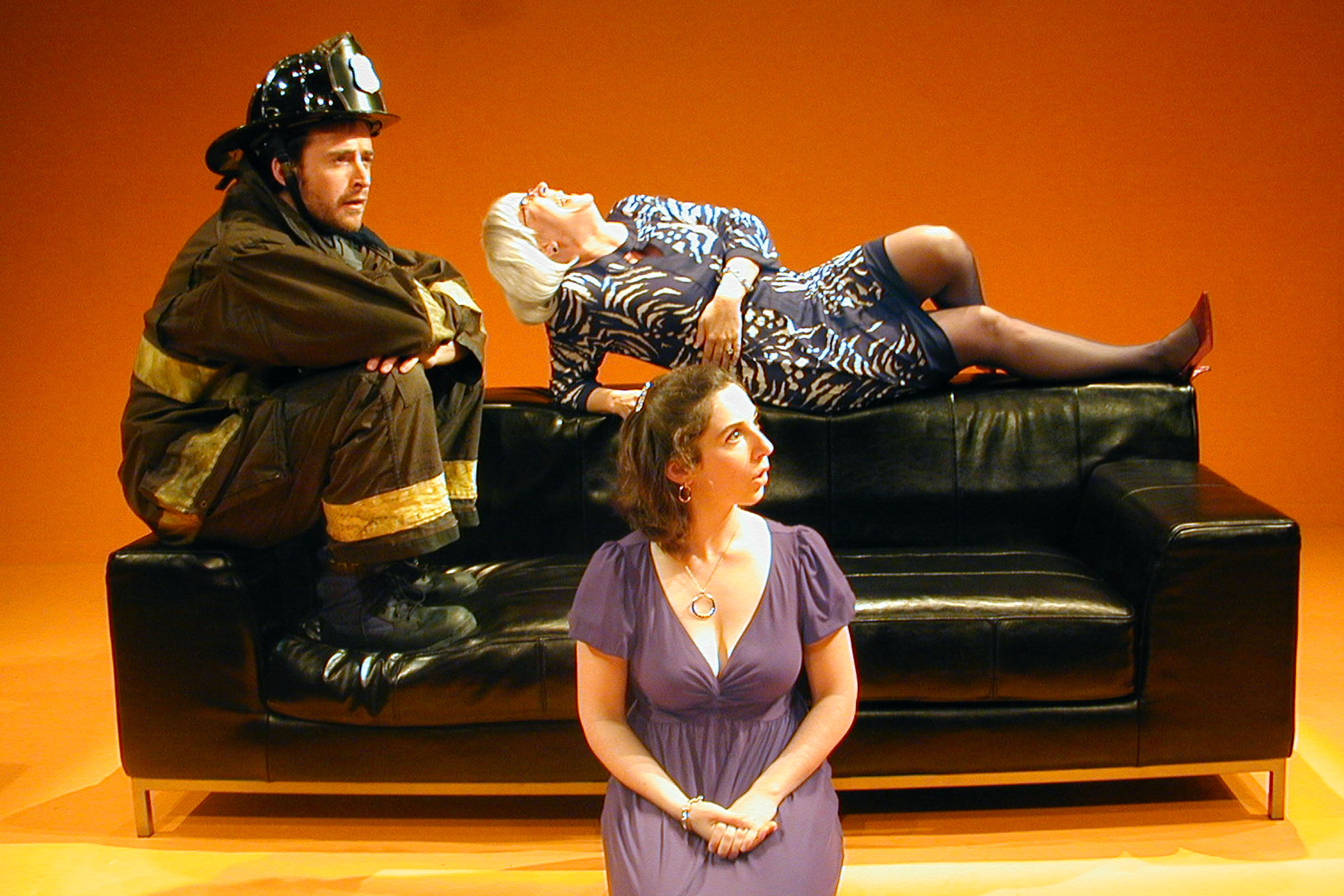
Being an absurdist play--lots of non sequitur dialogue, few stage directions--The Bald Soprano is very open to directorial interpretation. I've heard of productions that fill it with vaudeville-type gags or ones that turn it into a parody of English people and customs. It seemed that one of the goals of the Cutting Ball production was to strip away several of these "conceptual" layers and just let the text and the humor come through. I mean, of course the director, Rob Melrose, put his own ideas into it (he is also responsible for the new translation) but the stage was painted a flat yellow-orange, there weren't any props, there was no attempt to suggest "England."

It's funny: even though the text is so absurd and should offer no clues as to when the play takes place, it still seems a product of the 1950s--and it couldn't take place in the present day. In one scene, the Smiths' doorbell keeps ringing, but when someone gets up and answers the door, no one is there. It is interesting that Mr. Smith justs assumes that Mrs. Smith will answer the door, because she is a woman and the hostess--and he gets offended when Mrs. Smith suggests that he should do it himself. Perfect 1950s gender roles, in other words. It's weird how much of this kind of thing gets revealed in a text that is supposedly "meaningless." But then, The Bald Soprano was always meant to present a skewed version of our society and the language we use (as opposed to a fantasy of a completely different universe), so no wonder the mores of the time it was written show up in its subtext...

I liked how the actors found the subtext they needed, too, and how each of them created a distinct comic persona. Mrs. Smith the perky hostess, capable of saying any of Ionesco's dialogue with a straight face; Mr. Smith more voluble than his wife, jumping on furniture in frustrated bourgeois rage; Mrs. Martin the nervous younger woman, always uncertain of how to behave; and Mr. Martin placidly smiling, trying to calm his wife down.

I saw the show with a French friend, who said that she had never seen a production of the play, but that one of the oft-repeated lines from the show has passed into French parlance and tonight she finally learned where it was from. In the famous scene between Mr. and Mrs. Martin, they keep saying "Comme c'est curieux ! Comme c'est bizarre! et quelle coïncidence !" ("How curious it is, how bizarre, and what a coincidence!") as the realization slowly dawns on them that they are husband and wife. Evidently this is now a famous quote among French people.

(I just thought--is the Mr. and Mrs. Martin scene intended as a parody of all of those "recognition" scenes of classical Greek drama, where Electra recognizes Orestes by his birthmark, etc.?)

Tonight the theater was mostly filled with a crowd of high-school students from Marin. They were an encouragingly enthusiastic crowd, a few of them laughing to the point of having fits, and everyone going nuts (as high-schoolers do) when the maid and the fireman started making out. At the end of the show, Cutting Ball raffled off a bottle of wine and naturally, one of the teenagers won it. Which just goes to show that life does have its absurdities.