Of the books I've read lately, the one that I can sense will most influence my playwriting, and has inspired me to sit down and write a few scenes, isn't a playscript or a book on theater history. It's Dorothy Parker's Complete Stories.
These days, Parker seems best known for her persona: the iconic Algonquin Round Table wit, one of the world's first snarky women, author of mordant little poems. But that leaves a lot out. For one, we forget her deep troubles, that she was "one of the saddest rapid-burnout cases in American letters," as Joan Acocella once described her. (My father once accused me of "wanting to be Dorothy Parker"--Heaven forbid, I say!) But we also forget that, out of all her writing, she was evidently proudest of her short stories, not her poetry or epigrams.
I picked up the Penguin Classics edition of Parker's Complete Stories (I have a Penguin Classics fetish and a "complete works" fetish, so this was a must-buy), and, after I got past the irritating introduction by scholar Regina Barreca, discovered some wonderful writing. (This review at the site Words on Us perfectly expresses my grievances with the introduction. Basically, Barreca noisily defends Parker against every criticism that has ever been leveled at her--even though some of those criticisms are valid, and not just malicious invective cooked up by the patriarchal establishment.)
I'll begin with a criticism of my own: yes, Parker was funny and cynical, but she could rely too much on cheap ironies. Reading this collection, it gets to the point where you can anticipate the plot of the story from seeing its title: if a story is called "Oh! He's Charming!" or "The Wonderful Old Gentleman," you can predict that the man in question is going to be horrible.
But not all of the stories are this simplistic--and, as I said, I was surprised and thrilled to discover that most of them function like one-act plays. A man and a woman, or sometimes two female friends, have a conversation in a taxicab or on a banquette at a cocktail party--and that's the story, the effects all achieved with dialogue. Some of my favorites: "A Terrible Day Tomorrow" (guy tries to get a girl drunk--his speech getting more and more rambling as he drinks), "Arrangement in Black and White" (which indicts racist attitudes by letting us overhear the patronizing things said by a woman at a party), and "Dusk Before Fireworks" (a painfully observed account of a clever young woman in love with a man who keeps stringing her along). Interspersed with these stories-in-dialogue are some other stories, told in the first person--that is, "dramatic monologues." The narrator of the monologue is often Dorothy Parker herself, complaining humorously about her broken garter or her awful dance partner or her insomnia. But sometimes she writes in a different voice--check out "Lady With a Lamp," the monologue of a rather unlikable woman visiting her friend, who is indisposed after having an abortion. It captures the personality of this "frenemy," and I am sure it was quite daring for 1931!
Has anyone ever acquired the rights to some of Parker's stories and adapted them into a theater piece? I can picture it now--"A Dorothy Parker Evening." It would alternate her dialogue sketches with her dramatic monologues, and then finish up with a dramatization of one of her longer stories... might I suggest "The Game" (a collaboration with Ross Evans, from 1948), which is a fantastic, tense story about a game of charades that reveals a sordid secret. It would be a fun evening in the theater--and because of Parker's name recognition, I think it would also have commercial appeal!
And in the meantime, I know I'll be returning to Parker's stories, examining how they work and how much her dialogue conveys. I love discovering "playwrights-in-disguise"--authors of prose fiction whose greatest asset is their dialogue. There's Parker, Hemingway, Armistead Maupin... who else?
Thursday, November 5, 2009

Wednesday, November 4, 2009
Undertow
Continuing my mini-series of "Circular Songs in Foreign Languages that I Really Love," here's the classic Brazilian song "Aguas de Março," sung by Elis Regina and "Tom" Jobim (who also wrote it).
This is another song where the music seems to circle around and around--the best description of this is in, of all places, the Wikipedia entry... which points out that the music matches the lyrics, because it sounds like water inexorably flowing through gutters and swirling down drains. (Listen to the way the bass line is a steady downward progression--and the high piano notes at the end of the song bounce like little water droplets.)
And, just as hurricanes swirl counterclockwise in the northern hemisphere and clockwise in the southern hemisphere, this song takes on a different meaning depending on where you live. In the northern hemisphere, you hear the title "Waters of March" and picture the last rains of winter, melting the snow, nourishing the young plants... but the Portuguese lyrics are "São as águas de março fechando o verão"--"It's the waters of March, ending the summer." And the other lyrics describe sticks and stones and bits of refuse, all caught up in the torrent.
So, despite the relaxed bossa nova beat and the laid-back singing, the song has a dark undertow, an awareness of death. And yet, Elis and Tom manage to have fun with it--they swim against the current, even as they know that one day it will sweep them away. As the lyrics go on to say, "É a promessa di vida no teu coração"--"It's the promise of life in your heart."
I swear, you listen to these three songs in a row--Brel, Moreau, Regina & Jobim--and you come away feeling that you have touched some very profound truths about life and love and death... and it took only ten minutes!
Tuesday, November 3, 2009
Whirlpools
It's late, so another video tonight: "Le tourbillon de la vie," sung by Jeanne Moreau in Jules and Jim.
My mom rented this movie for me the summer after my freshman year of college--I had a year's worth of French under my belt, so she thought it was something I ought to see.
"I saw this movie once, years ago, and I don't remember anything about it," my mom said as she put the disc into the DVD player, "except that at one point Jeanne Moreau sings a little song with a guitar."
After watching the movie, I understood what my mother meant. Because this song is unforgettable.
It is a perfect two minutes of film--all the more so because of its imperfections. Moreau sings the wrong lyrics at one point, and later she dips her head so her mouth nearly moves out of frame. But I love that Truffaut chose to use this take, rather than one that seemed less natural and spontaneous.
I'm posting this today because Jeanne Moreau is my new favorite actress and so this song has been running through my head. And also, I think it goes well with the Brel song I posted yesterday, for reasons that I am having a hard time articulating. Well, so "le tourbillon de la vie" means "the whirlpool of life," and the lyrics describe a never-ending cycle of an on-again off-again relationship. And even if you don't know French, you can hear that the music of it is circular too, going round and round. Because it's a perfect moment, you imagine you could go on listening to it forever, its endless circularity.
And the Brel "Valse à Mille Temps" is a circular song too--it's about a dance, the waltz, where you whirl around and around; the music churns and repeats; the lyrics have to do with the cycle of growing up and falling in love; Brel performs it while spinning on a merry-go-round. (In the American musical Jacques Brel Is Alive and Well and Living In Paris, this song got translated as "We're On a Carousel.") So I get a similar feeling when listening to both these songs--like there is some wisdom buried within them, though they may seem like mere little ditties on a first hearing. And I've been wondering why these circular chansons affect me so deeply, and feel so profound.
Monday, November 2, 2009
"La Valse à Mille Temps" and a Month with 30 Posts
I just learned, courtesy of Jaime at Surplus, that November is NaBloPoMo--and because I unintentionally got things off to a good start by posting something yesterday, why shouldn't I make it official and try to write a post a day? Yes, I tried and failed at NaPlWriMo (National Playwriting Month, for you acronym-averse) two years in a row--that's why I'm not participating in it this year--but one blog post per day doesn't sound too hard. And I won't lack for subjects: the theater season is in full swing, movies are opening, I've been meaning to post about several books I've read this year...
But because it is 11:30 PM, I'm going to fulfill today's requirement by posting a video: Jacques Brel singing "La Valse à Mille Temps."
I discovered this song thanks to Youtube (it doesn't appear on my Brel greatest hits CD) and now I am obsessed with it. It starts out as a very sweet, sentimental waltz about Paris and young love and the springtime (not that there's anything wrong with that!), but then the lyrics get much more intricate and punning and impossible-to-translate than you'd expect for a typical song of that genre, and it crescendos and speeds up, till at the end the great Monsieur Brel is just spitting out the words as fast as he can... you must see and hear it. Enjoy!
Sunday, November 1, 2009
Les Voix, Les Voici: Damrau and Flórez in "Fille du Régiment"
 In 2008, I watched Laurent Pelly's production of La Fille du Régiment, starring Natalie Dessay and Juan Diego Flórez, as a Metropolitan Opera TV broadcast... so why did I go see it when it came to the San Francisco Opera last week? First, because Flórez came with the production to San Francisco, and I couldn't pass up the chance to hear him live. And second, because I was curious how soprano Diana Damrau would fare in a staging that had been built around Natalie Dessay's talents and persona. So much of Pelly's production relied on the fact that Dessay is kooky and athletic and a petite gamine Frenchwoman. What would it be like with Damrau--who sings many of the same roles as Dessay and is known as a good actress, but looks stereotypically German and might bring a different energy to the role?
As it turns out, Dessay and Damrau seem to approach the role of Marie, "the daughter of the regiment," from opposite directions. Dessay starts out as a bundle of manic energy, singing forcefully and doing physical comedy tricks; and just when you think that's all there is to her, she dials it back and breaks your heart. Damrau executes the same gestures and choreography as Dessay, but in a much more controlled ("regimented"?) way. Her Marie is tomboyish, but never kooky. Her singing is more controlled too--so maybe it is closer to ideal bel canto style, and it's proof of her skill that she can sing softly during elaborate coloratura passages. All the same, there were times when Damrau was almost too quiet--and it's not that she has a tiny voice, because there were moments when she let it out and easily filled the auditorium. And those were the moments that you tended to notice and want more of.
There is a lot of spoken dialogue in Fille du Régiment, where Dessay probably has the advantage, being a native French speaker. Damrau's pronunciation wasn't bad, but she lacked Dessay's comic timing (e.g. the scene where Marie reads a letter aloud, sounding the words out because she hasn't had any formal schooling). I could also tell that Damrau and Flórez faked the kiss after their love duet--but, as I learned from the New Yorker profile of Dessay last spring, she insisted that Flórez had to really kiss her, or it wouldn't look believable.
Overall, I think that this production still works best as The Natalie Dessay Show--but in a more traditional production of Fille du Régiment, one that treated its heroine as a more conventional ingénue, I might prefer to see Damrau. This was Damrau's first attempt at the role of Marie, but I do hope it isn't her last!
 Juan Diego Flórez is the real deal, and I will count myself lucky to have heard him perform the role of Tonio in person. No, we couldn't get him to encore "Pour mon âme," but his joyful rendition of it is something to treasure. (He also has perfected his French pronunciation: when I watched the telecast it annoyed me that he sang "J'y sa flamme" instead of "J'ai sa flamme," but he didn't do that last week!) And we gave Flórez another thunderous ovation, welcoming him into our hearts, after his tender Act II aria. He sings with brilliant musicality, looks good onstage, and makes everything seem effortless. I also like that he was unafraid to give Tonio an endearingly dorky quality, especially in his first scenes. I can't imagine opera divos of the past, like Pavarotti or Domingo, allowing themselves to act so goofy.
As for the supporting cast, Meredith Arwady was delightful in the role of the Marquise de Berkenfield--acting like Margaret Dumont and singing with a huge contralto voice. I do not think that Bruno Praticò was an ideal choice to play Sergeant Sulpice, however: Sulpice does not have a lot of difficult singing, but he does have a lot of French dialogue, and Praticò's thick Italian accent rendered him almost incomprehensible when speaking French. It seems like it wouldn't be too hard to find a bass-baritone who sang just as well but could handle the dialogue better.
Photos from San Francisco Opera. Top: Marie saves Tonio from certain death. Bottom: Marie, Tonio, and Sulpice reunited.
Tuesday, October 27, 2009
A.S. Byatt's Meticulous Process
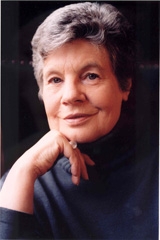 Last night I went to see a conversation between Robert Hass, the former poet laureate, and A.S. Byatt. If you have been reading my blog for a while you may remember that Byatt is one of my very favorite novelists (all my Byatt posts are here) so I was excited to see her in person. She is currently promoting a long novel called The Children's Book, which takes place from 1895 to 1919 and sounds tremendously up my alley--about artists and parents and children and fairy tales and coming of age in the Edwardian era, "that magical, golden time to be a child" as Byatt put it.
Byatt is a stout lady with a refined English accent of the sort that people don't seem to have anymore (she is 73 years old, so I suppose that makes sense). The conversation last night was about 75 minutes long, including questions from the audience. Here are some of the moments that stuck with me.
- Byatt has a reputation as a very cerebral writer, so I found it fascinating to learn that when she writes, she imagines how it would feel in her own body to experience what the characters are feeling or doing. (She said that this can make writing sex scenes a very weird experience--needing to imagine herself in the bodies of both partners!)
- Even though she is an acclaimed and prolific novelist, Byatt says that she still has a hard time thinking of herself, or describing herself, as "a writer." Instead, she says, she thinks of her career in terms of "there's work to be done, something that needs to be said, a new chapter that needs to be written." I am beginning to think that Byatt might have the right idea--that it might be healthier to say "I write plays" instead of "I am a playwright." Putting the emphasis on the work, not on your own ego and identity. (And an active verb like "I write" is always stronger than the verb "to be.")
- Byatt thoroughly outlines every novel, then sits down and writes it straight through--not jumping around from point to point in the structure. She talked about how the novels of the Frederica Potter Quartet were hard to write because their plotting was motivated solely by the characters' psychology; so it was a relief for her to take a break from the Quartet to write Possession, which is a detective story, much more rigorously plotted. I can't remember whether she considers the plot of The Children's Book more like Possession or more like the Quartet, however.
- Byatt tries hard to find something that she likes in every character that she writes--considering them from every angle and trying to see how their flaws could also be construed as virtues, as she put it. I think this is one of the reasons I love the Frederica Potter quartet so much--because she centered four novels around a character that some writers might consider too unlikable to be a heroine.
- Byatt next wants to write a novel about the Surrealists--she has some images or ideas in mind, but no characters yet. She notes that the major Surrealists "seem to have all been quite disagreeable people" so that will pose a challenge, since she doesn't want to write a satire about pretentious artists, but a real humane novel.
- Anyone who has read some Byatt knows that she loves metaphor--and that's why she loves fairy tales, too, because of their archetypal qualities. Fairy tales ("the Germanic, Grimm kind") play a role in The Children's Book as they do in some of her other novels. And like Possession, The Children's Book also contains poems written by Byatt in the voice of some of her characters; she was not originally going to do this until a young man who was writing a thesis on Possession ("a ferocious Pole," she described him) challenged her to incorporate World War One poetry into the new novel. When she realized that the metaphors of the First World War poets fit into the scheme of metaphors that she had already built up, she had no choice but to write some poems in that style and include them in the novel.
- Byatt also loves imagery and seems to have a very visual imagination. She described how she vividly pictures scenes as she writes them, e.g., getting a very clear image of a man sunbathing among brussels sprouts in a garden, wearing nothing but a wristwatch.
- But then, because she is a perfectionist, she has to make sure that these images are "accurate." That is, she realized that the man couldn't be surrounded by brussels sprouts, because they grow when the weather is too cold for sunbathing; and she also realized that she needed to Google "wristwatch" to find out whether a man in the Edwardian period would wear one. As it turns out, he wouldn't, so that had to go, too.
- Another tool that Byatt used while writing The Children's Book was an Excel spreadsheet that kept track of how old every one of her characters was supposed to be in every year from 1895 to 1919. "Because I had to make sure that all the characters aged at the same pace as everyone else, you see," she explained. However, she also admitted that she made a calculation error on the spreadsheet and didn't realize it until after the novel went to press--meaning that one of the characters in The Children's Book doesn't age the way he or she is supposed to. Byatt refused to say anything more about the matter, so I'll have to look out for this mistake when I read the novel!
Saturday, October 24, 2009
A Moreau moment
The other day, when I envisioned a Chanel biopic made in the 1950s or '60s with Jeanne Moreau in the lead, I was mainly thinking of how Moreau and Chanel share a certain uncompromising, implacable quality (which is not a quality one associates with Audrey Tautou)...
 Little did I know that Chanel was one of Moreau's favorite designers, that there are photos of them together in Chanel's famous apartment...
 ...and that even today, Moreau maintains her association with the couture house, narrating an audio guide for a Chanel exhibition and appearing in a video on the Chanel website where she gives a tour of this apartment (go here and click on #2).
I am actually in a Jeanne Moreau phase at the moment--it started when I watched Viva Maria on Comcast last week. No offense meant to Brigitte Bardot, Moreau's Viva Maria costar, who is of course beautiful and delightful. But in general, I am never as fascinated by bubbly and exuberant Bardot types as I am by women like Moreau--whose eyes held an infinite sadness and wisdom and seen-it-all quality even when she was only in her thirties.
When I grow up I want to be an intense French woman. Chic and opinionated, passionate but unsentimental. Like Moreau. Like Chanel. Like Natalie Dessay. Like my host mothers in Paris and Bordeaux. Not altogether like Edith Piaf, whose life was too painful for anyone to covet; but like her, like all these women, in taking Je ne regrette rien as a motto!
Subscribe to:
Posts (Atom)