I hope neither Brooke Berman nor Liz Duffy Adams would feel offended if I said that, in retrospect, seeing them in person felt like the soup and salad courses of a fancy dinner, and seeing Tony Kushner speak at the Herbst Theater on November 6 felt like the main dish. (This, despite the fact that I chatted with Berman and asked Adams a question during a talk-back, whereas I didn't directly communicate with Kushner at all.) Face it, Tony Kushner is the author of the most important and influential American play of my lifetime, and I was thrilled to have the opportunity to hear him speak in person.
Kushner had come to town for the opening of a new exhibit at the Museum of Performance and Design, "More Life! Angels in America at Twenty" (which I have not yet seen). His talk on Saturday took the form of an hour-long chat with the museum director, with some time for questions from the audience.
I was disappointed that the Herbst Theater was only half full--I'd thought that the San Francisco gay community would have turned out in force. I sat with about six of my friends toward the back of the theater; so the "young San Francisco theater community" made a respectable showing, at least.
One gets the impression from reading Kushner's work, or articles about him, that he is extremely intelligent, agonizingly self-conscious, and never quite at his ease. Seeing him in person bore this out; the applause embarrassed him, and his three-piece suit was a little too big for him. And yet, it is so fascinating to listen to him talk and argue, to hear him employ million-dollar words and instantly quotable phrases. For instance, he said that if he were writing Angels in America now, he'd have a harder time feeling sympathy for the Mormon characters, because the Mormon church nowadays is so much more politically active than it used to be (cf. Prop. 8). But, twenty years ago, the Mormon church "did not yet engage in the kind of sulfurous evangelism that has come to define them." Yes, Tony Kushner can come up with phrases like "sulfurous evangelism" when speaking off the cuff. I was dazzled.
I'm always fascinated to learn what shaped my favorite works of art, especially when it happened in unexpected ways. Kushner talked about how the Eureka Theater, in San Francisco, commissioned him to write Angels in America when all he had was the seed of an idea for a play about AIDS and Roy Cohn. Even though this original idea implied a lot of gay male characters, the Eureka had three resident actresses, and Kushner was instructed to include parts for all of them. Thus, we get Hannah, Harper, and a female Angel. And I think the play is immeasurably stronger--it becomes universal--because it includes such great roles for women.
He wrote the early drafts of the play while living in San Francisco, going to the Café Flore (an always-bustling café on a street corner in the Castro--it still exists) and doing his writing there. Evidently, early drafts of the play have a whole parallel plotline that takes place in S.F., before Kushner decided to set all of it in New York City (and assorted metaphysical realms). I've always wondered, though, if he ever considered having any of Angels in America take place in Los Angeles--the City of Angels?
San Francisco is still a presence in the finished script; there's the Angel's "Heaven is a City Much Like San Francisco speech" (sound familiar?), and Harper's decision to move there at the end of the play--where San Francisco is presented as a place of hope and healing.
"Poor Harper," joked Kushner, "someone pointed out to me once that she leaves her gay husband only to move to San Francisco... I mean, what was she thinking?"
At one point during the talk, Kushner defended himself against the charge that he "preaches to the choir" by saying "Historically, haven't some of the most renowned preachers been the ones who preached to the choir?" This must be one of his new "things" to work into his speeches; I found a similar quote in a recent LA Times article. "A great preacher starts with the doubt and uncertainty and skepticism that are the necessary concomitants of faith... He starts in the scary places, in the places where God is silent, in the places where God seems cruel, in the places where the world is not just and where people are ground to dust by monstrous, even satanic, forces where God doesn't intervene. Or where you ceaselessly betray God in your heart and your actions. You start there and progress toward whatever hope for change and light you can find. It's true of the prophets, it's true of John Donne, Reinhold Niebuhr and Martin Luther King. And it's true of artists."
(Of course Kushner didn't put it quite the same way when I heard him speak, though I do recall that he specifically mentioned John Donne that time, too.)
One of the audience members asked whether Kushner tries to convey a message with his plays, and if so, what it is. Kushner replied that he doesn't think the theater is the right place to convey messages. "If I really had a message," he said, "if all I were trying to do with my plays were to say something like You Should Be Nicer to Gay People, Because Gay People are People Too, I'd put it on a billboard... I'd write it on a fortune cookie! I wouldn't make people sit through a seven-hour play! And then everyone could read their fortune cookies and see the message and go home and watch Project Runway. And they'd probably be a lot happier... although maybe not this year." Whereupon Kushner launched on a hilarious tangent about how much he adores Project Runway, how excited he was when he met Michael Kors recently, and how much he disagrees with the most recent choice of winner. I must say, I had expected Kushner would talk about his disappointment with recent election results... but the results of the 2010 midterm elections, not the results of Project Runway!
I think it is disingenuous of Kushner to say that his plays are not meant to convey any message. Because I think that drama can be a subtler, but more effective way, of getting a message across. Reading a slogan like "Gay People Are People Too" takes five seconds and is quickly forgotten. But to see a seven-hour drama about the lives of five gay men--all of them fascinating, complex characters who are defined by so much more than their sexual orientation--that conveys the message "gay people are people too," and in a much more compelling way. I feel like Kushner probably knows this, but for whatever reason, he won't say it in public.
Kushner concluded by saying something similar to this passage from the above-mentioned LA Times article: "I don't think my plays are polemical. I don't think you can be if you deal in paradox and contradiction. Everyone has principles, an ideological program to which they are more or less consciously adherent, ways in which they fail or ways in which their lives don't fit comfortably with what they profess to believe. And if you're not nuts and you have some kind of inner life, you experience those contradictions as internal stresses that have to be reconciled."
But I recall it as being even more beautifully phrased than this. Something about how it's terrible to write a play about something that you have a black-and-white opinion about... but the only thing that's worse is to write a play about something that you don't have a black-and-white opinion about. It's a contradiction, a paradox, and if you're going to be a playwright, you have to embrace this ambiguity.
It was the perfect note on which to end the talk. I turned to my friend in the seat next to me and we both breathed "Wow..." simultaneously. Tony Kushner. There's no one like him.
For more on Kushner and his unique position in the American theatre, I also recommend this New York Magazine profile of him from last month.
Showing posts with label lectures/interviews. Show all posts
Showing posts with label lectures/interviews. Show all posts
Thursday, November 18, 2010

Tuesday, October 27, 2009
A.S. Byatt's Meticulous Process
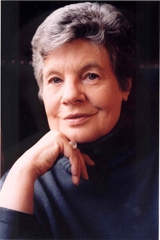 Last night I went to see a conversation between Robert Hass, the former poet laureate, and A.S. Byatt. If you have been reading my blog for a while you may remember that Byatt is one of my very favorite novelists (all my Byatt posts are here) so I was excited to see her in person. She is currently promoting a long novel called The Children's Book, which takes place from 1895 to 1919 and sounds tremendously up my alley--about artists and parents and children and fairy tales and coming of age in the Edwardian era, "that magical, golden time to be a child" as Byatt put it.
Byatt is a stout lady with a refined English accent of the sort that people don't seem to have anymore (she is 73 years old, so I suppose that makes sense). The conversation last night was about 75 minutes long, including questions from the audience. Here are some of the moments that stuck with me.
- Byatt has a reputation as a very cerebral writer, so I found it fascinating to learn that when she writes, she imagines how it would feel in her own body to experience what the characters are feeling or doing. (She said that this can make writing sex scenes a very weird experience--needing to imagine herself in the bodies of both partners!)
- Even though she is an acclaimed and prolific novelist, Byatt says that she still has a hard time thinking of herself, or describing herself, as "a writer." Instead, she says, she thinks of her career in terms of "there's work to be done, something that needs to be said, a new chapter that needs to be written." I am beginning to think that Byatt might have the right idea--that it might be healthier to say "I write plays" instead of "I am a playwright." Putting the emphasis on the work, not on your own ego and identity. (And an active verb like "I write" is always stronger than the verb "to be.")
- Byatt thoroughly outlines every novel, then sits down and writes it straight through--not jumping around from point to point in the structure. She talked about how the novels of the Frederica Potter Quartet were hard to write because their plotting was motivated solely by the characters' psychology; so it was a relief for her to take a break from the Quartet to write Possession, which is a detective story, much more rigorously plotted. I can't remember whether she considers the plot of The Children's Book more like Possession or more like the Quartet, however.
- Byatt tries hard to find something that she likes in every character that she writes--considering them from every angle and trying to see how their flaws could also be construed as virtues, as she put it. I think this is one of the reasons I love the Frederica Potter quartet so much--because she centered four novels around a character that some writers might consider too unlikable to be a heroine.
- Byatt next wants to write a novel about the Surrealists--she has some images or ideas in mind, but no characters yet. She notes that the major Surrealists "seem to have all been quite disagreeable people" so that will pose a challenge, since she doesn't want to write a satire about pretentious artists, but a real humane novel.
- Anyone who has read some Byatt knows that she loves metaphor--and that's why she loves fairy tales, too, because of their archetypal qualities. Fairy tales ("the Germanic, Grimm kind") play a role in The Children's Book as they do in some of her other novels. And like Possession, The Children's Book also contains poems written by Byatt in the voice of some of her characters; she was not originally going to do this until a young man who was writing a thesis on Possession ("a ferocious Pole," she described him) challenged her to incorporate World War One poetry into the new novel. When she realized that the metaphors of the First World War poets fit into the scheme of metaphors that she had already built up, she had no choice but to write some poems in that style and include them in the novel.
- Byatt also loves imagery and seems to have a very visual imagination. She described how she vividly pictures scenes as she writes them, e.g., getting a very clear image of a man sunbathing among brussels sprouts in a garden, wearing nothing but a wristwatch.
- But then, because she is a perfectionist, she has to make sure that these images are "accurate." That is, she realized that the man couldn't be surrounded by brussels sprouts, because they grow when the weather is too cold for sunbathing; and she also realized that she needed to Google "wristwatch" to find out whether a man in the Edwardian period would wear one. As it turns out, he wouldn't, so that had to go, too.
- Another tool that Byatt used while writing The Children's Book was an Excel spreadsheet that kept track of how old every one of her characters was supposed to be in every year from 1895 to 1919. "Because I had to make sure that all the characters aged at the same pace as everyone else, you see," she explained. However, she also admitted that she made a calculation error on the spreadsheet and didn't realize it until after the novel went to press--meaning that one of the characters in The Children's Book doesn't age the way he or she is supposed to. Byatt refused to say anything more about the matter, so I'll have to look out for this mistake when I read the novel!
Saturday, July 18, 2009
Theater à la Als
On Thursday night, I attended a discussion between Hilton Als, theater critic at The New Yorker, and Michael Paller, dramaturg at ACT. The topic was "Outsider Artists Inside the Theater" – a subject that could seemingly be interpreted in several different ways, but which the two men mainly used to talk about diversity (race, gender, sexuality) and the American theater. These are complicated issues, and the discussion tended to leave me of two minds, rather than making my thoughts clearer. Maybe it was supposed to. That's why it was a conversation instead of a lecture, right? That's why the basis of theater is dialogue and not monologue, yes? So here are some of the questions I'm asking myself, and the things I'm conflicted about.
One subject that got mentioned was the necessity of producing plays written by "outsiders" (that is, members of historically disenfranchised groups). Paller pointed to ACT's production of a play that dealt with Japanese-Americans returning to San Francisco after having been in the internment camps – he said that it got a great response from the Asian community and brought many people to ACT who had never been there before. And that's all well and good, but wouldn't the real measure of success be how many of these new audience members came back to see another play at ACT the next year – a play that did not have a specifically Asian theme? If the effect of producing plays by gays/minorities/women is an increasing polarization of the audience (blacks go to see black plays, women go to see stories about women), is that really progress? Maybe it's naive of me, but I still dare to believe that good art is universal, and that nothing is gained from going to see plays or movies only about people who are "like you."
(Hilton Als saw this from a different perspective. Speaking of plays like The Color Purple and the all-black Cat on a Hot Tin Roof, he said, "I'm happy that they're bringing in new audiences, but do they have to be such crap?" He wants to see more plays like for colored girls... that speak genuinely to the black experience, and fewer crassly commercial appeals for black people's money.)
In talking about the difficulties faced by minority actors, Als brought up the story of a talented black actress, Susan Batson. (Als claims that black women and Asian men are the two groups most often misrepresented or underrepresented in the American theater.) Batson grew so dissatisfied with the typecasting and racism that were pervasive in the New York theater of the '60s and '70s that she stopped performing and became a highly regarded acting coach. Her clients now include such movie stars as Nicole Kidman and Brad Pitt. "It's wonderful that she found something that she's really talented at, and can be happy doing," said Als. And part of me wants to agree with this. But another part of me wonders, "Isn't this just another example of a black woman disappearing behind the scenes, devoting her life to helping porcelain-skinned Kidman and blue-eyed Pitt – white people who grab the fame and the glory? Is this progress? Is this the best we can hope for?"
One final thing that has me conflicted is Hilton Als' attitude toward theater and theater criticism. Als says that in his reviews, he tries to treat theater like literature; when he sees a new play, he tries to fit it into the context of the writing that has come before it. Paller read aloud from Als' recent review of the David Adjmi play Stunning, and asked Als to discuss it. Stunning is about some Syrian-American Jews and their black housekeeper, and Als' review compared it to the works of other authors, such as Bernard Malamud, who have written about the relationship between blacks and Jews. On the one hand, Als' approach argues for the inherent dignity of theater and of the playwright – treating theater as an important component in the narrative of American culture. Too often, Als said, we think of the playwright as someone who merely creates a blueprint for the actors and director to fill in, rather than as the instigator and the driving creative force. And he says that anyone who is serious about culture must try to read or see the important plays of the year, the way that they would go see the award-winning movies.
But then, Als followed that up with a comment along the lines of "So playwrights should try to get people to read their work, that's the important thing, and they shouldn't care if it doesn't get produced." Which, excuse me, sounds like a very strange thing for a theater critic to say. It singlehandedly discounts the contributions of the actors, director, and designers in creating the theatrical experience. It insults the playwright by suggesting that she should limit her aspirations and be content to write "closet dramas," rather than works that will be brought to life on the stage. And also, it's counterintuitive: I think that in this country, even fewer people read plays as literature than attend the theater, so if Als got his way, theater would be even further marginalized. Trying to get people to see live theater is hard, but there are ways to promote it and make it sound fun: it's a night out on the town, you might get to see great acting or singing or dancing, it's amazing to laugh or cry along with your fellow audience members. Whereas trying to convince people to read plays because it's the "important" thing to do makes play-reading sound like a boring old slog.
Furthermore, sometimes Als' insistence on treating theater as literature makes it seem like he's just using the play he's reviewing as an excuse to talk about something else that he thinks is more important. That's kind of how I felt about the Bernard Malamud references in the Stunning review (which I also think have the effect of making the reader feel stupid for not having read, or even really heard much about, Malamud). It also seems that Als is somewhat notorious for writing irrelevant intro paragraphs, which further reinforce the impression that he'd rather be discussing something other than the play he's ostensibly reviewing. I don't always love the theater criticism of Als' colleague John Lahr either, but I much prefer his idea of the theatrical experience. "The John Lahr recipe for telling whether a play is good or bad is if you can shut your eyes when you're in the theater and get all the meaning – it's a bad play. You didn't have to be there," he has said. As opposed to suggesting that the best way to experience a play is to read it.
One subject that got mentioned was the necessity of producing plays written by "outsiders" (that is, members of historically disenfranchised groups). Paller pointed to ACT's production of a play that dealt with Japanese-Americans returning to San Francisco after having been in the internment camps – he said that it got a great response from the Asian community and brought many people to ACT who had never been there before. And that's all well and good, but wouldn't the real measure of success be how many of these new audience members came back to see another play at ACT the next year – a play that did not have a specifically Asian theme? If the effect of producing plays by gays/minorities/women is an increasing polarization of the audience (blacks go to see black plays, women go to see stories about women), is that really progress? Maybe it's naive of me, but I still dare to believe that good art is universal, and that nothing is gained from going to see plays or movies only about people who are "like you."
(Hilton Als saw this from a different perspective. Speaking of plays like The Color Purple and the all-black Cat on a Hot Tin Roof, he said, "I'm happy that they're bringing in new audiences, but do they have to be such crap?" He wants to see more plays like for colored girls... that speak genuinely to the black experience, and fewer crassly commercial appeals for black people's money.)
In talking about the difficulties faced by minority actors, Als brought up the story of a talented black actress, Susan Batson. (Als claims that black women and Asian men are the two groups most often misrepresented or underrepresented in the American theater.) Batson grew so dissatisfied with the typecasting and racism that were pervasive in the New York theater of the '60s and '70s that she stopped performing and became a highly regarded acting coach. Her clients now include such movie stars as Nicole Kidman and Brad Pitt. "It's wonderful that she found something that she's really talented at, and can be happy doing," said Als. And part of me wants to agree with this. But another part of me wonders, "Isn't this just another example of a black woman disappearing behind the scenes, devoting her life to helping porcelain-skinned Kidman and blue-eyed Pitt – white people who grab the fame and the glory? Is this progress? Is this the best we can hope for?"
One final thing that has me conflicted is Hilton Als' attitude toward theater and theater criticism. Als says that in his reviews, he tries to treat theater like literature; when he sees a new play, he tries to fit it into the context of the writing that has come before it. Paller read aloud from Als' recent review of the David Adjmi play Stunning, and asked Als to discuss it. Stunning is about some Syrian-American Jews and their black housekeeper, and Als' review compared it to the works of other authors, such as Bernard Malamud, who have written about the relationship between blacks and Jews. On the one hand, Als' approach argues for the inherent dignity of theater and of the playwright – treating theater as an important component in the narrative of American culture. Too often, Als said, we think of the playwright as someone who merely creates a blueprint for the actors and director to fill in, rather than as the instigator and the driving creative force. And he says that anyone who is serious about culture must try to read or see the important plays of the year, the way that they would go see the award-winning movies.
But then, Als followed that up with a comment along the lines of "So playwrights should try to get people to read their work, that's the important thing, and they shouldn't care if it doesn't get produced." Which, excuse me, sounds like a very strange thing for a theater critic to say. It singlehandedly discounts the contributions of the actors, director, and designers in creating the theatrical experience. It insults the playwright by suggesting that she should limit her aspirations and be content to write "closet dramas," rather than works that will be brought to life on the stage. And also, it's counterintuitive: I think that in this country, even fewer people read plays as literature than attend the theater, so if Als got his way, theater would be even further marginalized. Trying to get people to see live theater is hard, but there are ways to promote it and make it sound fun: it's a night out on the town, you might get to see great acting or singing or dancing, it's amazing to laugh or cry along with your fellow audience members. Whereas trying to convince people to read plays because it's the "important" thing to do makes play-reading sound like a boring old slog.
Furthermore, sometimes Als' insistence on treating theater as literature makes it seem like he's just using the play he's reviewing as an excuse to talk about something else that he thinks is more important. That's kind of how I felt about the Bernard Malamud references in the Stunning review (which I also think have the effect of making the reader feel stupid for not having read, or even really heard much about, Malamud). It also seems that Als is somewhat notorious for writing irrelevant intro paragraphs, which further reinforce the impression that he'd rather be discussing something other than the play he's ostensibly reviewing. I don't always love the theater criticism of Als' colleague John Lahr either, but I much prefer his idea of the theatrical experience. "The John Lahr recipe for telling whether a play is good or bad is if you can shut your eyes when you're in the theater and get all the meaning – it's a bad play. You didn't have to be there," he has said. As opposed to suggesting that the best way to experience a play is to read it.
Tuesday, April 22, 2008
Bill T. Jones at Vassar

I don't really follow modern dance, but one of the dancer-choreographers I am most familiar with is Bill T. Jones. I came to him via musical theater, wowed by his choreography for Spring Awakening. (It's not traditional Broadway dance at all, but I think "Totally Fucked" might be the most exciting production number I've ever seen.) Last semester I did a brief report on Jones for my intro modern dance course, so I learned more about his dance company and his penchant for choreographing pieces that address political and social topics. And yesterday, Jones came to Vassar to give a lecture--which I attended.
Jones' topic was his work-in-progress, a piece about "the legacy of Abraham Lincoln," commissioned by the Ravinia Festival for the 200th anniversary of Lincoln's birth (in 2009). He read us some speeches of Lincoln's that have inspired him, concluding with the "With malice toward none, with charity for all" speech (and for a dancer, he's got a good voice!). He talked about accepting the commission, his cynicism toward all the money being spent to celebrate Lincoln's birthday, but also being moved to tears when he got to see Lincoln's top hat up close. He thinks that the piece may involve dramatizing the conflict between the 5-year-old boy taught that "the guy on the penny" was a great American hero, and the 56-year-old man who no longer believes in heroes.
Jones talked a lot about the difficulties of making art that has a political viewpoint. He said that he began his career at a time when Minimalism and Formalism were the prevailing styles, and it was seen as vulgar to care about content instead of form. Even today, the dance establishment does not always like Jones' politically minded pieces...and Jones agonizes about how to stage and dramatize issues like freedom, slavery, religion... since he cannot simply rely on the aesthetic beauty of his dancers and his music, as some choreographers do. With this Lincoln piece, he hardly knew where to begin, and is slowly finding his way into it. However, one thing he definitely does not want to do is make it about that other Illinois politician, Barack Obama--that's too simplistic.
The only dancing Jones did was a series of poses that flowed into one another like tai chi moves--giving each pose an apt name, sometimes serious ("Apollo Belvedere"), sometimes amusing ("Nineteenth-Century Melodrama: Eek, a Mouse"). He repeated the series four or five times, narrating the names of the poses but also talking about other stuff, too, while doing it. I'd be interested to know if some of this ends up in the final version of the Lincoln piece (working title: "A Good Man").
As a highly verbal person, it is sometimes hard for me to enjoy abstract arts like dance or symphonic music, so I enjoyed hearing a renowned choreographer discuss the thought process that goes into his work.
Photo from record.wustl.edu
Wednesday, March 12, 2008
Sondheim Week: The Man Himself
Note: This write-up is done from memory and all quotes are paraphrased to the best of my ability, as opposed to verbatim.
What a thrill it was to see Frank Rich interviewing Stephen Sondheim onstage at the Schnitz last night! The audience was so warm and appreciative, even humming along to the Sondheim songs that played over the speakers as we filed in. Portland Arts and Lectures has tried for over ten years to bring Sondheim to town, but he refuses to do lectures, only q&a sessions. Finally, they persuaded Frank Rich to persuade Sondheim to agree to an interview, and it turned into a short West Coast tour between these old friends.
The organizers set up a fake "living room" onstage, with armchairs, a lamp, and a table with a big bouquet of flowers. Sondheim seemed in good health and spirits. My parents guessed that he was only about 70 years old and I had to inform them that he will celebrate his 78th birthday this month!
Many of Rich's questions dealt with Sondheim's younger years, when he was writing West Side Story and Gypsy and working with some of the best theater artists of the previous generation. Sondheim began by telling the convoluted tale of how he got to write lyrics for West Side Story: he originally auditioned and was hired as lyricist for another Bernstein-Laurents-Robbins project that then fell through. Months later, he ran into Laurents at a party and learned that the three collaborators were about to start a modern version of Romeo and Juliet. "Who's doing the lyrics?" Sondheim asked, out of sheer curiosity, not because he hoped to get the gig himself. Laurents smacked his forehead and said "Why didn't I think of that? I didn't like your music much, but I like your lyrics." Betty Comden and Adolph Green, who originally wanted to write the lyrics, were in Hollywood and unable to break their studio contract. So Sondheim auditioned once again for Bernstein, who seemed disappointed that he did not have any "poetic" lyrics in his arsenal, but nevertheless, gave him the job. Sondheim didn't want to accept it, because of his desire to write both lyrics and music, but his mentor Oscar Hammerstein told him it was a once-in-a-lifetime chance and he'd better take it.
Sondheim said that he had a pleasant working relationship with Bernstein, because they were both fans of crossword puzzles and "cutthroat anagrams," and could thus release their tension by playing anagrams instead of yelling at each other. He called Jerome Robbins, though, "one of the two most difficult men I ever worked with," and told of Robbins' attempt to cut "Little Lamb" from Gypsy without consulting the authors, and how the Dramatists' Guild had to intervene. (Sondheim's other "most difficult" collaborator was Richard Rodgers, but he did not elaborate on that.)
Still, Jerome Robbins was responsible for fixing A Funny Thing Happened on the Way to the Forum by adding "Comedy Tonight." That show originally had had a funny opening number, but director George Abbott cut it because he didn't think it was hummable, and Sondheim replaced it with something called "Love Is In the Air"--"a charming song, but it made the show seem more like A Little Night Music than a baggy-pants farce." The show got terrible reviews in Washington, D.C. (a preteen Frank Rich got an excellent orchestra seat because it was playing to near-empty houses), and, at their wits' end, the collaborators called in Robbins for advice. Sondheim showed him the original funny song that Abbott didn't like, and Robbins said "That's just the kind of thing you need--now write another song that Abbott will approve. And don't put any jokes in it, because I'm going to create the jokes with my staging." Sondheim confessed that he thinks "Comedy Tonight" has "a very boring lyric--it's just a list" but because of the physical gags that Robbins choreographed, it became "one of the most brilliant opening numbers I've ever seen."
Oscar Hammerstein died before Sondheim achieved his greatest success, but had already seen enough to be very proud of his student. Sondheim talked about playing "Maria" for Hammerstein--"and it's not one of my favorite lyrics, but it's a very Hammerstein lyric, in its simplicity"--and seeing tears in his mentor's eyes. The whole audience smiled warmly and said "aww." "If you think that's touching," said Sondheim, "there's something else... When Oscar knew that he was dying, he invited his children and me to dinner... Oh God, I'm going to start crying... and on the piano he had a whole stack of photographs of himself, and asked us all to take one. And I asked him if he'd sign mine, which is a little strange, like asking your dad to autograph something... But he did, and when he handed it back I saw what he'd written... 'To Stevie, my friend and teacher,'" Sondheim finished through his tears.
"That really reminds me of his lyric from The King and I, 'By your pupils you'll be taught,'" Rich remarked.
Sondheim also talked about his encounters with Cole Porter. At 18, he wrote a Cole Porter pastiche song, called "The Canasta-Tico," for a Williams College revue, and was invited to play it at Porter's house in Williamstown. Filled with trepidation, even afraid of tracking mud onto Porter's spotless white carpets, Sondheim played his song. "That's not bad," said Porter, "but you know, I usually try to extend the endings of my songs a bit more... Let's see what we can do." And he showed Sondheim how to make his pastiche even more Cole Porter-ish. "What a generous man," Sondheim said to us.
About ten years later, when Sondheim and Styne were writing Gypsy, Ethel Merman invited them to play their songs for Porter, who had just had his second leg amputated and was feeling very depressed. Sondheim played "Together Wherever We Go," singing the quadruple-rhymed lyrics of the bridge:
One of the things I liked most about Sondheim's talk was that his lessons for musical-theater writing also apply to non-musical playwriting. The "Comedy Tonight" anecdote illustrates the importance of telling the audience exactly what to expect within the first five or ten minutes of a show. From Robbins, Sondheim also learned that songs must have an action: Robbins was at first disappointed with "Maria" because it's just a guy standing center stage singing for three minutes about how he's in love. And Sondheim's own favorite songs among his oeuvre tend to be complex musical scenes like "Someone in a Tree" ("the way it dealt with time onstage has, I think, never been done before or since"), "Opening Doors" ("my most autobiographical song, and I love how it compresses two years in the characters' lives"), "God, That's Good," and "A Weekend in the Country" ("like a puzzle--it took me a week to figure it out"). These are not necessarily Sondheim's most musically gorgeous songs, or his funniest, or his catchiest, and they're certainly not the kind of songs you can extract and put in a musical revue. But that's why he loves them: for their specificity, for the amount of dramatic action that takes place within them, and for how they musicalize and dramatize character relationships. Sondheim, it seems, has the soul of a dramatist, more than that of a composer. Perhaps that is what makes his work so innovative.
"As for songs qua songs," said Sondheim, "something like 'Finishing the Hat'" is among his favorites, for its in-depth portrait of the creative process and the toll it takes. Still, a song like "Finishing the Hat" is equivalent to a monologue in a straight play, whereas "A Weekend in the Country" is equivalent to an entire scene. And I know that in my own writing, I am much prouder when I perfect a very complex scene with lots of characters, than when I complete a monologue that could easily be lifted from the play and used as an actor's audition piece--so I understand where Sondheim is coming from.
At the beginning of the interview, Rich and Sondheim remarked that the Schnitz, a former movie palace with ornate plasterwork and chandeliers, "would be the perfect place to do Follies," and eventually the conversation turned to that musical. Sondheim revealed some of the composers that he tried to pastiche: "One More Kiss" is Victor Herbert/Rudolf Friml, "You're Gonna Love Tomorrow" has a Jerome Kern verse and Burton Lane chorus, "Lucy and Jessie" is Cole Porter, and "Losing My Mind" is a straight take-off on the Gershwins' "The Man I Love." He denied, though, trying to say anything specific about these songwriters through pastiche--he just chose composers that were popular at the time that each female character sang in the Follies, and attempted to recreate their style.
As he has been doing for the last several months, Sondheim praised Tim Burton's Sweeney Todd film for stripping away every song that didn't further the action, and leaving only what was cinematic. Asked which of his other musicals he thinks have the potential to make good movies, he named Company and Into the Woods. Company because it is a "vignette-style" show, like the successful Chicago, and Into the Woods for just the opposite reason--because it is so full of action and plot.
At the end, Rich took some questions from the audience. Though many people wanted Sondheim to name his favorite songwriters of the younger generation, he politely declined, because he doesn't want to go on record as anointing his favorites, and make all the other young songwriters disappointed or jealous. It is nice that he realizes his power in the American musical theater, and wants to use it for good, not for ill.
Someone else asked, "As New Yorkers, could you please give us some insight on what is going on with your governor" --Sondheim burst out laughing-- "and whether you think it would make a good musical." "You know who would have made it a musical, would be the Gershwins," said Sondheim, "a 21st-century Of Thee I Sing."
Next question: Would Sondheim consider writing a show for Elaine Stritch? Sondheim replied that she is one of his favorite performers, but he would write a show "for her" only if he found a story that he wanted to dramatize with a role in it that Stritch should play. He does not write pure "star vehicles."
Another person asked if Sondheim had any anecdotes from his years living next door to Katharine Hepburn. He certainly did! As a younger man, he tended to compose very late at night, and at the time he was writing Company, Katharine Hepburn was in New York rehearsing the musical Coco. In the wee hours of the morning, as he slaved away over "The Ladies Who Lunch"--making a lot of noise because of the primal scream moment, "IIIII'LL drink to that!"--he heard a knock at his door, and there was Katharine Hepburn, in nightgown and babushka, barefoot in the dead of winter, ready to chew Sondheim out for keeping her up all night. (Sondheim tried to do a Hepburn imitation for us, but admitted he is not very good at it.) Sondheim later learned from Michael Bennett, who choreographed both Coco and Company, that Hepburn had been using "that young man next door who keeps me up all night" as an excuse to get out of rehearsal early. "And that's why she was a star," concluded Sondheim.
Rich ended the evening with the perfect audience question: "Can we sing 'Happy Birthday' to you?" And so the entire huge auditorium sang "Happy Birthday, dear Stephen" in honor of his upcoming 78th. It was not a very pretty sound--I think the orchestra section started singing before the balcony section caught on--but the spirit of it was genuine and it made everyone feel warm and happy.
Before that, Sondheim had answered the age-old question about whether he prefers writing music or lyrics. "I love music," said Sondheim. "It's easy. You play a chord, it sounds good--and I love dissonance, so you play a wrong note, it sounds good, too! Lyrics--sometimes the perfect phrase will just come to you, but usually, it's a lot of sweat-work."
But no wrong notes were struck last night--and I will treasure the memory of this evening, and many of the stories Sondheim told us, as much as I treasure so many of his songs.
Further links: An interview between Rich and Sondheim done eight years ago for the New York Times Magazine; my friend Marc actually met the man last night!
What a thrill it was to see Frank Rich interviewing Stephen Sondheim onstage at the Schnitz last night! The audience was so warm and appreciative, even humming along to the Sondheim songs that played over the speakers as we filed in. Portland Arts and Lectures has tried for over ten years to bring Sondheim to town, but he refuses to do lectures, only q&a sessions. Finally, they persuaded Frank Rich to persuade Sondheim to agree to an interview, and it turned into a short West Coast tour between these old friends.
The organizers set up a fake "living room" onstage, with armchairs, a lamp, and a table with a big bouquet of flowers. Sondheim seemed in good health and spirits. My parents guessed that he was only about 70 years old and I had to inform them that he will celebrate his 78th birthday this month!
Many of Rich's questions dealt with Sondheim's younger years, when he was writing West Side Story and Gypsy and working with some of the best theater artists of the previous generation. Sondheim began by telling the convoluted tale of how he got to write lyrics for West Side Story: he originally auditioned and was hired as lyricist for another Bernstein-Laurents-Robbins project that then fell through. Months later, he ran into Laurents at a party and learned that the three collaborators were about to start a modern version of Romeo and Juliet. "Who's doing the lyrics?" Sondheim asked, out of sheer curiosity, not because he hoped to get the gig himself. Laurents smacked his forehead and said "Why didn't I think of that? I didn't like your music much, but I like your lyrics." Betty Comden and Adolph Green, who originally wanted to write the lyrics, were in Hollywood and unable to break their studio contract. So Sondheim auditioned once again for Bernstein, who seemed disappointed that he did not have any "poetic" lyrics in his arsenal, but nevertheless, gave him the job. Sondheim didn't want to accept it, because of his desire to write both lyrics and music, but his mentor Oscar Hammerstein told him it was a once-in-a-lifetime chance and he'd better take it.
Sondheim said that he had a pleasant working relationship with Bernstein, because they were both fans of crossword puzzles and "cutthroat anagrams," and could thus release their tension by playing anagrams instead of yelling at each other. He called Jerome Robbins, though, "one of the two most difficult men I ever worked with," and told of Robbins' attempt to cut "Little Lamb" from Gypsy without consulting the authors, and how the Dramatists' Guild had to intervene. (Sondheim's other "most difficult" collaborator was Richard Rodgers, but he did not elaborate on that.)
Still, Jerome Robbins was responsible for fixing A Funny Thing Happened on the Way to the Forum by adding "Comedy Tonight." That show originally had had a funny opening number, but director George Abbott cut it because he didn't think it was hummable, and Sondheim replaced it with something called "Love Is In the Air"--"a charming song, but it made the show seem more like A Little Night Music than a baggy-pants farce." The show got terrible reviews in Washington, D.C. (a preteen Frank Rich got an excellent orchestra seat because it was playing to near-empty houses), and, at their wits' end, the collaborators called in Robbins for advice. Sondheim showed him the original funny song that Abbott didn't like, and Robbins said "That's just the kind of thing you need--now write another song that Abbott will approve. And don't put any jokes in it, because I'm going to create the jokes with my staging." Sondheim confessed that he thinks "Comedy Tonight" has "a very boring lyric--it's just a list" but because of the physical gags that Robbins choreographed, it became "one of the most brilliant opening numbers I've ever seen."
Oscar Hammerstein died before Sondheim achieved his greatest success, but had already seen enough to be very proud of his student. Sondheim talked about playing "Maria" for Hammerstein--"and it's not one of my favorite lyrics, but it's a very Hammerstein lyric, in its simplicity"--and seeing tears in his mentor's eyes. The whole audience smiled warmly and said "aww." "If you think that's touching," said Sondheim, "there's something else... When Oscar knew that he was dying, he invited his children and me to dinner... Oh God, I'm going to start crying... and on the piano he had a whole stack of photographs of himself, and asked us all to take one. And I asked him if he'd sign mine, which is a little strange, like asking your dad to autograph something... But he did, and when he handed it back I saw what he'd written... 'To Stevie, my friend and teacher,'" Sondheim finished through his tears.
"That really reminds me of his lyric from The King and I, 'By your pupils you'll be taught,'" Rich remarked.
Sondheim also talked about his encounters with Cole Porter. At 18, he wrote a Cole Porter pastiche song, called "The Canasta-Tico," for a Williams College revue, and was invited to play it at Porter's house in Williamstown. Filled with trepidation, even afraid of tracking mud onto Porter's spotless white carpets, Sondheim played his song. "That's not bad," said Porter, "but you know, I usually try to extend the endings of my songs a bit more... Let's see what we can do." And he showed Sondheim how to make his pastiche even more Cole Porter-ish. "What a generous man," Sondheim said to us.
About ten years later, when Sondheim and Styne were writing Gypsy, Ethel Merman invited them to play their songs for Porter, who had just had his second leg amputated and was feeling very depressed. Sondheim played "Together Wherever We Go," singing the quadruple-rhymed lyrics of the bridge:
Wherever I go, I know he goesAnd when Sondheim got to the "amigos" line, he heard Porter give a delighted gasp. "He hadn't seen it coming!" crowed Sondheim, still thrilled at the memory nearly fifty years later. "He didn't know there was going to be a fourth rhyme! And when you realize that Cole Porter loved to use foreign words in his own lyrics--it's a real Cole Porter rhyme! To this day--I'm not kidding--it is my proudest moment of lyric writing."
Wherever I go, I know she goes
No fits, no fights, no feuds and no egos
Amigos
Together!
One of the things I liked most about Sondheim's talk was that his lessons for musical-theater writing also apply to non-musical playwriting. The "Comedy Tonight" anecdote illustrates the importance of telling the audience exactly what to expect within the first five or ten minutes of a show. From Robbins, Sondheim also learned that songs must have an action: Robbins was at first disappointed with "Maria" because it's just a guy standing center stage singing for three minutes about how he's in love. And Sondheim's own favorite songs among his oeuvre tend to be complex musical scenes like "Someone in a Tree" ("the way it dealt with time onstage has, I think, never been done before or since"), "Opening Doors" ("my most autobiographical song, and I love how it compresses two years in the characters' lives"), "God, That's Good," and "A Weekend in the Country" ("like a puzzle--it took me a week to figure it out"). These are not necessarily Sondheim's most musically gorgeous songs, or his funniest, or his catchiest, and they're certainly not the kind of songs you can extract and put in a musical revue. But that's why he loves them: for their specificity, for the amount of dramatic action that takes place within them, and for how they musicalize and dramatize character relationships. Sondheim, it seems, has the soul of a dramatist, more than that of a composer. Perhaps that is what makes his work so innovative.
"As for songs qua songs," said Sondheim, "something like 'Finishing the Hat'" is among his favorites, for its in-depth portrait of the creative process and the toll it takes. Still, a song like "Finishing the Hat" is equivalent to a monologue in a straight play, whereas "A Weekend in the Country" is equivalent to an entire scene. And I know that in my own writing, I am much prouder when I perfect a very complex scene with lots of characters, than when I complete a monologue that could easily be lifted from the play and used as an actor's audition piece--so I understand where Sondheim is coming from.
At the beginning of the interview, Rich and Sondheim remarked that the Schnitz, a former movie palace with ornate plasterwork and chandeliers, "would be the perfect place to do Follies," and eventually the conversation turned to that musical. Sondheim revealed some of the composers that he tried to pastiche: "One More Kiss" is Victor Herbert/Rudolf Friml, "You're Gonna Love Tomorrow" has a Jerome Kern verse and Burton Lane chorus, "Lucy and Jessie" is Cole Porter, and "Losing My Mind" is a straight take-off on the Gershwins' "The Man I Love." He denied, though, trying to say anything specific about these songwriters through pastiche--he just chose composers that were popular at the time that each female character sang in the Follies, and attempted to recreate their style.
As he has been doing for the last several months, Sondheim praised Tim Burton's Sweeney Todd film for stripping away every song that didn't further the action, and leaving only what was cinematic. Asked which of his other musicals he thinks have the potential to make good movies, he named Company and Into the Woods. Company because it is a "vignette-style" show, like the successful Chicago, and Into the Woods for just the opposite reason--because it is so full of action and plot.
At the end, Rich took some questions from the audience. Though many people wanted Sondheim to name his favorite songwriters of the younger generation, he politely declined, because he doesn't want to go on record as anointing his favorites, and make all the other young songwriters disappointed or jealous. It is nice that he realizes his power in the American musical theater, and wants to use it for good, not for ill.
Someone else asked, "As New Yorkers, could you please give us some insight on what is going on with your governor" --Sondheim burst out laughing-- "and whether you think it would make a good musical." "You know who would have made it a musical, would be the Gershwins," said Sondheim, "a 21st-century Of Thee I Sing."
Next question: Would Sondheim consider writing a show for Elaine Stritch? Sondheim replied that she is one of his favorite performers, but he would write a show "for her" only if he found a story that he wanted to dramatize with a role in it that Stritch should play. He does not write pure "star vehicles."
Another person asked if Sondheim had any anecdotes from his years living next door to Katharine Hepburn. He certainly did! As a younger man, he tended to compose very late at night, and at the time he was writing Company, Katharine Hepburn was in New York rehearsing the musical Coco. In the wee hours of the morning, as he slaved away over "The Ladies Who Lunch"--making a lot of noise because of the primal scream moment, "IIIII'LL drink to that!"--he heard a knock at his door, and there was Katharine Hepburn, in nightgown and babushka, barefoot in the dead of winter, ready to chew Sondheim out for keeping her up all night. (Sondheim tried to do a Hepburn imitation for us, but admitted he is not very good at it.) Sondheim later learned from Michael Bennett, who choreographed both Coco and Company, that Hepburn had been using "that young man next door who keeps me up all night" as an excuse to get out of rehearsal early. "And that's why she was a star," concluded Sondheim.
Rich ended the evening with the perfect audience question: "Can we sing 'Happy Birthday' to you?" And so the entire huge auditorium sang "Happy Birthday, dear Stephen" in honor of his upcoming 78th. It was not a very pretty sound--I think the orchestra section started singing before the balcony section caught on--but the spirit of it was genuine and it made everyone feel warm and happy.
Before that, Sondheim had answered the age-old question about whether he prefers writing music or lyrics. "I love music," said Sondheim. "It's easy. You play a chord, it sounds good--and I love dissonance, so you play a wrong note, it sounds good, too! Lyrics--sometimes the perfect phrase will just come to you, but usually, it's a lot of sweat-work."
But no wrong notes were struck last night--and I will treasure the memory of this evening, and many of the stories Sondheim told us, as much as I treasure so many of his songs.
Further links: An interview between Rich and Sondheim done eight years ago for the New York Times Magazine; my friend Marc actually met the man last night!
Subscribe to:
Posts (Atom)