Showing posts with label script reading roundup. Show all posts

Sunday, October 8, 2017

Script Reading Roundup: Majok and Ionesco

Today's Script Reading Roundup: two talented playwrights of Eastern European heritage with very different styles, approaches, and places in the canon.

Ironbound
by Martyna Majok
My rating: 4 of 5 stars

The Ironbound is a neighborhood in Newark, New Jersey, but it's also an appropriate metaphorical title for this play about a Polish immigrant woman struggling to make the best of a bad set of options. Martyna Majok dramatizes pivotal moments in the life of Darja over the course of more than 20 years, creating a bravura role for an actress in the process. Although the title of the play makes it sound very grim, it has moments of humor and tenderness, and the three male roles reveal unexpected depths. Admittedly, some plot developments at the end failed to convince me: the main difficulty with this kind of character-study, slice-of-life play is wrapping it up in a satisfying way, and I'm not sure Ironbound pulls it off. Still, this is an absorbing and heartfelt drama about the crumbling American dream and the choices Darja makes to cling to it.

Rhinoceros and Other PlaysRhinoceros and Other Plays by Eugène Ionesco
My rating: 4 of 5 stars

Just after the 2016 U.S. election, Teju Cole published an essay on what Rhinoceros can tell us about the dangers of “minimiz[ing] evil or describ[ing] it as something else.” And it really is uncanny how the dialogue in this play anticipates arguments that I am currently reading online and in newspapers… even though Ionesco's characters are discussing an invasion of terrifying, mindless, destructive animals, and we nowadays are discussing the Trump administration. (Oh, wait.)

Admittedly, Rhinoceros is one of those plays that was groundbreaking when it was first produced but now feels more familiar. Just as R.U.R. set the pattern for subsequent “robot uprising” stories, Rhinoceros often feels like a prototype for zombie movies. I mean, obviously it’s about people turning into rhinos, not zombies, but it uses a lot of the same tropes: the mysterious outbreak that advances with terrifying speed, the confusion and angst of the dwindling band of survivors, the understanding that this supernatural horror is really a metaphor for something else.

Though Ionesco’s message about the lure of fascist conformity is pretty grim, there is enough absurdist humor here to keep it an entertaining read (I particularly liked the stage direction “the rhinoceros replies with a violent but tender trumpeting”). It’s also comforting to think that maybe the misfits of the world are the ones best equipped to resist mass hysteria. The protagonist, Berenger, is a bit of an outsider in his small provincial town: he’s melancholic, alcoholic, dissatisfied with life. But he is able to resist the rhinoceros plague after the more outwardly successful citizens succumb.

I was less impressed with the other two, shorter plays in this volume. While Rhinoceros deals with “normal” people reacting to an absurd situation and involves some degree of psychological realism, the characters in the other plays are shrill, absurdist caricatures. Also, it’s annoying that the The Future is in Eggs is listed as “a kind of sequel to Jacques, or Obedience,” but Jacques isn’t included in this volume (you have to get Grove Press’s other Ionesco compilation, The Bald Soprano and Other Plays , for that).

Sunday, August 13, 2017

Script Reading Roundup: Nothomb, Wilde, Frangione, Wright

An eclectic Script Reading Roundup today: a French-language play I found at a Little Free Library, an excellent edition of Oscar Wilde's best plays, a reread of a Canadian Christmas dramedy I originally blogged about in 2010, and an epic adaptation of my favorite children's fantasy trilogy.

Les CombustiblesLes Combustibles by Amélie Nothomb
My rating: 2 of 5 stars

Les combustibles, the first and only play by popular French-language author Amélie Nothomb, is a fable about the role of literature in times of turmoil. It’s the second winter of a siege, and at the University, there is no fuel other than the books on the shelves. The cynical Professor, his assistant Daniel, and Daniel’s girlfriend Marina debate whether they should burn the books to keep warm, or whether that would be a pyrrhic victory for humanity.

I read Les combustibles in French after picking it up from my local Little Free Library, figuring that I’m probably the only person in the neighborhood who’d be interested in reading a French-language play. (An English translation exists under the title Human Rites, a somewhat irrelevant pun – a more accurate title might be Kindling.) The writing was elegant and easy to read, and I enjoyed following the characters’ arguments. At times, however, the intellectual combat is so tidy that it’s easy to forget that the characters are desperate and starving. Also, it can be hard to understand their anguish about burning the books. This isn’t Fahrenheit 451; presumably, other copies of these books still exist in other collections, in cities that are not currently under siege. As such, destroying the Professor’s library doesn’t mean irreparably destroying human knowledge. Maybe I’m heartless, but in that situation, I’d say, burn the books and save yourself!

It was also annoying that the only female character is a beautiful, waiflike 20-year-old whom the stage directions constantly compare to a child or an angel. Naturally, both of the male characters have sex with her, and neither of them seem to respect her. I’m used to this kind of stuff from male playwrights, but not necessarily from women.

-------------------

Les combustibles, la première et seule pièce de théâtre par Amélie Nothomb, est une fable à propos du rôle de la littérature aux temps troublés. C’est le deuxième hiver d’un siège, et pour combustible, chez l’Université, il n’y a que les livres. Le Professeur cynique, son assistant Daniel, et Marina la petite-amie de Daniel, débattent s’ils doivent brûler les livres afin de réchauffer, ou si cela serait, pour l'humanité, une victoire à la Pyrrhus.

J’ai lu Les combustibles en français après l’avoir pris de la Petite Bibliothèque Gratuite du coin, en supposant que je sois la seule personne dans mon quartier qui s’intéresse à lire une pièce en français. (Il y a une traduction en anglais avec le titre Human Rites, un jeu de mots assez hors sujet – un titre plus exact serait peut-être Kindling.) L’écriture était élégante et facile à lire, et j’aimais suivre les arguments des personnages. Cependant, parfois, le combat intellectuel est tellement rangé qu’on oublie que les personnages sont désespérés et affamés. Aussi, c’est peut-être difficile de comprendre leur angoisse à propos de brûler les livres. Ceci n’est pas Fahrenheit 451; probablement, d’autres exemplaires de ces livres existent encore dans des autres collections, dans des villes qui ne sont pas assiégées. Alors, la destruction de la bibliothèque du Professeur ne signifie pas la destruction irréparable des connaissances humaines. Peut-être que je suis cruelle, mais dans cette situation, je dirais: brûlez les livres, sauvez vous-mêmes!

De plus, c’était ennuyeux que le seul personnage féminin est une jeune femme de 20 ans, belle et frêle, comparée avec une enfante ou un ange dans les indications scéniques. Naturellement, les deux personnages masculins font l’amour avec elle et ne semblent pas la respecter. J’ai l’habitude de voir ces bêtises chez les dramaturges masculins, mais pas forcement chez les femmes.


The Importance of Being Earnest and Other PlaysThe Importance of Being Earnest and Other Plays by Oscar Wilde
My rating: 5 of 5 stars

It's easy to give Oscar Wilde's collected plays five stars just because he was so brilliant and The Importance of Being Earnest is one of the most perfect comedies ever written, but where this Penguin Classics edition really excels is in Richard Allen Cave’s introduction and notes. Cave reminds us that these are not just collections of witty lines, they are plays, and Wilde was a man of the theater. The endnotes are full of information about the sets, costumes, and stage business of the original productions, and sometimes even include Cave's thoughts on moments that are particularly difficult to pull off in performance. Some people might find his opinions too obtrusive, but I loved this level of detail and think that all aspiring directors of Wilde plays should peruse this edition, since Cave has thought so much about how these plays work onstage.

The edition collects all of Wilde’s major, mature plays and even throws in his one-act Florentine Tragedy for good measure (though it's a rather weak play, requiring you to slog through a lot of sub-Shakespearean blank verse for the reward of a sword fight and a twist ending). There are his three Society Comedies (Lady Windermere's Fan, A Woman of No Importance, An Ideal Husband), which blend melodrama, satire, social commentary, and aphorisms; his decadent and pageant-like Salome ; and the incomparable Earnest.

Reading all of these plays in a row, I realized that the scope of Wilde's characterization was wider than I'd given him credit for. For instance, though the three Society Comedies all feature an aristocratic dandy character, each dandy has a very different personality and function. Lord Darlington in Lady Windermere’s Fan is an irresponsible romantic; Lord Illingworth in A Woman of No Importance is an unscrupulous cad; Lord Goring in An Ideal Husband is his play’s moral conscience. I was also impressed with the variety of female characters and the amount of stage time they receive. Young actresses love the Gwendolen-Cecily scene from Earnest, of course, and there are other all-female scenes in the Society Comedies that are even longer and more complex. Good roles for women aren't rare in classic drama, but it's quite unusual to see 6 distinctly characterized women talk for 12 pages without any men interrupting, as they do in Act Two of A Woman of No Importance!


Cariboo MagiCariboo Magi by Lucia Frangione
My rating: 4 of 5 stars

Programming a holiday-season play can be really tough for theaters, especially small indie theaters that want to do something a little quirkier than A Christmas Carol. Where to find a play that is Christmassy but not overtly religious, cheerful but not cloying? Well, Lucia Frangione's Cariboo Magi feels like it was written to solve this problem. You could even interpret it as a meta-commentary on the challenges of staging a Christmas play: it's about a desperate, ragtag theater troupe that travels to the goldfields of British Columbia, circa Christmas 1870. Their final product--a mash-up of the Nativity story, Hamlet, A Christmas Carol, and The Last of the Mohicans--must be seen to be believed!

Frangione, an actress as well as a playwright, wrote herself a fab starring role as Madame Fanny Dubeau, the theater troupe's leader, whose "elegant veneer thinly hides a cunning, avaricious businesswoman." But the other characters are also vividly drawn: there's Joe Mackey, a Chinese-Canadian miner and lovelorn poet; Reverend William Teller, an alcoholic, self-pitying minister; and Marta Reddy, a hot-tempered German girl who is eight months pregnant. There are no villains here, just four misfits who act tough but are all lost or wounded in some way. Fittingly for a Christmas tale, in the end they are all healed and uplifted. But it's not Christianity or even "the Christmas spirit" that saves them--it's the power of theater.


His Dark MaterialsHis Dark Materials by Nicholas Wright
My rating: 4 of 5 stars

The Golden Compass was my favorite book when I was 9 years old and I grew up to be a playwright, so I found it very rewarding to read and consider Nicholas Wright’s stage adaptation of Philip Pullman's fantasy trilogy. I enjoyed its self-assurance, its willingness to deviate from the novels in order to tell a story that makes sense onstage. Characters with similar functions are combined: Tony Makarios and Billy Costa; Serafina Pekkala and Mary Malone. Some plot-holes are filled: I really like how it rewrites Lord Boreal’s theft of the alethiometer so it doesn't involve Lyra’s foolish failure to recognize him. And at least one of the play’s innovations—having Lyra learn the truth of her parentage from Mrs. Coulter herself, rather than from the gyptians—is so emotionally compelling that the otherwise lackluster film version used it too.

I have to disagree with my friend Stuart, though, about whether the play seems less anti-religion than the books. On the contrary, I think the atheist themes are more explicit in the play version. But this means it feels better integrated. The books can feel like a bit of a bait-and-switch: the first book mostly reads like a thrilling fantasy-adventure where Dust is a MacGuffin, while the later books push an anti-religion, pro-Dust agenda. In the play, religion is depicted as sinister and oppressive from the start. The people in Lyra’s world are constantly praying to “the Authority,” and the role of Fra Pavel, a high Church official, is expanded into a real villain part.

Of course, in order to condense 1200 pages of fiction into a 2-part play, the action has to move insanely fast. (In the books, Lyra’s stay at Bolvangar covers nearly 70 pages; in the play, it covers 11 pages.) I do wonder how an audience who’s not familiar with the books would react to the play version, especially the relentless pace of the action. I also wonder if I’d find it too rushed, were I to see it staged. That’s unlikely to happen, however: this epic drama requires vast resources and I don’t think anyone besides the UK’s National Theatre has produced it. Still, I enjoyed reading it and thinking about dramatic structure, theatricality, and how an adapter can wield his subtle knife to show us new worlds.

Friday, April 7, 2017

Script Reading Roundup: Foote, Shakespeare, Goldman

In this month's edition of Script Reading Roundup (brief thoughts on plays that I've read): three plays about British Isles royalty and one play about a little old lady from Texas.

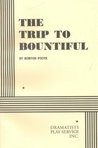
The Trip to BountifulThe Trip to Bountiful by Horton Foote
My rating: 4 of 5 stars

“I’ve waited a long time. Just to get to Bountiful. Twenty years I’ve been walkin’ the streets of the city, lost and grieving. And as I’ve grown older and my time approaches, I’ve made one promise to myself, to see my home again… before I die…”

Such is the premise of Horton Foote’s elegiac drama The Trip to Bountiful. Mrs. Carrie Watts lives in a cramped apartment in Houston with her kind but weak-willed son Ludie and her frivolous, overbearing daughter-in-law Jessie Mae. For years, she has been trying to sneak away to her East Texas hometown, Bountiful, and each time, her relatives catch her before she can leave Houston. But one day…

The Trip to Bountiful is largely a touching character study, but there is a surprising amount of suspense as we watch to see how Mrs. Watts will make her escape. I also liked how Mrs. Watts is kind of an opaque figure during Act One (which is dominated by Jessie Mae’s chattering) but comes into her own when she sets out on her journey.

Admittedly, it’s disconcerting to see that according to the stage directions, Mrs. Watts is only 60. She seems much older than the 60-year-old women I know nowadays; indeed, in recent productions, the role is often taken by a more elderly actress. (Cicely Tyson was 88 when she played Mrs. Watts on Broadway in 2013!) At any rate, it is a lovely role for an older lady who can project an unpretentious, middle-American dignity. It is not a “diva” role; quite the opposite.

Another Southern writer famously said “You can’t go home again.” The Trip to Bountiful complicates that statement: when Mrs. Watts returns to Bountiful, she finds it diminished, abandoned, a ghost town. But nonetheless, it is still home.

MacbethMacbeth by William Shakespeare
My rating: 4 of 5 stars

All right, Shakespeare, you win: I don’t hate Macbeth. But it took me a long time to get to this point. As a teenager, I saw a terrible production of Macbeth and then acted in a terrible production of Macbeth; later, I saw a few more productions that didn’t do much to change my prejudiced mind, and wrote an essay about how Macbeth is the most over-produced Shakespeare play merely because every middle-aged white male actor thinks he should play the Thane of Cawdor. By that point, my hatred of Macbeth had hardened into a kind of shtick: I found it amusingly contrarian to say I hated this play that everyone else seems to adore, so I played up my dislike for it.

But I’m nearly 30 now, so the time has come to put away childish things and admit on the Internet that Macbeth is never going to be my favorite Shakespeare play, but I certainly don’t think it’s bad.

How did I get to this point? Seeing Sleep No More in New York City helped—it’s not every Shakespeare play that lends itself to transformation into a physical-theater gothic-noir haunted house. The introduction to the Pelican Shakespeare edition helped, or at least allowed me to forgive my high-school drama teachers for not doing any cross-gender casting (which resulted in me playing a non-speaking ensemble member while boys who couldn’t speak blank verse played all the thanes). The Pelican editor, Stephen Orgel, digs deep into how the play presents women as a disruptive or antagonistic force, and managed to convince me that putting female thanes in Macbeth might well make a hash of its themes. Reading Harold Bloom’s Shakespeare: The Invention of the Human helped; one of my objections to Macbeth was always that the minor characters do not have much personality, but Bloom suggests that that’s intentional. If the “secondary males in the play” are “wrapped in a common grayness,” Bloom says, it is only so that we more readily identify with Macbeth and “journey inward to [his] heart of darkness.” Or, in other words: Marissa, stop thinking that you’ve found a flaw in Shakespeare; the man was a genius and he knew exactly what he was doing.

So, all right: assuming that competent actors play them, Macbeth and his Lady are fascinating characters. The play moves swiftly and its language obsessively focuses on a few major threads of imagery: blood, shipwrecks, birds, sleep, nighttime and darkness. That imagery, plus the supernatural elements, give Macbeth a unique atmosphere among Shakespeare’s plays, even though I hate it when productions focus on the supernatural bits at the expense of everything else. (A pitfall that has beset Macbeth almost from the start, it seems; the Hecate character is an interpolation by Thomas Middleton. Jacobean audiences couldn’t get enough of those witches!) The scene where Macduff learns the news of his family’s death will wreck me every time. And, even though we know Macbeth is a murderous tyrant who deserves what’s coming to him, Shakespeare somehow makes us sympathize with his paranoia, terror, and nihilism.

I still think Macbeth is not a great choice to produce in a high school or college setting. And I still think there are probably too many productions of it overall.

But no, I don’t hate it.

CymbelineCymbeline by William Shakespeare
My rating: 3 of 5 stars

I can’t recount the plot of Cymbeline out loud without bursting into giggles. Which is kind of odd: this play is not really considered a comedy in the same way as A Midsummer Night's Dream or Twelfth Night are, yet I can describe the stories of those plays with a straight face. Cymbeline, though… when I try to explain the sequence of events that result in the heroine waking up next to a headless body and mistaking it for that of her husband, I can’t stop laughing.

As other people have said, this play feels like what would result if you fed all of Shakespeare’s other plays into an extremely intelligent super-computer and asked it to produce something “Shakespearean.” It’s easy to imagine that Shakespeare knew he was at the end of his career and decided to play around with his pet motifs, including some winks at the audience. I mean, the play begins with two unnamed lords saying, basically, “Remember when King Cymbeline’s two little boys vanished without a trace? I wonder what happened to them.” (Gee, do you think that’ll become important later on in the story?) And by the end, Shakespeare has thrown so many plotlines into the play that it takes a scene nearly 500 lines long to resolve everyone’s story.

Very little in Cymbeline is profound, but a lot of it is awfully fun. Princess Imogen is a delightful heroine, the role of the self-involved dolt Prince Cloten can be hilarious in the right hands, and there are many other nice opportunities for comedians and character actors. The most difficult role is probably that of Imogen’s husband Posthumus, because it’s very hard to feel sympathy for him after he makes a wager on his wife’s fidelity. (One possible solution, which I saw in a production in summer 2015: portray Posthumus as extremely drunk at the time he makes the wager.) Overall, I think Cymbeline can be a charming, amusing, and unexpected choice for summertime Shakespeare in the Park companies, or for high schools who don’t want to stage Twelfth Night or Midsummer for the umpteenth time. Because, trust me, it’s as funny as either of them.

The Lion in WinterThe Lion in Winter by James Goldman
My rating: 5 of 5 stars

Where has The Lion in Winter been all my life? Why didn’t I read it when I was 16 years old and equally obsessed with Shakespeare’s Antony and Cleopatra and Edward Albee’s Who's Afraid of Virginia Woolf? (It really reads like a cross between those two plays.) As a lover of eloquent dialogue, larger-than-life characters, handsome men and strong women, why did I wait so long to encounter this brilliance?

James Goldman’s play is based on real-life political intrigues involving King Henry II, Queen Eleanor of Aquitaine, their three ambitious sons, and the French royal family, though with dramatic license taken to make it juicier. Taking place over a period of less than 24 hours, the plot is a complex swirl of alliances, manipulations, and betrayals, with various territories, marriages, and thrones used as bargaining chips.

Goldman makes no attempt to write dialogue that sounds “medieval,” or to replicate the exact circumstances of court life in 1183. (The royal family decks the halls with Christmas holly themselves—there are no servants or minor courtiers to be seen.) But at the same time, he grants his characters their full measure of dignity and charisma. He humanizes them but he does not cut them down to size. They are wittier, more attractive, more passionate, more conniving than everyday people, and I love all of these glorious monsters.

In one of the play’s most famous lines, Eleanor shouts “Of course he has a knife. He always has a knife. We all have knives. It is eleven eighty-three and we’re barbarians.” And indeed, the metaphor I keep thinking of to describe this play is a jeweled dagger. It is elegant and cutting, hard and glittering, extravagant and yet just right.

Wednesday, February 8, 2017

Script Reading Roundup: Douthit, Karam, Lucas

I'm trying to read more plays in 2017 and also post brief thoughts on what I've read. For my first script review roundup of the year: an obscure play by Lue Morgan Douthit, an acclaimed comedy by Stephen Karam, and two quite different plays by Craig Lucas.

Honor Bright: A Play in Two Acts by Lue Morgan Douthit
My rating: 3 of 5 stars

Meet Edie Barrett Barnett. She has emotionally distant parents named Charles and Marian, and dutiful older siblings named Chip and Kate, and a loyal family cook/nanny named Sarah, and a boyfriend at Harvard Med named Jessie, and a sensible sidekick named Janet. She has a mischievous streak and a drinking problem and a desperate need to rebel against her family’s strict expectations.

In short, Edie is the epitome of a troubled WASP girl, but that means Honor Bright sometimes feels more like an anthropological study than a drama. The play is a series of vignettes from Edie’s high school and college years, as she tries to figure out how her life became a downward spiral. Edie (played by three different actresses) is a reasonably complex character, but everyone else in the play is a one-dimensional archetype. Maybe that’s because Edie filters the story through her own perspective and fails to recognize the full humanity of her friends and family, but it can feel like she’s stacking the deck. At the same time, the play’s tragedy is how the other characters fail to recognize Edie’s full humanity: unable to understand how alienated she feels, they dismiss her as a “moody” girl who just needs to “get over it.” WASP emotional repression cuts both ways.

The playwright, Lue Morgan Douthit, is best known these days as the longtime dramaturg and literary manager for the Oregon Shakespeare Festival. Honor Bright, her M.A. thesis play, was produced Off-Broadway in 1984.

Speech and DebateSpeech & Debate by Stephen Karam
My rating: 5 of 5 stars

Speech & Debate is about three smart, alienated, awkward high school students in Salem, Oregon, brought together by a sex scandal involving their drama teacher. As a former teenage misfit from Oregon, I may be predisposed to love it. But I think lots of people will enjoy this funny, offbeat, clever script.

The three protagonists—frustrated theater-geek Diwata, dogged journalism-nerd Solomon, and cynical ex-Portlander Howie—are excellent roles for young actors. Stephen Karam expertly wrings humor from how teenagers can be confident and tech-savvy and smarter than adults give them credit for, while also completely unaware of their own vulnerabilities and follies.

Each of the play’s scenes is named and loosely modeled after a speech-and-debate event (Extemporaneous Commentary, Declamation, etc.), and in its 100 minutes, the play makes use of a remarkable range of communication techniques: instant messages, podcasting, interpretive dance, radio journalism, and more. Through this variety of media, the message comes through loud and clear: these kids are desperate to be heard.

Reckless - Acting EditionReckless by Craig Lucas
My rating: 3 of 5 stars

There’s an entire sub-genre of American drama in which, through forces beyond her control, a sweet but scattered woman gets thrown into increasingly bizarre situations involving an array of oddball characters. These plays tend to be fast-paced lampoons of television, psychiatry, the nuclear family, and all the other ways in which we try to pretend that everything is all right. And while your initial reaction such a play is likely to be “How wacky!”, by the end of it you may be saying, instead, “How sad!” Christopher Durang has written several plays like this; David Lindsay-Abaire’s Fuddy Meers is another example. And after reading Craig Lucas’ Reckless, from the mid-1980s, I’m willing to bet that it helped codify a lot of the elements of this sub-genre. It’s the story of a young wife and mother named Rachel who is forced to flee her house in bathrobe and slippers one Christmas Eve after her husband confesses he’s hired a hitman to kill her. From there, the play mounts a satirical assault on the institutions and customs of “normal” American life. No one’s who they say they are; psychiatrists are useless; bizarre violent crimes abound. And if Rachel makes a reckless decision or two along the way, it’s only because, as another character says, “life’s been reckless with [her].”

Small Tragedy by Craig Lucas
My rating: 3 of 5 stars

For most of its length, Small Tragedy is a sharply observed backstage comedy about 6 people in 1990s-era Boston trying to stage a small-scale production of Oedipus Rex. The characters are the usual suspects—the pompous director, the earnest young actor—plus a handsome and taciturn Bosnian refugee, whose presence spurs romantic intrigue as well as conversations about the relevance of Greek tragedy. The dense overlapping dialogue, frequent use of split scenes, and minimal stage directions pose a worthy challenge to directors, actors, readers, and theatergoers.

However, near the end of Act Two, there are some sudden and implausible plot twists, followed by a rushed ending. The mood of the play shifts from easygoing comedy to portentous drama. This all seems intended to illustrate how we (like Oedipus) are willfully oblivious to the true, tragic nature of things, and possibly even make us feel guilty for preferring the low-stakes humor of Act One. But this shift in tone, and this thematic point, seems like it'd be very hard to pull off in performance.