Showing posts with label wes anderson. Show all posts

Saturday, April 8, 2017

A Sentimental Journey through France and Austria: "The Baltimore Waltz" at Magic Theatre

Anna (Lauren English) gets a diagnosis from The Third Man (Greg Jackson)
while her brother Carl (Patrick Alparone) looks on. Photo by Jennifer Reiley.
Last night, after I saw Magic Theatre’s production of Paula Vogel’s The Baltimore Waltz, I waited for a bus in a driving rainstorm and eavesdropped on two middle-aged women discussing Trump’s airstrike in Syria. “I’m just waiting for World War III to start,” said one. “Yeah, I look up and expect a nuclear bomb to fall on us any day now,” said the other. I’ve been having similar thoughts—how could I not? I’m about to turn 30 and I have serious doubts that I will make it to 40. And in response, I’ve thought a lot about chucking it all and going on a hedonistic spree—traveling and eating good food and hobnobbing with interesting people. Voraciousness in the face of death.

So I can relate to Anna, the heroine of The Baltimore Waltz, an American woman in her early 30s who receives a fatal diagnosis of Acquired Toilet Disease (ATD) and responds by taking a tour of the great cities of Europe and having a lot of sex. Lauren English’s performance as Anna shows a woman shaking off her good-girl inhibitions and letting her instincts drive her. Accompanying Anna on her European trip is her brother Carl (Patrick Alparone, precise and dapper in flannel pajamas, velvet slippers, and a suit jacket). Every other character in the show—doctors, waiters, European locals—is played by Greg Jackson, who seems to have made a specialty of quick-change comic versatility: his bio also lists credits for A Gentleman’s Guide to Love and Murder and The 39 Steps.

Carl & Anna in the Parisian croissant-bed. Photo by Jennifer Reiley.
There’s a strong sense of whimsy to The Baltimore Waltz, as Carl and Anna travel through a primary-colored, storybook version of Europe. (It’s probably significant that both characters work with children in their day jobs: he is a children’s librarian and she is a first-grade teacher.) In Paris, the headboard of the bed is decorated with croissants and the stagehands wear berets; in Amsterdam, the bed has a tulip-patterned coverlet and the stagehands wear Dutch bonnets.

Indeed, if The Baltimore Waltz were ever made into a movie, I think it should be directed by Wes Anderson, that most whimsical of filmmakers. It already features a lot of Anderson motifs: a caper-style plot, train journeys with stylish luggage, Central European bellhops who wear those funny little caps, characters who seem suspended between childhood and adulthood, allusions to classic cinema (The Third Man, in this case). This production reinforces the Anderson connection by having the actors take their bows to Joe Dassin’s song “Les Champs-Elysées,” which also plays at the end of The Darjeeling Limited. 

The trick with whimsy in theater or cinema, of course, is to employ it in service of a deeper emotion. Eventually, The Baltimore Waltz reveals that there is a heartbreaking reason for all of the kookiness and stereotypes of Carl and Anna’s European trip. Childlike escapist fantasies can be a defense mechanism against real, adult pain.

The Baltimore Waltz plays at Magic Theatre through April 16, 2017. I received a free ticket through the Magic Theatre’s press office.

Wednesday, December 2, 2009

The Films of 2001

I wrote the other day, "I think 2001 is the year I became aware that movies could be art and not just entertainment." And specifically, I think three films that came out that year are what did the trick.


The first, and most important, was Moulin Rouge, which came out in June. (I was almost fourteen--the perfect age to go completely nuts for it.) I already loved musicals, but I had never seen one like this. I thought it was brilliant, dazzling, enthralling... in fact, it was so important to me that I am having a hard time blogging about it. Suffice it to say that I may have seen it more times than any other movie, because it's the first DVD I ever owned-- i.e., it's the movie that spurred my parents to buy a DVD player the following Christmas. I love it in a way that surpasses explanation, and you'll just have to believe that this movie is part of me.


Last week, I rewatched Moulin Rouge for probably the fifteenth time. Then a few days later, I rewatched The Royal Tenenbaums for the first time since it came out at Christmas of 2001--and that's what got me thinking along these lines in the first place. As I wrote a few days ago, I loved Tenenbaums when I saw it in the theater, though I couldn't really explain why at the time. But now, I think it's because (like Moulin Rouge) it was so original, and so clearly an aesthetic experience.


The third of these movies, also released at Christmas of 2001, was Amélie. I've seen that one an intermediate number of times--maybe three or four. It's actually the first French movie I ever saw. A bit of a cliché, I know... and indeed, Amélie has been criticized for pandering to cliché notions of "Frenchness" instead of providing a more complex, less nostalgic view of Paris. But, just like Baz Luhrmann's Montmartre and Wes Anderson's New York, Jean-Pierre Jeunet's Paris is a fantasy world.

So in the span of a few weeks at the end of 2001, I was watching Moulin Rouge repeatedly on my new DVD player (I loved all the special features!) and seeing The Royal Tenenbaums and Amélie. While I didn't make note of it at the time, that had to have had an impact on me.


These three movies all fall into different genres, have different thematic concerns, etc., but at the same time, something seems to link them. They are all obsessively made, and obsessively stamped with their director's personality. All three directors pay great attention to the formal and aesthetic elements of their films: controlling the costumes, sets, cinematography, even the color palette! They create their own worlds: you can say "Anderson" or "Luhrmann" or "Jeunet" and picture exactly the kinds of movies that each man makes. These films are the work of fanatics.


Did I love these movies because they spoke to something that was already in my soul, or did they mold me into the person I am today? That's perhaps the most important question, but I can't answer it. However, if the only thing you knew about me is that, at the age of fourteen, I loved Moulin Rouge, The Royal Tenenbaums, and Amélie, you'd probably be able to paint an accurate portrait of my personality now, eight years later. From my love of these movies, you could predict that I am a romantic. An aesthete. A lover of beauty. An auteurist. A francophile. An idealist, a fantasist, an escapist. An admirer of cleverness and audacity, but only when combined with a sentimental heart. You might even predict that I'd become a writer myself (note that both Moulin Rouge and Tenenbaums feature characters who are playwrights!).


And also, because these three movies taught me that artists could become known for their voice and style, they might have contributed to my becoming a writer. In 2001, I enjoyed writing, but I worried about my lack of ability to come up with interesting and unique stories. That's what I thought writers did: construct plots. I was reading a lot of fantasy literature at the time, and thought I liked it because it always had an exciting and fast-paced plot.

But these three movies are distinguished by their style, not their story. Moulin Rouge has a clichéd plot, and knows it, and therefore it puts it onstage and strings it with sequins and makes it sing and dance. The Royal Tenenbaums is a dysfunctional-family dramedy--a well-worn genre. But, love it or hate it, it's a lot more memorable than dozens of other dysfunctional-family dramedies, because of its unique style. Amélie is a series of anecdotes and character sketches that hangs together only because everyone is so charming and so darn French. So these movies might have made me subconsciously begin to realize that plot isn't the most important thing. (I also began to understand that I loved fantasy novels not for their plots, but for the worlds they created.) Voice, mood, style, soul is what I look for in art.

Sunday, November 29, 2009

A Wes Anderson Weekend

I just had a Wes Anderson weekend. Not in the sense of dealing with family dysfunction, listening to a lot of '60s pop music, or arranging my room so that it is perfectly symmetrical--but in the more literal sense of watching The Royal Tenenbaums last night and Fantastic Mr. Fox today.

I hadn't seen Tenenbaums since it came out, when I was fourteen. I really liked it at the time, for reasons that I could not quite articulate, and was curious whether it held up. Furthermore, in the past eight years, I have become more aware both of Wes Anderson's aesthetic and of the classic filmmakers who have influenced him. I know now to look out for Anderson's camera movements, his throwaway jokes, the things that happen at the edges of his carefully composed shots.

I guess that when I first saw Tenenbaums, I liked it because it was different from anything else I'd seen--2001, I think, is the year I became aware that movies could be art and not just entertainment. But now, as a semi-cinephile who watches movies very differently from the way I watched them when I was 14, I got more out of The Royal Tenenbaums, and I think I connected to it more deeply. I felt more in tune with the deadpan performances, and was more saddened by the moment when Ritchie tries to kill himself (though, at the same time, more aware of the sheer weirdness of the images: the sink filled with blood and hair-clippings). I also remember that my parents didn't like Tenenbaums because they were squicked out by the quasi-incest plotline, while at the time I accepted it with a fourteen-year-old's logical equanimity: "Margot is adopted... so who cares?" Now, I know that it's more complex than that; even though Margot and Ritchie aren't related by blood, they were raised together, and that does make things kind of weird.

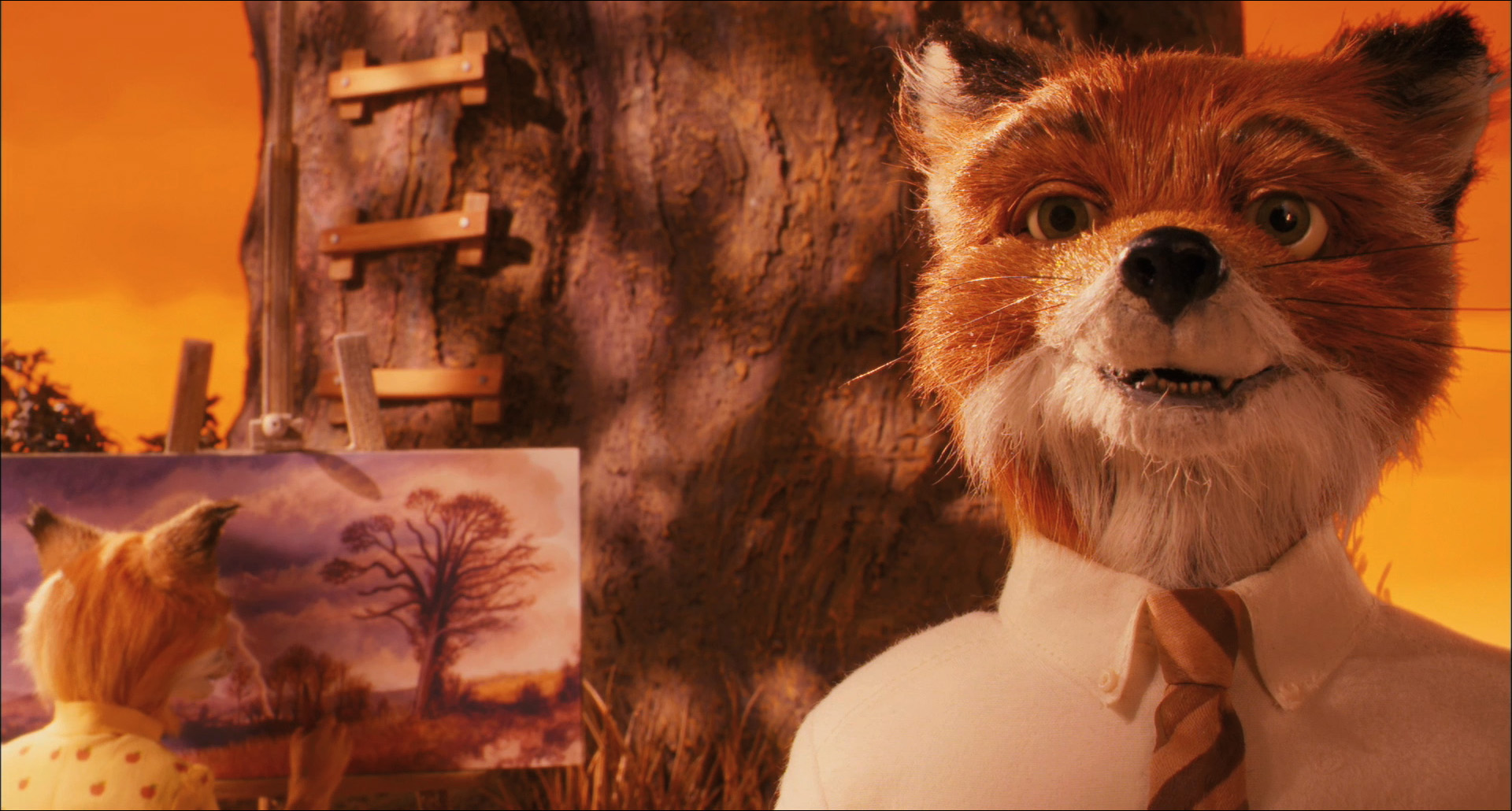
As for Fantastic Mr. Fox, there's nothing sad or squicky about it--it's an absolute delight. I was hooked from the first sequence, where Mr. and Mrs. Fox sneak into a farmyard and, in a superb tracking shot, scurry around various obstacles to get to the chicken coop, while the Beach Boys' "Heroes and Villains" plays.

These fantastic foxes are surprisingly expressive. Maybe it's because their angular, bony bodies are based on human proportions rather than vulpine ones. Or maybe it's because they're so wonderfully tactile, with their real rippling fur and bright porcelain eyes. In contrast, the characters of this year's other stop-motion animated film, Coraline, are smooth and hard, almost the way that computer animation is smooth and hard. And, while I admired Coraline as a technical achievement, it did not charm and captivate me in the way that Mr. Fox did.

Anderson invited George Clooney and Meryl Streep--who might be two of the coolest people in Hollywood--to voice the title character and his wife. Excellent choices. Mr. Fox, being a cocky and clever paterfamilias, reminds me of Clooney's character in O Brother Where Art Thou, which is probably my favorite Clooney role. And Streep's voice work makes you wonder how much of her success is due to her voice's gentle, fluting timbre.

While Tenenbaums is all about symmetrically composed shots and deadpan acting, Fantastic Mr. Fox is much more about the pleasures of kinetic movement. Several sequences seem designed just to push the technical limits of stop-motion animation. Whether it's dozens of squirrels helping the Foxes move into their new home, or Mr. Fox's heists and ambushes, or a tracking shot of all the animals cooking a feast, there is dazzling stuff here. All done with the utmost precision--but without preciousness.

I haven't read Roald Dahl's original novel, but I suspect he might have put more emphasis on the villains, three poultry farmers named Boggis, Bunce and Bean. Gleeful nastiness was one of Dahl's favorite themes, but it isn't one of Anderson's. He's much more fascinated by the opportunity to create a detailed world for the animals: their tailored clothes, their paintings and newspapers, their Quidditch-like game called "whack-bat." (The best thing he does with the villains is a visually clever sequence introducing the three of them.) And, though the Foxes aren't full-fledged Wes Anderson neurotics, they show some complexity and emotion. The story starts because Mr. Fox has a midlife crisis; his wife mingles love and exasperation; their son resents his popular cousin. And just when things threaten to get too heavy... bam! there's another phenomenal setpiece.

I was quite proud of myself for recognizing that some of the music in Fantastic Mr. Fox came from François Truffaut's Day for Night, one of my favorite movies. Day for Night is very precisely made, very controlled, very aware that it is a film--and yet it manages to be filled with such joy and vitality. The same description applies to Fantastic Mr. Fox.

Tuesday, June 10, 2008

The Savage truth about playwrights

Laura Linney and Philip Seymour Hoffman are The Savages.

The other night I watched The Savages, written and directed by Tamara Jenkins. Among other reasons I wanted to see it, main character Wendy Savage (Oscar nominee Laura Linney) is a playwright--and I have a minor hobby of analyzing the way that playwrights are portrayed in other media (movies, novels). Fun fact: in real life, Laura is the daughter of playwright Romulus Linney, so she's probably very familiar with the theatrical-academic world of The Savages.

Wendy is an example of how I don't want to end up. She is 39 years old, unproduced, working temp jobs, applying fruitlessly for grant money, single, childless, and having dispassionate sex with a balding 52-year-old married guy. She's so beaten-down by life that she is stunned when a guy who works at her father's nursing home asks to read her play. "Where I come from, people never want to see your unproduced plays," Wendy explains. To me, this rang a little false. The impression I get from reading blogs like surplus is that the New York theater world is full of people passing unproduced scripts around and gossiping about which ones deserve productions. And it made me wonder: why doesn't Wendy try to join a writing group?

Still, I loved her reaction when the man says that he liked her semi-autobiographical play. "You don't think it's self-important and bourgeois?" Wendy asks earnestly. Ha.

Wendy's brother Jon (Philip Seymour Hoffman) is also involved in theater as a drama professor in Buffalo, so their dialogue has several funny theater references in it. (Wendy: "Now we have to go out West and get Dad!" Jon: "We don't, Wendy, we're not in a Sam Shepard play.") And I almost burst out laughing when I saw that Jon had a Richard Foreman poster leaning against the wall of his living room (photo below). Too perfect! I just wish that The Savages could've worked in a reference to A. R. Gurney, famous for his plays about Buffalo, NY.


At the end of the movie, Wendy's growth as a character, a sense of "she's gonna be all right after all," is symbolized by her play getting a small New York production. Jon watches a rehearsal and comments on the play's "mix of naturalism and magical realism," which is again, TOO perfect, because that's the major trend in playwriting these days--Tony Kushner, Sarah Ruhl. I never expected a movie to capture this about the theater world.

Still, I always think it's facile when movies show writer-characters overcoming their lousy childhoods by transforming them into works of art. I guess it's the dramatic payoff for making Wendy a playwright in the first place, but it gives the impression that the only thing playwrights can write about is themselves. Wes Anderson did the same thing with Margot in The Royal Tenenbaums--at the end of the movie, she overcomes her depression and writes a play about her dysfunctional family. Though I feel it's more tongue-in-cheek in Anderson's version than in Jenkins'.

As female playwrights in movies go, though, I love Margot Tenenbaum. She talks less about playwriting than Wendy Savage does, but since she's in a Wes Anderson movie, she's got lots of weird quirks and an iconic wardrobe. Someday, I'm going to be Margot for Halloween. I already have dark-blond bobbed hair and a fur coat I inherited from my grandma.

Wes Anderson also created a memorable playwright character with Max Fischer, of Rushmore. I haven't seen that movie for a while, but I just watched some clips on Youtube, and think I need to see it again. Max, in all his awful, egotistical, awkward glory, is painfully reminiscent of how we playwrights can get on our worst days. And his line "I can write a hit play. Why can't I have a little drink to unwind myself?" certainly resonates with this not-yet-21-year-old playwright...

Photos from criticsrant.com

Sunday, September 30, 2007

La nostalgie de Paris

I'm really missing Paris this weekend. After being on the Vassar campus almost continuously for a month, I want nothing more than to wander up and down Paris's streets. I have also been eating a good deal of French-ish food lately--I taught myself to make clafoutis, and sold crêpes for the French Club--which doesn't help. Proustian sense-memories and all that. But really, what brought on this nostalgia is my downloading Wes Anderson's short film Hotel Chevalier free from iTunes last night.

The movie features Jason Schwartzman as a guy moping around a Paris hotel room, and Natalie Portman as his ex-girlfriend who comes to pay him a visit. As a narrative, it's not much: we get hints about why they broke up and what has happened to them since, but a lot of stuff is left open-ended.

But you don't watch a Wes Anderson film for its plot, necessarily; more for its aesthetics. And this one doesn't disappoint. Of course, it is shot in a super-wide aspect ratio, the art direction features vivid colors and weird objects, every frame is meticulously arranged. Much of it is underscored with a great ballad called "Where Do You Go To, My Lovely?", which has quirky lyrics and a kind of melancholy, yearning feeling. Schwartzman and Portman (try saying that five times fast... or better yet, "Schwartzman and Portman in Portland") capture this same melancholy in their acting. So already, the movie is enough to put you in a sweetly wistful mood.

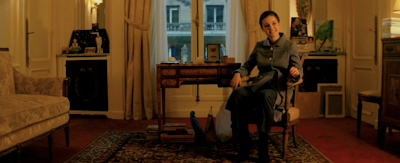
But I think it has a special poignancy for me. This shot of Natalie Portman in the hotel room:


brings back so many memories. When I lived in Paris I had a balcony off my room, with doors just like these: made of glass and swinging out, with a rotating knob-handle in the middle. I have never seen these kind of doors anywhere but Paris--perhaps they are the original "French doors"? Also, my room in Paris had a warm red-and-yellow color scheme, just like this hotel room.

At the end of the movie, Schwartzman asks Portman "You wanna see my view of Paris?" and they go out through the glass doors onto the balcony.


They stand for a moment, looking out, then go back inside. Then the camera pans to the left to show you what they were looking at, and you expect one of those really stereotypical Parisian landscapes: glowing lights, the Eiffel Tower, Notre Dame... But instead, you see this:

It's the building across the street! And when you think about it, that's so true: at least 95% of the windows in Paris don't have a stereotypical view, but instead just face out upon other buildings. And yet it has its own beauty and grandeur--this kind of architecture is just lovely--and it reminds me so much of the view I had for four months earlier this year.

Damn it, Wes Anderson. Just when I was getting sick of your quirk and twee-ness, you have to go and break my heart. And before that, you directed a television commercial that never fails to make me smile:


because it's such a great homage to Day for Night, one of my all-time favorite movies (I love Truffaut!). Oh well, Wes. I can't stay mad at you for long.

All images are screen-captures from Hotel Chevalier--I just figured out how to make them on my computer!