I hadn't seen Tenenbaums since it came out, when I was fourteen. I really liked it at the time, for reasons that I could not quite articulate, and was curious whether it held up. Furthermore, in the past eight years, I have become more aware both of Wes Anderson's aesthetic and of the classic filmmakers who have influenced him. I know now to look out for Anderson's camera movements, his throwaway jokes, the things that happen at the edges of his carefully composed shots.
 I guess that when I first saw Tenenbaums, I liked it because it was different from anything else I'd seen--2001, I think, is the year I became aware that movies could be art and not just entertainment. But now, as a semi-cinephile who watches movies very differently from the way I watched them when I was 14, I got more out of The Royal Tenenbaums, and I think I connected to it more deeply. I felt more in tune with the deadpan performances, and was more saddened by the moment when Ritchie tries to kill himself (though, at the same time, more aware of the sheer weirdness of the images: the sink filled with blood and hair-clippings). I also remember that my parents didn't like Tenenbaums because they were squicked out by the quasi-incest plotline, while at the time I accepted it with a fourteen-year-old's logical equanimity: "Margot is adopted... so who cares?" Now, I know that it's more complex than that; even though Margot and Ritchie aren't related by blood, they were raised together, and that does make things kind of weird.
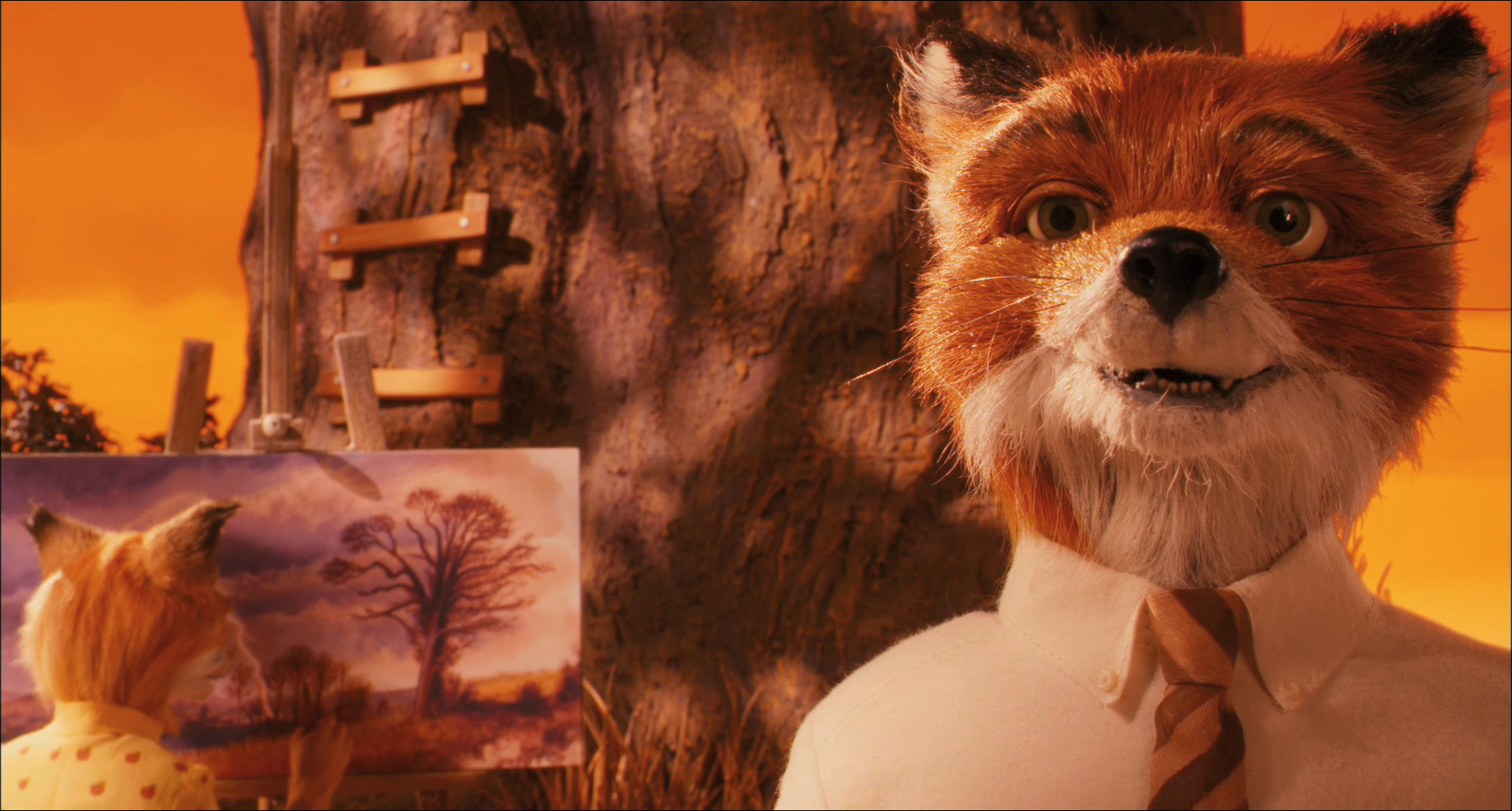 As for Fantastic Mr. Fox, there's nothing sad or squicky about it--it's an absolute delight. I was hooked from the first sequence, where Mr. and Mrs. Fox sneak into a farmyard and, in a superb tracking shot, scurry around various obstacles to get to the chicken coop, while the Beach Boys' "Heroes and Villains" plays.
These fantastic foxes are surprisingly expressive. Maybe it's because their angular, bony bodies are based on human proportions rather than vulpine ones. Or maybe it's because they're so wonderfully tactile, with their real rippling fur and bright porcelain eyes. In contrast, the characters of this year's other stop-motion animated film, Coraline, are smooth and hard, almost the way that computer animation is smooth and hard. And, while I admired Coraline as a technical achievement, it did not charm and captivate me in the way that Mr. Fox did.
Anderson invited George Clooney and Meryl Streep--who might be two of the coolest people in Hollywood--to voice the title character and his wife. Excellent choices. Mr. Fox, being a cocky and clever paterfamilias, reminds me of Clooney's character in O Brother Where Art Thou, which is probably my favorite Clooney role. And Streep's voice work makes you wonder how much of her success is due to her voice's gentle, fluting timbre.
 While Tenenbaums is all about symmetrically composed shots and deadpan acting, Fantastic Mr. Fox is much more about the pleasures of kinetic movement. Several sequences seem designed just to push the technical limits of stop-motion animation. Whether it's dozens of squirrels helping the Foxes move into their new home, or Mr. Fox's heists and ambushes, or a tracking shot of all the animals cooking a feast, there is dazzling stuff here. All done with the utmost precision--but without preciousness.
I haven't read Roald Dahl's original novel, but I suspect he might have put more emphasis on the villains, three poultry farmers named Boggis, Bunce and Bean. Gleeful nastiness was one of Dahl's favorite themes, but it isn't one of Anderson's. He's much more fascinated by the opportunity to create a detailed world for the animals: their tailored clothes, their paintings and newspapers, their Quidditch-like game called "whack-bat." (The best thing he does with the villains is a visually clever sequence introducing the three of them.) And, though the Foxes aren't full-fledged Wes Anderson neurotics, they show some complexity and emotion. The story starts because Mr. Fox has a midlife crisis; his wife mingles love and exasperation; their son resents his popular cousin. And just when things threaten to get too heavy... bam! there's another phenomenal setpiece.
I was quite proud of myself for recognizing that some of the music in Fantastic Mr. Fox came from François Truffaut's Day for Night, one of my favorite movies. Day for Night is very precisely made, very controlled, very aware that it is a film--and yet it manages to be filled with such joy and vitality. The same description applies to Fantastic Mr. Fox.

