Showing posts with label india. Show all posts

Saturday, March 14, 2009

The Wintersyana

Thanks to my new housemate I feel like I have really been getting a crash-course in Indian culture lately! (Just created an "India" tag for the blog.) This weekend, she has a friend visiting from New York, who is studying at Parsons School of Design and knows Nina Paley, the woman behind the animated movie Sita Sings the Blues. According to her, this is a must-see!

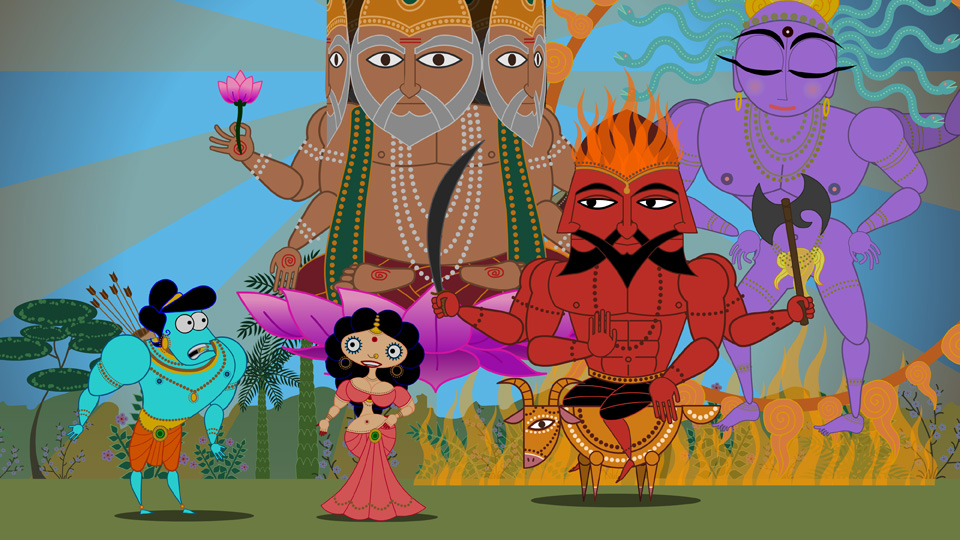
Sita Sings the Blues (a film championed by Roger Ebert, among others) is based on the Ramayana: Sita, the wife of King Rama, is a classic example in literature of the abandoned and rejected wife. Nina Paley uses Sita's story, as well as old jazz songs, to explore her own feelings after her husband rejected her.

Because I was not familiar with the Ramayana story, my friend told it to me, focusing on the parts that involve Sita:

Queen Sita is kidnapped by a demon and her husband, King Rama, undertakes an elaborate quest to rescue her. Once he has rescued her, though, he is haunted by the thought that the monster must have violated her, or that she otherwise has not remained faithful to him. Sita swears, several times, that she is chaste. She even undergoes a trial by fire in order to prove it: the gods rescue her from the flames because she is telling the truth. Nevertheless, people in the kingdom start to gossip about Sita, which infuriates Rama and stirs up his doubts again. Despite the fact that she is pregnant, he exiles her from the kingdom. Sita takes refuge in an ashram and gives birth to twin boys, raising them to adulthood with the help of a wise guru. Many years later, Rama's army invades the region where the ashram is, but is defeated by a force led by his two sons. Rama realizes that these must be no ordinary boys--they must be of royal blood. Thus he meets his sons for the first time and is reunited with Sita. Still, he continues to have doubts about Sita's chastity, the boys' parentage, etc. Frustrated by her husband's lack of faith in her virtue, Sita cries, "If I have always answered my husband's questions truthfully, then may the earth swallow me up!" The earth swallows her up and she is never heard from again.

When I heard this, I immediately thought, "This has the most fascinating parallels with The Winter's Tale!" To wit:
  • A jealous husband who will not listen to reason...
  • ...falsely and repeatedly accuses his wife of infidelity...
  • ...his cruelty not mitigated by the fact that she is in the advanced stages of pregnancy...
  • ...nor the fact that the gods themselves swear to her virtue.
  • The child/children are brought up in a distant land, in a pastoral setting, without meeting their father the King...
  • ...though they have an innate nobility that sets them apart and eventually brings them to their father's attention...
  • ...which also leads to their father being reunited with his long-suffering and virtuous wife.
I'm not sure what I should think about the different ways these tales end, though. My friend explained to me that for Hindus, Sita's being swallowed by the earth isn't suicide, exactly--it is more a reunion with the earth goddess, her energy being absorbed back into the earth. And there is something to admire about a woman who refuses to take her husband back if he is still just as jealous as he was when he exiled her in the first place. Still, to me it does seem like a kind of suicide, or defeat, or giving up. Meanwhile, The Winter's Tale has a much more hopeful and happy ending: Leontes realizes his mistakes and is given a second chance; Hermione forgives him. But it can't have been fun for Hermione to spend sixteen years in hiding, out of sight of everyone, in the hopes that her husband might one day forgive her. And, while the humanist in me appreciates the message that people can change, that Leontes can become a better man; the feminist in me wonders if it's a good idea to give women hope that their cruel and abusive husbands will eventually change, since so many of them never do.

Because of copyright/distribution issues Sita Sings the Blues is available as an open-source movie to watch online. I hope to find the time to do so soon!

Tuesday, March 3, 2009

March Updates

**Salman Rushdie has written the piece on Slumdog Millionaire that I longed to read as soon as I saw the movie. He attacks it both from a narrative/literary standpoint and from an Indian/postcolonial standpoint, but always with a good dose of sardonic Rushdie wit:
"It used to be the case that western movies about India were about blonde women arriving there to find, almost at once, a maharajah to fall in love with, the supply of such maharajahs being apparently endless and specially provided for English or American blondes; or they were about European women accusing non-maharajah Indians of rape, perhaps because they were so indignant at having being approached by a non-maharajah; or they were about dashing white men galloping about the colonies firing pistols and unsheathing sabres, to varying effect. Now that sort of exoticism has lost its appeal; people want, instead, enough grit and violence to convince themselves that what they are seeing is authentic; but it's still tourism. If the earlier films were raj tourism, maharajah-tourism, then we, today, have slum tourism instead."
The piece discusses a whole lot more than Slumdog Millionaire--its general subject is the art of film (and other) adaptation. A lot to digest, and highly recommended. (Incidentally, this article is just one more proof that The Guardian has the best Books section in the English-speaking world, bar none.)

**Maybe I'm a bit too hard on Slumdog Millionaire, though. My main objection to it is its theme of "destiny"--I believe that characters' free will is the essence of drama, and resorting to destiny as deux ex machina is just lazy and lowbrow. Yet at the same time, I have a pervasive habit of seeking external signs and hints from destiny in my own life. Can something cosmic happen to give me a clue that I'm in the right place at the right time? Is there some deeper meaning behind coincidental encounters? Is this all, somehow, being orchestrated?

**Speaking of adaptation, a month or so ago I planned to do a big ambitious blog post that involved comparing Fitzgerald's Benjamin Button short story, the recent film based on it, and the novel The Confessions of Max Tivoli, which also uses the conceit of a man who ages backwards. But I haven't been able to work up the enthusiasm to go see the movie, and I wasn't all that jazzed about Max Tivoli when I read it, so it's probably not going to happen. I think perhaps I am just wishing I were back at college--I mean, why else would I get an urge to write a big compare-and-contrast essay?

**I also have, from long ago, the beginnings of a blog post about works of art that use reverse-chronology in general... not just the obvious ones like Memento and Betrayal either...but now we are talking about a huge can of worms.

**It's not the Baptistry Doors, but I'm pretty pleased with how this turned out...

I found colored paper at a crafts store pre-cut to the 12" by 12" size I needed, and the photographs come from a book of platinum prints titled Dana Buckley: Fifty. (I don't know if you can see them that well, but they are all black-and-white images of flowers.) I got the book on sale at Stacey's and, though I am usually against mutilating books, decided that it was worth it in this instance.

**Because I'm the kind of girl who gets upset over the closing of bookstores that I've never even been to, you can imagine how torn up I am that Stacey's Books is going out of business. It became my go-to bookstore when I started working in the financial district...and now it's shutting down after more than eighty years?! I have gotten some very good deals as they clear out their stock, which makes me feel like a war profiteer, but really, what else do you expect me to do?

Sunday, February 15, 2009

Everybody into the pool

Last night I went with some friends to a bar that projected Bollywood videos as a visual accompaniment to bhangra music. And one of them qualifies as the weirdest, most demented production number I have seen in a long time. Think really bad CGI-animated bugs and lobsters, a moment where time stops for half of the characters while the others run around causing mischief, a woman in a yellow bikini singing while underwater, that very Bollywood attitude that thinks nothing of letting the camera linger over a woman's cleavage but is appalled by kissing, and lots of people falling into swimming pools.

I went online and hunted it down this morning. The song is "Lazy Lamhe," from the film Thoda Pyaar Thoda Magic.

Reading about the film, I learned that the woman wearing the red vest and long skirt is supposed to be an angel in disguise on Earth, which I guess explains the weird goings-on, but if you don't know that, the imagery here is decidedly trippy.

Sunday, January 4, 2009

Slumdog Salman

I spent a very low-key New Year's Eve at a movie theater watching Slumdog Millionaire, which had come highly recommended to me. Sadly, I think I may have gotten myself a little too excited to see it: while I did appreciate it as a colorful and propulsive cinematic achievement, I wasn't as emotionally affected by it as other people have been.

One of my new housemates (I mean, new-new--I just moved in yesterday) is Indian-American and I found myself discussing Slumdog Millionaire with her. "I just don't see why people say that this movie is inspiring when the happy ending is only because fortune randomly chose to favor this guy!" I said.

"Oh, but that's so India," said my housemate. She switched into an Apu-from-The-Simpsons voice (something that a lot of my Indian friends seem to relish doing in order to mock people from the old country): "Don't you see, Marissa, everything ees karma. Good theengs are coming to you eef you have thee good karma."

"I guess I'm more inspired by stories about people who get out and do things, rather than people who have good karma or luck or whatever." (I was thinking of Milk, specifically.)

"Yeah," said my housemate. "Trust me, I get sick of that whole karma thing too. But try telling that to my relatives."

I wrote a review for the IMDB in which I discuss this point at greater length, and you can read it if you like, but you know whose opinion of Slumdog Millionaire I would really like to hear? Salman Rushdie's!

So far as I know, Rushdie isn't in the habit of reviewing movies--but if I edited a magazine (and it wasn't bleeding money in this economy) I'd ask him to write an article about Slumdog Millionaire. I think it could be a very valuable pairing. Rushdie wrote one of the first Indian novels to hit it big in the West (Midnight's Children) and Slumdog Millionaire seems poised to do the same for Indian cinema.

Furthermore, Rushdie's books often feature magical realism and Slumdog Millionaire is a fairy tale. Both Midnight's Children and Slumdog Millionaire use some contrivances in order to make the protagonist's life match up with important historical events (in the case of Rushdie) or key trends and features of modern-day India (in the case of the movie). Indeed, both protagonists metaphorically represent India. Saleem Sinai was born at the moment of Indian independence, his nose is shaped like the Indian subcontinent, he is Hindu-born but Muslim-raised, etc. Jamal Malik, meanwhile, represents the way that contemporary Indians would like to see themselves: a good-hearted underdog whose street smarts and innate virtues, combined with Fortune's favor, will lead to success. The movie even takes care to point out that India's motto is "Truth alone triumphs," and that's exactly what happens in Jamal's story. Rushdie wrote his novel when India was at a low ebb, so Saleem goes from riches to rags; the opposite happens to Jamal.

Salman Rushdie is a very smart and witty man (and I speak from experience--he lectured at Vassar while I was there) who could provide a unique perspective on the movie that'll probably win Best Picture this year. So somebody get him to write about it, please! When publications like The New York Times Book Review hire famous authors to review the works of other authors, why is there nothing comparable for movie reviews?

Addendum: I just discovered that Rushdie, Umberto Eco, and Mario Vargas Llosa jokingly call each other "The Three Musketeers." If you have seen Slumdog Millionaire, you know that this is just TOO apt. This convinces me: Salman, IT IS WRITTEN that you must review this film!