Wednesday, December 31, 2008

2008 in Books

Time for my annual list of books I read over the past year (my 2007 edition is here). First, the statistics:
  • 32 books read.
  • 5 British, 21 American (1 Russian-American), 2 French (1 translated, 1 not), 1 Danish (written in English), 1 Mexican (written in English), 1 Indian (written in English), 1 Sri Lankan-Canadian
  • 22 books by 19 different male authors, 9 books by 9 different female authors; 1 anthology.
  • 13 non-fiction/memoir/advice, 19 fiction/poetry/humor.
  • 28 read for pleasure, 4 for school.
  • 30 new reads, 2 re-reads.
Weirdest connections between three books I read this year:
  • The Memoir Trifecta (written about here)
  • I read 2 Jewish-themed alternate history-novels: The Plot Against America and The Yiddish Policemen's Union. And The Plot Against America takes place during the exact same years, in the same region of the country, and among the same ethnic group as does Michael Chabon's earlier novel The Amazing Adventures of Kavalier and Clay.
Now for the list. I link to my blog postings if I've written about the books already, and provide brief notes/comments if I haven't posted about the book.
  • The Dangerous Book for Boys. Highly recommended. Yes, really! I think that the best books create and evoke a whole world in the reader's imagination, and this one certainly does: a fantasy of Edwardian boyhood.
  • Letters to a Young Artist. Mixed feelings. As I read this book, I thought that Anna Deavere Smith had a lot of good things to say...but one year on, I can barely remember any of them. I don't do well with books that consist only of abstract musings and advice on "being an artist."
  • The Amazing Adventures of Kavalier and Clay. Highly recommended.
  • The Dud Avocado. Recommended.
  • The Mysteries of Pittsburgh. Recommended. Some aspects of it, like the gangster subplot, are not successful, but since I'm the same age as the characters--and they are memorable characters--it was a good read.
  • Fin-de-Siècle Vienna: Politics and Culture. Recommended. Fin-de-siecle Vienna is one of the places I would go to if I had a time machine, and this is a Pulitzer-Prize-winning collection of essays on some of its major figures.
  • Introducing Kafka. Highly recommended. A weird, but great little mini-biography of Kafka in graphic-novel form, with illustrations by R. Crumb.
  • Monsieur Vénus. Mixed feelings. In general, "scandalous and decadent" French novels never appeal to me as much as I think they will. This book has some interesting things to say about gender roles, which is why we read it for class--but was it fun to read? No.
  • Thunder at Twilight: Vienna 1913-1914. Highly recommended. One of the most exciting history books I've ever read: it reads like a novel, and makes the atmosphere of late-Habsburg Vienna come alive.
  • Hons and Rebels. Highly recommended.
  • Entertainers and the Entertained. Not recommended. John Houseman led a very interesting life and some of that makes it into this collection; but it would probably be better just to read his autobiography, as there is a lot of filler in this book.
  • My Life in France. Recommended. I love Julia Child's no-nonsense voice. She makes her love for France clear, while avoiding gushy sentimentality.
  • The Yiddish Policemen's Union. Highly recommended.
  • Seven Gothic Tales. Recommended.
  • Attack of the Theater People. Mixed feelings. I thought that How I Paid for College hung together better...and I worry that Edward's misadventures are going to get steadily less charming the older he gets.
  • Wonder Boys. Recommended. Kind of a "shaggy professor story," in that I don't know if it says anything meaningful about life, but it's a very fun read. I like the movie version, too, which wisely eliminates the weakest section of the novel--Grady's Passover seder with his estranged wife's family.
  • Wicked. Mixed feelings.
  • The Four Agreements. To be avoided.
  • The God of Small Things. Mixed feelings. Friends had told me that it would make me cry, and it didn't, so I suppose it was inevitable that I felt disappointed.
  • The Maltese Falcon (re-read). Recommended.
  • A Heartbreaking Work of Staggering Genius (re-read). Highly recommended.
  • Divisadero. To be avoided.
  • The Blue Flower. Recommended.
  • Oh the Glory of It All. Highly recommended.
  • Tales of the City. Highly recommended for San Franciscans; good, but not as essential, for everyone else.
  • The Man Who Ate Everything. Recommended. I read Jeffrey Steingarten's other book, It Must've Been Something I Ate, last year, and enjoyed it...this is more of the same, which is what I wanted.
  • Frankenstein. Recommended. It's a classic, and a quick read at that...what's not to like?
  • Fierce Pajamas: Humor Writing from The New Yorker. Recommended, as long as you like "New Yorker humor." A good book to keep on your nightstand and read a few pieces a day. Some great parodies, classic short stories, light verse.
  • Pnin. Highly recommended.
  • The Plot Against America. Recommended. This is the first Philip Roth I've read, and while I wasn't blown away, I liked his characterization and general style. I just feel that this book didn't quite hang together, in the way that Roth tries to combine the genres of "simple family drama" and "alternate-history political thriller."
  • The Rest Is Noise. Highly recommended.
  • Arthur Rimbaud: Complete Works. Mixed feelings. Of course I'm glad to have familiarized myself with Rimbaud. But I don't know whether I needed to read his complete works--the poems, with their highly abstract language, all blended into one another after a while. I should've read fewer poems, and read them in French.
I fulfilled one of my goals of getting more comfortable reading nonfiction, though I read even fewer books in translation than I did in 2007, and I still have a lot of plays sitting unread on my shelf. I'm not going to set reading goals for the year ahead, but I am curious whether my 2009 statistics will be different from those of years past. 2009, after all, will be my first full year out of school, free from homework and able to read books entirely of my own choosing.

See ya on the flipside (of the calendar, that is).

Tuesday, December 30, 2008

20th-Century Music, 21st-Century Reading Experience

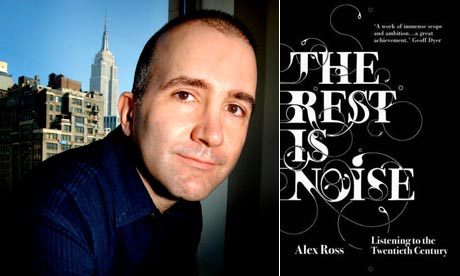
The day before I do my annual list-of-books-I-read-this-year post, I want to write about one of my new favorites: The Rest is Noise, by Alex Ross (music critic for The New Yorker). This long, dense, but rarely dull history of 20th-century classical music has been snapping up accolades since its publication last year, and I feel they are deserved. Though I'm not even that familiar with 20th-century classical music (having grown up in a house where "atonal," said by my mother with an inimitable sneer, is a dirty word) I may become an enthusiast after reading this book!

First, I liked that The Rest is Noise cleared up some misconceptions I had about musical history. I knew that Schoenberg was the first atonal composer and became famous circa 1910. I also knew that for much of the 20th century, critics and academics scorned tonal music; and I assumed that Schoenberg was the one who started that attitude. In reality, Schoenberg had his acolytes in the early 20th century, but he wasn't militant about atonality; the guy who really began that was Pierre Boulez, circa 1950.

I got the sense that if Boulez wasn't still alive, Ross would've come right out and said that the young Boulez behaved like a real jerk. Though Ross admires the music he writes about, he sometimes adopts a skeptical tone when discussing certain avant-garde excesses or composers' personal foibles. I like how his voice is not just that of an impersonal scholar: he makes room in the book for quirky tangents on his personal obsessions like trombone glissandos and Thomas Mann's Doctor Faustus.

Ross writes in a way that made me want to hear the pieces of music he describes, and, in the rare instances that I was familiar with the music he discusses, I'd hum it to myself in order to hear in it what he hears. For instance, this is what he writes about "Mack the Knife" (and by the way, if you haven't ever listened to Lotte Lenya's version, you totally should):
"Insidiously hummable... A simple tune circles around and around, coming to rest repeatedly on an added-sixth chord--a C-major triad plus the note A, which was a favorite device of Debussy. That "sweetened" harmony would become a standard device in jazz, but there is something desperate and bedraggled about Weill's use of it here. In the first verse, the main chord is wheezed out on a solo harmonium; thumping bass notes give the melody heavy feet; and throughout, the almost obsessive stress on the note A tends to darken rather than lighten the mood, nudging the music toward the minor mode. "Mack the Knife" is a song chained to one chord. It's a pop tune with no exit."
What's even more cool about The Rest is Noise is that Ross is a longtime blogger who has thoughtfully compiled an online "audio guide" to his book, featuring many of the key pieces of music that he talks about. It's a real 21st-century reading experience! Not only did this immeasurably enhance my appreciation of the book, I expanded my musical tastes. I never guessed I'd be so taken with John Cage's Sonata V for Prepared Piano! (Go here and scroll down to hear it.)

Now I know that as I continue to explore 20th-century music, The Rest is Noise will be my primer and guidebook. I'm already disappointed that in the wake of the financial crisis, San Francisco Opera has canceled the production of Peter Grimes that they were planning for next season, because Ross adores Peter Grimes and spends 10 pages analyzing it. However, SFO will produce Porgy and Bess this summer, and Ross does a 4-page analysis of that opera, which I will surely reread right before I go see it.

The strongest parts of The Rest is Noise are the ones where Ross can most fully explore his thesis of how composers' work intersected with larger trends--artistic, political, and social--in the culture where they lived. Really a great idea to have the middle three chapters be "The Art of Fear: Music in Stalin's Russia," "Music For All: Music in FDR's America," and "Death Fugue: Music in Hitler's Germany." The final chapters are a little weaker simply because classical music has become more disconnected from the mainstream culture in recent decades, and so the end of the book focuses more on musical criticism than broad cultural analysis. Still, Ross remains an optimist about the state of classical music and a cheerleader for new composers. Indeed, he's caused me to ask: "Why do I know who the hot young playwrights and novelists are, but not the hot young composers?"

Photo of Alex Ross and his book from The Guardian.

It's a sham of a mockery of a parody!

I've got a problem: I think that half of the movie previews I see look so asinine that they must be SNL-style parodies... until the movie actually opens and I realize that it's not a joke at all.

I'm not even talking about previews for movies that are blatantly commercial, superficial, and trend-driven. We all know that Hollywood is money-grubbing and will always use the proven formula rather than deriving something new. Thus, for instance, every romantic comedy these days seems to be a parody of the last one that opened (27 Dresses, Made of Honor, Bride Wars--it's the new "the more weddings, the better" school of filmmaking). I suppose you can laugh at previews for these movies. But they are almost too banal to be awful.

No, what's worse is when I see a preview for a movie that is meant to be an earnest drama, but it only makes me want to burst out laughing. Recent examples include the preview of The Boy in Striped Pajamas--which I felt sure was a parody of Oscar-baiting, British-accented, cute-kids-suffer-under-the-Holocaust movies. And the preview for Flash of Genius--which had to be a parody of inspirational biopics about "little men with big dreams," because who would ever go see a serious movie about the guy who invented windshield wipers?

Obviously I am not the only person who has this problem. I watched Tropic Thunder last night, and the three parody trailers that begin that movie might just be the funniest thing about it. As if to prove my point, the least amusing of the three trailers belongs to the crass commercial movie (five Jack Blacks, in fat suits, farting at each other) and the most hilarious trailer is for the earnest drama (Robert Downey Jr. and Tobey Maguire as gay medieval monks). People who take themselves too seriously are always funnier than people who know they're half-ridiculous to begin with. Which is why Robert Downey's whole performance in Tropic Thunder is so good, and so funny. But I digress.

I know older people say that people of my generation love irony too much, that we want to mock everything that society once held dear. Well, maybe that's so. But dang it, it's only because so many of today's movies and celebrities and goings-on seem like sitting ducks!

P.S. It may seem like my blog has been all about movies lately. That's because I go in cycles, like the moon: I have a Movies Phase for a few months, then a Theater Phase, say, or an Opera Phase... It's just the way I am.

Sunday, December 28, 2008

Highly-Anticipated Movie Reviews: "Milk"

Third in an occasional series. Note: title of series usually implies "movies I've been anticipating for a long time" not "I sense that you, the reader of my blog, will be in agony until you read my thoughts on this movie," although I know that in this case, at least one of you has been anticipating my Milk review...


Movie title: Milk

Reasons for anticipation: I am a San Franciscan now! Harvey Milk is a bona fide San Francisco hero, and I had the amazing opportunity to see a movie about his life at the Castro Theater, the gorgeous old movie house that is the centerpiece of the neighborhood where Milk made his name. Additionally, I always feel like I ought to go to Gus Van Sant's movies--he's from Portland and went to my high school--even if I haven't actually seen very much of his filmography.

My verdict: You don't have to be a San Franciscan to think that this is a really good movie, but that makes it even better.

Elaboration: OK, I've been in San Francisco for four months, but I hadn't actually set foot in the Castro until I went to see Milk. One of the things I love about this city is how tightly the neighborhoods are packed together without losing their individual character, and the Castro is no exception. Where else will you find people passing out flyers for a "Repeal Prop 8" vigil taking place that night in Union Square, while chatting about a part of the male anatomy that sounds like "Balzac" but isn't? Or bars/cafes that, at midday on a sunny Saturday, have absolutely no women inside at all? (Indeed, I was a little disappointed that there was a line for the ladies' room at the Castro Theater...)

There was also a line to get into Milk--the Castro is a big movie theater, but still, I have never seen that many people so excited to see a movie, when it's not even opening weekend! Though Harvey Milk died thirty years ago, he still lives in the city's memory. When I volunteered for the Obama campaign I met a retired gentleman named Alec who used to work in San Francisco city planning. In the course of his job, Alec had met and done business with Harvey Milk and the rest of the Board of Supervisors. "I liked Harvey," said Alec. "He tended to support our side."

Like many San Franciscans, Alec grieved the assassinations; still, he was careful to tell me and the other young volunteers that he feels ambivalent about Harvey Milk's death. Or perhaps, ambivalent about people who want to characterize Milk as a gay martyr. Homophobia played a role in Milk's death, but Dan White wasn't merely an anti-gay zealot. Instead, he was mad that Milk had convinced Mayor George Moscone not to give White back his seat on the Board of Supervisors after he resigned. So at the same time as Alec deplores the killings, he also admits that Moscone and Milk could have tried to handle this sensitive political situation with more tact.

The screening of Milk began with an unexpected treat: a concert on the vintage movie-theater organ, featuring movie-diva songs like "New York New York" and "Over the Rainbow," plus a Christmas medley. (Bad pun alert:) The organist pulled out all the stops! Seriously though, he took full advantage of all of the different voices that the organ can provide--sheer bliss for a girl who grew up associating the organ with that generic Catholic-Mass sound and wondered why her church organ had so many stops if the organist never used most of them.

The movie got an amazing response from the crowd--I don't think I have ever before been at a play or movie where people hiss the villain at his/her entrance, but that's literally what happened when Anita Bryant, the sugary-voiced anti-gay pop singer, first appeared on screen. Credit must go to Gus Van Sant's smart use of documentary footage, which makes everything seem more immediate for people who remember the era. He doesn't want us to be distracted by seeing a Hollywood star impersonate Bryant, nor does he want us to think that her words come from a screenwriter's artifice. No, he presents Bryant exactly as she was, and that is damning enough.

You'd be forgiven for thinking that the "You gotta give 'em hope" speech Milk delivers in the movie is something that screenwriter Dustin Lance Black invented after witnessing the rise of Barack Obama, but it, too, is the authentic words of the real Harvey Milk. Still, it is really startling how much the movie seems to mirror the issues raised by the 2008 election. As Isaac of Parabasis wrote, "It is remarkably well-timed to have a movie about a political organizer who learns that the key to effective organizing is to provide "HOPE" while fighting an anti-gay ballot proposition in California. It may, in other words, have stumbled into being the Movie of the Year. Not necessarily the "best" movie of the year, mind you, but the movie that best encapsulates our year."

Milk is unapologetic about its characters' homosexuality and Harvey Milk's status as an outsider, so that it made me reflect on what has been both gained and lost over the last 30 years. Now that gay people have more rights and are more accepted by American society, we expect our gay politicians to be "upstanding citizens," and if there's any whiff of scandal from them, it's worse than it is for a straight politician. Yet Milk shows Harvey dating Jack Lira, a cute Mexican guy who is much younger and obviously mentally unstable--something that I think would cause a scandal nowadays, even in San Francisco, but did not do so 30 years ago.

If I have one criticism of Milk, it's that things get a little heavy-handed toward the end--Harvey achieves a kind of closure with his ex-boyfriend the night before he dies, which makes his death seem more bittersweet than the shocking and brutal act it was in reality. Still, I must hand it to the filmmakers for taking advantage of San Francisco's geography to determine the last thing that Harvey Milk saw before he died, and using it to craft a supremely moving climax. The location shooting and art direction is excellent: it's always nice to see our beautiful City Hall onscreen, and Harvey's apartment has many architectural details that scream "San Francisco."

Until those final minutes, Milk is the rare inspirational biopic made with a light touch and several good jokes. The filmmakers recognize the way that members of underdog groups--gays, Jews--have always used self-deprecating humor as a defense mechanism, and this sensibility permeates the screenplay. There are also some lines guaranteed to bring down the house in San Francisco, though I don't know how well they'll play elsewhere. At one point, Milk asks his political staff "What is the biggest problem in this city?" Cleve Jones, a young aide, responds, "The way it always smells like piss in the Tenderloin?"

Sean Penn's performance is really as amazing as everybody says it is; though he's known for playing intense and brooding characters, he excels as Harvey Milk, who is a true extrovert--someone who thrives around other people and genuinely wants to help them. Again, because of the movie's use of documentary footage, all of the actors have to feel "super-authentic" so that they don't jar when placed next to the 1970s footage, and I think they succeed admirably. Josh Brolin, as Dan White, is creepy because he resists the temptation to "act creepy"--to see a soft-spoken, square-jawed dad-next-door shooting his colleagues is even scarier, I think, than to see an obvious "deranged psycho killer" type do it.

Back in October I visited City Hall for the first time and saw two gay men getting married on the steps of the beautiful Rotunda. And in just a few days, my old hometown of Portland will become the largest-ever American city with an openly gay mayor (Sam Adams). And so, rest in peace, Harvey Milk.

Friday, December 26, 2008

Best Meals of the Year

I've always had trouble deciding what my all-time favorite food is. They say that when I was a little kid, my grandmother asked me "Marissa, what is your favorite meal?" and I responded "All three!"

Now that I am living in San Francisco, a city with so much good ethnic food on offer, it's even harder to determine my favorite. However, I recently realized that my three top candidates all fall under the same rubric: "Seasoned Roast Pork in Some Kind of Bread Product."

This unwieldy description covers my three favorite foods of 2008: banh mi sandwiches; char siu bao (Chinese pork buns); and carnitas burritos.

Banh mi: I will always associate this sandwich with San Francisco, despite its hybrid French-Vietnamese origins, because it's what I had for lunch the day after I moved to the city. I was wandering around Chinatown and environs, stumbled into a tiny Vietnamese coffee shop, and decided to try a banh mi for the first time. As soon as I bit into it, I wondered why I'd never had one before: anything that involves roast pork, a French baguette, and lots of cilantro is bound to appeal to my palate! (Though I do pick out the cucumbers--I don't like cucumbers.) This is probably the cheapest, healthiest, best lunch you can get in downtown San Francisco. My top food discovery of 2008.

Char siu bao: These steamed pork buns, especially from Yank Sing, are like biting into heavenly clouds. The lightest, sweetest, fluffiest white dough surrounds a dollop of sweet-sauced barbecued pork; truly, one of the greatest food combinations ever invented. My office is right near one of Yank Sing's outposts, and sometimes at lunch I get their take-out meal consisting of a tangle of chow mein, a potsticker, a springroll, and one precious bao. I always end up eating way too much of the chow mein and feeling sluggish all afternoon. But it's worth it for the bao.

Carnitas Burritos: Unlike banh mi and bao, I knew about carnitas burritos before coming to San Francisco, but the plethora of great taquerias in this city have provided me with more authentic and better-quality burritos than I've had before. Besides, it's not just a food: it's an experience. In this case I must give a shout-out to my neighborhood burrito joint, Ocean Taqueria, on Divisadero Street.

Ocean Taqueria is a very long, narrow space, which feels a little weird, but it's staffed by the nicest guys you could ever meet. I can come in with dirty hair, and speak my horrible Spanish to them (I have to pause after every three words to make sure I don't slip into French), and they will still smile at me and call me amiga or corazon.

They gave me free tortilla chips when I came in in mid-afternoon in September and said "no estoy empleada," they served me and my housemates efficiently on Election Night (I was eating an Ocean Taqueria burrito while watching Obama's acceptance speech), and on Christmas Eve, they made me probably the best carnitas burrito of my life, and wished me "feliz Navidad."

My God, I'm going to miss them when I move to the Inner Sunset next week.

Thursday, December 25, 2008

merry merry happy happy

I know Christmas is almost over, but I can't go to bed without posting this video of "Have Yourself A Merry Little Christmas," as sung by Theo, a friend of mine from high school.

The mood of the video sort of captures how my Christmas turned out. Relaxed. Lo-fi. Not a lot of crowds and excitement and forced holiday cheer. But warm and heartfelt.

I hope yours was the same.

Saturday, December 20, 2008

Focus Features rocks my socks


Just got back from seeing Milk at the Castro Theater. I'll write more about that experience later on, but for now, can I just say how much I love Focus Features? Seriously, it is almost absurd how frequently a Focus Features release turns out to be my favorite movie of a given year. Sometimes when I see their logo appear before a movie or a trailer, I even get giddy with anticipation.

For a run of 3 or 4 years earlier this decade, Focus Features held utter sway over my heart and the hearts of other cinephiles. I can never settle on what my favorite movie of 2002 is, but Focus' Far From Heaven is definitely up there. (The other contenders are The Hours and Adaptation. Great year for Streep and Moore!) And my favorite pictures of 2003, 2004 and 2005 are all Focus releases: Lost in Translation, Eternal Sunshine of the Spotless Mind, and Brokeback Mountain.

After that, Focus lost their way a little bit. 2006 was the first year that none of their movies got any Oscar nominations; and in 2007, Atonement was certainly a well-made and acclaimed movie, but in some subtle way, it doesn't feel "Focus-y"... it's the kind of prestige drama that any studio could have released. Besides, I think I love the book Atonement too much to ever consider naming a film version of it, no matter how good, as my favorite film of the year.

But this year, Focus is back in form and I am loving it. My two favorite new movies of 2008 are In Bruges and Milk--both of them Focus Features productions. Like I said, this is getting ridiculous... but I don't want it to end!