Monday, February 16, 2009
The Playwright's Nightmare, part 2: "Rich and Famous"
A.C.T.'s blurb for their production of John Guare's Rich and Famous contained several phrases that are always right up my alley. Phrases like "dark comedy," "nightmarish phantasmagoria," "twisted humor, rapid-fire dialogue, and outrageous songs." Well, I guess I got my hopes up too high, for what turned out to be a weird hybrid of absurdist comedy and shticky vaudeville, with a rather obvious moral: "If wealth and fame are your reasons for becoming an artist, maybe you shouldn't be one." Though the play deals with a poor schnook whose life is falling apart, it lacked the edge and the menace that I associate with the term "dark comedy," and the shifts in tone made it hard to know what's really at stake.
Said schnook, Bing Ringling, is "the world's oldest promising playwright," about to have his first Off-Off-Broadway production. In the course of the evening, he experiences the Playwright's Nightmare in its purest form: his actors are terrible, the critics savage his play, his girlfriend breaks up with him, he learns that his producer produced his play for basically the same reason that Max Bialystock produced Springtime for Hitler, etc. etc.
Some of John Guare's dialogue is funny, with appealing observations about the playwright's life and the type of people who take up this profession. (When Bing says that he wishes life were like "a Truffaut movie with songs," I thought Yes! Of course!) But I realize that my warm feelings are attributable more to my own sentimentality about being a playwright, than to the quality of the script. It's no different than a doctor enjoying a lousy TV medical drama because it happened to get something right about working in a hospital. That doesn't mean it's good.
Mostly, Rich and Famous seems confused about what tone to adopt: broad-but-still-plausible humor, or all-out exaggerated absurdism? Example of the former: The star of Bing's play is a terrible actor who moonlights as a transsexual hooker. Examples of the latter: Bing has written over 800 unproduced plays, and his parents are so over-doting that they have saved and bronzed all of his old diapers. When the play becomes untethered from the real world like this, it becomes hard to care about the characters, or even to know what to think of them.
Bing Ringling himself is a muddled figure. He is collaborating with famous composer Anatol Torah (a wicked lampoon of Leonard Bernstein) on a musical comedy, but the joke is that all of Anatol's songs sound exactly the same. So when Bing fawns over Anatol's music, does that mean that he realizes Anatol is a hack but is trying to flatter him, or are we meant to think that Bing actually believes Anatol's hype? Neither option is very flattering to our hero--it means that Bing is either a hypocrite or an idiot--but worse than that, the play doesn't discernibly choose one option over the other. Also, say what you will about Bernstein, but I've never heard anyone accuse him of writing the same song over and over. This joke falls flat.
Even more confused is the question of whether Bing is any good as a playwright. Like Guare, he is fascinated with the ancient Etruscans, and he is proud of a showpiece speech in his play that goes "If I could have been born anybody--my pick of a Kennedy or a Frank Sinatra or a Henry Ford or the King of Greece--out of that whole hat of births, I still would've picked to be an Etruscan." But what we see of Bing's play, The Etruscan Conundrum, makes it look like a mess that combines this ancient civilization with Dante's Inferno with awful costumes that look like rejects from Xanadu, all enacted by two talentless performers--so why should we care whether this guy succeeds or fails?
(The Etruscan passages are new to this production of Rich and Famous. According to Guare, the original 1974 production never showed us what Bing's play was, but when he revised the script for ACT, he decided to incorporate parts of his own first play, Muzeeka. I suspect that owing to the fact that nobody performs Muzeeka anymore, Guare wanted to preserve the speech about the Etruscans in another play that had a better chance of success--but unfortunately, as I said, it just muddies things up.)
I did like the last scene of Rich and Famous, which took place far above Times Square and featured a nifty set design, as well as making a good satirical point about the toll fame can take on people who have reached the pinnacle of success. Other than that, though, the play is very uneven. The lead essay in the ACT playbill tries to make a case for the work as a profound exploration of "our own self-created myths of progress and vision," which I think is unbearably pretentious for something that is basically an absurdist vaudeville, but I will be saving my playbill anyway because of John Guare's essay and interview, which are quite chatty and informative.

Sunday, February 15, 2009
Everybody into the pool
Last night I went with some friends to a bar that projected Bollywood videos as a visual accompaniment to bhangra music. And one of them qualifies as the weirdest, most demented production number I have seen in a long time. Think really bad CGI-animated bugs and lobsters, a moment where time stops for half of the characters while the others run around causing mischief, a woman in a yellow bikini singing while underwater, that very Bollywood attitude that thinks nothing of letting the camera linger over a woman's cleavage but is appalled by kissing, and lots of people falling into swimming pools.
I went online and hunted it down this morning. The song is "Lazy Lamhe," from the film Thoda Pyaar Thoda Magic.
Reading about the film, I learned that the woman wearing the red vest and long skirt is supposed to be an angel in disguise on Earth, which I guess explains the weird goings-on, but if you don't know that, the imagery here is decidedly trippy.
I went online and hunted it down this morning. The song is "Lazy Lamhe," from the film Thoda Pyaar Thoda Magic.
Reading about the film, I learned that the woman wearing the red vest and long skirt is supposed to be an angel in disguise on Earth, which I guess explains the weird goings-on, but if you don't know that, the imagery here is decidedly trippy.
Saturday, February 14, 2009
l'amour et la mort

Now I shall not fear DeathThis is the most memorable quote about love I have heard recently. On the surface and devoid of context, it seems blissfully romantic: "I shall not fear death because I have loved and have been beloved. Memories of love comfort and strengthen me. Yea, though I walk through the valley of the shadow of death, no evil will I fear, for thou art still with me," etc.
Because I have known Love.
--from Mary Zimmerman's The Arabian Nights
But in the context of the show, it's spoken by a young woman whom love has put through the wringer, and what she means is, "I shall not fear death because I have known love, painful and unrequited love, and nothing, nothing could be as deep and terrible as that."
Or, as Oscar Wilde put it, "The mystery of Love is greater than the mystery of Death."
Wishing you a mysterious Valentine's Day.
Image: "Death and Love," etching by Edvard Munch.
Monday, February 9, 2009
Birds Do It, Bees Do It... Playwrights Do It?
Inspired by yesterday's Vibrator Play post, an incident from my past...
(Blog readers who are offended by unmarried young ladies with saucy senses of humor are advised to click away now.)
In the summer of 2006, I got to spend 10 days in New York City with seven other teenage writers, my fellow winners of the Young Playwrights Festival National Competition. We were largely unchaperoned (to my pleasant surprise) and though we didn't get up to any real mischief, we had lots of good conversations about writing and about much less highbrow matters.
One evening, we were riding the subway back to our hotel, and got on the topic of "do it" jokes. Maybe one of us mentioned having theatrical friends who owned "Actors Do It On Cue" or "Techies Do It In the Dark" T-shirts. We quickly realized that we'd never heard a "do it" joke for playwrights, so naturally, we had to remedy that. We started tossing ideas around:
"Playwrights do it with--with..."
"Playwrights do it with all the right words..."
"But that works for any kind of writer..."
"Playwrights make you follow their stage directions..."
I bit my lip and thought about playwriting, the workshops we'd been having to learn about our craft (one was with Sarah Ruhl, in fact), and the buzzwords our teachers used... Then, when I knew I had a winner, I announced:
"Playwrights Do It with a Dramatic Climax."
(Blog readers who are offended by unmarried young ladies with saucy senses of humor are advised to click away now.)
In the summer of 2006, I got to spend 10 days in New York City with seven other teenage writers, my fellow winners of the Young Playwrights Festival National Competition. We were largely unchaperoned (to my pleasant surprise) and though we didn't get up to any real mischief, we had lots of good conversations about writing and about much less highbrow matters.
One evening, we were riding the subway back to our hotel, and got on the topic of "do it" jokes. Maybe one of us mentioned having theatrical friends who owned "Actors Do It On Cue" or "Techies Do It In the Dark" T-shirts. We quickly realized that we'd never heard a "do it" joke for playwrights, so naturally, we had to remedy that. We started tossing ideas around:
"Playwrights do it with--with..."
"Playwrights do it with all the right words..."
"But that works for any kind of writer..."
"Playwrights make you follow their stage directions..."
I bit my lip and thought about playwriting, the workshops we'd been having to learn about our craft (one was with Sarah Ruhl, in fact), and the buzzwords our teachers used... Then, when I knew I had a winner, I announced:
"Playwrights Do It with a Dramatic Climax."
Sunday, February 8, 2009
The Operating Theater: "In the Next Room, or, The Vibrator Play"
 Last week I attended the first-ever public performance of Sarah Ruhl's latest, In the Next Room (or the vibrator play) at Berkeley Rep. I'd been hearing about this one for a while (and I'm glad she amended the title) so it was nice to be in the San Francisco Bay Area when it premiered! This is also probably the best area of the country to premiere such a play, considering San Francisco's reputation (the famous sex-toy shop Good Vibrations even gave away freebies at the 30-Below after-party). It is based on the historical oddity that vibrators were one of the first electronic devices ever invented, used by medical doctors to induce "paroxysm" in their female patients and cure them of "hysteria."
In the Next Room might be the first Sarah Ruhl play that contains nothing in it to violate the laws of physics, biology, chronology, etc. It's still got a wide streak of lyricism, and it's based on a quirky (but true!) premise, but everything that happens in it falls within the realms of human plausibility. Indeed, I suspect that Ruhl made a conscious choice to use Victorian-style dramaturgy in this Victorian-set play. In the Next Room is staged to take place on only one, richly detailed set, representing the parlor of the Givings' home and the adjacent room that Dr. Givings has appropriated for his medical examination room/"operating theater." And the characters never break the fourth wall, either. It is impressive to see Ruhl the rule-breaker, queen of the impossible stage direction, create an entertaining and original play using a more conventional style of playwriting.
The play's two heroines also seem based on Victorian iconography: chatty, bubbly blonde Catherine Givings (you get the sense that Catherine was a "popular girl" in school) and haunted, sensitive brunette Sabrina Daldry. What's interesting, though, is I feel that most modern playwrights would be attracted to Sabrina's darkness and pain, and make her the principal character. Instead, Ruhl focuses on Catherine, showing us that this woman, who at first seems comparatively shallow and untroubled, has her own insecurities and her own discomfort with the constraints of Victorian society; she just hides it better than the "hysterical" Sabrina does.
 I did have some structural quibbles about In the Next Room. The second act is longer than the first and yet I still didn't feel like the story of the secondary couple (the Daldrys) was satisfactorily resolved. Also, for much of the play, I felt that the subplot wherein Catherine hires Elizabeth, an African-American woman, as a wet-nurse for her baby daughter was unnecessary. The play is already juggling several large subjects (gender, sexuality, mental and physical health) so that it seems overly ambitious to tackle race relations as well. Also, though the play obviously strives for political correctness, it still felt stereotypical, or condescending, that Elizabeth is the only woman in the play who has achieved orgasm during sex. (You know, the old cliché that black people are less inhibited, more sexual than whites.) Still, Elizabeth eventually delivers one of the most affecting monologues I have heard in a long time... so does that make it worth it? I don't know.
What is most revolutionary about In the Next Room (or the vibrator play) is how innocent it is. The characters' attitudes toward the vibrator are governed by this Victorian-era syllogism:
a) Sexual pleasure is sordidSo the amazing thing is seeing how these women, who are so inhibited in every other aspect of their lives, are completely uninhibited when it comes to the vibrator, because they don't know any better. In this play, emotions and relationships can be messy and lead to guilt, but orgasms are always guilt-free. And even in the 21st century, that is a bold and refreshing sentiment.
b) Thus, respectable upper-middle-class white women do not experience sexual pleasure
c) Thus, the "paroxysms" that the vibrator induces in these women have nothing to do with sex, or sexual pleasure
d) Thus, the vibrator is perfectly healthy and wholesome
In the Next Room (or the vibrator play) is at Berkeley Rep through March 15. I strongly recommend it, despite my quibbles--I haven't even mentioned how funny it is!
Top photo: Maria Dizzia as Sabrina, Hannah Cabell as Catherine.
Bottom photo: Melle Powers as Elizabeth, Hannah Cabell as Catherine, Joaquin Torres as Leo Irving.
All images © Berkeley Repertory Theatre. All rights reserved.
Thursday, February 5, 2009
The Playwright's Nightmare, part 1: "A Dead Man's Memoir"
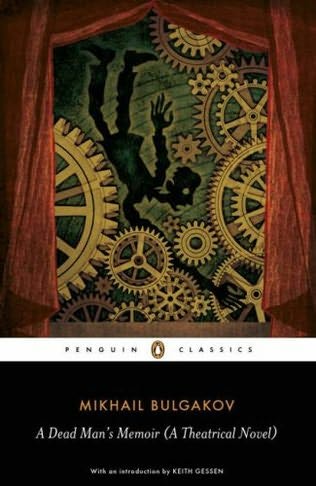 From the back cover of the Penguin Classics edition of A Dead Man's Memoir (A Theatrical Novel) by Mikhail Bulgakov:
Sergei Maksudov has failed as a novelist and made a farce of a suicide attempt, but only after a surprise break as a playwright on the Moscow stage does his turmoil truly begin. Thrown uncomprehending into theatre life, he soon sees his beloved play dragged into chaos by inflated egos, jealous critics, literary double-dealers, communist censors and insanely bad acting. A Dead Man's Memoir is a brilliant, absurdist tale of the exhilaration and black desperation wrought on one man by his turbulent love affair with the theatre. Based on Bulgakov's own experiences at the famous Moscow Art Theatre of the 1920s and 30s, it reaches its comic height in a merciless lampooning of Stanislavski's fashionable stage techniques.
Well, you can see why I bought and read this at once, can't you?
A Dead Man's Memoir reads like a compendium of everything that playwrights fear and dread, all becoming reality for the hapless Sergei Maksudov. The thrill of seeing your name on a poster, followed by the agony of eavesdropping on people making fun of your work. Rashly signing your name to a restrictive contract just because you're so thrilled someone wants to produce your script, and then realizing you've signed your soul away. Being forced to make huge changes to the script, in order to suit the director's oddball whims. The black comedy of this is reinforced by Maksudov's narrative voice: extremely self-conscious, self-pitying, introverted and neurotic. These seem to be common vices among playwrights, or at least fictitious playwrights. Think Barton Fink.
Bulgakov wrote A Dead Man's Memoir under the repressive Soviet regime (which made life difficult for him), but as the Introduction to my edition points out, there is almost no political content in the novel. The satire is, instead, mainly directed at "literary types" and the bizarre bureaucracy/behind-the-scenes intrigue that can develop at a large theater company. And a lot of this still feels very true today. There is a long passage about how the box-office manager deals with all of the assorted people who swarm the theater requesting tickets to sold-out shows; I'm sure that Berkeley Rep staffers dealt with something very similar when The Arabian Nights sold out last month!
Still, I'm unwilling to call A Dead Man's Memoir a "must-read" for everybody. Though Penguin does everything it can to conceal this fact from you, it is an unfinished novel, abandoned after about 160 pages. Furthermore, there are a lot of characters (all with lengthy Russian names, of course) to keep track of. Perhaps Bulgakov intended to bewilder the reader, to mirror Maksudov's bewilderment as he navigates the theater's dense bureaucracy; still, it can get confusing.
The final pages of this unfinished work, however, which make fun of Stanislavski's "sense memory" and "emotional truth" exercises, will be hilarious to anyone who's ever studied acting. And though I am not sure whether the general public will feel the same way, I squirmed in uncomfortable recognition through all the bleakly comic scenes of Maksudov's powerlessness and woe.
Stay tuned for "The Playwright's Nightmare, part 2": my thoughts on Rich and Famous, the John Guare play-about-a-playwright that I saw on Tues. at ACT.
Sunday, February 1, 2009
SNL or Humana Festival?
Questions of categorization in the arts are notoriously tricky to answer. Where is the dividing line between a novel and a novella, between personal expression and self-indulgence, between comedy and farce?
Or, the question that prompts me to write this blog post: What is the difference between a short-and-funny one-act play and a comedy sketch?
You might say that comedy sketches tend to be more topical and up-to-the-minute--but while many sketches make fun of current celebrities or politicians, comedy troupes also perform material that makes fun of broader quirks of human nature or society. And yes, any one-act play that is longer than 10 minutes and/or features subtle characterizations is unlikely to merit the question "Is this sketch comedy instead?" But I've seen some pretty wacky one-acts in my time. What makes David Ives' hilarious "Words, Words, Words" (a conversation between three monkeys placed in front of typewriters to see if they will type the complete works of Shakespeare) a one-act play and not a comedy sketch?
Is it like what Sondheim says about Sweeney Todd: "If you perform it in an opera house, then it's an opera"? In other words, could the exact same script be considered both a comedy sketch and a one-act play, if in the first case it is performed by a sketch comedy troupe and in the second case by a cast of Equity actors? Is the author's intent the only thing that dictates whether it is "theater" or "sketch comedy"? (If so, damn, that makes me feel powerful!)
I'm asking this because on Friday I got an idea for a new one-act play, and I don't get those very often. But it quickly occurred to me that the subject of this hypothetical play is rather topical, and the conceit of it is extremely silly, and I probably wouldn't be able to sustain it for longer than 10 minutes. So, what's the difference between that and a comedy sketch? I think of myself as a playwright and would like to write a good one-act; it would take some mental adjustment to think of myself as a sketch-writer and I don't want to get led too far down that path.
I still think it would be a good idea for me to write this play, don't get me wrong, since it will surely teach me something about my craft. I just wish I knew what it is that I'll be writing!
Or, the question that prompts me to write this blog post: What is the difference between a short-and-funny one-act play and a comedy sketch?
You might say that comedy sketches tend to be more topical and up-to-the-minute--but while many sketches make fun of current celebrities or politicians, comedy troupes also perform material that makes fun of broader quirks of human nature or society. And yes, any one-act play that is longer than 10 minutes and/or features subtle characterizations is unlikely to merit the question "Is this sketch comedy instead?" But I've seen some pretty wacky one-acts in my time. What makes David Ives' hilarious "Words, Words, Words" (a conversation between three monkeys placed in front of typewriters to see if they will type the complete works of Shakespeare) a one-act play and not a comedy sketch?
Is it like what Sondheim says about Sweeney Todd: "If you perform it in an opera house, then it's an opera"? In other words, could the exact same script be considered both a comedy sketch and a one-act play, if in the first case it is performed by a sketch comedy troupe and in the second case by a cast of Equity actors? Is the author's intent the only thing that dictates whether it is "theater" or "sketch comedy"? (If so, damn, that makes me feel powerful!)
I'm asking this because on Friday I got an idea for a new one-act play, and I don't get those very often. But it quickly occurred to me that the subject of this hypothetical play is rather topical, and the conceit of it is extremely silly, and I probably wouldn't be able to sustain it for longer than 10 minutes. So, what's the difference between that and a comedy sketch? I think of myself as a playwright and would like to write a good one-act; it would take some mental adjustment to think of myself as a sketch-writer and I don't want to get led too far down that path.
I still think it would be a good idea for me to write this play, don't get me wrong, since it will surely teach me something about my craft. I just wish I knew what it is that I'll be writing!
Subscribe to:
Posts (Atom)