Three years ago, The New Yorker's Winter Fiction issue printed a lengthy except from Ian McEwan's novella On Chesil Beach, which was about to be published. I eagerly looked forward to it; at the time, McEwan's Atonement was my favorite novel in the entire world.
Among the many virtues of Atonement is that it is one of the great love stories of modern literature, with one of the few sex scenes that doesn't seem like a candidate for the annual Bad Sex in Fiction award. As a bookish but secretly romantic teenager, I found the scene between Robbie and Celia in the library to be extremely seductive. It's not gratuitous, either--it has to be genuinely sexy in order for the novel to work.
So when The New Yorker advertised their Chesil Beach excerpt with some titillating tagline like "Ian McEwan narrates a 1960s wedding night," I secretly hoped for another Atonement-quality sex scene. Well, the joke was on me. As the very first sentence of On Chesil Beach proves, this is a story about bad sex, told in painstaking detail--an anti-erotic tale.
Last week I finally read On Chesil Beach in its entirety--it's a short work, 39 thousand words--and I can't help but feel that McEwan is deliberately repudiating his earlier novel. It would be a very typical thing for him to do--as Atonement proves, he's a master of pulling the rug out from underneath the reader. There are enough parallels between the lovers in Atonement and the lovers in Chesil Beach for me to think that McEwan expects the reader's memories of Atonement to provide a subtext for the events of Chesil. Both works are set in the past and teddibly English. In both cases, the characters having sex are just out of university. The girl is extremely virginal, the boy slightly (but only slightly) more experienced. The girl is from a cultivated upper-middle-class family; the boy is a working-class striver whose intelligence is his ticket to higher social status.
In a way, therefore, On Chesil Beach is McEwan performing an act of literary criticism on himself. "You were turned on by my sex scene in Atonement?" he seems to say. "Don't you realize that that was fiction and fantasy? Here's how it really would have happened."
Anyway, On Chesil Beach is a well-crafted anti-erotic narrative about the wedding night of Florence and Edward in an English seaside hotel. The central problem is that while Florence loves Edward, she is repelled by anything sexual (even French-kissing), and knows she is powerless to articulate her fear and disgust. Edward is aware that his bride hasn't liked physical affection, but he assumes it will all change now that they are married, and is eager to lose his own virginity. On that night, however, everything goes wrong in the worst possible way; from the start, the atmosphere in the chilly and antiseptic hotel room is one of unease.
McEwan fills out the novella with some flashbacks about how Florence and Edward first met, their respective upbringings, etc. I was not as fond of these parts--they are straight narration (the omniscient McEwan telling us "Edward's mother was like this" or "Florence's string quartet was like that") with little action or dialogue to enliven them. In these passages, the characters feel artificial, constructed to represent ideas about sexual attitudes and class divides in 1962. But Florence and Edward come to life whenever McEwan is describing their thoughts, feelings, and actions on that fateful wedding night. (Similarly, I tend to think that the best parts of Mad Men are when the writers explore and deepen the characters' relationships, not when they go "Oh my god, the '60s!") Their conversation on the beach toward the end of the novella, in which almost every line of dialogue has either Florence or Edward saying the worst possible thing they could say at that moment, is especially well done. Atonement is about one big, horrible lie that ruins a life; On Chesil Beach is about how lives can also be ruined by an accumulation of little mistakes.
At first there seems to be no explanation for Florence's sexual unresponsiveness, but eventually the narrator hints that Florence's father abused her when she was younger. (I wasn't just imagining this, either: according to a recent New Yorker profile of McEwan, this was even more blatant in earlier drafts.) Not sure I agree with this choice; it seems so pat, like a diagnosis. I think I'd be more interested in reading about a woman whose fear and abhorrence of sex wasn't linked to childhood trauma--at any rate, that would be more original. This also means that the narrator is unreliable or disingenuous: the first line of On Chesil Beach says "they were both virgins," but maybe Florence isn't a virgin, right? And if we can't trust the first sentence, can we trust anything else the omniscient narrator says--though he seems so perfectly candid?
Showing posts with label ian mcewan. Show all posts
Showing posts with label ian mcewan. Show all posts
Sunday, December 6, 2009

Friday, December 21, 2007
Cecilia in a Green Dress
Atonement, the movie, is getting mixed reviews, but one thing that everyone is raving about is Keira Knightley's green evening dress. A slinky Art Deco column of emerald-colored silk, there's something iconic about it--I'm having the same reaction to it as I did to Nicole Kidman's red gown in Moulin Rouge, and I haven't even seen the movie yet.

The idea for this spectacular green dress originated in Ian McEwan's novel. I've always had a weakness for scenes in novels that describe pretty clothes--and I don't mean ostentatious chick-lit name-dropping, but an appreciation for color and style and the effect that clothes have on the characters. If the book is set in the past and describes dresses which I could never hope to buy at the department store--and if it mentions several dresses in the same scene--so much the better. Atonement hits all of these buttons. Cecilia, after some events earlier in the day that left her rather shaken, is trying to choose a dress that will give her confidence during a small dinner party. But the task is more difficult than she imagined:

Cecilia and Scarlett run into similar problems: a black dress that ages them, a pastel dress that makes them look babyish, dresses rendered unwearable by cigarette burns or grease spots. And the dress they finally end up choosing, the one that makes them feel the most confident, also happens to be green in color and slightly too formal and sexy in style. I just noticed that my bookshelf has Ian McEwan shelved right next to Margaret Mitchell--as if the two books were communing with each other.
Indeed, Gone With the Wind is a treasure trove of clothing descriptions: besides this, there's the dainty gowns at the Confederate ball contrasting with Scarlett's black mourning attire, the famous dress that she makes for herself out of curtains, the scandalously low-cut gown that Rhett forces her to wear to Ashley and Melanie's party... But it often seems like the most renowned novelists consider their characters' clothing frivolous, and leave the extended descriptions of dresses to girly romance novelists like Mitchell. That's why I love it so much when someone like McEwan uses his talented pen to describe what his characters are wearing--he not only has a good eye for clothing styles, he understands that they can tell so much about the person wearing them.
Photo of Keira Knightley from dailymail.co.uk. Photo of Vivien Leigh from dressaday.com; see also the accompanying blog post

The idea for this spectacular green dress originated in Ian McEwan's novel. I've always had a weakness for scenes in novels that describe pretty clothes--and I don't mean ostentatious chick-lit name-dropping, but an appreciation for color and style and the effect that clothes have on the characters. If the book is set in the past and describes dresses which I could never hope to buy at the department store--and if it mentions several dresses in the same scene--so much the better. Atonement hits all of these buttons. Cecilia, after some events earlier in the day that left her rather shaken, is trying to choose a dress that will give her confidence during a small dinner party. But the task is more difficult than she imagined:
On two occasions within half an hour, Cecilia stepped out of her bedroom, caught sight of herself in the gilt-framed mirror at the top of the stairs and, immediately dissatisfied, returned to her wardrobe to reconsider. Her first resort was a black crêpe de chine dress which, according to the dressing table mirror, bestowed by means of clever cutting a certain severity of form. Its air of invulnerability was heightened by the darkness of her eyes. Rather than offset the effect with a string of pearls, she reached in a moment's inspiration for a necklace of pure jet. [...]For the sake of brevity, I left out some passages that delve further into Cecilia's state of mind, but even shortened, this is great writing-- combining sensuous description, sociological observation (changing fashions) and character development. But to me this scene has always seemed an echo of one of my other favorite clothes-in-literature scenes: Scarlett O'Hara trying to choose a dress for the Twelve Oaks barbecue near the beginning of Gone with the Wind.
But the public gaze of the stairway mirror as she hurried toward it revealed a woman on her way to a funeral, an austere, joyless woman moreover, whose black carapace had affinities with some form of matchbox-dwelling insect. A stag beetle! It was her future self, at eighty-five, in widow's weeds. She did not linger--she turned on her heel, which was also black, and returned to her room. [...]
She stepped out of the black crêpe dress where it fell to the floor, and stood in her heels and underwear, surveying the possibilities on the wardrobe racks, mindful of the passing minutes. [...]
She ran a hand along the few feet of personal history, her brief chronicle of taste. Here were the flapper dresses of her teenage years, ludicrous, limp, sexless things they looked now, and though one bore wine stains and another a burn hole from her first cigarette, she could not bring herself to turn them out. Here was a dress with the first timid hint of shoulder pads, and others followed more assertively, muscular older sisters throwing off the boyish years, rediscovering waistlines and curves, dropping their hemlines with self-sufficient disregard for the hopes of men. Her latest and best piece, bought to celebrate the end of finals, before she knew about her miserable third, was the figure-hugging dark green bias-cut backless evening gown with a halter neck. Too dressy to have its first outing at home. She ran her hand further back and brought out a moiré silk dress with a pleated bodice and scalloped hem--a safe choice since the pink was muted and musty enough for eveing wear. The triple mirror thought so too. [...]
Perhaps there was now a harsher light at the top of the stairs, for she had never had this difficulty with the mirror there before. Even as she approached from a distance of forty feet, she saw that it was not going to let her pass; the pink was in fact innocently pale, the waistline was too high, the dress flared like an eight-year-old's party frock. All it needed was rabbit buttons. [...] It would not help her state of mind to go down looking like, or believing she looked like, Shirley Temple.
More in resignation than irritation or panic, she returned to her room. [...] She knew what she had to do and she had known it all along. She owned only one outfit that she genuinely liked, and that was the one she should wear. She let the pink dress fall on top of the black and, stepping contemptuously through the pile, reached for the gown, her green backless post-finals gown. As she pulled it on she approved of the firm caress of the bias cut through the silk of her petticoat, and she felt sleekly impregnable, slippery and secure; it was a mermaid who rose to meet her in her own full-length mirror.
What dress would best set off her charms and make her most irresistible to Ashley? Since eight o'clock she had been trying on and rejecting dresses, and now she stood dejected and irritable in lace pantalets, linen corset cover and three billowing lace and linen petticoats. Discarded garments lay about her on the floor, the bed, the chairs, in bright heaps of color and straying ribbons.
The rose organdie with long pink sash was becoming, but she had worn it last summer when Melanie visited Twelve Oaks and she'd be sure to remember it. And might be catty enough to mention it. The black bombazine, with its puffed sleeves and princess lace collar, set off her white skin superbly, but it did make her look a trifle elderly. Scarlett peered anxiously in the mirror at her sixteen-year-old face as if expecting to see wrinkles and sagging chin muscles. It would never do to appear sedate and elderly before Melanie's sweet youthfulness. The lavender barred muslin was beautiful with those wide insets of lace and net about the hem, but it had never suited her type. It would suit Carreen's delicate profile and wishy-washy expression perfectly, but Scarlett felt that it made her look like a schoolgirl. It would never do to appear schoolgirlish beside Melanie's poised self. The green plaid taffeta, frothing with flounces and each flounce edged in green velvet ribbon, was most becoming, in fact her favorite dress, for it darkened her eyes to emerald. But there was unmistakably a grease spot on the front of the basque. Of course, her brooch could be pinned over the spot, but perhaps Melanie had sharp eyes. There remained varicolored cotton dresses which Scarlett felt were not festive enough for the occasion, ball dresses and the green sprigged muslin she had worn yesterday. But it was an afternoon dress. It was not suitable for a barbecue, for it had only tiny puffed sleeves and the neck was low enough for a dancing dress. But there was nothing else to do but wear it. After all she was not ashamed of her neck and arms and bosom, even if it was not correct to show them in the morning.

Cecilia and Scarlett run into similar problems: a black dress that ages them, a pastel dress that makes them look babyish, dresses rendered unwearable by cigarette burns or grease spots. And the dress they finally end up choosing, the one that makes them feel the most confident, also happens to be green in color and slightly too formal and sexy in style. I just noticed that my bookshelf has Ian McEwan shelved right next to Margaret Mitchell--as if the two books were communing with each other.
Indeed, Gone With the Wind is a treasure trove of clothing descriptions: besides this, there's the dainty gowns at the Confederate ball contrasting with Scarlett's black mourning attire, the famous dress that she makes for herself out of curtains, the scandalously low-cut gown that Rhett forces her to wear to Ashley and Melanie's party... But it often seems like the most renowned novelists consider their characters' clothing frivolous, and leave the extended descriptions of dresses to girly romance novelists like Mitchell. That's why I love it so much when someone like McEwan uses his talented pen to describe what his characters are wearing--he not only has a good eye for clothing styles, he understands that they can tell so much about the person wearing them.
Photo of Keira Knightley from dailymail.co.uk. Photo of Vivien Leigh from dressaday.com; see also the accompanying blog post
Friday, November 16, 2007
Men Who Read Too Much?
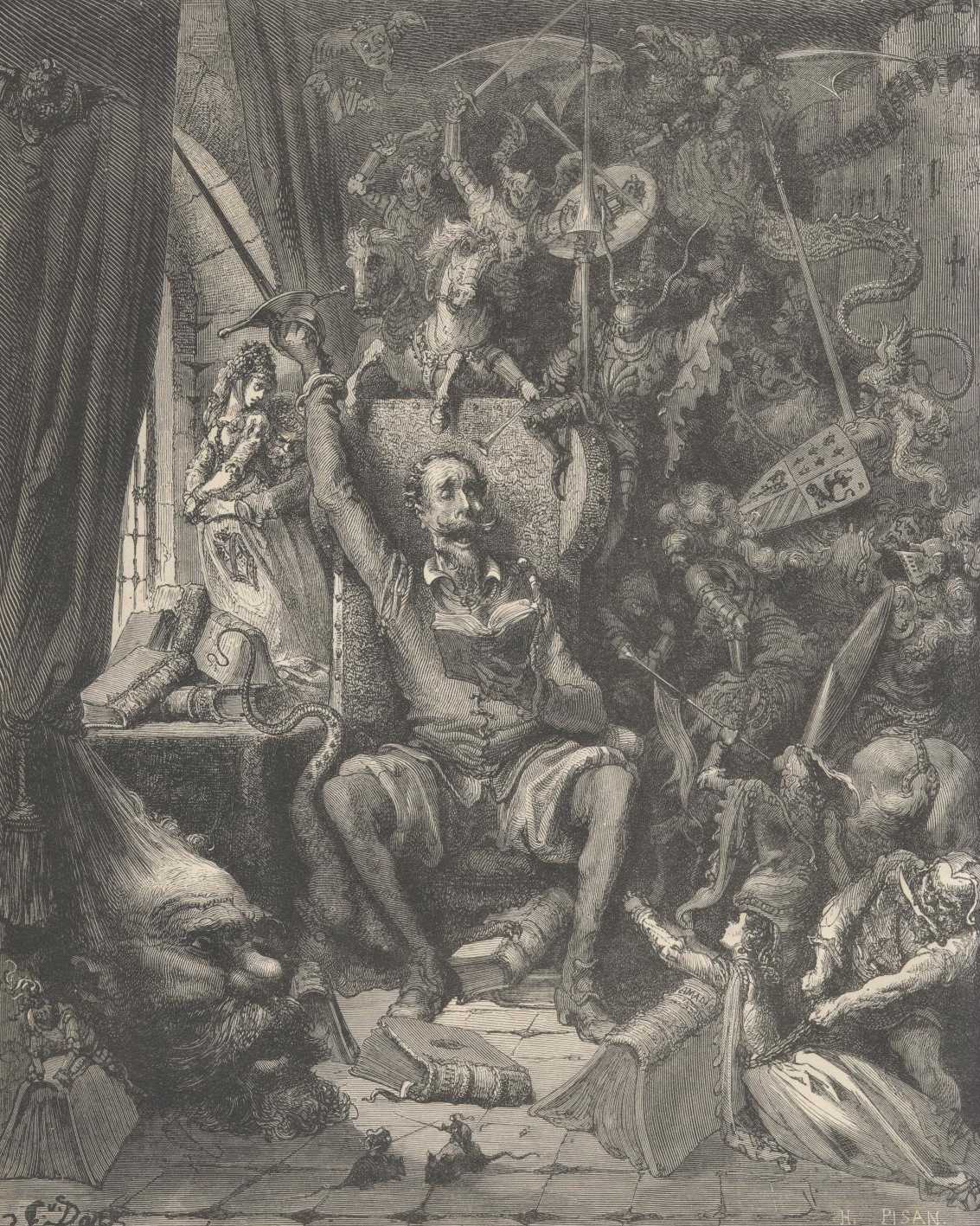
"Don Quixote in His Library" by Gustave Doré. Image from doreillustrations.com. (Click here to see it enlarged--the detail is amazing.)
I didn't expect to have more thoughts about literary characters who read too much so soon after my previous post, but inspiration can come from the oddest sources, and it did today.
I was reading Aphra Behn's delightful farce The Emperor of the Moon, which concerns a silly old doctor who is fascinated by astronomical and esoterical books, and is convinced that there is a kingdom on the moon. Two young men pretend to be princes of the moon kingdom in order to marry the doctor's daughter and niece. When the doctor finds out that he's been duped, and there is no lunar empire, he vows:
Burn all my books, and let my study blaze,Here the editor notes an allusion to Don Quixote, who also burns his books when he becomes aware that they have deceived him.
Burn all to ashes, and be sure the wind
Scatter the vile contagious monstrous lies.
And that made me realize: in literature, it's not just women who read too much. Because the granddaddy of all those 19th-century female characters is Don Quixote de La Mancha--the most thoroughly literature-deluded character ever created. And one of the most memorable--and from one of the world's earliest novels.
I love how, nearly from the start, novels have satirized other genres, commented upon themselves, made claims about storytelling, described how a good novel requires a wise and critical reader. I just love that.
The missing link between Don Quixote and Northanger Abbey might be a 1752 novel by Charlotte Lennox called The Female Quixote, or the Adventures of Arabella (thanks, Wikipedia). It's the comic story of a girl who has read too much and convinced herself that she should behave like a beautiful and dazzling romance heroine. Thus she is ancestor to Catherine Morland, Tatiana Larina and Emma Bovary.
And also to Briony Tallis. Because I may be stabbing in the dark here, but I think I've discovered an Atonement allusion/in-joke. In the novel, 13-year-old Briony writes a play called The Trials of Arabella, and her plot has some similarities to Lennox's. Lennox's Arabella "suffers a severe illness caused by her leap into a river to escape imaginary ravishers" (source) and during her convalescence finally realizes that she can no longer live her life as a romance. Briony's Arabella "contracts cholera during an impetuous dash towards a seaside town with her intended" and during her convalescence realizes that "love which did not build a foundation on good sense was doomed" (source).
The more I think about Atonement the more it seems to self-consciously tie in with various literary traditions: country-house novel, war novel, modernist novel of shifting perceptions... and now, with references to Northanger Abbey and The Female Quixote, novels about reading the world versus reading a novel. And that's what gives it so much resonance and power--its reshaping of past traditions. Isn't the world's literary heritage grand?
Wednesday, November 14, 2007
Women Who Read Too Much
 "La liseuse" by Fragonard. Photo from mtholyoke.edu
This week I had to lead a discussion in English class on Northanger Abbey. An unorthodox choice of Austen novel to study--but because the course is all about how different authors construct heroism, and the first line of the novel is "No one who had ever seen Catherine Morland in her infancy would have supposed her born to be an heroine," surprisingly appropriate. I'd first read Northanger two years ago on a "read the complete works of Austen" kick, and though it's her most lightweight novel, I find it utterly charming.
Rereading it, I recalled an offhand comment one of my professors once made: 19th-century literature is filled with women who read too much and get in trouble for it. He made this comment in an opera course where we read Pushkin's verse novel Eugene Onegin to see how Tchaikovsky adapted it. Its heroine, Tatiana, commits a major faux pas when she emulates the heroines of the French romance novels she loves, and writes a love letter to Onegin, whom she barely knows.
I'd never explicitly noticed the pattern before, but it's very true. Two other major examples of 19th-century women who read too much are the aforementioned Catherine Morland, who reads too many Gothic novels and can't tell fact from fiction. And Emma Bovary, who wants to live her life like a romance heroine, only to be rewarded with dissatisfaction, ennui, and an ignominious death. I'm sure there are more, but I may not have read them yet.
From a feminist point of view, perhaps there's something sinister about this--an effort by patriarchal societies to demean women's reading? These books often make fun of the genres women like (romances) as well as women's naiveté in thinking that life can be like a novel.
When I was in France there was a coffee-table book for sale called Les femmes qui lisent sont dangereuses (Women Who Read are Dangerous) which analyzes paintings of women reading. I always meant to buy this book for my mom (she's decorating a spare bedroom with prints of reading women) but it's a heavy, expensive tome all in French... Still, I'd be interested to know what the book says about the gender implications of women reading. Why is it "dangerous"?
And there's something odd about people writing novels that demean people who read novels. Jane Austen points this out in her spirited "Defense of the Novel" in chapter 5 of Northanger Abbey:
I will not adopt that ungenerous and impolitic custom so common with novel–writers, of degrading by their contemptuous censure the very performances, to the number of which they are themselves adding — joining with their greatest enemies in bestowing the harshest epithets on such works [...] [A novel is] only some work in which the greatest powers of the mind are displayed, in which the most thorough knowledge of human nature, the happiest delineation of its varieties, the liveliest effusions of wit and humour, are conveyed to the world in the best–chosen language. (Full text here)Still, Northanger Abbey alleges that novels can be dangerous for naive readers who fall prey to their seductions and fail to distinguish fact from fiction. But meanwhile we are falling prey to the seduction of Austen's writing--its "wit and humour," its "knowledge of human nature." Don't you think it's funny that we love Jane Austen's characters and talk about them as if they were real people? Does this make us bad, naive readers?
The notion of women reading too much and getting in trouble for it seems mostly a 19th-century phenomenon. I can think of bookish females in 20th-century novels (such as my beloved Frederica Potter) but they are not punished for their reading in the same way.
One possible exception is Atonement--which takes its epigraph from Northanger Abbey (the end of chapter 24, where Henry reprimands Catherine for imagining wild and melodramatic things about his family). This really is the perfect quote to begin Atonement, and Ian McEwan suggests that Briony's having read too much contributes to the error she makes. Still, Briony is just 13--younger than Catherine, Tatiana, or Emma. We can no longer accept an adult woman being as naive a reader as those three ladies; but we can still accept it in a child.
I mentioned Atonement to my English professor because of the Northanger connection, and though he had never heard of it, he was thrilled to be told. "You know I hardly ever read anything from later than the sixteenth century," he said, "and when I do, it's because it has some connection to those earlier works." The mere notion of its title got him excited--"It came out about 5 years ago? The early 21st century? To think that in this day and age, a book called Atonement could get published--and you say it was a success, they've even sold the movie rights? Amazing!" He expounded upon the idea of "atonement," an ancient concept that often comes up in the medieval-theological stuff he reads, but sorely lacking and desperately needed in the modern world. It's a fundamental human question, he said: can we ever atone? Red-faced with excitement, he said he'd run to the bookstore right after class and purchase Atonement--"If it's as good as its title, I'll love it!"
Thursday, November 1, 2007
Book-to-Movie Anticipation, Part 2: Atonement
In the first part of this post on how two of my all-time favorite books are being turned into movies this fall, I looked at Philip Pullman's The Golden Compass, which became my favorite book when I was 9 years old. And it retained that position for quite a long time--I loved its sequels too, and there were other books I enjoyed, but I don't think it ever had a serious challenger. By the time I was in high school, though, I began thinking it silly that my favorite book was a children's novel. And when I was 15, I finally read a book that knocked The Golden Compass off its pedestal: Atonement, by Ian McEwan.
I read Atonement on a high-school trip to Cuba (a long story which I may get around to telling someday). It was 2003 and the Iraq War had just begun, so you could draw a parallel between that and the depiction of World War II in the novel, though I doubt I was conscious of it at the time. The book had gotten good reviews and was half-price at Costco, so I picked it up rather on a whim--thinking "This had better be good, or I'll be stuck in Cuba with a lousy book."
And at first I read it leisurely--the first section is slowly paced in that classic "British country house novel" way--though I was impressed with McEwen's attention to detail and shifting perspectives. And then, as the book's inexorable chain of events got set into motion, it hooked me in the same way The Golden Compass had. I'd vowed that on our bus trips through Cuba I would observe the countryside instead of reading; soon, that vow was broken. When I finished the book, I stared blankly out the bus window, feeling swelled-up with emotion and ready to cry; just then, we went down a particularly twisty road and the kid in front of me got carsick--the bus had to pull over so he could vomit out the window. That was all anyone could talk about for the rest of the day--"David threw up!" Me, I barely noticed. As it has done to many other readers, that last section of Atonement knocked me flat. Devastated me.
Due to Atonement's critical acclaim and general brilliance, as well as the public's appetite for romantic dramas, I was sure it would be made into a movie someday. Still, I worry that something fundamental may get lost in the translation to the screen. *VAGUE SPOILERS* The end of the book is so powerful because you discover that it's a novel about the act of writing. In order for the twist to function the same way in a movie version, you'd have to make the older Briony a film director instead of a novelist, but I highly doubt that change took place.
*SPOILERS END*
All the same, I'm excited about the movie. I was surprised how much I liked director Joe Wright's film version of Pride and Prejudice, which looked beautiful and brought the characters' emotions to life. (You can read my IMDB review here, though it seems that some Austenites took offense at my statement "I admire Jane Austen's novels, but admire good filmmaking even more.") Screenwriter Christopher Hampton proved with Dangerous Liaisons that he can turn a difficult-to-adapt novel into a lively drama. Wright obviously enjoys working with Keira Knightley and she did a good job in Pride and Prejudice--though I wonder if she's too beautiful and glamorous to play Cecilia.
I had a bit of the opposite reaction when I heard James McAvoy would be playing Robbie. Now, as you can see from the photo above, he's not a bad-looking chap, he seems likable, decent, and sympathetic--all qualities that Robbie requires. But I'll admit I pictured Robbie as much more traditionally handsome, and rough around the edges (he's the cleaning lady's son after all) where McAvoy is wet behind the ears. Still, I have heard good things about McAvoy's acting talent and hope to be pleasantly surprised. This movie was made to fulfill Wright's and McEwan's visions, not to fulfill my own romantic dreams, you know!
I will always love Atonement, but I'm less willing to call it my Favorite Book of All Time, as I did when I was sixteen or seventeen. I now think it's a little foolish to single one book out as my all-time favorite, as well as awfully hubristic that both of my former All-Time Favorites, The Golden Compass and Atonement, were written during my own short lifetime. It's exciting, though, that two such high-profile movies based on two such great books are coming out this fall. Often I love the kind of books that would never be made into movies!
Subscribe to:
Posts (Atom)