Wednesday, July 18, 2007

Anton Chekhov, Ladies' Man

I discovered the following anecdote while flipping through a pile of old theatre programs/directors' notes for work. I wish I could find an actual corroborated source for it, because it's almost too good to be true--nasty, clever, and hilarious.


Evidently women were always falling madly in love with Anton Chekhov. Which I guess I understand. He was cute, and tubercular, and worked as a doctor, and wrote little gem-like short stories. Kind of like a real-life Doctor Zhivago, now that I think about it. Very tragically attractive in that melancholy, Russian way. But, he also had a wicked sense of humor...

In his first major play The Seagull, the young and innocent Nina falls in love with Trigorin, a famous writer who is summering nearby. The day he goes back to the city, she gives him a medallion engraved with the title of his book, plus a page and line number: "Days and Nights, page 121, lines 11 and 12." They direct Trigorin to the line "If ever you have need of my life, come and take it."

Now, supposedly, Chekhov based this on an episode from his own life. Lydia Avilova, an unhappily married aspiring author, was one of the many women who threw themselves at Anton. Indeed, she gave him a medallion engraved with a book title, page, and line number, referring to a line Chekhov had once written: "If ever you have need of my life, come and take it."

But it gets better. Chekhov ignored Lydia's gift. He never replied. (Men!) But some months later, he ran into her at a party--a masquerade ball.

"What happened, Antosha? Didn't you like it?" begged Lydia.

"The medallion? What?--oh yes--sorry I never got back to you," said Chekhov hastily. "But, actually, I've got this new play opening in a couple of weeks--it's called The Seagull--and you must come see it. Opening night, I insist. I know I haven't treated you right--but come see The Seagull and All Will Be Revealed."

So Lydia showed up in the opening-night audience. The performance was a disaster. This was before Chekhov partnered with Stanislavski; people had a hard time understanding his plays. (They still do!) Lydia strained to make out the actors' words above the jeering of the audience, so she could hear Chekhov's answer to her. And in Act III, when Nina gives Trigorin the medallion, Lydia felt absolutely humiliated. Betrayed.

But not so humiliated that she didn't notice a fine detail: the line and page numbers (page 121, lines 11 and 12) on the medallion in The Seagull were different from the ones on the medallion that Lydia had actually given to Chekhov. She memorized the new numbers and rushed home immediately after the performance was over. Perhaps this was Chekhov's real answer! She pulled his book of stories off the shelf and paged through it. But lines 11 and 12 of page 121 were nonsensical, irrelevant.

Then she realized that Chekhov might have been directing her to her own recently published book of stories. She took it from her desk--flipped through it with trembling fingers--found page 121, counted down 11 lines, and discovered this sentence:

"It is not proper for young ladies to attend masked balls."

Thursday, July 12, 2007

"Recess" (With Apologies to Amy Winehouse)

"Rehab" must be the catchiest song I've heard in a long time. Trouble is, I can't just go around singing it, since I've never exactly been a candidate for rehab. My version would have to go more like this--the theme song to my elementary school years:

They tried to make me go to recess
I said no, no, no
Yes, I'm a geek
But when I join a clique
You’ll know, know, know
I ain’t got the time
And if the library suits me fine
Just try to make me go to recess
I won’t go, go, go

I’d rather be inside today
I ain’t got no urge to play
There’s nothing, nothing you can teach me
That I can’t learn from Ernest Hemingway

Us'lly get a lot in class
But I know my next test’s hard to pass

They tried to make me go to recess
I said no, no, no
Yes, I'm a geek
But when I join a clique
You’ll know, know, know
I ain’t got the time
And if the library suits me fine
Just try to make me go to recess
I won’t go, go, go

Teacher said, “What are you doing here?”
I said “You know the idea:
I’m gonna, I’m gonna lose my grade point
So I always keep a textbook near."

She said "I think you're a bit obsessed,
Listen, the world won't end if you fail a test"

They tried to make me go to recess
I said no, no, no
Yes, I'm a geek
But when I join a clique
You’ll know, know, know
I ain’t got the time
And if the library suits me fine
Just try to make me go to recess
I won’t go, go, go

I don't wanna get teased again
I just, ooh, just need a friend
I'm not gonna play kickball
When everyone will kick my rear end

It's not just my pride
It's just so my grades won't slide

They tried to make me go to recess
I said no, no, no
Yes, I'm a geek
But when I join a clique
You'll know, know, know
I ain't got the time
And if the library suits me fine
Just try to make me go to recess
I won't go, go, go

Wednesday, July 11, 2007

Side note on "Happy Feet"

It pained me a little to link to that image of Happy Feet in the post below, since I have an unreasonable prejudice against that movie.

I haven't seen it. I don't even want to, it makes me so annoyed. See, ever since I heard the premise of the story--young penguin can't sing like all the other penguins, so he tap-dances instead--I KNEW they ripped it off from one of my all-time favorite children's books, The Trumpet of the Swan. In which a young swan who can't sing like all the other swans (or even talk) learns to play the trumpet like Louis Armstrong instead. "Why is no one complaining about this?" I said to myself. "Stupid people don't know about E.B. White...."

This similarity (aka rip-off) now rates a mention on Happy Feet's wikipedia page, but I'm still dissatisfied. I grind my teeth to think that somewhere, at this very moment, there is a kid reading The Trumpet of the Swan for the first time and dismissing it as "Oh, this is just like Happy Feet."

I got obsessed with Trumpet of the Swan at the same time I was obsessed with ballet and Swan Lake, which started me on a collection of china and glass swans that now gathers dust on our living-room mantelpiece. It also gave me my first stirrings of ecological awareness, with the theme that the mighty Trumpeter Swan is endangered and needs protection. What's more, it's hilarious, in a way that doesn't just appeal to kids. I still enjoy rereading it.

Oh, and also? I'm so attached to my old copy of Trumpet of the Swan that I am ALSO unreasonably annoyed that they commissioned new illustrations for it a few years ago. What was wrong with the originals, which the author presumably approved?!

Tuesday, July 10, 2007

My 8-Year-Old Cousin Should Really Have His Own Blog

But since I doubt he does, he'll just have to make a guest appearance on mine.

P. is my godfather's youngest child. Actually, he is the youngest son of a youngest son of a youngest son. Maybe that's what makes him so magical?

He is eight years old and just discovering that life is unfair. We all have to realize this at some point, and he's doing it younger than most. (I think I was in junior high before I realized this. But that's what junior high will do to ya.) He's realized that the first two months of school are always "a waste, cause you're just going over what you did last year" and that learning cursive handwriting is also a waste. He rails against the practice of pricing an item $10.99 instead of $11. "They're tryin' to make you think it's cheaper so they can just get all your money! But it's not ten-ninety-nine, it's eleven, and everyone knows it's a trick! I know only one person who would fall for that--a BABY! Because they don't know any better!"

He hates the long lines at the amusement park, how you can give the carnie your ticket and he'll still make you wait for a few cycles of the Ferris wheel to go around. It's like, he has just realized that as an 8-year-old kid, he really is powerless, subject to the whims and rules of every adult. Even worse, most ADULTS are powerless at times, in the face of queues, bureaucracy, marketing gimmicks, etc... and he's not taking this lightly.

His philosophy: "I wish life was like a buffet. Or a soda machine. Cause you put in your money, and then you choose. Put in the money, and then choose. That way you can figure out what you want and you don't get choiced too early. But no, it's not like that. Life is never like a buffet." (I love the way he talks. "Get choiced"--maybe you've never heard it before but you know exactly what it means.)

Here on this earth, we have to make our choices blindly and then pay the price. And P. has just figured this out.

But yet, he is not cynical, he is not being pessimistic on purpose, and he is certainly not having spoiled, angry tantrums about the world's unfairness. He just sees things clearly and tells 'em like he sees 'em. Sometimes I think he has more integrity than most of the adults I know.

Other favorite comments:

"Nuns are kinda like vampires. With the black capes."

"Peach rings are my major weakness. If I left my peach rings out on my balcony overnight the birds would eat them and get high on the sugar and start tap-dancing."


This kid knows his movies! He talks with great authority about the plots of Transformers, Ratatouille, and Harry Potter 5 before he'd even seen them. He can analyze a movie preview like a very astute 21st-century kid. And then analyze life like an uncorrupted prophet. "He's been here before," says my dad to my uncle. I don't know if I believe in that stuff. But I'm certainly glad he's here now.

Monday, July 9, 2007

German Culture, Part Zwei

I'm still thinking about German culture and how we view it in the United States...specifically, why we think this way about it. My first post just listed artistic works made by Germans or taking place in Germany that I have enjoyed. Now I'm trying to dig a little deeper.

I asked a cellist friend of mine if there's a reason a disproportionate amount of great composers came from Germany. After all, Germany's level of industrialization, education, etc. was always relatively similar to that of England or France, but those countries produced mostly second-rate composers, not the constant stream of first-raters from Germany. Unfortunately, my friend doesn't have an answer to this.

I wonder, though, if it relates to how Germany became unified a lot later than England or France. I've always been fascinated by this aspect of German history: a crazy patchwork of principalities, nominally controlled by the Holy Roman Empire but nothing like a modern nation-state. Maybe each city-state's ruling prince sought to attract the best musicians and artists? Maybe this spurred them on to creativity?

The play Bach at Leipzig uses the idea of warring city-states in early 1700s Germany for farce. All the characters come from different territories and think differently about music and religion, which foments competition. And at the climax, Bach's transcendent music is the only thing that stops a violent fight. I think this is a funny exchange, between two organists from warring states:
KAUFMANN. Think! That is what unites us! Our art! Our theatre! Our music! Culture, Steindorff! That is, in the end, all that distinguishes us--
STEINDORFF. (Wearily) From the animals, yes.
KAUFMANN. No! From the English!
STEINDORFF. What?
KAUFMANN. From the Italians! From the rest of Europe!
STEINDORFF. (Beat) German culture is all that distinguishes us from non-Germans.
KAUFMANN. Yes! And I propose a renewed commitment to our common Germanity!
This idea of city-state competition also reminds me of that wonderful speech from The Third Man:
In Italy for 30 years under the Borgias they had warfare, terror, murder, and bloodshed, but they produced Michelangelo, Leonardo da Vinci, and the Renaissance. In Switzerland they had brotherly love - they had 500 years of democracy and peace, and what did that produce? The cuckoo clock.
Neither Germany nor Italy united till the mid-1800s. And Italy, in my book, is #2 for classical music next to Germany (I'm an Italian opera fan). Could their tumultuous, fragmented histories explain it?

Obviously, the elephant in the room is World War II and what happened afterwards...the Nazi/Communist legacy. It destroyed the world's faith in Germany and perhaps the Germans' faith in themselves. We don't want to believe that a people that provoked such atrocities is also capable of the deep humanity of Beethoven's Ninth. After sixty years in which Germany has behaved like a "good citizen," and nearly twenty years since the two halves of Germany reunited, we have accorded them a limited sort of forgiveness. But we still shy away from describing these great composers, writers, etc. as specifically German, perhaps for fear of provoking the Nazi/Aryan/"Germans are superior" thing again.

My cellist friend told me about a scene in the movie Judgment at Nuremberg where Marlene Dietrich's character, seeking to prove that not all Germans are evil, takes one of the judges to a concert of German classical music. For my friend, this was a revelation too: he had always thought of these composers as just part of "Western heritage," but now he realized that they are German, and the pride that Germans take in them.

He also told me about a composer he's recently discovered: Robert Kahn, a talented student of Brahms' who was very successful in the early 1900s. When Hitler rose to power, Kahn fled to England, and the Nazis destroyed most of his "degenerate Jewish" music.

Indeed, sadly, Germany and Austria were once the countries where Jews were most fully integrated into society. Kahn was composing at the same time Freud was psychoanalyzing and Einstein was theorizing and Walter Benjamin was philosophizing and Hugo Preuss was writing the Weimar Republic constitution... and then this community was scattered or killed. Perhaps the most fascinating and tragic German Jew was chemist Fritz Haber, who during WWI invented various poison gases for Germany and was hailed as a patriotic hero. His wife, opposed to his inventing chemical warfare, killed herself. Haber thought that Germany would always honor him, but with the rise of Nazism in 1933, he was forced to flee. He died a year later, probably from stress. Some of his Jewish relatives were gassed with the same chemicals he had helped invent...

A tumultuous history indeed--and maybe that tumult provoked greatness, as a reaction of the human spirit in extremity. But nowadays we don't like to mention that greatness--we are too afraid of causing tumult once again.

le cinéma parisien

Last week I saw two movies on two consecutive nights. Both were set (largely) in Paris and aimed for that Gallic romance. One was about France's most iconic chanteuse, who lived a life of tragedy and pain. The other was about a rat who wants to be a chef.

Guess which one I liked better?

Reviews up now at IMDB: La Vie en Rose and Ratatouille.

(I'm hoping to make this a trifecta: Paris, je t'aime is still on my list of movies to go see!)

Wednesday, July 4, 2007

"Orson's Shadow" at ART

Saw this play a week ago at Artists Repertory Theatre. It's closed now, but I still thought I'd write it up.

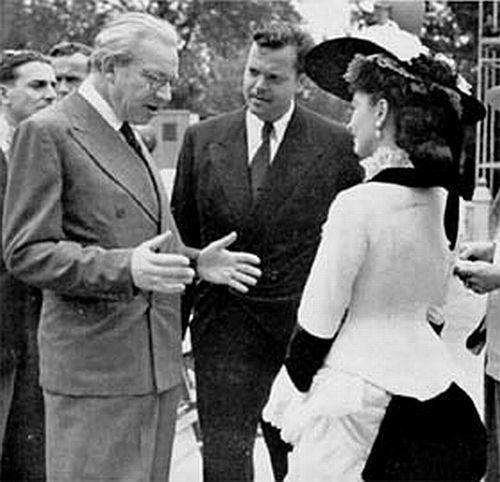
Photo of Alexander Korda, Orson Welles and Vivien Leigh from if charlie parker was a gunslinger....

Austin Pendleton's hit play Orson's Shadow is a backstage comedy-drama about what comes after fame, success, and celebrity. It takes place in 1960--about 2 decades after Orson Welles made Citizen Kane, Vivien Leigh made Gone with the Wind, and "Larry" Olivier made Rebecca. The trendy theatre critic Ken Tynan brings Orson, Larry, and Larry's new flame Joan Plowright together to stage Ionesco's Rhinoceros, whereupon all hell breaks loose. Larry is a preening diva, Orson has been a failure for over a decade, Ken is nervous and sickly, and Vivien is manic-depressive. Only Joan is really presented in a positive light, as a smart and hardworking young actress who has great sympathy for her rival, Vivien. I wonder if Pendleton had to do this because Joan Plowright is the only one of these figures still alive.

Kudos to Pendleton for discovering such a rich dramatic situtation and cast of characters. For instance, Orson, Ken, and Larry all hate Rhinoceros, but the play convincingly explains why they each decide to produce it. Orson hates Larry for "ruining me in Hollywood in 1948" but loves Ken and Vivien. Ken, the famously waspish critic who slammed Vivien's Cleopatra (she still hasn't forgiven him), idolizes both Larry and Orson like an awestruck fan. Here is a man who loves "not wisely but too well." Actually, that goes for all of the characters. And they hate too well, also. Their relationships are complex and well-explored, full of interesting parallels and contrasts.

Pendleton has a harder time beginning and ending his play. The story requires a lot of exposition in order to make sense and Pendleton, not wanting to use the time-honored device of staging a conversation between two characters that reveals all the relevant information, instead makes a joke out of it. It looks like such a conversation will begin between Ken and a young stagehand, until Ken turns to the audience and says "I wouldn't want to make that nice young man a vehicle for exposition," and does a monologue explaining the situation. This postmodern cutesiness annoyed me. The end of the play is similar: just when the passions and and tensions boil over, the action stops and Joan delivers a monologue explaining what happened to all of the characters in the future. It's too quiet an ending for a play so full of wit and conflict.

Todd Van Voris did a great job as Orson Welles, capturing the physique, the rich baritone voice, and the emotions of a man who once had it all, lost it, blames other people for his problems, knows deep down it's really his fault, but is determined to stick with his art. Followspot said it better than I could: "a brooding, wounded giant with a voice that can wake the dead." Susan Maginn was a very vulnerable and sympathetic Vivien Leigh--the way she alternated between self-aware acceptance of her mental illness, and complete irrationality, was skillful and sad. Michael Mendelson captured all of Ken Tynan's tics and neuroses, including a great emphysema attack in Act II.