Well, with this post, I've accomplished it. A post a day for thirty days. So, let's finish up this blogging experiment with some thoughts on whether it succeeded and what I may have learned from it.
I can mentally divide my NaBloPoMo posts into three categories: those that I would have written anyway, those that I might not have written otherwise but were fun to work on or nicely expand the scope of my blog, and those that are ridiculous nonsense slapped up for the sake of fulfilling my goal. So the biggest conclusion I have drawn from the experience is that, while "writing every day generates excellence," writing something every day for public consumption is far too stressful. This month I came across an interview clip where Tony Kushner says, "The thing that all writers must say to themselves, to start writing, is, 'Nobody ever has to see this thing. I can throw it away, I'm alone with it, no one has to know what an idiot I really am. I can burn it! If it doesn't work, if it really sucks, I can just pretend that it never happened.' But directors can't do that."
How apt, I thought. Because, if directors can't do that, neither can bloggers. As Kushner implies, what makes blogging so weird is that it is the world's first instantaneously public kind of writing. Writing has always been lonely and hard; now, in addition to that, it offers an easy way of embarrassing yourself in public!
I never created a blog mission statement or anything, but I do have a sense of what are and are not topics for marissabidilla, and some general guidelines like "don't get too personal." I don't think I crossed any of my boundaries in the course of these thirty days, but I definitely felt that, if you're under such intense pressure to generate a post a day, it would be really easy to slip up, to reveal more of yourself than you'd want to reveal if you were thinking clearly.
And, like I said, daily blogging was not always fun. For instance, on Saturday 11/14, I was having an evening out (Playwrights' Pub Night) and knew I needed to post something before I left my house. But I seemed to have no good ideas, and almost panicked, and by the time I managed to put something up, that meant that I'd be late to Pub Night.
Or, on Sunday 11/8, I had several good ideas for long posts, but insufficient time to write them. I was finding it very hard to think of an idea for a short post, and I wanted to get the day's blogging over with quickly, so I could enjoy the Mad Men finale in peace. So when I overheard French Guys #1 and 2 going into their riff on "Barefoot in the Park," I said a silent prayer of thanks to the blog gods that this conversation--a perfect marissabidilla topic--had taken place and I could just transcribe it!
This monthlong experiment has given me newfound respect for people who can maintain a high-quality blog while posting every day. (Especially the people who can post every day and still find the time for other, non-blog, creative endeavors. How do they do it?) But it has made me realize that I, personally, need a slower blogging-rhythm, and that there is no shame in that. In that sense, though my playwriting has languished this month, I do believe that NaBloPoMo has been valuable for me, teaching me something about myself and my blogging philosophy. I've had this blog for almost 2 1/2 years and got into a bit of a rut in August/September, so maybe it made sense to swing the pendulum in the other direction for November. And I'd probably recommend an experiment like this to other people who've been blogging for about as long as I have or who need a bit of a kick-start.
But don't expect me to keep this up and don't expect me to do it again next year.
Monday, November 30, 2009

Sunday, November 29, 2009
A Wes Anderson Weekend
I just had a Wes Anderson weekend. Not in the sense of dealing with family dysfunction, listening to a lot of '60s pop music, or arranging my room so that it is perfectly symmetrical--but in the more literal sense of watching The Royal Tenenbaums last night and Fantastic Mr. Fox today.
I hadn't seen Tenenbaums since it came out, when I was fourteen. I really liked it at the time, for reasons that I could not quite articulate, and was curious whether it held up. Furthermore, in the past eight years, I have become more aware both of Wes Anderson's aesthetic and of the classic filmmakers who have influenced him. I know now to look out for Anderson's camera movements, his throwaway jokes, the things that happen at the edges of his carefully composed shots.
 I guess that when I first saw Tenenbaums, I liked it because it was different from anything else I'd seen--2001, I think, is the year I became aware that movies could be art and not just entertainment. But now, as a semi-cinephile who watches movies very differently from the way I watched them when I was 14, I got more out of The Royal Tenenbaums, and I think I connected to it more deeply. I felt more in tune with the deadpan performances, and was more saddened by the moment when Ritchie tries to kill himself (though, at the same time, more aware of the sheer weirdness of the images: the sink filled with blood and hair-clippings). I also remember that my parents didn't like Tenenbaums because they were squicked out by the quasi-incest plotline, while at the time I accepted it with a fourteen-year-old's logical equanimity: "Margot is adopted... so who cares?" Now, I know that it's more complex than that; even though Margot and Ritchie aren't related by blood, they were raised together, and that does make things kind of weird.
 As for Fantastic Mr. Fox, there's nothing sad or squicky about it--it's an absolute delight. I was hooked from the first sequence, where Mr. and Mrs. Fox sneak into a farmyard and, in a superb tracking shot, scurry around various obstacles to get to the chicken coop, while the Beach Boys' "Heroes and Villains" plays.
These fantastic foxes are surprisingly expressive. Maybe it's because their angular, bony bodies are based on human proportions rather than vulpine ones. Or maybe it's because they're so wonderfully tactile, with their real rippling fur and bright porcelain eyes. In contrast, the characters of this year's other stop-motion animated film, Coraline, are smooth and hard, almost the way that computer animation is smooth and hard. And, while I admired Coraline as a technical achievement, it did not charm and captivate me in the way that Mr. Fox did.
Anderson invited George Clooney and Meryl Streep--who might be two of the coolest people in Hollywood--to voice the title character and his wife. Excellent choices. Mr. Fox, being a cocky and clever paterfamilias, reminds me of Clooney's character in O Brother Where Art Thou, which is probably my favorite Clooney role. And Streep's voice work makes you wonder how much of her success is due to her voice's gentle, fluting timbre.
 While Tenenbaums is all about symmetrically composed shots and deadpan acting, Fantastic Mr. Fox is much more about the pleasures of kinetic movement. Several sequences seem designed just to push the technical limits of stop-motion animation. Whether it's dozens of squirrels helping the Foxes move into their new home, or Mr. Fox's heists and ambushes, or a tracking shot of all the animals cooking a feast, there is dazzling stuff here. All done with the utmost precision--but without preciousness.
I haven't read Roald Dahl's original novel, but I suspect he might have put more emphasis on the villains, three poultry farmers named Boggis, Bunce and Bean. Gleeful nastiness was one of Dahl's favorite themes, but it isn't one of Anderson's. He's much more fascinated by the opportunity to create a detailed world for the animals: their tailored clothes, their paintings and newspapers, their Quidditch-like game called "whack-bat." (The best thing he does with the villains is a visually clever sequence introducing the three of them.) And, though the Foxes aren't full-fledged Wes Anderson neurotics, they show some complexity and emotion. The story starts because Mr. Fox has a midlife crisis; his wife mingles love and exasperation; their son resents his popular cousin. And just when things threaten to get too heavy... bam! there's another phenomenal setpiece.
I was quite proud of myself for recognizing that some of the music in Fantastic Mr. Fox came from François Truffaut's Day for Night, one of my favorite movies. Day for Night is very precisely made, very controlled, very aware that it is a film--and yet it manages to be filled with such joy and vitality. The same description applies to Fantastic Mr. Fox.
I hadn't seen Tenenbaums since it came out, when I was fourteen. I really liked it at the time, for reasons that I could not quite articulate, and was curious whether it held up. Furthermore, in the past eight years, I have become more aware both of Wes Anderson's aesthetic and of the classic filmmakers who have influenced him. I know now to look out for Anderson's camera movements, his throwaway jokes, the things that happen at the edges of his carefully composed shots.
 I guess that when I first saw Tenenbaums, I liked it because it was different from anything else I'd seen--2001, I think, is the year I became aware that movies could be art and not just entertainment. But now, as a semi-cinephile who watches movies very differently from the way I watched them when I was 14, I got more out of The Royal Tenenbaums, and I think I connected to it more deeply. I felt more in tune with the deadpan performances, and was more saddened by the moment when Ritchie tries to kill himself (though, at the same time, more aware of the sheer weirdness of the images: the sink filled with blood and hair-clippings). I also remember that my parents didn't like Tenenbaums because they were squicked out by the quasi-incest plotline, while at the time I accepted it with a fourteen-year-old's logical equanimity: "Margot is adopted... so who cares?" Now, I know that it's more complex than that; even though Margot and Ritchie aren't related by blood, they were raised together, and that does make things kind of weird.
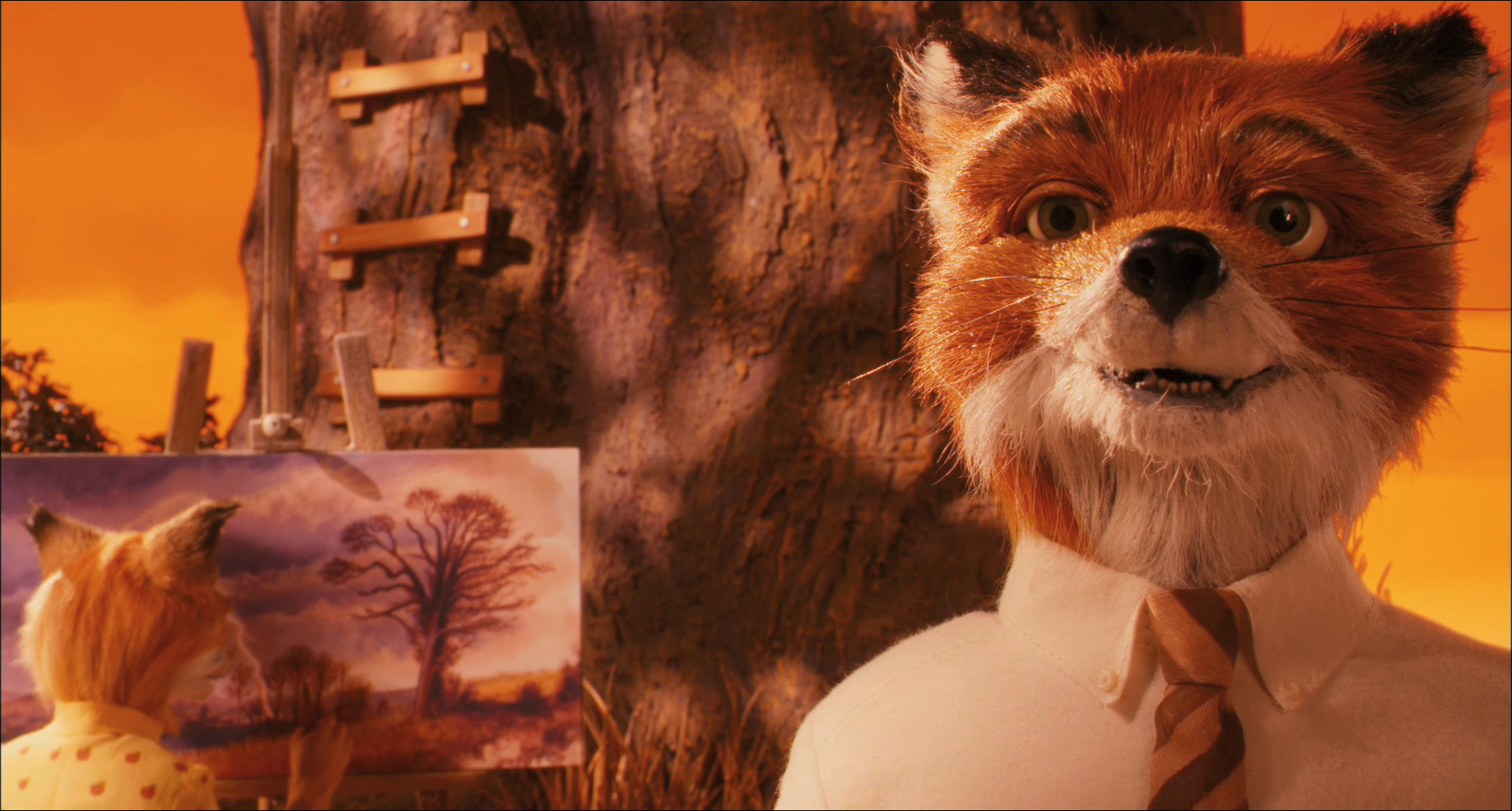 As for Fantastic Mr. Fox, there's nothing sad or squicky about it--it's an absolute delight. I was hooked from the first sequence, where Mr. and Mrs. Fox sneak into a farmyard and, in a superb tracking shot, scurry around various obstacles to get to the chicken coop, while the Beach Boys' "Heroes and Villains" plays.
These fantastic foxes are surprisingly expressive. Maybe it's because their angular, bony bodies are based on human proportions rather than vulpine ones. Or maybe it's because they're so wonderfully tactile, with their real rippling fur and bright porcelain eyes. In contrast, the characters of this year's other stop-motion animated film, Coraline, are smooth and hard, almost the way that computer animation is smooth and hard. And, while I admired Coraline as a technical achievement, it did not charm and captivate me in the way that Mr. Fox did.
Anderson invited George Clooney and Meryl Streep--who might be two of the coolest people in Hollywood--to voice the title character and his wife. Excellent choices. Mr. Fox, being a cocky and clever paterfamilias, reminds me of Clooney's character in O Brother Where Art Thou, which is probably my favorite Clooney role. And Streep's voice work makes you wonder how much of her success is due to her voice's gentle, fluting timbre.
 While Tenenbaums is all about symmetrically composed shots and deadpan acting, Fantastic Mr. Fox is much more about the pleasures of kinetic movement. Several sequences seem designed just to push the technical limits of stop-motion animation. Whether it's dozens of squirrels helping the Foxes move into their new home, or Mr. Fox's heists and ambushes, or a tracking shot of all the animals cooking a feast, there is dazzling stuff here. All done with the utmost precision--but without preciousness.
I haven't read Roald Dahl's original novel, but I suspect he might have put more emphasis on the villains, three poultry farmers named Boggis, Bunce and Bean. Gleeful nastiness was one of Dahl's favorite themes, but it isn't one of Anderson's. He's much more fascinated by the opportunity to create a detailed world for the animals: their tailored clothes, their paintings and newspapers, their Quidditch-like game called "whack-bat." (The best thing he does with the villains is a visually clever sequence introducing the three of them.) And, though the Foxes aren't full-fledged Wes Anderson neurotics, they show some complexity and emotion. The story starts because Mr. Fox has a midlife crisis; his wife mingles love and exasperation; their son resents his popular cousin. And just when things threaten to get too heavy... bam! there's another phenomenal setpiece.
I was quite proud of myself for recognizing that some of the music in Fantastic Mr. Fox came from François Truffaut's Day for Night, one of my favorite movies. Day for Night is very precisely made, very controlled, very aware that it is a film--and yet it manages to be filled with such joy and vitality. The same description applies to Fantastic Mr. Fox.
Saturday, November 28, 2009
Sixty-Nine Essays and Two Authors
By now it should be obvious that I am completely obsessed with The New Yorker. Earlier in the year I suffered a form of New Yorker-related madness, where I thought that if I could just read every article that has been published in the magazine, I would possess "all ye know on earth, and all ye need to know." (Oh, to become a cyborg and download the complete New Yorker archives into my brain!) So I began buying and reading collections of essays by New Yorker writers. Yes, despite the fact that the infamous Half-Read Pile of back issues is building up on my bedroom floor... and despite knowing that, as a subscriber, I can access the complete archives of The New Yorker for free on my computer.
(All the same, even though I could have read these essays for free rather than paying $15 or so for a paperback, I do think that books are more convenient... and also, to plunge too deeply into the New Yorker Digital Archive is dangerous...)
Anyway, I started off by reading essay collections by two female writers currently on staff at the magazine: Cleopatra's Nose by Judith Thurman and Twenty-Eight Artists and Two Saints by Joan Acocella. Thurman's favorite topics include fashion designers, femininity and power, and anything French. (She reminds me a lot of a French teacher I had in college, whose area of study involved "reclaiming" for serious inquiry topics that men have historically dismissed as too frivolous and girly.) Acocella, the New Yorker dance critic, writes about choreographers and dancers, but also about books and authors, many of them European. In the introduction to her book, she notes that the essays are tied together by the theme of how her favorite artists overcame challenges and managed to keep going.
The heart of Thurman's book are her essays on the great fashion designers of the 20th century--Balenciaga, Schiaparelli, etc. These make wonderful introductions to some very important figures; it is otherwise difficult to find good information on fashion history without shelling out $60 for some coffee-table book from Rizzoli. (Magazines like Vogue aren't educational because they assume that their readers all grew up in Park Avenue apartments and learned about fashion design from playing dress-up in Mommy's Chanel suits.) I returned to Thurman's Yves Saint Laurent essay after seeing the YSL exhibit at the De Young and her Chanel essay after seeing Coco Before Chanel. Not only does she recount each designer's history in the impeccably fact-checked New Yorker way, she also makes some interesting observations: for instance, that because Elsa Schiaparelli grew up an Italian aristocrat, she had the freedom to make kooky and surreal clothes, but because Coco Chanel grew up poor in the French provinces, she knew that her designs had to be impeccably tasteful.
Other good things in Thurman's book include the opening essay, a jaw-dropping profile of the artist Vanessa Beecroft; her essay on Leni Riefenstahl, which provides a fascinating new perspective on the issue of whether Riefenstahl can be considered a great filmmaker; and her reviews of the now-classic novels Possession and Beloved. Still, there is a good deal of filler in Thurman's book too, with several essays that are reviews of Fashion Week collections, which are of limited interest several years after the fact.
Acocella's book is more of a piece--it's not padded with short, ephemeral dance-review pieces the way that Thurman's is padded with fashion reviews. Her thoughtful essays on dancers and choreographers seem to cover most major 20th-century dance-world personalities except for Balanchine (though Balanchine gets touched on in several essays, such as the one about Suzanne Farrell). Acocella's account of Martha Graham's long career and the fight over the intellectual property rights to her dances is absolutely riveting. Just as I didn't know much about fashion history before reading Cleopatra's Nose, I didn't know much about dance history before reading Twenty-Eight Artists and Two Saints, and again appreciated the education. I also really enjoyed Acocella's essays on literature and authors; for example, her Dorothy Parker piece was one of the things that inspired me to pick up Parker's Complete Stories last month.
Sometimes The New Yorker gets accused of having a single "house style" for its authors, but Acocella's and Thurman's voices are different and distinctive. Thurman strikes me as more self-conscious than Acocella, more in love with hearing herself talk. Her style is dense and aphoristic; Acocella's is lucid and expository. Thurman has more individual sentences that you want to quote, but with Acocella you are more likely to remember the thrust of the argument.
I should also note that Acocella's book is more handsomely produced, with a black-and-white photo decorating every chapter and a thorough index in the back. Because Thurman's style is so dense with references to other artists, it is frustrating that her book lacks an index. (I even took a pen and annotated the table of contents so I'd remember what the subject of each essay was--and I hardly ever write in my books.)
So I guess that Acocella's book wins over Thurman, if you had to pick just one; but I have returned frequently to both of these essay collections since I read them circa last February/March, and know that I'll continue to do so in future. Both have introduced me to some wonderful artistic personalities and offered fresh insights on artists that I was already familiar with. I love these kinds of books! I love The New Yorker! Come on and fill up my brain!
Friday, November 27, 2009
Matilda, Ma-Ma-Matilda
 Am thinking of going to see Fantastic Mr. Fox this weekend, more out of cinephilia/Wes Anderson fandom than out of childhood nostalgia, because I don't recall ever reading that book when I was little. I read a lot of other Roald Dahl books, though, and my all-time favorite is definitely Matilda. Its title character might just be the first member of my pantheon of smart-girl heroines--how could I not love it?
Matilda is a five-year-old child prodigy, born into an awful family (used-car-salesman dad, television-obsessed mom) and attending a school where the principal is the sadistic, power-mad Miss Trunchbull. The story is about how Matilda gets revenge, first with a series of clever pranks on her family and then, after discovering that she has telekinetic powers, by mentally moving objects to impersonate the ghost of Miss Trunchbull's dead brother. Revenge/comeuppance is a frequent theme in Roald Dahl and I think children find it very satisfying. When I was a kid, I loved stories of horrifically nasty people getting their just deserts--not only Matilda, but also, say, the way the evil headmistress in A Little Princess is finally punished.
Matilda's parents, meanwhile, are the sort of characters that make you realize that the Dursley family, of Harry Potter, is directly descended from Roald Dahl's villains. But J.K. Rowling softens things by saying "it's OK, the Dursleys aren't Harry's real family; he had wonderful parents who loved him, but unfortunately they're dead"--which plays into the childhood fantasy of thinking that your parents aren't really your parents, that you must be adopted, a long-lost prince or princess, etc. Dahl is having none of that. Mr. and Mrs. Wormwood are Matilda's real parents, and that's what makes them even worse than the Dursleys.
As for Matilda's telekinetic powers, they arise because she is not being challenged in school (the Trunchbull forbids her to skip a grade) and thus has a lot of excess mental energy built up, which she learns how to channel to make small objects move. After the Trunchbull's defeat, when Matilda moves to the appropriate grade level, her powers fade away.
Now, I first read Matilda when I was probably five years old, and knew that I wasn't being appropriately challenged in kindergarten (I ended up skipping first grade)... and I admit that I wondered whether I, too, might not have developed telekinetic powers! I definitely had a few afternoons of imitating Matilda by sitting on the end of my bed and trying to move the objects on my bureau using my mind.
And then when I skipped from kindergarten to second grade, I ended up with a teacher who looked as sweet as Miss Honey (Matilda's kindhearted kindergarten teacher) but was really a Trunchbull in disguise... but that's a story for another day.
By the way, early in the novel, Roald Dahl includes a list of the books that Matilda's friendly librarian gives her to read after she finishes reading all of the children's books at her local library. They are:
- Great Expectations
- Nicholas Nickleby
- Oliver Twist
- Jane Eyre
- Pride and Prejudice
- Tess of the d'Urbervilles
- Gone to Earth
- Kim
- The Invisible Man
- The Old Man and the Sea
- The Sound and the Fury
- The Grapes of Wrath
- The Good Companions
- Brighton Rock
- Animal Farm
- The Red Pony
Thursday, November 26, 2009
"Casanova": Who Writes Your Screenplays?
I spent Thanksgiving with my aunt, uncle, and cousin in the East Bay. After dinner (the basics like turkey, stuffing and mashed potatoes, plus a dish of creamed peas and pearl onions--a tres Midwestern contribution from my Minnesotan uncle) we watched the Casanova film that came out a few years ago, starring Heath Ledger. My aunt is very proud of our Italian heritage and loves any kind of costume drama with Venetian vistas; plus, knowing that we won't get any more Heath Ledger movies makes his whole filmography seem precious.
But I wasn't really crazy about Casanova. I guess I wanted Casanova to be like Don Giovanni--an unrepentant rake and lady-killer--but this film version removes his edginess and complexity. He is always likable, as chivalrous as a seducer can possibly be, and despite his reputation, we don't see him juggle many lovers. Instead, the movie says that Casanova just needed to find the one woman that was meant for him, and then he'd instantly go monogamous. Meanwhile, the woman (Francesca, played by Sienna Miller) is supposed to appeal to a modern-day audience because she pretends to be a dutiful daughter, but secretly she's feisty and fights in duels and writes proto-feminist pamphlets and disguises herself as a man. But all of this feels so calculated to appeal to us, and so anachronistic considering that the movie takes place in 1750, that it annoys me. Just because I'm a feminist doesn't mean that I want every movie to contain a spunky feminist role model. Instead, I want female characters to be believable according to the setting of the film, and Francesca is not.
When I got home, I looked up the original New York Times review of Casanova. A.O. Scott liked it lots more than I did--but he also revealed something interesting: Tom Stoppard evidently did an uncredited rewrite of the Casanova script!
It's funny what learning something like that can do. I had thought that Casanova was a mediocre romp with nice costumes, suitable for watching in a Thanksgiving haze of triptophan and wine, but not deserving of any futher consideration. But now, knowing that one of my favorite playwrights had a hand in the script, I wished I'd paid it more attention. Could I have detected a "Stoppard touch" in any of the scenes? None of the dialogue struck me as that great on first hearing, but rereading it on the IMDB quotes page, could I hear a hint of Stoppard in some of the sillier jokes? And was Stoppard's contribution more about giving the dialogue a witty sheen, or did it extend to fixing problems of plot and character? Because despite his script-doctoring, Casanova still has one-dimensional characters and a contrived, mechanistic plot. The film even contains elementary screenwriting mistakes like naming one character "Victoria" and a completely unrelated character "Vittorio"--couldn't someone have changed one of those names?
There is a moment at the end of Casanova that I'd like to think is a Stoppard contribution--or maybe it's from Jeffrey Hatcher, another playwright who worked on the screenplay. Casanova and Francesca are rescued from the Inquisition's clutches by a troupe of traveling players, who express hope that the young lovers will join the acting company. Francesca gives the head of the troupe an appraising look and says "Who writes your plays?"
Wednesday, November 25, 2009
Things I Want to Arrive Now, Dammit
Because tomorrow may be devoted to gratitude but today one is still allowed to be greedy and impatient...
- Movies: Broken Embraces, Me and Orson Welles. A.O. Scott has developed a bad habit of giving rave reviews to movies that aren't open in my city yet.
- Newspapers/magazines/saviors of the printed word: McSweeney's San Francisco Panorama. So looking forward to this!
- Abstract qualities: Inspiration, imagination, willpower, gumption, etc.
- And most importantly: The end of the month, so that I no longer have to write a blog post every day! (Can you tell I'm frustrated?)
Tuesday, November 24, 2009
Theatre Links, November 24
- Sarah Ruhl's In the Next Room, or the Vibrator Play--which I saw at its first preview at Berkeley Rep--has now opened on Broadway. Here is a round-up of the critics' opinions. Going by this scale, I think my personal grade would be in the B or B-minus range... generally enjoying the play while also thinking that it tries to stir a few too many themes together and doesn't quite gel. Then too, I tend to be indulgent of such faults (over-ambitiousness, over-cleverness) since they are the faults that I am prone to myself.
- Boston Globe theater critic embarrasses himself by a. writing a review that is a gushy mash note to one actress in a large and complex production and b. getting the actress's name wrong. Linking to this because the actress in question is someone that I went to college with! (She played the leading role in the first staged reading of my first play.) Good for her... I guess?
- The play that my college friend is acting in is called Sleep No More, and actually sounds really intriguing--an immersive mash-up of Macbeth and Hitchcock. Here's a Boston Globe preview article, a better review, and a blogger who also mentions my friend's scene. When Isaac of Parabasis recently asked "What plays do you refuse to see again?" I nominated Macbeth, because I don't consider it one of Shakespeare's best plays and I am really sick of it (within a 6-year span, I saw 3 productions and acted in 1). But if I were on the East Coast I would SO try to see Sleep No More, even though it's a Macbeth adaptation--and even if I didn't know any of the cast members!
Subscribe to:
Posts (Atom)