Friday, June 27, 2008

Gothic, with a philosophical twist

This painting, "Frederiksborg Castle by Moonlight" (detail) by Danish artist Ferdinand Richardt, looks the way that Dinesen's work feels.

A few days ago I finished Seven Gothic Tales, by Isak Dinesen (aka Baroness Karen Blixen), a dense and somewhat mysterious book. Dinesen, a Dane who wrote in English, got excellent reviews in Anglophone countries when this book appeared in 1934; yet her countrymen were confused, because Seven Gothic Tales doesn't fit into any literary tradition. It is not "modernist," or modern, at all. The tales all take place in the 1800s, in a world of aristocrats and the artists they patronize. They are moody, refined, and definitely seem to come out of a vanished past.

I mentioned that knowing French is a big help when reading Seven Gothic Tales; German and Italian would be useful too. Plus a knowledge of European high-culture icons from the Renaissance to 1900: Dante, Mozart, Goethe, etc., all get referenced. Dinesen was also very influenced by her Christian upbringing, and often alludes to Bible stories or thinks about them in new ways. Her characters are the kind of people who spend long evenings reading leather-bound books by candlelight, and talk in aphorisms derived from what they have learned.

"Gothic" can imply cheap thrills and melodrama, but the Seven Gothic Tales are reflective and rather nostalgic/elegiac. They go off on tangents, they contain stories nested within other stories, and though some of them contain macabre or fantastical elements, not all of them do. And even the fantastical elements are intended to make you think, not merely to shock you. Indeed, Seven Gothic Tales is about as philosophical as I like to get with my reading--I am not a particularly abstract thinker and don't get much pleasure from reading books and articles of pure philosophical thought. But in Seven Gothic Tales, the philosophical insights are grounded in the narration or in parable form. Some of Dinesen's favorite concerns: God, fate, and the nature of storytelling.

Dinesen's use of a male pen name is interesting to consider in conjunction with how her stories depict male-female relations. Her characters often talk about wanting a world where men are men and women are women, full of essential, mysterious, captivating femininity...a very retrograde attitude. Yet while Dinesen's female characters are often very beautiful and bewitching, they couldn't be described as conventional. She is drawn to old spinster ladies, prostitutes, women of adventure, country girls who dream of revolution.

Oh, and except for "The Dreamers," which partly takes place on a raft off the African coast, there are no other clues that these stories were written by someone who is currently most famous for "having a farm in Africa." Seven Gothic Tales is Continental to the core.

Here are some thoughts on the individual stories:
  • The Deluge at Norderney--This novella-ish piece (79 pp) is a classic example of an "Elevator Story," where you find a way to get several people in a room and talking. In this case, a renowned Cardinal, a deluded old lady, her quiet young goddaughter, and a melancholy young man are all in a barn loft trying to escape a flood. A good introduction to Dinesen's style, it is mysterious and allusive, yet there is a sense of a larger design and it's up to you to puzzle it out.
  • The Old Chevalier--This is the shortest story in the collection, a melancholy reminiscence from an old man. Contains some of the provocative ideas on male-female relations discussed above, and a little macabre shiver at the end.
  • The Monkey--I'm not sure if the flagrantly fantastical ending of this story actually works. But there's a lot of other good stuff here: an old prioress with a sinister agenda, delicate allusions to homosexuality, a young woman of immense strength and integrity.
  • The Roads Round Pisa--This story has an involving and somewhat mysterious plot centered around a duel. The climax reveals the connections between everything in a surprising way, although you'd get more out of it if you are able to read Dante's Italian.
  • The Supper at Elsinore--One of my favorites, a ghost story that is not merely creepy/shocking, but has psychological depth to it. The ghost of a sailor returns to have supper with his two spinster sisters, and the results are slightly unsettling and very believable.
  • The Dreamers--I'm not sure I understand the African framing device for this story, but as one character says, "It is not a bad thing in a tale that you understand only half of it." The nested story is also bizarre, but in a good way, and features one of Dinesen's most unforgettable women.
  • The Poet--For most of its length, this story of an ill-fated love triangle in a provincial town is more reminiscent of 19th-century realistic fiction than of the "Gothic." But at the end, in a deft twist, it becomes a story about the art of storytelling and narrative compared with the unpredictability of real life. A great way to end the collection.

Wednesday, June 25, 2008

Kaddish for Cody's

In my recent post on The Yiddish Policemen's Union I mentioned that Cody's Books, in Berkeley CA, was asking people who they'd cast in the film adaptation (to be directed by the Coen Brothers).

Well, I guess that's called off, since Cody's Books has now closed after 52 years in business.

Darn. I'm always sad when a bookstore closes, and I feared something might be up--Cody's Books hadn't updated their blog in about a month. I know times are tough for independent bookstores, but I thought things might be better in the anti-corporate People's Republic of Berkeley. Guess not.

And I was curious, too, to see what kind of responses they'd get to their casting contest, because I was having trouble with my entry. For Meyer Landsman, it's hard to think of Jewish actors who are the right age (early/mid 40s) and can play a classic tough-but-vulnerable noir hero. (The most prominent Jewish actors in that age group are Ben Stiller and Adam Sandler--no thanks!) Meyer's partner, Berko Shemets, is a tall and husky man who is half Tlingit--can't think of many Native American actors off the top of my head either. And if the movie has any flashback sequences, it'll need to perform the impossible task of finding a guy who's believable as the potential Messiah.

If you've got any bright ideas for casting The Yiddish Policemen's Union, please leave them in the comments.

The 21 Club


Last time I wrote, it seems I was too busy lamenting my lack of a royal coronation to notice that I should have been celebrating my one-year blogiversary! And I promise that the coming year at marissabidilla will be even better. I'm full of grand (if vague) plans to get more readers. For one, I want to be more open about telling people I'm a blogger when I meet them in real life.

Still, gotta look to my future: just a short while after this blogiversary comes my own birthday--I'll be 21! And you can imagine how much I'm looking forward to that. It's a real pain to spend 4.5 months in France at the age of 19, drinking good wine on a regular basis, then return to this country and still be 14 months too young to buy alcohol.

And I have a story that relates to this--no, not to alcohol, but to turning 21. Two years ago, on the day I turned 19, I learned I had won the Young Playwright's Contest and flew to New York for two weeks of seeing plays and attending workshops. Lucas, the Young Playwrights literary manager, led the familiar exercise where you find an intriguing story in the newspaper and figure out how to dramatize it. Playwriting teachers love this--I think I've done it in every playwriting class I've ever had.

Since I love historical subject matter with a light touch, I found a New York Times review of a new biography of Lorenzo Da Ponte, Mozart's most famous librettist. I said I'd write a kind of jukebox-opera in which an elderly Da Ponte looks back on his life and tells his own story--all the songs would have Mozart's music but new lyrics in English. I'd still like to see a play or movie about Da Ponte--the guy led a fascinating life.

But in this exercise, I was totally bested by my fellow playwright Brittani, who found inspiration in Seventeen magazine: an article called "21 Things To Do Before You Turn 21." "This," she announced, "is going to be the greatest romantic-comedy movie ever."

The heroine of Brittani's movie would be a girl who was about to turn 21, read this list and realized that she'd lived a really uneventful life. Maybe she'd done some of the boring stuff like Save $1000 or Donate Prom Dress to Charity, but none of the kooky things that make this list so hilarious. So, before she's 21, she decides to Go on a Road Trip with her best friends and complete the to-do list. And naturally, she falls in love along the way. The last line of the movie would involve her checking off the last item on her list: "Say 'I Love You.'" Aww.

So, with my own 21ist birthday coming up, I decided to hunt down this Seventeen article and check off what I've accomplished.

THINGS I'VE DEFINITELY DONE:
  • Learned to play a musical instrument--I don't excel at it, but I can plunk out chords and melodies, and play a little Mozart, on the piano.
  • Saved $1000--My last name means "stingy" in Czech. And true to form, I like to save money!
  • Gotten to know my grandparents--I loved asking them about what life was like back when they were my age.
  • Won an award--Uh, I've kind of been an overachiever since elementary school.
  • Had my fortune told--After my high school graduation, my school threw an all-night party including a fortune-teller. It was pretty fun.
  • Done my own laundry--I would HOPE that every 21-year-old has done this!
  • Ridden a horse--A few times, when on vacation.
  • Seen the ocean--Not that hard to do, growing up in Portland.
  • Left the country--It started when I was 5 years old and went to British Columbia, and now I consider myself a seasoned traveler!
THINGS I'VE KINDA-SORTA DONE:
  • Taken a road trip--Never in the classic way with a group of friends. But I drove out to Joseph, Oregon with my dad last summer, and that was pretty fun.
  • Said "I love you"--I've gotten better about telling my friends and relatives that I love them. But I've never been in a serious romantic relationship. "Seventeen Magazine--Making Girls Feel Inadequate for Not Having Boyfriends since 1944!"
  • Milked a cow--I think I might have done this once, when I was a little girl at some Pioneer Days or County Fair-type event.
  • Forgiven someone--The article means this in the sense of "formally make amends." But I'm more likely to forgive someone in my heart than to do it face-to-face.
  • Seen something that is "the world's largest"--Well, I've never gone out of my way to see the world's largest ball of string, say, but I've been to other silly roadside attractions like the Oregon Vortex. By the way, I think that in Brittani's movie script, there would have to be an annoying frat-boy character who claimed he had the world's largest schlong. Right?
  • Learned to love my body--Oh, I'm sure this is an ongoing process for every girl. But, for instance, I've become more accepting of my big feet, etc.
THINGS I'VE NEVER DONE:
  • Gone skinny-dipping--The Mock Trial team at my high school used to bond by skinny-dipping in the freezing Oregon ocean, but I never did Mock Trial.
  • Bought a lottery ticket--Why haven't I done this? (Maybe 'cause I'm stingy?)
  • Learned to drive a stick shift--Hell, I only got my license six months ago!
  • Gone to a drive-in movie--Are there any drive-ins left in Oregon?
  • Donated my prom dresses--Maybe I'm just selfish, but my prom dresses were beautiful vintage pieces, and I don't want to give them up.
  • Waitressed at least once--My mother once said to a friend, "I don't think Marissa is nice enough to be a waitress." I took offense at the time, but now I see what she means--I probably lack the patience to be a really good waitress.
image found here

Sunday, June 22, 2008

Queen for a day


Design for Queen Elizabeth's coronation gown. Image from nga.gov.au

I know it's silly, but I was secretly hoping something exciting would happen to me yesterday. You see, as a little girl, I invented an elaborate fantasy of a parallel world in which I was royal--and yesterday, i.e., the summer solstice two weeks before my 21st birthday, was the day I had set aside for my coronation. And a small part of me would still like to believe in my parallel world, which I called "Rabildia," derived from the word "ruby" (my birthstone). What's more, it would still be nice to believe in the persona I invented for myself.

Queen Marissa Guinevere was brave and strong and good at archery and had a beautiful gray horse and a pet owl named Mistwing. What's more, she was also extremely skilled at performing magic. And she was gorgeous (I spent a significant amount of time designing gowns for her to wear), but proudly independent, and would take no guff from anyone.

I suppose all this is fairly typical. I was an only child, I read too much, I was under-challenged in school, I had an unacknowledged loneliness and anger inside me... of course I'd escape into a fantasy world. Only later have I realized just how much of a coping mechanism Rabildia was. There is a suite of stories in which Princess Marissa is locked up in a tower for several years during her adolescence, due to a misinterpretation of an ancient prophecy. I wasn't merely copying old stories like "Rapunzel." I was making a metaphor about the alienation I felt during my own adolescence.

But at age 18 or so, Princess Marissa is freed from the tower, she attends the Rabildian College of Mantic Arts, and when she is 20, her father dies and she must be crowned Queen. Since many fantasy books ascribe great importance to the summer solstice, I made it a key date in my mythos as well. It's the Rabildian national holiday--the anniversary of a day when the forces of light overcame the forces of darkness and united the country. And Marissa chooses it for her coronation.

When I was 12 I seriously planned to write a novel about Rabildia, and managed about 60 pages of disconnected stories. Here is the coronation scene, with some present-day comments in italics.
Marissa was not quite twenty-one when her father died and she became ruler. Her mother had died some years before, so she had little help in setting out on the journey of ruling and righting a kingdom. (When I was 12, I loved phrases that sounded grandiose even if they don't make sense. Like "ruling and righting"--when Marissa inherits the kingdom, she doesn't really need to "right" it; her father was a good leader.)

On his deathbed, the king said to Marissa, “I know you can rule Rabildia well...”

Between her tears, Marissa said “Thank you, Daddy...this really means a lot to me...knowing you believe in me...”

“...but your destiny is not here!” finished the king as emphatically as his weak voice could speak.

The tears suddenly stopped flowing from Marissa's face. This was so shocking: she would be the queen. And how could a queen’s destiny not be in her land? After a little consideration, Marissa thought she figured out what her father meant. It was actually pretty obvious. All her life, she’d been groomed for finding a husband, and that destiny her dying father talked about would be where her husband lived. She’d marry some old king, join Rabildia to his lands, and stay in his country.

While Marissa was contemplating, her father had died. (Reflecting my level of self-obsession, I'm writing about a character, based on myself, who is so self-involved she isn't even paying attention at the moment of her own father's death! By the way, the king's deathbed prophecy was meant to foreshadow a later development in the story, which is that Queen Marissa travels to our world and meets me, the girl from the Portland suburbs--so her destiny lies elsewhere.)

The coronation took place on Midsummer’s Day, the most important day in all the land. Midsummer Day is the longest day of the year when the folk celebrate the sun, the anniversary of the unification of Rabildia, and the halfway-point of the Rabildian year (which begins on what we’d call December 21, the shortest day of the year). Incidentally, Midsummer’s Day that year was a fortnight before Marissa would be twenty-one. Many people thought she should be coronated on her birthday, as twenty-one is the customary coming-of-age, but she convinced them that Midsummer held so much more significance for the people of the land. (I now know that "coronated" is not a word. And I love that although this is supposed to take place on a totally different PLANET, the length of a year and the date of the solstice is the same as it is on Earth.)

Marissa's coronation dress was another sore point. All the old dukes wanted her to wear red silk in honor of Rabildia, but red is not the best color for a blonde. Finally, they settled on a purple silk with green silk trimmings and many rubies. She thought it was lovely. (See what I mean about being obsessed with my character's clothing? My tastes in coronation dresses have changed now, though. Maybe I'm unduly influenced by Queen Elizabeth's dress above, but I'd want a heavy ivory satin richly embroidered with gold threads and rubies. Purple is regal, yes, but the dress I designed looked too much like a ball gown, not ceremonial enough.)

With trembling hand and the appearance of a deer (noble but with an ever-present sad fear) Marissa walked up the throne room of the forest castle. The ermine robe of state trailed long behind her, but still she was cold. Her guts hurt and she had a sinking feeling that something bad would happen. Her magic gave her a strong front and stiff upper lip, but inside she was falling apart. She wanted to throw off the robe, race to the throne, and get it all over with. But she had to be-–etiquette demanded it--dignified. (Boo hoo, it's so hard to be Queen!)

The crown was placed on her head, and the worst part was over, or so she thought. Marissa was queen.

As she took the gold scepter into her hands, the ruby at the top kindled and emitted a spark, which drifted down the aisle, fell to the center of the room, and became a miniature version of the scepter’s ruby. In unison, the crowd gasped.

Some few superstitious folk fled, while the older people shook their heads. "Marissa is so young, poor girl, she doesn’t even know she’s possessed by a Nemwi’hymat,” they whispered, but loud enough for the worried new queen to hear. Yet the wisest person in the throne room did not shake his head: Vatewté, Marissa's second father. From his honored seat, he turned back down the aisle. Many assumed he would flee as well. His footsteps echoed from the marble floors and Gothic ceiling. (Explanations: A Nemwi'hymat is a kind of demon, and Vatewté is a wise old wizard who tutored Marissa--she loves him more than she loved her real father.)

As he reached the little ruby, Vatewté stopped, picked it up-–again the crowd gasped-–strolled leisurely to the throne, and presented it to Marissa.

“It’s not to worry,” he whispered in her ear. “Those fools out there don’t know it, but nothing bad can spark the ruby on a scepter that has only been touched by good hands. I want you to take the little stone it produced, and wear it as a charm, because it came from the scepter and will forever link you with it, and the magic of Rabildia.”

From the inside of the royal robe, Marissa ripped a silken thread, tied a sturdy knot, and hung the little jewel around her neck, where it fit in the hollow of her throat. Soon, everyone admired her new necklace and forgot about the gem’s “curse.”
Well, nothing exciting happened yesterday--no crowns or ermine or magically self-propagating rubies--and while I feel ready, I guess, to get a job and enter the "real world," I certainly can't imagine feeling ready to rule a country. But then, the point of Queen Marissa is that she's an idealized version of me, stronger and more capable. And I guess that's why I still want to believe she's out there, somewhere, sitting newly-crowned on her throne.

Wednesday, June 18, 2008

Reasons to Know French

I don't know if I'll ever use French in my career, but I have no regrets about majoring in it at college. Oddly enough, one of the greatest benefits of knowing French is that it has made me more able to appreciate the literature of other countries. Many classic authors wrote at a time when it was assumed that all "cultured" people would know some French, and they insert French passages into their novels sans traduction (see what I did there?). Here are some books I have read that make me say "Boy! I'm glad I know French!"
  • Seven Gothic Tales by Isak Dinesen--This is the book that prompted this post, as I'm reading it right now. Written in 1934, and mostly taking place among European aristocrats of the 1800s, the elegant, dense prose has French aperçus sprinkled throughout. The story "The Deluge at Norderney" ends with a sentence in French that requires you to know what the passé simple of the verb se taire is--in other words, this is not French 101 stuff.
  • Lolita by Vladimir Nabokov--Humbert Humbert tells us he was born in Paris, and he fancies himself a cultured European aesthete, so he throws around French phrases and French dialogue whenever he can. And of course, because it's Nabokov, there must be a punning or a hidden meaning behind all these uses of French.
  • The Dud Avocado by Elaine Dundy--Not as "deep," perhaps, as the other books on this list, but as it's the tale of an American girl in Paris, and was written in the 1950s when "cultured" people knew French, Dundy doesn't bother to translate some of the dialogue. However, it's mostly on a French 101 level.
  • Anna Karenina by Leo Tolstoy--I actually read this book before I had studied much French, but I remember that Tolstoy's aristocratic characters frequently switch between speaking Russian and French. My copy (the Pevear and Volokhonsky translation) translated the French in footnotes, whereas other editions translate it in the body of the text, contrary to Tolstoy's intentions. I hear that War and Peace has even more French-language passages in it than Anna Karenina does.
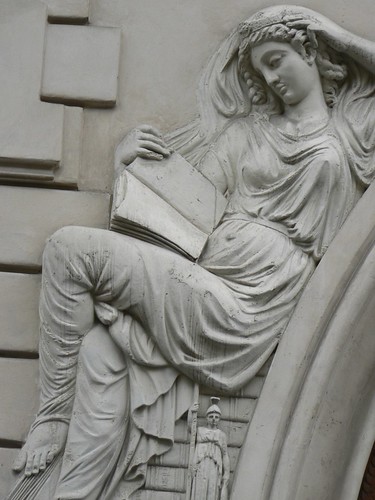
Photo by claudecf on flickr: it's a bas-relief above a door in Paris.

Tuesday, June 17, 2008

Tonys 2008: A Latin hat at that

In an ideal world, I'd have seen many more Broadway shows this season than I actually did--at the very least, Sunday in the Park with George, South Pacific, and In the Heights--but I had to watch the Tony Awards anyway! Some thoughts, post-ceremony:


Favorite moment: Lin-Manuel Miranda rapping his Best Score acceptance. He was obviously so exhilarated and overwhelmed--you could tell it was a bit of a struggle to get the words out--but he kept on going and gave a memorable, emotional speech. And of course, I loved the Sondheim shout-out.

Also great: how the Broadway community seems to support Mr. Miranda and wants him to succeed, hoisting him onto their shoulders after In the Heights won Best Musical. Now, it's probably easier for a young composer/lyricist to get this support than a young playwright, since there are not many musical theater composers these days compared to the number of playwrights...but still, I find it heartening. Also heartening, or at least a moment when I said "right on!": Tracy Letts' speech that said, basically, "You produced a new American play on Broadway without any movie stars in the cast--imagine that!"

I know there's no better way to divide it up, but I still think it's weird that the award for Best Play goes to both the writer and the producers. It becomes most jarring with something like The 39 Steps, which by all accounts is a wonderfully entertaining piece of theater but, as a comic adaptation of a film script, seems out of place with the other nominees in its category. I wish, too, that they'd allowed the writers their moment in the spotlight by announcing their names and filming their faces when reading the Best Play nominees.

But nope, it was Musicals Night, with the producers seemingly attempting to cram in mentions of every show currently running on Broadway. My reactions to the added musical numbers:
  • The Lion King: I know it's Disney, but that is some awesome, awesome theatricality right there.
  • The Little Mermaid: Too bad that theatrical magic isn't in this number. And notice that they filmed the actress in close-up, because otherwise we'd see how silly her mermaid costume really looked.
  • A Catered Affair: Terrible. A banal, rambling mess of a song--and this is the best they could do for national television?
  • Young Frankenstein: A one-joke song ("Deep Love") with a predictable melody/chord pattern, but at least the actors were selling it with great conviction. Is it just me, or is the tune a little reminiscent of "The Impossible Dream"?!
Thoughts on other musical performances:
  • I was surprised to like the dancing from Grease. When you cast a girl from a reality show there's no guarantee that she'll be able to do the splits and high kicks.
  • The dance number from Cry-Baby is very Susan Stroman in its use of props but if I hadn't read that the men were tap-dancing with license plates, I don't think I would have been able to tell what was on their feet.
  • Riddle me this: If Passing Strange has got such great reviews, why have I never been able to work up an interest in seeing it? And why did I not get pulled in by their Tony performance? Why do people claim that Stew is a great lyricist, when the line "I've found a place where I can be / That thing called me" (or something like that) actually made me wince?
  • I very much liked the In the Heights number and the way it told a story through music and lyrics, except at the end when too many of the lyrics got lost in the muddle.
  • Ooh, I wish I could've seen Sunday in the Park. The projections looked gorgeous, and Daniel Evans had so much emotion singing "Move On" (and looked so happy to be there!). My friend was rooting for him instead of Paulo Szot.
  • South Pacific looked good, too, though. Just-for-fun prediction: next time Kelli O'Hara gets nominated for a Tony, she'll be the front-runner to win it. She's come on so strongly over the past few seasons (Light in the Piazza, Pajama Game, South Pacific) that she nearly feels overdue.
What with Gypsy, and Sunday, and Lin-Manuel's shout-out, and his own special-achievement Tony, this felt like Stephen Sondheim's night, though he wasn't even there. Leave it to him to stick up for playwrights and librettists, thanking all of his collaborators in a letter (meanwhile, Best Book wasn't even awarded on the telecast!). What a classy and generous man. But I feel for him, too. Really, it must be lonely at the top--to be the most feted artist of the American musical theater for over twenty years, with people expecting miracles every time he writes a song. I wrote him a letter this spring after hearing him speak, to express my sincere gratitude for his songs and his creation of the Young Playwrights Festival--but I have to wonder if letters like mine just increase the pressure he feels of crushingly high expectations.

Photo from broadway.com

Monday, June 16, 2008

"Yiddish Policemen's Union": No Kvetching Here

I've written before about my love for classy detective novels, so when The Yiddish Policemen's Union came out last year, I thought "I should check this out." And then a couple of months ago I read Kavalier & Clay and realized that Michael Chabon is awesome in general, making Yiddish Policemen's a must-read.


The Yiddish Policemen's Union is a classic hardboiled mystery in an inspired alternate-history setting. We learn on Page 1 that a man using the alias Emanuel Lasker has been shot dead in a fleabag hotel--but this hotel is in the Yiddish-speaking metropolis of Sitka, Alaska, which was granted to the Jews for 60 years following the failure of the state of Israel in 1948. Now it is 2007 and Sitka is about to return to American control, throwing its residents into a muddle. And when detective Meyer Landsman, already down-on-his-luck, tries to solve Lasker's murder, he runs up against a complex conspiracy involving some obscure corners of Jewish lore.

My half-Jewish mom informs me that landsman is the Yiddish word for "countryman, comrade," and Meyer Landsman is kind of an Everyman figure...at least, an Every-detective. Chabon has fun drawing parallels between secular Jews and noir detectives, both trying to do right in a world that lacks a Messiah or a moral compass. Though cynical and faithless, they persevere. They both use self-deprecating wisecracks as a kind of armor. And not only does Landsman have personal angst (a failed marriage), he also carries the angst of his entire race. When an Indian doctor criticizes his alcohol habit, Landsman retorts: "Tell me, please, if the country of India were being canceled, and in two months, along with everyone you loved, you were going to be tossed into the jaws of the wolf with nowhere to go and no one to give a fuck, and half the world had just spent the past thousand years trying to kill Hindus, don't you think you might take up drinking?"

As shown by its willingness to play with Jewish stereotypes, The Yiddish Policemen's Union is refreshingly irreverent. Everyone calls one another "yid," and the murdered man was a heroin addict who tied off with the cord from his tefillin. Yet at the same time, the novel explores issues of contemporary Jewish identity--ones that resonate in our own world and not just in alternate history. For instance: is Judaism religious, ethnic, or something else? Can secular Jews and orthodox Jews get along? What does it mean to belong to a group that defines itself by its exile? Can the Jews ever find a place to accept them? (In the novel, the colonizing Jews of Sitka end up in a rather Israel-and-Palestine situation with the native Alaskan tribes.)

But The Yiddish Policemen's Union is also a real page-turner, told in present tense so the events come even more vividly to life. Sitka and its residents are wonderfully imagined--in fact, I wanted to see more of some characters. For instance, the American reporter Dennis Brennan, who speaks a hilariously mangled version of Yiddish, appears in only one scene. Yiddish slang peppers the book; my copy (Harper Perennial, paperback) had a helpful mini-glossary at the end.

What I love most about Chabon's writing is what I'd call his thematically appropriate similes. Many writers fill their pages with flashy similes, but if anything can be compared to any other random thing, where is the resonance, where is the weight? (E.g., this bugged me about Marisha Pessl's writing in Special Topics in Calamity Physics. A simile like "Houses slumped against the smooth lawns like dozing elephants on ice rinks" feels forced and unnecessary.) Chabon, however, usually draws comparisons that enhance his novel's themes and concerns. Similes that could only fit The Yiddish Policemen's Union and would seem inappropriate in any other book. For instance, during a funeral sequence, the fir trees in the cemetery "sway like grieving Chassids," and the voice of blues singer Robert Johnson "sounds as broken and reedy as a Jew saying kaddish in the rain." Because in this scene, along with the fir trees and the blues music, there are also grieving Chassids saying kaddish in the rain. The similes add detail and emotional resonance--they are not merely flashy.

Or see this dazzling passage, describing Landsman's sister Naomi, a bush pilot:
The wings of an airplane are engaged in a constant battle with the air that envelops them, denting and baffling and warping it, bending and staving it off. Fighting it the way a salmon fights against the current of the river in which it's going to die. Like a salmon--that aquatic Zionist, forever dreaming of its fatal home--Naomi used up her strength and energy in every struggle.
So in three sentences, Chabon draws an intricate web of connections between Naomi's personality, what she does for a living (fly airplanes), the wildlife of the area where she lives (Alaskan salmon), and her religion (Judaism). Startlingly clever and illuminating.

The Coen Brothers are going to adapt Yiddish Policemen's Union as a movie, and I could not be happier. Is it a contradiction to say that the world of this book is sui generis and totally original; yet at the same time, it cries out to be a Coen film? It's noirish, it uses weird slang, it delights in language, it takes place in an odd corner of America, most of its roles are for "character actors," there's plenty of violence and dark humor and some seriously evil characters... all the typical Coen Brothers motifs. (And the brothers are Jewish, of course.) A Berkeley bookstore is having a "cast the Yiddish Policemen's movie contest" (scroll down)--I just might put together an entry!

The Yiddish Policemen's Union is now sitting comfortably on my shelf next to Raymond Chandler's The Big Sleep. It's just a coincidence due to alphabetical order. But it feels right.